




כ׳ תשרי ה׳תשפ״ז | October 1, 2026
OU Leaders Take Rebbe’s Lesson From Dubai Hijacking
In a statement, Orthodox Union President Mitch Aeder and OU CEO Rabbi Josh Joseph reflect on the Rebbe’s timeless lesson that “a Jew is never stuck,” and how it came vividly to life aboard the hijacked Dubai flight.
By Mitch Aeder – President of the OU and Rabbi Dr. Josh Joseph – CEO
In 1967, a group of Lubavitch women traveling to Detroit reportedly found themselves stranded by a snowstorm. Frustrated that they were unable to reach their destination, the leader of the group called the Lubavitcher Rebbe’s office for guidance and told his secretary that they were stuck in Detroit.
A moment later, the secretary returned with a message: “The Rebbe does not know what ‘stuck’ means.”
She began explaining the meaning of the word stuck.
“The Rebbe knows what the word means,” the secretary clarified. “The Rebbe believes that a Jew is never stuck.”
The women understood the message. Instead of simply waiting for the next flight, they fanned out across the airport, meeting fellow Jews and distributing Shabbos candles.
His response contained a powerful idea: A Jew is never stuck. You are exactly where you need to be.
If Providence has placed you somewhere, even somewhere you did not intend to be, the question is not, how do I get out of here? The question is: What am I supposed to accomplish while I am here?
We saw an extraordinary illustration of that idea unfold this week on FlyDubai flight 1073.
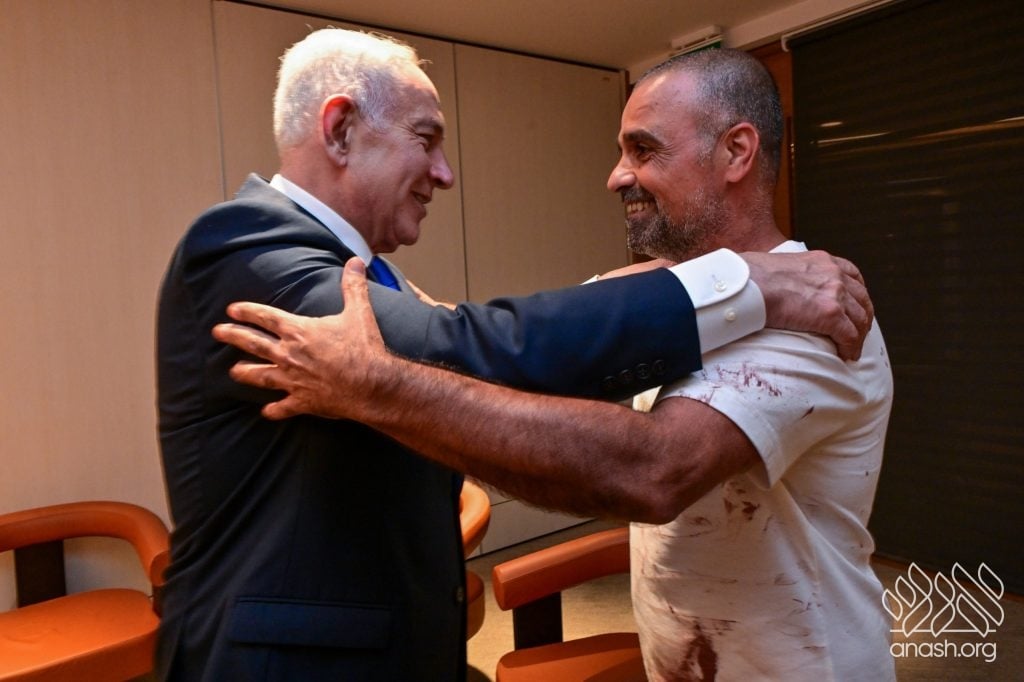
While most of the passengers and crew were understandably immobilized when their plane was hijacked, a number of passengers recognized that they were there for a reason. Yaniv Hayun, a plumber with no aviation experience, grabbed the controls and helped level the aircraft. A dentist, Dr. Shota Musayev, treated and stabilized the badly wounded captain, Captain Smit Machchhar, a hero in his own right. And Tzvika Manes and Assaf Rajuan, two businessmen, helped restrain the terrorist.
They were simply passengers trying to get home. But at that moment, they were exactly where they needed to be.
Perhaps that is a useful way to think about Jewish life outside of Israel.
There are many mitzvos hat’luyos ba’Aretz – mitzvos that can only be performed in Eretz Yisrael. But perhaps, in a non-halachic sense, there are also mitzvos hat’luyos b’chutz la’Aretz – responsibilities and opportunities uniquely available to Jews who find themselves elsewhere.
As the first yahrzeit of Rabbi Moshe Hauer, zt”l, approaches, his life offers a shining example. Rabbi Hauer possessed a passionate love for Eretz Yisrael. Yet much of his extraordinary impact was accomplished from Baltimore and later from the leadership of the Orthodox Union in America. He taught Torah, built institutions, strengthened vulnerable members of our community, advocated for Israel and the hostages, testified before Congress on antisemitism, brought factions of the Jewish people to the same table, and helped give American Orthodoxy a serious and principled public voice.
He demonstrated what can be accomplished when a Jew takes seriously the place from which Hashem has asked him to serve.
For those of us living outside of Israel, that means at least three things.
Supporting Israel: When Esther hesitated to approach Achashverosh, Mordechai challenged her: “And who knows whether it was for a time such as this that you attained royalty?” Her unique position afforded her unique responsibilities.
Since October 7, Jews outside Israel have demonstrated this in extraordinary ways: providing material assistance, advocating for Israel, volunteering, raising funds, and reminding Israelis that they are not alone. Those of us who are not physically on the front lines have opportunities to stand behind those who are.
Building Jewish unity: Israeli society contains profound and often painful disagreements. Jews outside Israel have disagreements as well, but the distance can create an opportunity to build relationships across communal lines, learn to disagree without severing relationships, and create spaces where Jews of very different backgrounds still recognize one another as members of one people.
Shining a light outward: Jews in the Diaspora live every day alongside neighbors, colleagues, and friends of other faiths and backgrounds. That proximity creates its own responsibility. Yirmiyahu instructed the Jews exiled to Bavel, “Seek the welfare of the city to which I have exiled you… and pray to Hashem on its behalf” (Yirmiyahu 29:7). We have opportunities to contribute to the societies in which we live and demonstrate through our conduct what a life shaped by Torah can look like.
On Sukkos, we take four species, which the Midrash understands as representing different types of Jews. Each is different, yet each plays a critical role in the mission of Am Yisrael (Vayikra Rabbah 30:12). Perhaps geography works similarly.
The service of Jews living in Yerushalayim, Tel Aviv, near Gaza, and in the North is obvious and deeply appreciated, especially since October 7. But we should not overlook the unique service to our people that can be performed by Jews from Los Angeles to New York – or over the skies of Saudi Arabia.
Our personal circumstances may be different, as may be our plans for the future. But we share a yearning for Eretz Yisrael and simultaneously, a conviction that Jewish life outside of Israel should never be lived in a holding pattern. As long as we are here, there is Torah to teach, chesed to perform, a state of Israel to support, Jews to bring together, and a broader society to contribute to in ways that only Diaspora Jews can.
A Jew is never stuck. There is always something to do exactly where we are
 COMMENTS


Thanks for the article. A little clarification – the women from NY were attending a N’shei Chabad Convention in Oak Park, MI, in the early 1970s. I lived in OP and I was on the committee organizing the convention. The snowstorm came on Sunday and the flights were canceled from the Detroit Airport. When the president of N’shei Chabad contacted the Rebbe’s office in NY and said they were ‘stuck’, the Rebbe clarified that they should use their time wisely. Rabbi Ahron Goldstein, the Chabad shliach in Ann Arbor, MI, who worked with the students, faculty and staff at the University of Michigan, organized a visit to the women’s dorms and did mitzvah Neshek with them, distributing small candle-lighting kits and other literature. It was a real kiddush Hashem! The women were able to fly home the next day B”H! Something to remember!
It was at the conclusion of a Nshei Chabad Convention in Detroit that the NY delegation was stranded during the storm at the airport waiting for their return flight home.
It was my mother Mrs. Miriam Popack who coordinated that mid- winter convention and spoke to the Lubavitcher Rebbe’s office from the airport. The Rebbe was always interested in details of the women’s activities.
After the Rebbe’s reply – the women divided up- some going to a college campus, others to a nursing home to distribute Shabbos candle lighting kits.
This story has been retold thousands of time – literally throughout the world – for its universal message and direction for life.