A Holy Jew Lived in Shanghai: The Remarkable Life of Harav Meir Ashkenazi – II
Part two of the series about the fascinating and colorful story of Harav Meir Ashkenazi of Shanghai traces his response to the Holocaust, post-war communal activism, visit to Eretz Yisrael and America, and his final years in New York as the rov and father figure of the international Shanghai diaspora.
Part 1 of this series covered the life of Harav Meir Ashkenazi until the end of World War II. We followed his story from his youth in Cherikov to his studies in Lubavitch, service in the Russian army, rabbonus in Vladivostok, early years in Shanghai, and leadership of the community and refugees over the war years.
Drawing on contemporary articles in the Yiddish, Hebrew, Russian, and German press, the present installment covers Harav Ashkenazi’s response to the Holocaust, post-war communal activism, visit to Eretz Yisrael and America, and his final years in New York as the rov and father figure of the international Shanghai diaspora.
A future third installment will relate an incredible episode from the life of this remarkable rov.
Responding to the Holocaust
On Rosh Chodesh Elul 5705, news of the second atom bomb dropped on Nagasaki, and rumors of Japan’s surrender swept through Shanghai, triggering wild celebrations in the streets. Jewish refugees confined to the Hongkew Ghetto tore down the posters marking the borders of the ghetto (for a contemporary account, see here).
Crowds in Shanghai celebrate the Japanese surrender on V-J Day, August 15, 1945 (6 Elul 5705).
Days later, on 6 Elul 5705, Japanese Emperor Hirohito broadcast Japan’s surrender over the radio, and the war was finally over. On 25 Elul, American soldiers, accompanied by the Chinese Nationalist Army, entered Shanghai, and the ghetto boundaries were completely dismantled.
For the over 20,000 Jews of Shanghai, most of them European refugees, the joy of liberation was tempered by the devastating news coming from Europe about the tragic fate of their families and communities. While communication was very limited during the war years, the Jews of Shanghai were aware that a terrible tragedy was unfolding in Europe. But the full magnitude of the catastrophe only struck them now that it was all over.
Harav Ashkenazi addressed the historic moment in his Rosh Hashanah message, published in the bi-weekly newspaper of his Russian Ashkenazi community. This Russian-language newspaper, titled Nasha Zhizn (Наша жизнь), appeared between 5701 and 5706, and also included English and Yiddish sections, titled Our Life and Unzer Leben, respectively.
Jewish refugees in Shanghai look for names of relatives and friends who may have survived the war. Courtesy of the JDC archives.
In his moving message, Harav Ashkenazi gives voice to the deep sadness and mourning for the world that was lost. He then turns to the survivors of Shanghai and calls on them to express their gratitude to Hashem for saving them, and highlights the immense responsibility that lies on the survivors to build the future of the Jewish people, a future that can only be based on Torah foundations.
Here is the English translation of this message, originally published in Russian in the 29 Elul 5705 issue (September 7, 1945) of Nasha Zhizn.
Rabbi M. Ashkenazi
New Year, New Era
We are living out the final days of the old year and stand on the threshold of the incoming new year. Every year at this time, we mentally take stock of all we have experienced over the year and ponder the prospects of the year to come. On the eve of this particular new year, however, we stand not only before the end of a passing year, but before the end of an entire era—the era of bloody war.
The World War has ended, and humanity celebrates the arrival of peace. A truly horrific era is drawing to a close. Bloodshed, misfortunes, devastation! Yet, what shook and shattered us most deeply were our numerous and painful losses, the sacred martyrs of our people who fell at the hands of the enemy simply for proudly bearing the name “Jew.”
The Jews declared war on no one, yet the war’s impact fell heaviest upon them. Our sorrow runs deep, and our wounds ache, for the spiritual centers of Jewish life have been broken and destroyed. Our only comfort lies in the bright hopes of the future.
Now comes the time for taking account, for a cheshbon hanefesh. Only when we look back and recall all the horrors of the events in Europe that wiped our finest spiritual centers from the face of the earth and destroyed the flower of our scholarship and culture, do we realize how profound our gratitude to the Almighty must be. Only then do we realize how great our praise must be to Him who spared us and delivered us from the fate suffered by our unfortunate brethren.
An alley in the Jewish ghetto, Shanghai, 5704. Courtesy of Yad Vashem.
Let us seek to grasp the gravity of the responsibility that has fallen upon us, and remember our duties to our people. Let us strive to make use of our opportunities to fulfill whatever the coming moment will demand of us. The future will require us to close ranks more tightly and, through united strength, forge once again our future well-being and preserve our historic heritage. And what is this heritage? Our heritage is our Torah, our religious spirit, and our national sentiments—all that is encapsulated by the name “Jew,” the name for which the finest sons and daughters of our people met so tragic a death.
Standing on the threshold of a new year and a new era, we must not forget that our salvation was granted to us from Above as a great gift. We must repay it by fulfilling our moral debt to G-d and to our people. Not through egoism, greed, and self-interest, but by helping our neighbor, upholding ideals of lofty morality, and embracing the beauty of our traditions, shall we forge our bright future.
May the old era, with all its terrible curses, come to an end, and may the L-rd bless us with a New Year filled with every good.
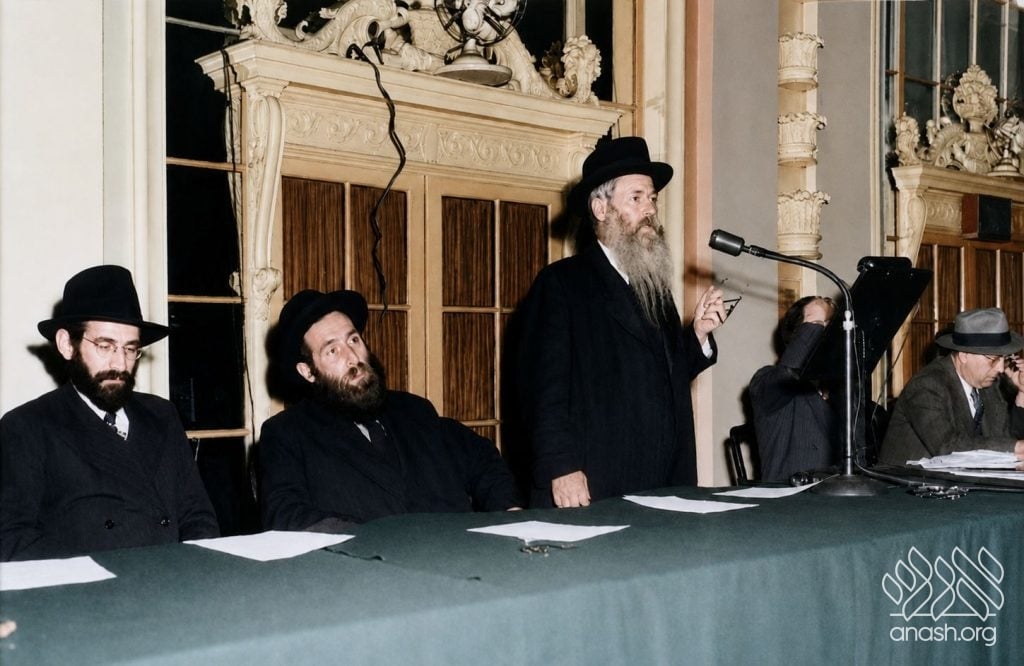
Harav Ashkenazi (third from right) at a demonstration organized by the Coordinated Committee for United Zionist Action in Hongkew, Shanghai, on 7 Cheshvan, 5706. The demonstration called for the British Mandate to open the doors to Eretz Yisrael for all Jews.
Two months later, on 6 Kislev 5706, the Shanghai branch of Agudas Yisrael, led by members of the Polish refugee community, held a “Commemoration Meeting” to honor the memory of the six million victims of the Holocaust.
Harav Ashkenazi spoke at the gathering, and his speech was published in The Jewish Voice of the Far East, the English section of the Jüdisches Nachrichtenblatt newspaper of the German Jewish refugee community.
Here too, Harav Ashkenazi spoke movingly about the magnitude of the tragedy the Jewish people had suffered, and urged the survivors to honor the memory of the victims by recommitting themselves to Hashem and His Torah. Here is the write-up of Harav Ashkenazi’s address, as it appeared in the 15 Kislev 5706 (November 20, 1945) issue of Jüdisches Nachrichtenblatt.
A group of Mirrer yeshiva bochurim poses with an American chaplain in Shanghai.United States Holocaust Memorial Museum.
“Jewish Blood Was Not Spilt in Vain”
The Rev. Chief-Rabbi Ashkenazi’s Speech at the Commemoration Meeting of Agudas Jisroel
“We have gathered here to-day to honour the memory of our Jewish brethren and sisters who died in such a cruel way and who were not even accorded the mercy of a Jewish grave. How sanctified is just for the Jews the notion of a “Jewish grave”! We are told of one of our ancient leaders that he hurried during a pogrom to the cemetery to lie on a Jewish burial ground should the enemy’s hand fell him.
Tragical is the fate of our perished ones if we imagine the horrible means which the barbarious murderers applied to their unfortunate victims. With a trembling voice we cry out: Look down from the heights and see how we have become to scorn and shame among the peoples so that we would feel happy if we would be regarded like sheeps brought to the shambles. They get more consideration, they are treated more human than our martyrs.
We know the law of our holy Thora forbidding us to slaughter the cow and its calf on the same day. The fathers and mothers of our people have been murdered together with their sons and daughters.
What remains for us to do to honour their memory? The Holy Scripture recounts that the voice of G-d called out to Kain: Your brother’s blood is crying up to the heaven! — The blood of our victims is crying to us: Remember, brethren, that we died for our Jewish being. You were spared. You are filling the gap. Be united, observe the holy Sabbath, observe the Jewish love of men, remember that you have to rebuild the Jewish life! If you will truly come up to this task than we will know that our blood has not been spilt in vain.
So, let us pray to the mercyful G-d that he may console us in our great grief and that our holy country and Zion, her capital, may soon be built.”
Harav Ashkenazi’s Pesach message in Nasha Zhizn (11 Nissan 5706—April 12, 1946) also addressed the fallout of the Holocaust. In this powerful message, he invokes Shefoch Chamascha on the Germans, explaining why this wicked people must be eradicated, and the lesson we must learn from the depths to which our enemies sank.
Rabbi M. Ashkenazi
The Festival of Pesach
We now welcome the festival of Pesach, the first Pesach after the war. Without fear, panic, or anxiety, we shall celebrate our traditional sedorim. Even those who are still in the camps, those who still remain there, will observe this Pesach more joyfully than they did last year. However difficult their experiences may be, their spirits are brighter.
Harav Ashkenazi. Courtesy of Dovid Zaklikowski and HasidicArchives.com.
When we celebrate our ancient traditional Seder this year, and when we read our Haggadah again, we must give serious thought to its words. Then we will better understand all that our sages have taught us.
In the midst of our Haggadah there comes a point when, in accordance with tradition, we open the door for Eliyahu the Prophet, whom we welcome with the prayer known as “Pour Out Your Wrath.” This prayer reads: “Pour out, O L-rd, Your wrath upon the nations that have not known You, and upon the kingdoms that have not called upon Your Name, for they have devoured Your sons and laid waste their dwellings. May Your wrath overtake them and drive them from beneath G-d’s heavens.”
How did it come about that our Torah, which taught the world ethics and morality, the Torah that warns people not to take revenge upon others, the Torah that plants in people the seeds of goodness, should call down curses and every kind of calamity upon those who refused to acknowledge the word of G-d? How are we to understand this?
Now, in the wake of the recent catastrophe, the meaning of this prayer should be clear to everyone. We have seen how the German people, having in their madness openly and brazenly rejected G-d and His commandments, disgraced their own name, turning everything into a curse upon themselves and upon the whole human race. They awakened the beast within man, a beast that disgraces G-d and His creation. Without faith in a Higher Justice, without faith in the Creator of the universe, without obedience to His commandments, without an understanding of the idea of redemption, people lose their human form and forfeit the right to mercy.
Rebbetzin Toibe Liba Ashkeanzi
No nation in the world has paid so dearly for these principles and ideas as we Jews have. No one has struggled for them so long and so persistently as we have. We gave the world the idea of redemption, and continue to uphold it. The time has already come for all to recognize that those who dishonor G-d’s name simultaneously dishonor the name of man, who was created in the image and likeness of G-d. Such a being is no longer a human being, but a beast possessing all the secrets of nature, a beast capable of destroying the entire world.
And the Jewish idea of redemption, which goes hand in hand with the fundamental principles of the Jewish religion, will bring liberation to the better among the wicked, to the choice ones among those who have fallen away.
In the name of this idea, we must act. We must continue the task bequeathed to us by our forefathers. We must continue to consolidate and strengthen the source of our faith, to draw the Jewish soul closer to the words of our prophets and sages, so that, step by step, we may lay the foundation for a new Jewish redemption, which, according to our faith, will ultimately bring the true and final redemption to the entire world.
*
Post-War Communal Life
The war was now over, but the refugees’ Shanghai saga continued. Most of the 20,000 or so German and Polish refugees wished to leave for Eretz Yisrael or the United States. But just as no one cared to save the Jews during the Holocaust, no one wished to welcome its survivors. The gates to Eretz Yisrael were held shut by the British Mandate, and America’s doors were also largely closed.
As related in our earlier article about the Lubavitcher bochurim in Shanghai, even the lucky few refugees who were able to obtain visas were held back by the unavailability of passenger ships.
Jewish life in Shanghai continued to function on a large scale until 5709, even as the refugee population gradually contracted as thousands successfully obtained visas for America, Australia, or Austria.
Jewish refugees leave Shanghai for America, early 5708.
Now released from the ghetto, the refugee Jews sought to better organize their communal life. The local German Jewish newspaper records Harav Ashkenazi’s activities to strengthen religious life in the German refugee community during this period.
During the Tishrei season, Harav Ashkenazi issued an appeal to the Jews of Shanghai to strengthen their observance of Shabbos and close their stores on this day. The German Jewish community (Gemeinde) endorsed his call in the Jüdisches Nachrichtenblatt newspaper (14 Tishrei 5706—September 21, 1945).
His Reverence Rabbi Ashkenazi has recently addressed an appeal to the Jewry of Shanghai to observe the Sabbath rest and to close their businesses, true to the Law. It goes without saying that we support this call, and we would welcome it if our members would comply with this appeal.
Shanghai, Sept. 20, 1945
Jüdische Gemeinde
A few weeks later, elections were held in the German Jewish Gemeinde. Harav Ashkenazi issued an impassioned call to the members of the community, imploring them to vote only for religious representatives (Jüdisches Nachrichtenblatt, 26 Cheshvan 5706—November 2, 1945).
Appeal by Rabbi M. Ashkenazi concerning the forthcoming communal elections
We consider it our sacred duty to draw the attention of our dear coreligionists to the fact that, according to the laws of our holy Torah, every Jew is obligated to take an active part in shaping his Jewish community.
Now that the time has come when, through free elections, you are able to determine the character of your community yourselves, be fully conscious of the grave responsibility you bear for the future community, for its work and its accomplishments!
Be clear as well that it is a requirement of our ancient law, handed down to us and proven through the ages, that only those individuals who are themselves conscious Jews in their own lives, and who put Jewish law into practice in their own conduct, have the right to stand at the head of a Jewish community. These men, who do not shrink from the difficult sacrifices demanded of a person by the many commandments of our Torah, will likewise shrink from no sacrifice when it comes to standing up for you in every respect. No task will be too great for such men.
If, on the other hand, you elect men who violate the laws of the Torah in their personal lives, you sin not only by having entrusted such men with office and honor, but at the same time you bear responsibility for all actions of the community that stand in contradiction to the divine truths. Denial of G-d, un-Jewishness, and immorality, hitherto confined to the private life of an individual, will now, from positions of leadership, come to dominate the entire community.
Brothers! Recognize your duty!
Be conscious of the magnitude of your task!
Then you will know how you must vote!
Shanghai, Marcheshvan 5706
Rabbi M. Ashkenazi
Visit to Eretz Yisrael
A year later, ahead of Tishrei 5707, Harav Ashkenazi embarked on a journey to Eretz Yisrael. In addition to his great love for the Holy Land, Harav Ashkenazi also had close family in Eretz Yisrael whom he hadn’t seen for years: his parents and son, Moshe.
After a few years in Harbin, China, Harav Ashkenazi’s parents, R. Shneur Zalman and Keila Ashkenazi, had moved to Shanghai, where Harav Meir served as the rov and their other children David (5657-5725), Gita (Klebanoff, 5661-5745), Rachel (Kommissaroff, 5666-5743), and Yehoshua (5667-5749) also settled.
Members of the Ashkenazi family. L-R: Michael Klebanoff, son of the rov’s sister Gita; Harav Ashkenazi; Honia Komissarroff, the rov’s brother-in-law; Lucy and David Ashkenazi, the rov’s brother and sister-in-law; and Manya, the rov’s daughter.Courtesy of Dovid Zaklikowski and HasidicArchives.com.
In 5694 the elder Ashkenazis set out to achieve their life-long dream of settling in Eretz Yisrael. With Jewish education in Shanghai severely limited, Harav Meir sent his bar mitzvah-age son Moshe (later Harav Moshe Ashkenazi of Tel Aviv) along with his parents, so that he could learn at Yeshivas Toras Emes in Yerushalayim.
Now, thirteen years later, Harav Ashkenazi would be reunited with his elderly parents and son once again. A little boy when Harav Meir last saw him, Moshe was now 26, married, and had two children. Over the war years, communication had been so limited that Harav Meir and his wife only received news of their son Moshe’s chasunah in Eretz Yisrael almost nine months after the event.
During his absence from Shanghai, Harav Meir was able to leave the leadership of the community and schools in the capable hands of his son-in-law, Harav Tzvi Hirsh Milner. A talmid of the Kaminetz yeshivah, R. Hirshel escaped to Shanghai together with the Mirrer Yeshivah, and he married the rov’s oldest daughter, Malka (Manya), in 5704.
The journey to Eretz Yisrael proved to be a harrowing experience. Upon finally arriving in Tel Aviv during Sukkos, on 20 Tishrei, Harav Ashkenazi related the story of his ordeal to a correspondent for the Eretz Yisrael daily Haboker newspaper (21 Tishrei 5707—October 16, 1946).
Harav Ashkenazi and Rebbetzin Ashkenazi farewell their son Moshe at the pier in Shanghai, 24 Shevat 5694.
Iraq Detains Jews Flying to Eretz Yisrael
Harav Meir Ashkenazi, the chief rabbi of Shanghai’s Ashkenazi community who arrived in Tel Aviv yesterday, told me about the ordeal suffered by two Jews who left Shanghai by air for Eretz Yisrael and had to make a stopover at the airport in Basra.
Harav Ashkenazi was traveling together with a resident of Eretz Yisrael who had found himself stranded in China before the outbreak of the war. Because he was a British subject, he had spent three years in a Japanese internment camp.
They flew by KLM to Calcutta, and their second stop was at the airport in Basra, Iraq. The plane was scheduled to remain there for forty minutes. An Arab official came aboard to inspect the passengers’ passports. When he noticed the rov, whose face is framed by a white beard, and then found an Eretz Yisrael passport in the hands of the second passenger, he expressed his regret that he could not permit Jews to continue through his country on their way to Eretz Yisrael. He ordered them off the plane.
They were assured that the questioning would take only a short time and that they would soon be allowed to continue their journey. Meanwhile, however, the plane took off, and the two men had no choice but to remain at the luxurious airport hotel, which was built by Solel Boneh.
The commander of the police in the Basra district was a British brigadier named Sargen. The hotel staff advised the rov to appeal to him, explaining that he wielded considerable influence and could decide their fate.
Mr. Sargen indeed received them graciously, and was very upset with the conduct of the Arab airport official. He immediately lodged a complaint with the official in charge of passport matters. The latter replied that the action had been taken in accordance with instructions from Baghdad, and that the laws barring Jews traveling to Eretz Yisrael could not be waived, even when they were merely passing through Iraq by air.
Mr. Sargen then appealed to the Iraqi Minister of the Interior, who promised that an answer would be forthcoming within several days. Seven days passed. Meanwhile, Harav Ashkenazi fell ill, and the British police commander eventually turned to the prime minister himself with an urgent appeal.
At the engagement of R. Tzvi Hirsh and Malka Ashkenazi, 29 Iyar 5703. The rabbonim pictured (L-R) are Harav Shmuel Walkin; Harav Yechezkel Levenshtein, the mashgiach of Mir; Harav Chaim Shmulevitz, the rosh yeshivah of Mir; and Harav Ashkenazi.
After twelve days, a negative reply arrived from the prime minister as well. The British officer advised the travelers to return to India and fly from there to Eretz Yisrael via another route.
“In the future,” the police commander told them, “write on your transit visas that you are traveling to Germany, Poland, or France. Any destination at all, so long as the name Eretz Yisrael does not appear.”
The Indian consul in Iraq initially refused to grant the Jews visas permitting them to return to India. But after the British ambassador intervened, Harav Ashkenazi and his companion were able to return to the airport in Karachi, India. From there, with the assistance of the local Jewish community, they boarded a direct flight to Lod.
The journey from India to Eretz Yisrael took them twenty-one days instead of three, and cost an additional two hundred Eretz Yisrael liras.
Members of the extended Ashkenazi family in Shanghai bidding farewell to their parents and Harav Ashkenazi’s son Moshe as they depart for Eretz Yisrael, 24 Shevat 5694. In the front row, L-R: Rebbetzin Toibe Liba, Harav Ashkenazi, Moshe Ashkenazi, R. Shneur Zalman Ashkenazi, Keila Ashkenazi.
Shortly after arriving in Eretz Yisrael, Harav Ashkenazi gave an interview to Leibel Bein, a Piasetzna chasid who worked as a journalist for Hatzofeh newspaper (4 Cheshvan 5707—October 29, 1946). We cited part of the interview in the previous installment, and now we will quote the rest of the interview, regarding the post-war period in Shanghai and the other Jewish communities in China. Published in a religious Zionist newspaper, the article focuses heavily on Eretz Yisrael.
Greetings from Our Brethren in the Far East
(A Conversation with Harav Ashkenazi, the rov of Shanghai)
Harav Ashkenazi
Harav Ashkenazi, the chief rabbi of Shanghai, arrived in Eretz Yisrael several days ago. He has served as chief rabbi for the past twenty years and, through his rabbinic leadership and communal work, has already written an august chapter in the revival of that remote Jewish settlement in the Far East.
I took the opportunity to speak with the distinguished rov, who graciously provided the readers of Hatzofeh fresh regards from the Jews of the Far East in general, and from the Jewish community of Shanghai in particular. . . .
[Harav Ashkenazi relates:] “The life of Shanghai’s Jewish community after its liberation from the Japanese constitutes a chapter of its own. Most of the seventeen thousand refugees had set their hopes on Eretz Yisrael from the outset. When registration was conducted asking where they wished to go, the majority chose Eretz Yisrael, even those who had previously felt no particular connection to the land of their forefathers. The refugees from Poland specifically registered for Eretz Yisrael without a single exception.
The Mirrer Yeshivah in the Beth Aharon shul in Shanghai, 5702.United States Holocaust Memorial Museum.
“Time passed, and visas for the United States and Canada arrived for entire groups of young bochurim, but they refused to use them. They endured great hardship and stubbornly resisted emigrating to America. They bombarded their relatives and acquaintances in Eretz Yisrael with letters and telegrams, all with the same message: ‘We have had more than our fill of the Shanghai exile. We have no desire to exchange it for another exile in America or Canada.’
“For more than a year, the five hundred yeshivah bochurim persisted in their refusal to travel to America. They hoped that Chief Rabbi Yitzchak Isaac Herzog would obtain immigration certificates for them. Indeed, the Jewish Agency allotted several hundred certificates on their behalf, but because of the political situation, this did not eventuate.
“As a result, the yeshivah bochurim finally agreed to travel to America and Canada temporarily, with no intention of settling there. They emphasized repeatedly that this was only for the time being; otherwise, they would under no circumstances have consented to go.
The Yeshivah Ketanah in Shanghai, 20 Elul 5704. The students of the Yeshivah Ketanah were from German refugee families, most of whom had not been frum before the war. From the Yeshivah Ketanah they went on to join the Mirrer Yeshivah.
“They have all since left Shanghai, and the first groups have already reached America and Canada. They now await the first opportunity to make aliyah and continue their Torah study here, for ‘there is no Torah like the Torah of Eretz Yisrael.’
“It is worth noting that three local boys, children of German-Jewish refugees who had joined the Mir Yeshivah, accompanied the five hundred yeshivah bochurim on their journey overseas.
“I can tell you the same,” he continued, “regarding the Amshinover Rebbe, Harav Shimon Kalish, and his family. When I left Shanghai by plane for Eretz Yisrael, he was waiting for a ship that would take him to America, after he and his family had waited in vain to receive immigration certificates and had been unable to make aliyah to Eretz Yisrael. But the Rebbe and his son and grandchildren will not reconcile themselves, even for a moment, to the thought of settling in America. From there, they will continue their efforts to hasten their journey to Eretz Yisrael.
The Amshinover Rebbe, Harav Shimon Sholom Kalisch (5643-5714). This picture was taken in Kobe, Japan, in 5701. Courtesy of the JDC archive.
“Even among the ordinary Polish Jewish refugees still in Shanghai, many stubbornly remain there, even though they could have traveled to North or South America as long as a year ago. They eagerly seize every scrap of news from Eretz Yisrael and sit waiting for immigration certificates. They fear that once they settle in America, it may prove difficult to uproot themselves and leave for Eretz Yisrael. And so they remain in Shanghai, awaiting deliverance.
“Although the organized religious element, the yeshivah bochurim, has left Shanghai, their influence has not been lost. The atmosphere there is now entirely different. A religious and national Jewish pulse once again beats within the community.
“But while it gives me great satisfaction to convey such heartening greetings from Shanghai, my spirit is saddened when I turn to another Jewish settlement in the Far East, the large Jewish community of Harbin.
“Until 1941, Harbin was regarded as the most important center of Jewish life in the Far East. It was the seat of the Jewish National Council of the Far East, and its community numbered more than eight thousand Jews, Jews in the fullest sense of the word. All belonged to the organized Zionist camp, led by the well-known Zionist activist Dr. Kaufman. Harbin also had a strong Mizrachi organization, headed by the city’s rov, Harav Kiselev.
Harav Aharon Moshe Kiselev (5629-5709), the rov of Harbin, China. Harav Kiselev had a close relationship with Chabad, and received the Rebbe Rashab’s berachah before assuming the rabbonus of Harbin in 5673.
“Now everything has changed for the worse. When the Soviets occupied Harbin, the community was cut off from the rest of Manchuria. The one thing we know is that immediately after the Russian occupation, Dr. Kaufman, head of the Jewish National Council, was arrested and exiled from Harbin. The same fate befell R. Alter Odlovsky, a Mizrachi activist and head of the Harbin community. As for Harbin’s rov, we know that he was summoned for questioning and later released. As I said, there is no contact with Harbin, and no one knows what has become of the Mizrachi organization there or of its director, Harav Yeivin.
“The Jews of Tientsin [Tianjin], by contrast, are living under more favorable conditions. The city was captured by the Chinese and is now home to several thousand Jews, fine and observant Jews. They have a well-organized communal council and a distinguished rov and av beis din, Harav Levin, who is accomplishing great things in the field of religious education. May Hashem help them, and may peace prevail in the Far East. Despite their secure material circumstances, the Jews of Tientsin, too, yearn with all their hearts to make aliyah to Eretz Yisrael.
“As for my own arrival here,” the distinguished rabbi concluded, “for years I have longed to come to our Holy Land. Aside from my love for Eretz Yisrael, I have parents, a son, and other relatives here. Unfortunately, my visa is valid for just six months—I wish I could stay here longer. During my absence, the Shanghai community will be led by my son-in-law, Harav Tzvi [Milner].”
The dedication of the shul in Tientsin (Tianjin), 5699. Harav Shmuel Shaul Levin, the rov of Tientsin, is on the right of the front row, holding a Sefer Torah.
*
Visit to America
After spending a couple of months in Eretz Yisrael with his family, Harav Meir continued on to America. Here he would have another moving reunion: with the Frierdiker Rebbe, whom he hadn’t seen since he was a young bochur, when the Frierdiker Rebbe had been the menahel of Yeshivas Tomchei Temimim.
New York’s Der Tog newspaper reported on his arrival (11 Teves 5707—January 3, 1947):
Harav Ashkenazi, Chief Rabbi of Shanghai, Arrives Here
The Vaad Hatzalah welcomes Harav Ashkenazi to America. Der Tog, 14 Teves (January 6, 1947).
Harav Meir Ashkenazi, Chief Rabbi of the Jewish community in Shanghai and spiritual leader of the far-flung Jewish communities of the Far East, arrived in America yesterday for a visit. On his way to America, Harav Ashkenazi stopped in Eretz Yisrael, where he conferred with leaders of the Yishuv.
Harav Ashkenazi will deliver his first greetings to American Jewry on Sunday, January 12, at 6:00 p.m., at the Hotel Astor, at the annual dinner of the United Lubavitcher Yeshivos. Harav Ashkenazi has brought with him a special, important message from the thousands of Jewish refugees stranded in Shanghai.
Harav Ashkenazi was met at the airport by a special committee sent by the Lubavitcher Rebbe, Harav Yosef Yitzchak Schneersohn, to whom the Chief Rabbi of Shanghai has come on an important mission.
Harav Ashkenazi received a well-deserved hero’s welcome in America. He was the star attraction at the annual dinner of the United Lubavitcher Yeshivos, a speaker at the Agudas Yisrael convention, and the guest of honor at the convention of the Vaad Maginei Umarchivei Hachinuch Hakasher—Shaloh (NCFJE).
Harav Ashkenazi addressing the NCFJE convention at the Biltmore Hotel in Manhattan. L-R: R. Shmuel David Raichik, R. Binyamin Gorodetsky, Harav Meir Ashkenazi (speaking), R. Yaakov Yehuda Hecht, David Eidelsberg (journalist with Morgen Zhurnal).
Of course, the true highlight of Harav Ashkenazi’s visit was seeing the Frierdiker Rebbe. Over the months he spent in New York, Harav Ashkenazi spent much time with the Frierdiker Rebbe, and the Frierdiker Rebbe spoke about him in glowing terms.
R. Avraham Weingarten, then a bochur in 770, wrote in his diary details he heard from the mashpia Harav Shmuel Levitin about Harav Ashkenazi’s visit, a few months after it had concluded.
[Harav Shmuel Levitin] spoke about Harav Meir Ashkenazi, saying that the Rebbe said that he was “an ohra’diker Yid, a lichtiger Yid,” [a luminous Jew]. . . .
[R. Shmuel continued:] R. Meir is lichtig, ohra’dik; nothing obscures [his spiritual sensitivity]. When he was here, he would not make any move without asking the Rebbe. He had pain in his leg and asked the Rebbe, by means of a note, whether he should come to a farbrengen. The Rebbe told him yes, provided he did not remain until a late hour. There were many other similar instances.
The Frierdiker Rebbe’s letter is read at the NCFJE convention. L-R: R. Shmuel David Raichik, R. Binyamin Gorodetsky, Harav Meir Ashkenazi, R. Yaakov Yehuda Hecht (reading the letter), David Eidelsberg, Nisson Gordon (journalist with Der Tog), R. Fishel Sochatshevsky (Mesivta Torah Vodaas).
*
The End of the Shanghai Exile
Over the months Harav Ashkenazi spent in America, many of his friends encouraged him to stay. The war was now over, and he had completed his historic mission of guiding and caring for refugees during the tumultuous and dangerous war years. He was approaching 60 and had suffered various health problems over the past few years. After over 20 years in the remote and Jewishly underdeveloped Far East, the time had come for him to settle in the thriving Jewish community of New York. The draw of living near the Frierdiker Rebbe was also very strong.
But Harav Ashkenazi rejected their entreaties and insisted on returning to Shanghai. This was his flock, and he could not leave them without a shepherd. The Talmud Torah and Beis Yaakov he had worked so hard to establish needed him. And so, in the spring of 5707, Harav Ashkenazi returned to Shanghai.
Harav Ashkenazi at the laying of the foundation stone for the extension of the Shanghai Jewish Club, 28 Tishrei, 5708.
But at the same time, dark clouds were brewing over China, clouds that would soon spell the end of Jewish life in the country.
After taking a break over the years of World War II and Japanese occupation, China’s civil war between the Nationalists and Communists reignited.
In the Hatzofeh interview we cited earlier, Harav Ashkenazi spoke about the impact of the Soviet occupation of Harbin, which cut it off from the rest of the world. In 5706 the Soviets handed the city of Harbin to Mao Zedong’s “People’s Liberation Army,” and the communist policies they implemented destroyed the Jewish community’s livelihood. Over the next few years, the 2,000 Jews of the city departed.
After consolidating control over Northern China, Mao’s Communists continued to advance southward toward the major prize of Shanghai. The economic situation in Nationalist-ruled Shanghai deteriorated rapidly, and by the beginning of Teves 5709 the fall of the city seemed inevitable.
Fearing totalitarian Communist rule, isolation from the rest of the world, and economic ruin, the approximately 15,000 Jewish residents of Shanghai were desperate to get out in time. But unlike the non-Jewish international residents of Shanghai, they didn’t have easy options. Most of the Jewish refugees were stateless, and those who had foreign citizenship had no interest in going back to their blood-soaked birthplaces either.
Jewish emigres are processed in Shanghai before their departure, 12 Shevat 5708. United States Holocaust Memorial Museum.
Under the U.S. Displaced Persons Act of 1948, over 4,000 Shanghai Jews were able to obtain visas and depart for America in the latter part of 5708. As the situation in Shanghai deteriorated in Cheshvan–Kislev of 5709, the Israeli government—still in the midst of its War of Independence—and the Joint Distribution Committee launched a massive rescue mission to save the 10,000 Jews stranded in Shanghai.
Harav Ashkenazi began preparing to leave Shanghai in Elul of 5708. He received the Frierdiker Rebbe’s berachah to leave (Igros Kodesh, vol. 9, p. 489), and instructions to ensure that the community’s religious needs would be adequately cared for after his departure. He finally left Shanghai in Kislev of 5709, and on 2 Teves 5709, the final day of Chanukah, he arrived in New York.
Upon his arrival, Harav Ashkenazi gave an interview to Nisson Gordon of Der Tog, explaining the situation in Shanghai (3 Teves 5709—January 4, 1949).
Harav Meir Ashkenazi of Shanghai Arrives in America; Brings News of the Jews of the Far East
Special Report by N. Gordon
After serving for twenty-three years as chief rabbi of the Jewish community in far-off Shanghai, Harav Meir Ashkenazi arrived in New York yesterday, bearing sorrowful news of the decline of yet another Jewish community, now being uprooted by the Chinese Civil War.
Harav Ashkenazi comes directly from Shanghai, where he has led Jewish life for the past twenty-three years. He particularly distinguished himself through his rescue work on behalf of the Jewish refugees who poured into the city during the war, under the Japanese occupation.
Some eight thousand Jews are now living in Shanghai, and the large majority of them are ready with their packed suitcases in hand, waiting for the next ship that will take them to Eretz Yisrael. . . .
The Hongkew district in Shanghai. Courtesy of Yad Vashem.
Last Friday, December 24, the first ship departed for Eretz Yisrael carrying nine hundred Jews. Another ship was also scheduled to leave that same day, but was delayed for certain reasons connected with the war. Harav Ashkenazi believes there is a strong possibility that all the Jews will manage to leave Shanghai before the city is turned into a battlefield or falls to the revolutionary armies.
The chief fear among Shanghai’s Jews is that under a revolutionary regime they will be cut off from the outside world and may never again have the opportunity to leave. For that reason, Harav Ashkenazi emphasizes, almost every Jewish family has its luggage packed and is waiting for a summons from the Israeli consul to board a ship.
The only members of Shanghai’s Jewish community who are not preparing to flee are those Sephardic Jews who hold British passports, particularly the Iraqi Jews, who hope their passports will protect them. The Sephardim number between two and three thousand souls in Shanghai, Tsingtao, and Tientsin. The German Jewish community numbers about four thousand, and the Ashkenazim about two thousand. Altogether, there are now approximately ten thousand Jews in China, the great majority of them in Shanghai.
The fate of the Jewish community of Harbin is at present completely unknown. Numerous attempts to establish contact with the Jews there have failed. The Jews of Shanghai are deeply concerned about the Harbin community, which was among the first to be engulfed by the present war.
The devastation in China is terrible. People are starving for a spoonful of rice, and the general mood is extremely grim.
On his journey, Harav Ashkenazi’s plane stopped at several Pacific islands that had been the scene of some of the fiercest battles of the war. On Midway Island, a Christian chaplain helped him find a candle so that he could light Chanukah candles.
In a follow-up article a few days later, Nisson Gordon, writing under the pen name “N. Dokshitzky,” presented a more detailed conversation with the newly arrived Shanghai rov, elaborating further about the rescue operation to transport Shanghai’s Jews to Eretz Yisrael and his feelings about the end of an era in his life and the close of a chapter in Jewish history (Der Tog, 9 Teves—January 10).
Rov Rescued from Shanghai Relates How the First Ship to Israel Carried Children
By N. Dokshitzky
Harav Meir Ashkenazi, chief rabbi of the Jewish community of Shanghai, arrived this week by plane from the Far East, where he had lived for the past twenty-three years. He is by now a seasoned “wandering Jew,” a man who has been forced more than once to take his staff in hand and seek a new place of rest.
During the First World War, while still a young man, he fled his small native town of Cherikov, in the Mogilev Province, traveling all the way to Vladivostok. From there, he went to Harbin and then to Shanghai, where he “stopped” for twenty-three years and served the local Jewish community as its spiritual leader.
Harav Ashkenazi is mesader kiddushin at the wedding of Yana (Yaakov) and Lea Liberman in Shanghai, 15 Sivan, 5708. Yana is wearing his Betar uniform.
Barely two years ago, he visited America briefly to see his family. Even then, those close to him pleaded with him not to return. But Harav Ashkenazi would not hear of remaining here and abandoning the Jews of Shanghai like sheep without a shepherd.
For twenty-three years he stood at the helm of Jewish life in Shanghai. He remained at his post until the final moment, when the ground began to burn beneath their feet, and the Jewish community began boarding ships bound for Eretz Yisrael.
Harav Ashkenazi’s rabbonishe countenance lit up as he began describing the joy that swept through Shanghai’s Jewish community when word spread that the Israeli consul was coming.
We met the Shanghai rabbi recently at his sister’s home on Riverside Drive. Seated beside a window overlooking the gleaming Hudson, Harav Ashkenazi kept his gaze fixed on the broad river as he spoke, smiling, of the great miracle that accompanied the exodus from Shanghai, an exodus that could otherwise have ended in terrible tragedy, chas veshalom.
When war erupted once again, and the front drew close to Shanghai, an emergency meeting was immediately called of the leaders of the city’s three Jewish communities: the Sephardi community, the Ashkenazi community, and the refugee community established during the recent war, when nearly twenty thousand Jewish wanderers were cast onto the shores of Shanghai.
The meeting was permeated by the pain and anguish Jewish leaders feel whenever their community stands on the brink of destruction. They resolved to send an urgent SOS to the government of the State of Israel, pleading with it to act as quickly as possible to save the Jews of Shanghai and prevent a repetition there of what had happened in Europe.
“A cable was sent to Israel’s foreign minister, with copies forwarded to President Chaim Weizmann and Chief Rabbi Dr. Yitzchak Halevi Herzog. The cable pleaded and warned: it pleaded for help from the State of Israel and warned that there was no time to lose.
It was not long before Harav Ashkenazi, as the signatory to the appeal, received word that Moshe Yuval, Israel’s vice-consul in New York, would fly to Shanghai at once to issue visas for Eretz Yisrael, and that every effort would also be made to prevail upon the IRO [International Refugee Organization] to provide ships for the refugees.
Moshe Yuval (5673-5742), aliyah activist and Israeli diplomat.
One look at Harav Ashkenazi’s radiant face gave me some sense of the joy in Shanghai’s Jewish quarter when the news arrived. Beyond the concrete prospect of rescue, it breathed new strength into broken Jewish hearts. It healed them with the ancient, time-tested balm of Jewish faith: Lo alman Yisrael; the Jewish people are not alone.
The Jews kissed each other with joy. It was not only because they would soon be aboard a ship bound for Eretz Yisrael. More than anything, they rejoiced that they had lived to see the day when a Jewish consul, representing a Jewish state, would come to rescue them.
Now they didn’t have to plead at the door of some non-Jewish official, begging him to take pity on them and grant them a visa. A Jewish consul would come and issue Jewish visas, visas that would carry them to the Jewish homeland.
“Moshe Yuval is a precious Jew with a warm heart,” Harav Ashkenazi relates. On Shabbos he visited the rov for cholent, and one can readily imagine how joy and tears mingled at the Shanghai rov’s final Kiddush before taking leave of his community.
The first ship was scheduled to depart on Friday, December 24. Only nine hundred passengers could be accommodated aboard the small vessel, whose crew had undertaken a sixty-day journey across seas and continents. Two ships had originally been expected, but the second was delayed because of the state of war. It is presumably already on its way, and other ships are likewise preparing to depart.
The Jewish community of Shanghai therefore decided that the children should sail on the first ship: the young boys of the Talmud Torah and the girls of the Beis Yaakov school, together with their parents.
All of Jewish Shanghai gathered at the port that Friday to bid farewell to the young tinokos shel beis rabban setting out for home in Israel.
The Talmud Torah in Shanghai, 5706.
“We decided to send the children ahead,” Harav Ashkenazi says, “because I believe with perfect faith that it is only in their merit that we will all be saved, in the merit of the pure breath of tinokos shel beis rabban…”
At this point, the Shanghai rov paused for a moment. The Talmud Torah in distant Shanghai had been the crown jewel of his institutions, the work closest to his heart. The Talmud Torah and the Beis Yaakov school had been founded during the war years, when among the thousands of refugees there were some seven hundred bnei Torah, whose presence breathed new life into local Jewish life.
“It was difficult for me to part from the children,” Harav Ashkenazi said with a deep sigh, “but thank G-d, they have been saved…”
Only a very small number of Sephardi Jews will now remain in Shanghai, people who hold British passports and believe these will protect them. The more recently arrived refugees, as well as the long-established Russian Jews, are packing their belongings and preparing to leave.
Harav Ashkenazi is a striking Jewish figure, whose name is pronounced with profound reverence by the hundreds of refugees who made their way from Shanghai to America. Religious and nonreligious Jews alike speak with admiration of his mesiras nefeshdiker work during the Japanese occupation, when he risked his life more than once to save a fellow Jew.
Harav Ashkenazi. Courtesy of Dovid Zaklikowski and HasidicArchives.com.
As a longtime resident of Shanghai, Harav Ashkenazi had the privilege of living outside the ghetto that the Japanese had established in Shanghai at the urging of their Nazi advisers. Living beyond the ghetto walls allowed him to move about with relative freedom and to intervene on behalf of Jews in their hour of need.
And there was no shortage of such hours of peril in wartime Shanghai, even though, as Harav Ashkenazi emphasized, both the Chinese and the Japanese are naturally distant from antisemitism. The special commander of the ghetto would often take a fancy to playing games with the Jewish refugees, and during such times Harav Ashkenazi would have to knock on doors and appeal for mercy.
The door of the home where Harav Ashkenazi is staying in New York did not close for a moment. Yeshivah bochurim have come, men who found in Harav Ashkenazi the heart of a father; and secular Jews have come as well, men who have not forgotten his work on behalf of the entire community and his mesiras nefesh.
Everyone who enters throws their arms around his neck and kisses him, with tears in their eyes.
“This is our Shanghai father!” one of the yeshivah bochurim cried joyfully when he entered the house and caught sight of Harav Ashkenazi’s face.
A brief notice in a later issue of Der Tog (20 Teves—January 21) added a paragraph about the role of the Joint in the emergency evacuation campaign.
Harav Ashkenazi on the Joint’s Work in Shanghai
In N. Dokshitzky’s article in DerTog about the Chief Rabbi of Shanghai, Harav Meir Ashkenazi, who has now arrived in America, a paragraph in which Harav Ashkenazi described the rescue work of the Joint in the Far East was inadvertently omitted.
Adolph C. Glassgold, director of the Joint in Shanghai from 5708 to 5711.
The paragraph reads as follows:
The great rescue effort has been made possible thanks to the vigilant work of the Shanghai Joint and its representative, Mr. Glassgold. Working in close cooperation with Israel’s vice-consul, Moshe Yuval, the Joint representative overcame every obstacle and paved the way for the rescue of Shanghai’s Jewish community.
Harav Ashkenazi also gave an interview to the Morgen Zhurnal newspaper (4 Teves—January 5), which we won’t cite here due to its repetitive nature. One specific quote from Harav Ashkenazi about the special merit of the Shanghai community is worth including, however.
According to Shanghai’s rov, however, there is no panic among the Jews there.
The building that served as the headquarters of the Joint in Shanghai.
“Perhaps it is in the merit of the gedolei Torah who were our guests and friends throughout the war,” Harav Ashkenazi says, “but the liquidation of our community is taking place under far better conditions than the destruction of our communities in Europe.”
Ultimately, when the city of Shanghai fell to the Communist army on 28 Iyar, 5709, there were 4,000–5,000 Jews still in the city. As the transition to a Marxist economy progressed, the Jewish residents lost their livelihoods. Over the next two years, almost all of the remaining Jews emigrated, and the Shanghai Jewish community was liquidated.
*
The Father of the Shanghai Diaspora
Despite his exile from Shanghai, Harav Ashkenazi remained the Shanghai rov throughout his life and continued to serve his flock, now exiled across the world. In a 26 Teves letter to him shortly after his arrival, the Frierdiker Rebbe appointed Harav Ashkenazi as director of the Shanghai refugee department of Machne Israel, Chabad’s social service agency.
Refugees stand on the stern of the Castel Bianco at the Hongkew Wharf in Shanghai and wave goodbye to their friends. The Castel Bianco departed on 29 Kislev 5709 for Eretz Yisrael, taking a circuitous Cape Route around Africa due to the ongoing War of Independence.
Harav Ashkenazi’s first publicly reported activity in this new capacity came a few weeks later, in Shevat–Adar of 5709. On 22 Shevat 5709, the SS General Gordon docked in S. Francisco, with 489 Eretz Yisrael-bound refugees from Shanghai on board.
The refugees were not given U.S. entry visas, so immigration authorities mandated they be held in detention until their departure from the country. A sealed cross-country “Liberty Train” transported the refugees to Ellis Island, where they were held at Ellis Island Immigration Station until they departed for Eretz Yisrael on 2 Adar.
During their week of detention on Ellis Island, relatives, friends, and representatives from Jewish relief organizations were granted special permission to visit. Harav Ashkenazi visited the detained refugees twice during their week on Ellis Island. As the refugees would be at sea over Purim, on his second visit Harav Ashkenazi brought them a Megillah to use. The Morgen Zhurnal (2 Adar—March 3) reported briefly:
A group of Shanghai refugees daven aboard the “Liberty Train” transporting them from S. Francisco to the East Coast. Leading the tefilah is 75-year-old Herman Auslander, a financier who had lived in Shanghai since 5660. United States Holocaust Memorial Museum.
Yesterday afternoon, a rabbinic delegation arrived at Ellis Island, headed by the Shanghai rov, Harav Ashkenazi.
The rabbonim brought the Jewish travelers a Megillah and various seforim. Harav Shmuel Walkin, who had lived in Shanghai during the war, also came to greet them. The Jews received him with great warmth.
The rabbonim offered their blessings and bade the Jewish wanderers a heartfelt “tzeischem leshalom.”
A more detailed report on this visit, clearly supplied by Lubavitch in New York, appeared in the Canadian Jewish Chronicle (10 Adar—March 11).
Shanghai Refugees Receive Megillah, Books from Lubavitcher Groups
A painting of Harav Walkin by Ernest Handel, an artist from Vienna who found refuge in Shanghai. Color digitally restored.
Moving Scenes and Impressive Ceremony on the Eve of their Departure for the Holy Land.
NEW YORK — Among the dreary days spent by the Shanghai refugees on Ellis Island en route to the Holy Land, one bright day stands out which will always be remembered by them for the inspiration and faith it has brought them.
Wednesday, March 2, 1949, was the third and last visiting day for the Jewish D.P.’s from Shanghai, and the Ellis Island ferry was busy plying the waters of the mouth of the Hudson, carrying visitors for a final good-bye to their relatives on the Island on the eve of their departure for the Holy Land. The corridors and meeting rooms of the huge detention building on the Island are lively with visitors and refugees. Excitement runs high.
In the main assembly hall, however, where no private visitors are permitted, it is strangely quiet. Here men, women and children wander about aimlessly, like shadows. They comprise the main body of the refugees—Jews of all types: Sephardic, Ashkenazic, Russian, German, Polish. They are the most lonesome ones on the Island. No relatives or personal friends come to visit them, for they have none on these shores. They are marking time in the dismal surroundings of the shelter.
Shanghai refugees arriving in Eretz Yisrael in Adar 1949 carrying their Sifrei Torah. Courtesy of Yad Vashem.
Suddenly a complete transformation takes place, as the lonesome refugees realize they are not friendless after all. A delegation of Rabbis have arrived to greet them in the name of the world-famous Lubavitcher Rabbi, Rabbi Joseph I. Schneersohn, and bring them his benediction.
But not merely to give them a warm hand-shake and hearty blessings did the venerable Rabbis come, although that in itself would have meant so much to the lonesome refugees. The delegation brought them a Megillah for Purim, since they would celebrate the festival on high seas, and many books for study and inspiration in Hebrew, Yiddish and English, published by the “Kehot Publication Society,” another of the Lubavitcher Rabbi’s creations.
The delegation consisted of Rabbi Meyer Ashkenazi, Chief Rabbi of Shanghai and Director of the Far Eastern Division of “Machne Israel,” Rabbi M. A. Hodakov, Director of “Merkos L’Inyonei Chinuch” and “Machne Israel,” and Dr. Nissan Mindel, Co-Director.
Harav Ashkenazi sends his berachos for Rosh Hashanah 5710 to the Shanghai expats in Sydney, Australia. Sydney Jewish News, 4 Tishrei 5711—September 15, 1950.
The Megillah was presented by Rabbi Ashkenazi in behalf of “Machne Israel.” Having been their spiritual leader in Shanghai for many years, Rabbi Ashkenazi struck a personal note in pointing to the symbolic and timely significance of the Megillah, since the story of Purim so vividly repeated itself in their own personal experience.
Dr. Nissan Mindel made the presentation of the books and literature in behalf of the “Merkos L’Inyonei Chinuch.”
The refugees were told that on arrival in the Holy Land a similarly warm welcome and practical aid awaited them from the Lubavitcher Rabbi’s representatives in the Holy Land.
Most of Harav Ashkenazi’s work with his exiled flock was personal and didn’t make the headlines. He kept in contact with ex-Shanghai residents across the world to give them encouragement, support, and berachos for their simchos.
Harav Ashkenazi and R. Mordechai Groner accompany R. Shimon Goldman to the chuppah. Courtesy of Dovid Zaklikowski and HasidicArchives.com.
Regarded by so many refugees as their surrogate father, Harav Ashkenazi was the guest of honor at their simchos in New York. When the orphaned Lubavitcher Shanghai survivor R. Shimon Goldman got married on 28 Adar 5709, it was only natural that he would ask Harav Ashkenazi to accompany him to the chuppah, like a father for his son.
Harav Ashkenazi lived the final years of his life on Crown St. in Crown Heights, near the Rebbe. In Av of 5709, he embarked on another trip to Eretz Yisrael to visit his family. On 5 Shevat 5710, he received a letter from the Frierdiker Rebbe with a berachah for his return to America, where “we will see each other amid abundant goodness” (Teshurah, Berkowitz-Ashkenazi 5763, p. 19). The Frierdiker Rebbe was nistalek five days later, and Harav Ashkenazi didn’t get the opportunity to see him again in this world.
Harav Ashkenazi at a reception in Eretz Yisrael in 5710 for Louis Schleifer, a major donor to Lubavitcher mosdos in America and Eretz Yisrael. Schleifer is seated at the center of the table, and Harav Ashkenazi is to the right. Courtesy of Dovid Zaklikowski and HasidicArchives.com.
When Harav Ashkenazi arrived back in New York on 5 Nissan, chasidim were working hard to prevail upon the Rebbe, known until then as the Ramash, to accept the nesius. As one of the senior chasidim present in New York at the time, Harav Ashkenazi played a key role in this process. Information about these activities is recorded in Yemei Bereshis.
Harav Ashkenazi at R. Shimon Goldman’s kabalas panim, standing behind the Rebbe.
The last years of Harav Ashkenazi’s life were marred by a lengthy and difficult illness, and he passed away at the relatively young age of 63 on 26 Av, 5714. His premature passing was deeply mourned by his many spiritual children across the world.
Der Tog (28 Av, 5714—August 27, 1954) reported on his passing and funeral:
Deep Mourning for the Passing of Harav Ashkenazi, Shanghai’s Last Chief Rabbi
Hundreds of Jews accompanied Harav Meir Ashkenazi, the rov of Shanghai, to his eternal rest last Wednesday. Harav Ashkenazi passed away that same day at three o’clock in the afternoon.
At the instruction of the Lubavitcher Rebbe, with whom the deceased was very close, the levayah was held immediately. Despite the short notice, word spread through the city with lightning speed, and hundreds of Jews gathered for the levayah outside his final residence, at 518 Crown Street in Brooklyn.
The Shanghai rov, who came to America after the war, earned an enduring name through the assistance he extended to the refugees who arrived in Shanghai, particularly the hundreds of yeshivah bochurim from all yeshivos. To them, he was like a devoted father.
His home in Shanghai was open to every refugee, each of whom found there a fatherly help and heimishe warmth.
Harav Ashkenazi was among the earliest students of the old Lubavitcher yeshivah in Russia. He was highly respected throughout the rabbonishe world for his greatness in lomdus and horaah. He was also a great chasid, and throughout the decades in which he served as chief rabbi of Shanghai, he remained in constant contact with the Lubavitcher Rebbe.
Here in America, all the Shanghai refugees, and especially the bnei Torah among them, regarded him as their personal representative and patron. His home was always filled with bnei Torah who came to visit him and talk in learning.
As one of the senior Chabad chasidim in America, he was among the most devoted chasidim of the previous Lubavitcher Rebbe זצ”ל, and of his successor, the present Rebbe, שליט”א.
The kevurah took place in Old Montefiore Cemetery, in the section belonging to Agudas Chasidei Chabad.
The niftar is survived by his wife, a prominent activist on behalf of Torah and bnei Torah; a son, Harav Moshe Ashkenazi, in Israel; and two daughters in this country.
Harav Ashkenazi at the Rebbe’s farbrengen on 24 Teves, 5712, seated to the left of the Rebbe. Courtesy of RebbeDrive.
A few days later, Nisson Gordon penned his own tribute to Harav Ashkenazi in Der Tog (4 Elul 5714—September 2), including more details about his final years in the chatzer of Lubavitch in Crown Heights.
The she’eiris hapleitah of Shanghai, together with religious Jews in general, suffered another grievous loss last week with the passing of the Shanghai rov, R. Meir Ashkenazi.
Harav Ashkenazi
Himself a Russian Jew and one of the earliest talmidim of the old Lubavitcher yeshivah in Russia, Harav Ashkenazi spent the years from the Revolution until 1949 in the Far East: in Vladivostok, Harbin, and, for more than twenty years, Shanghai. There he led the city’s rabbinate with great honor and dignity, enjoying the confidence of every segment of the Jewish population, Ashkenazim and Sephardim alike.
When hundreds of Jewish refugees made their way to Shanghai following the outbreak of the recent war, Harav Ashkenazi was the one who fulfilled the historic mission of welcoming and assisting the wanderers. It was not only the religious refugees and the yeshivah bochurim who found themselves stranded in Shanghai who found in him a rescuing angel. Every Jew whom fate cast into Shanghai during the war will long remember the brotherliness and genuine Jewish warmth shown to them by the Shanghai rov, and the helping hand he extended to each and every person.
When it became clear that Shanghai would fall to the Communists, Harav Ashkenazi left the city and came to New York, settling here in 1949. Although he no longer held a rabbonus position, the Shanghai refugees continued to regard him as their rov. His door remained open at all times to anyone seeking help, whether advice or practical assistance.
Harav Ashkenazi spent his final years in Brooklyn amid the community of Chabad chasidim. As one of its senior rabbonim and a recognized halachic authority, his word carried great weight among the local Lubavitcher chasidim.
Even after he fell ill and became bedridden, he never failed to attend the farbrengens of the Lubavitcher Rebbe every Shabbos Mevarchim, Yom Tov, or yoma depagra. Despite the great suffering he endured, he greeted everyone with a smile. Among the chasidim, he seemed to come back to life and forget his pain for a while.
He departed this world at a relatively young age, in his early sixties. His untimely passing is a grievous loss for our orphaned generation.
Jews like this are difficult to find.
Harav Ashkenazi conducts the Siyum Hashas at the Rebbe’s farbrengen on 24 Teves, 5712. Courtesy of RebbeDrive.
A future installment, planned for after Tishrei, will be devoted to a fascinating episode from Harav Ashkenazi’s life.
With thanks to members of the Ashkenazi family and Dovid Zaklikowski of HasidicArchives.com for providing pictures and information.
To view all installments of From the Margins of Chabad History, click here.
For additional exclusive content, follow the column on X: x.com/ChabadMargins
COMMENTS
We appreciate your feedback. If you have any additional information to contribute to this article, it will be added below.







 COMMENTS


We appreciate your feedback. If you have any additional information to contribute to this article, it will be added below.