




י״א ניסן ה׳תשפ״ו | March 28, 2026
The Whole Picture: The Rebbe’s Extraordinary Balance
In a landmark address, the Tolna Rebbe, Harav Yitzchok Menachem Weinberg, paints a picture of the Rebbe’s incredible greatness, highlighting the Rebbe’s fusion of total opposites in Torah, avodas Hashem, and leadership.
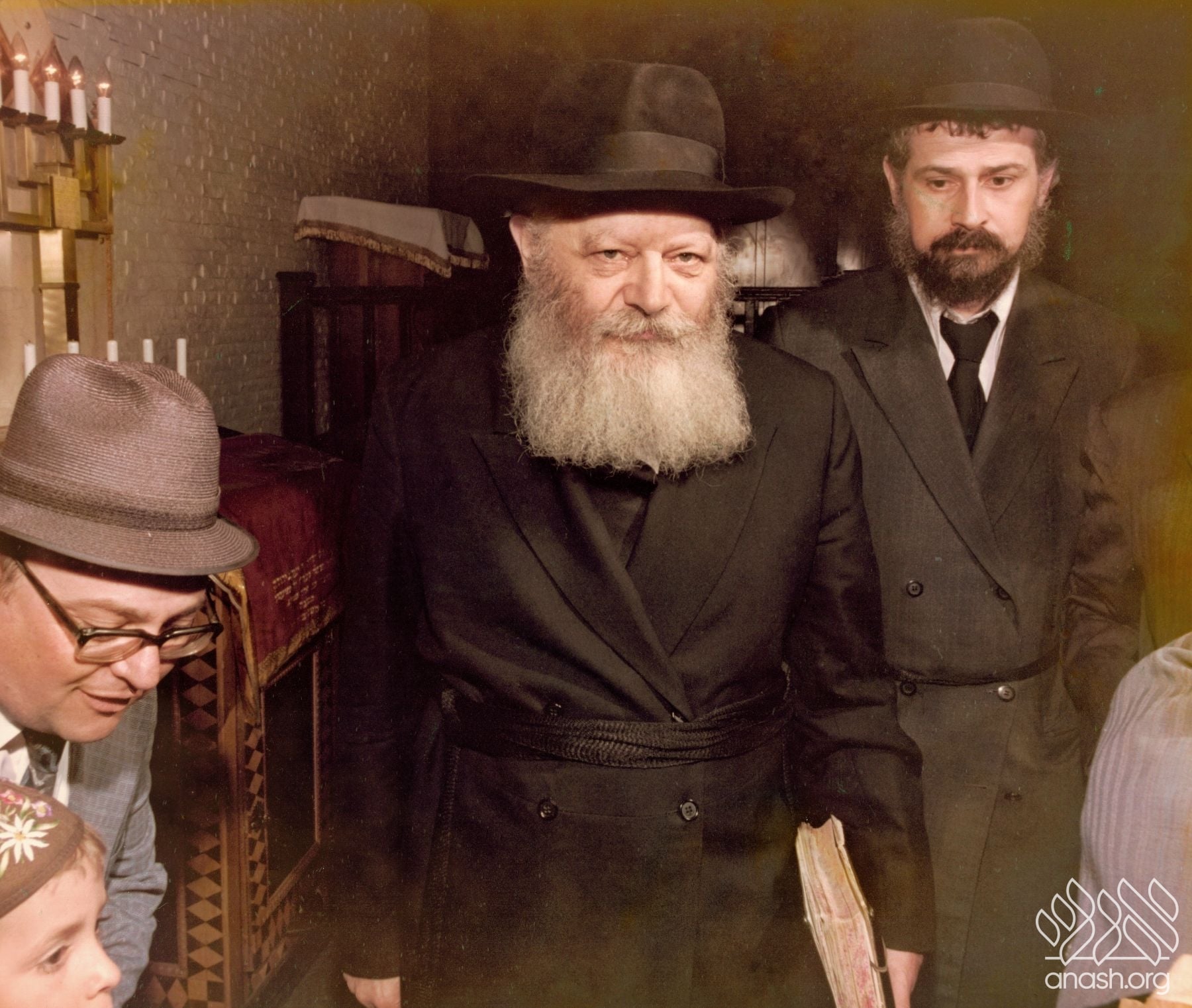
By Harav Yitzchok Menachem Weinberg – The Tolna Rebbe
Translated by Rabbi Boruch Werdiger
If, in attempting to describe the greatness of the Rebbe, we concern ourselves solely with stories of his miracles, and the like, we will never reach an accounting of his true greatness. Moreover, the purpose of the exercise would only be to seek out those aspects of his personage that are relevant to us, so that we may follow his example.
Therefore, our approach the subject will attempt to assess the Rebbe’s greatness by using a different yardstick, a yardstick that in, my opinion, itself requires a re-understanding of sorts: Completeness. What, then, does it mean for a person to be complete, or to be of consummate character?
The concept of completeness—in Hebrew shleimus—and that of peace—or sholom—are one and the same. But what does peace mean? It is a common error to understand peace as total alignment with a former adversary.
In the course of a discussion of the laws of burglary in Parshas Mishpatim (22:2), the Torah says that “if the sun shines” on an intruder, then he may not be killed in defense of the home. The Mechilta understands this turn of phrase to mean that the intruder doesn’t wish to cause any harm: “Just as the sun makes peace in the world, so it is here; it is known that he has come for peaceful purposes.” Why is the sun said to make “peace in the world”? Because the sun illuminates, and when the sun shines, everything beomes clear.
Peace is when two opponents learn to live together, to their mutual advantage. Each side hopes to be complemented, and completed, by the other; sholom as shleimus. To make a perfect choir, the choirmaster must select a variety of people, with different voices. If an artist wishes to highlight a mountain’s size, he will depict that mountain alongside a valley, thus giving a sense of its scale. Contrast, in other words, creates harmony. True wisdom must be holistic; it is knowing the right place and time for each and every thing. Only through that sort of comprehensiveness one can achieve a measure of perfection, of completion.
In his ethical writings, Rabbeinu Yonah speaks of person who has achieved this sort of perfection, “the person who is consummate in deed.” So how can we identify such a person, based on the above definition? True wholeness is to be found with someone who, on the surface, appears to possess contradictory qualities.
If one person, for example, is a maximalist in a particular character trait, and another person who is a minimalist in that same trait, then these two people presumably have deeply divergent personalities. And if we were to find one person who exhibits radical tendencies in one area, and completely opposite behavior in another area, we would think of this as being a contradiction.
In truth however, a person who is completeis capable of acting in opposite ways. When appropriate, he will be radical in one direction, and when appropriate, he will be just as radical in precisely the opposite direction. He achieves completeness precisely through that contradiction. And the more wildly different the modes of behavior he is capable of employing, at the appropriate times, the more complete he is.
Therefore, I have chosen to focus on several features of the Rebbe’s personage, all of them areas that seem to contain a paradox. In each of them, the Rebbe’s contradictory conduct creates a certain balance, and suggests an awe-inspiring degree of shleimus. The following points are only a drop in the Rebbe’s oceanic personality, but they can lead us to some recognition of the nature of the Rebbe’s completeness, and the degree of his shleimus, so as to form a guide for us.
***
Profound Simplicity, and Utter Genius
While there are countless different modes of Torah study, we can perhaps divide them into two broad classes. The first is a focus on the literal, basic, internal meaning of a given text; the second a more analytical approach, examining the underlying principles of text, and seeking to reconcile it with any number of external sources. In Hebrew, these approaches may be known as peshat, and pilpul; in the idiom of the Gemara, as ‘Sinai,’ referring to someone with a broader, comprehensive knowledge base (fluent in the laws given at Har Sinai), and ‘Uprooter of Mountains,’ (Oker Harim) referring to the practice of that analytical, argumentative sort of learning.
Throughout our history, there have been great personalities famed for their lucid, straightforward thinking, and their rejection of pilpul, and other contrived methods of learning. The Netziv of Volozhin is known for his singular commitment to simplicity. He takes a possuk, looks at the preceding passage, and what comes after it: Everything follows from there. The advantages of engaging with the sources directly, and closely, are self-understood, but this sort of treatment of a text has its disadvantages. Sometimes, it comes at the expense of depth, and fails to sufficiently sharpen and advance the mind.
Indeed, the great Torah genius Rabbi Yosef Dov of Brisk, and other like-minded peers at the Yeshiva in Volozhin, would deliver lectures of an entirely different kind, designed to sharpen the mind through pilpul and scholarly analysis. At one stage, these divergent approaches become the source of enormous tension in Volozhin. The Netziv’s lectures eventually failed to satisfy the stronger students in the yeshiva, because that genius of Brisk had so intensely advanced the pilpul method. The point in this being, it is enormously difficult for a person to immerse himself fully in one method of learning, and to be equally invested in a different methodology. One must come at the expense of the other.
Take the author of the Avnei Nezer, the razor-sharp edge of the knife of Polish learning. He is a consistent innovator, constantly upending previously-held conceptions of the subjects he deals with. You won’t find in his books the language of someone with a tendency towards straight peshat. Take the Sfas Emes, whose work on Gemara deals exclusively with peshat.
(It’s interesting: in his homiletic works on the weekly parsha, it’s near-impossible to find three consecutive paragraphs without a quote from his grandfather the Chiddushei HaRim, but in his scholarly Sfas Emes on Shas, from start to finish, he mentions his grandfather a grand total of four times! The Chiddushei HaRim, you see, had a penetratingly sharp approach to learning; the Sfas Emes, though a devoted student of his grandfather, paved for himself a new way of learning, dedicated to direct, literal interpretation.)
In the Rebbe’s method of learning, one notices something extraordinary. His approach to a given Torah subject is so rich, but the conclusions he draws are so simple. It is as though the opposite modes of study discussed above come together in the same method. If we were to follow the Rebbe’s approach to the study of Nigleh, of the Exoteric dimensions of the Torah, we could say that it tends towards the study of literal meaning, but we could also say it tends towards a deeper, analytical, investigatory approach of the kind discussed earlier. In the very same discussion, you can find an extraordinary new take on Torah topic, founded on some achingly abstract, revolutionary piece of inspired Rogatchover genius, and then the Rebbe will apply this cutting insight to understanding the simplest of ideas. It is to take the most powerfully incisive chiddush, or innovation, and bring it down to most basic, literal peshat. Somehow, these two opposites combine into one wonderful whole, a complete approach to learning not found in any other study of Nigleh.
This Toranic approach of the Rebbe is not merely that simplicity follows from genius, and genius from simplicity, but sometimes it is genius and simplicity all at once. Recently, I rediscovered the following brief thought from the Rebbe. When one year around Purim time, the Rebbe spoke publicly about his Mezuzah Campaign, Reb Zalman Gurary asked whether the talk had something to do with Purim.
“Of course,” said the Rebbe, without any hesitation.
“But what is the connection between the Mitzvah of mezuzah and the the holiday of Purim?”
“Look into it more deeply,” the Rebbe replied.
When Rabbi Gurary reported back to the Rebbe he did look into the matter, and still found no connection between the two themes, the Rebbe told him that it was alluded to in a possuk in Megillas Esther. It says that King Achashverosh declared (8:7), “Behold I have given the House of Haman to Esther.” What’s the first thing a Jew does when he—or she—receives a house that belonged to a non-Jew, as a gift? He puts up a mezuzah!
On the one hand, if we are to ask ourselves: “Did the Rebbe reach this insight by stroke of genius, or by simply having an ear for the literal?” it is clear that he came to it by way of peshat. One simply has to depict to himself a vivid enough picture of the Megillah’s narrative for it to be clear that when a Jew enters a new house, he or she fixes a mezuzah to the doorpost. But on the other hand, it is clear that more than just a cute inference drawn from the text, this insight also contains profound genius of its own.
The Midrash on the book of Koheles says, “Rabbi Chama said: The word ‘Behold,’ as declared by flesh-and-blood, teaches us about the ‘Behold’ of the Holy One Blessed be He…When Achashverosh said, ‘Behold I have given the house of Haman to Esther,’ it brought life to an entire nation. When the Holy One Blessed be He, about whom it is said, ‘Behold a day of the Lord is coming…’ will come, then how much more so.” By describing Achasverosh’s bequest of Haman’s house as bringing “life to an entire nation,” the Midrash seems to be suggesting that it was much more than mere the transfer of property. Rather, it represented a spiritual conquest of sorts: the house of Haman becomes the house of Esther, and Mordechai. Where the house once attested to ownership by Haman—the most intense evil—it has now been transformed to become the house of Mordechai, a place where holiness is manifest; starting, of course, with the mezuzah.
Another example:
In his glosses to the Pesach Haggadah, the Rebbe quotes the Vilna Gaon, in relation to the curious fact that the Four Questions as they appear in the Haggadah are not the same questions mentioned in the Mishna. The fourth question, that is to say, addresses the custom of reclining on the Seder night in the Haggadah, even though the Mishna addresses the roasted Paschal lamb. In his commentary on the Mishna, the Vilna Gaon resolves the anomaly by positing that when the Mishna was written, people would regularly recline while eating, and since the Beis Hamikdash still stood, the Korban Pesach was of course still offered up and eaten. Therefore, he says, since reclining at the Seder wouldn’t have been unusual in any way, only the roasted Korban Pesach, which was eaten once a year, would have warranted a place in the Four Questions. After the Destruction, the Pesach was no longer eaten, and people must have stopped reclining during regular meals, and the Four Questions took on the form they have today.
The Rebbe questions this entire answer by quoting the the Rambam (Hilchos Chametz uMatzah, 8:2), who records all five questions of the Ma Nishtanah, Reclining and Roasted questions included, and then adds in the next law, “These days, one does not say, ‘Tonight, [we eat only] Roasted,’ because we no longer have the Korban.” The Rambam’s construction, says the Rebbe, proves that in the Beis Hamikdash era, they did ask five questions! It is a simple question, to be sure, but the Rebbe was the first to ask it.
Yet another well-known illustration of that brilliant simplicity:
In the Chumash, the portion of Pekudei is the only parshah for which no tally of pessukim appears. Now, is there anyone in the scholarly community who actually cares about this trivial discrepancy? The Rebbe does care. He first suggests a simple explanation that the tally was indeed once written, before accidentally being dropped from print. (This alone is impressive: Despite the fantastic, creative solution that he suggests immediately afterward, he begins with a dull answer. Apparently, simplicity is more important than being clever! He therefore begins in the simplest way possible.) Then, he suggests a brilliant solution:
It may be, he suggests, that the words, “Bli Kol Siman,” orginally appeared following the parshah, indicating that the mnemonic for the number of pessukim is the actually the phrase “Bli Kol,” the numerical value of which is 92. Only thereafter did the typesetter misinterpret the mnemonic—the Hebrew phrase “bli kol” of course means “without any”—to mean that there is no Siman for the number of pessukim, and erased it altogether.
The Rebbe’s method of learning demonstrates both Talmudic approaches of Sinai and Uprooter of Mountains, and sometimesat the very same time. These are two opposite traits, that for most scholars, cannot grow from the same earth. But, with the Rebbe, the same talk will often contain elements of pure genius, following the incisive, analytical approach to learning, and it will contain elements of pure simplicity, following the literal approach to learning.
*
All the Time in the World, and No Time at All
Another place we find in the Rebbe the fusion of two radically opposed character traits is his combination of patience and vigor; his constant lack of time, alongside the feeling he gave of having all the time in the world.
There are some people who, whether by birth or determined effort to develop their character, are constantly dynamic and full of brisk, productive energy. This zrizus, as it is referred to in Hebrew, has its costs and benefits. The Kotzker Rebbe once said that responding to a question too quickly is a sign of lazy thinking, not of mental acuity. There are benefits, to be sure, but also costs; it’s not assured that he will always come up with the right answer. The capacity for patient deliberation of course brings the benefit of being able to properly and fully analyze the matter at hand—but there isn’t always time to wait around. Whatever their relative benefits, though, what is clear is that for a person of an extremely vigorous character, it is difficult to act with calm consideration, and vice versa.
But once again, here we find an interesting thing: The Rebbe was the most dynamic, vigorous figure of his time and also the most patient, literally all at once.
The Rebbe’s daily schedule is evidence enough that the Rebbe went about all of his affairs with the most extraordinary zrizus. Generally, tzaddikim spend a long time in prayer. Recordings of the Rebbe davening, however, are simply astonishing. He would daven at an entirely ordinary speed, not at any length at all. And how much time did the Rebbe dedicate to his own material affairs? The Rebbe’s secretary, Rabbi Yehuda Leib Groner, estimates that the Rebbe slept only four hours a day. Other activities, such as eating, were all conducted with unusual haste and an almost unimaginable perfunctoriness.
The Rebbe lamented his desperate lack of time numerous times. When a Yid who wanted to arrange an audience with the Rebbe once complained to him about how long he had to wait in line, the Rebbe answered that he doesn’t have any time either. “Even these few moments of my time that you’re taking up now,” said the Rebbe, “is something I’ll have to pay for dearly later on.”
And yet. During the time that he did set aside for others, the Rebbe gave people the feeling that he had all the time in the world for them. One Jew who used to live in Crown Heights, not a Chabad chossid, once told me that from when the Rebbe began distributing dollars for tzeddaka on Sundays, he loved to go each week. He wasn’t connected to the Rebbe in any direct or public way, but when he heard the Rebbe was dedicating his time to the broader public, he decided to go. He told me, “It was clear as day to me that when I stood before the Rebbe, nothing else in the world mattered to him. It was as though he had declared, ‘Move aside! Right now, the only thing that exists is this person standing in front of me, and I have all the time in the world for him!’ ” This wasn’t just the feeling of one person. Tens of thousands who passed by the Rebbe all felt the same thing, every time.
This is not even to mention the Rebbe’s practice of yechidus in previous years. How many hours did the Rebbe dedicate to people completely estranged from Yiddishkeit?
A Chabad chossid recounted to me that before one yechidus, the Rebbe’s secretary Rabbi Groner informed him that since it was so late, he would only have three minutes with the Rebbe. Since the matter I’ve come for is quite serious, the fellow told Rabbi Groner, it will take me at least five minutes to fully explain it, and the Rebbe will certainly need more time to answer me. Maybe it’s better to postpone? Rabbi Groner answered that he should go anyway, since he wasn’t sure when his next opportunity to meet the Rebbe would be.
When the fellow entered the Rebbe’s room, he said, “Reb Leibel told me that I only have three minutes. I’m worried that just saying what I have come for will take more than that.”
“Speak,” said the Rebbe.
The chossid, while holding in his hand the note he had prepared beforehand, told the Rebbe all the details of his predicament.
“After two and a half minutes, I finished speaking,” he later told me, “and barely had a minute left. It seemed impossible that the Rebbe would be able to answer me. I looked at him nervously, and worried that I would feel too rushed to understand the Rebbe’s answer, or that he would speak to quickly for me.”
To ease his anxieties, the Rebbe said, ‘I only have two minutes, but in those two minutes, it’s still possible to speak calmly,” and then, using the Yiddish word for slowly, “we can speak pavolia, pavolia…“
I don’t speak of this as a “miracle” of some sort, but just think of the patience, and the urgency, embedded all at once in those two minutes. If you ask someone to answer a difficult question, and he doesn’t have any time, then if he is a patient person, he will try to give his answer at a later time. If he a brisk sort of person, then he will try to speak quickly, at the risk of missing some detail. The Rebbe somehow had it both ways. He maintained a rigidly tight schedule, and had to fit everything in to those two minutes. But in those two minutes, he spoke calmly, and patiently broke down the subject to properly address it.
Such was the Rebbe’s daily routine. Even at the long farbrengens, there was not a minute that went unplanned. He could sit speaking Torah for six hours, converse with people on the side, say l’chaim to the chassidim present, sing, and dance. But everything was set to the clock, every moment filled to the brim. Anyone who participated, or watched one of those long farbrengens was amazed to see how there wasn’t a single second that wasn’t completely utilized in the service of G-d.
At the end of certain farbrengens, the Rebbe would give Reb Moshe Yaruslavsky the cake he had been served, in order to give it out to the visitors. I once heard, in R. Moshe’s name, that one such farbrengen lasted for over seven hours. R. Moshe had to stand at the ready, so that at the moment the farbrengen finished, he could hurry over immediately and receive the cake from the Rebbe. The way things seemed to going, R. Moshe figured that there were still a few minutes to go, but when the evening came to a close, the Rebbe actually had to wait half a minute for R. Moshe to make his way to the table. The Rebbe turned to speak with someone for those few moments, until R. Moshe came he handed him the cake. Then, with a smile, the Rebbe noted: “Half a minute.”
Isn’t this story mind-boggling? If the Rebbe spent over seven hours farbrenging, then it would seem that time was no object. But apparently, it is possible to sit a full seven hours with the congregation, complete with lengthy talks and Chassidic melodies, and long sessions of singing and dancing, and for a half-minute at the end to still be precious. Even though the Rebbe managed to fit in a few good words to another Jew in that time, if a half-minute isn’t used for its true purpose, it’s already a problem!
No matter how we look at it, the facts seem to cry paradox, just as they declare a wholeness. A shortage of time, alongside a surplus of time; a patient urgency; both operating together, each in its right place. Can there be anything more complete than this?
***
Loving, and Firm
It’s well known that in Kabbalah, the traits of Chesed and Gevurah are opposed to one another. Some people are kind, compassionate people, and some people have more strict, austere personalities.
Chesed types are invariably gentle, pleasant people, but they also have a certain disadvantage. At times a father needs to act firmly with his child, but if he has too soft a nature, he will fail to do so. But being too particular is also a problem. As the Gemara [Sanhedrin 113a] relates, Eliyahu Hanavi was so strict that he once refused to visit Rabbi Yosi Haglili over a minor slight. Our holy books say that any of these attitudes taken too far, or out of context, is improper. There must be balance between them.
Obviously, a gentle person will have difficulty acting in a strict manner, and so it is the other way around. But a look at the Rebbe’s comportment in these areas leaves one flabbergasted. How is it possible to maintain such radical behavior for so many years? To be both tough and compassionate; kind and strict; to have love and fear; all of these emotions to the utmost degree, each of them in its place.
The Gemara in Pesachim has some startlingly harsh language about a person who despises Torah Judaism. The Maharal of Prague has an illuminating comment on this. He explains that there in fact two dimensions to the person described in the Gemara. He is a Jew worthy of love and respect, yes, but at the same time there is a part of him with a total disregard, and contempt for the Torah. It is solely this aspect that the words of the Gemara are directed towards.
The Maharal’s explanation is no doubt true, but who is capable of taking that Gemara on board, and to fully apply both of those wildly divergent attitudes? Generally, we end up with one of two polar opposites: One end of the spectrum is inhabited by the hot-headed Zealot, who ends up throwing rocks at cars driving on Shabbos because of his combative nature. Even if he isn’t naturally inclined to do so, constantly criticizing and reprimanding other people’s deficiencies will eventually turn him into a person who only see flaws, and who must loudly protest them whenever he does. On the other end, we end with up an overly liberal, indulgent type, for whom nothing is ever a problem. This attitude has its own risks, and, to borrow a phrase from the Imrei Emes, “his love for all people may ruin his judgment; his love will cause him to declare the impure pure.”
Now, with these two opposites in mind, look at the Rebbe’s approach, and you will see wholeness manifest. I once saw a letter the Rebbe sent to someone who had made a new, illustrated Haggadah. The Rebbe opens with some warms words of encouragement, but then he gently suggests that since the author had sent him a copy of the Haggadah, he most likely wants to hear his thoughts on it. Then the Rebbe launches into a reasoned, but blistering critique of some additions he had made in the Haggadah. The Rebbe advises against publishing the Haggadah until it is changed, and condemns the effort with some sharp language.
The very same letter expresses extraordinary Ahavas Yisroel, alongside extraordinary Kano’us, zealousness. Were you to only see part of the letter, you would either think it had been written by some narrow-minded radical, or by someone with a far more open, permissive attitude to Judaism. It’s almost as though the letter was written by two different people, but it wasn’t: The Rebbe wrote the entire letter, out of one wonderful, complete whole; there is no contradiction. A Jew who takes pleasure in redesigning the Haggadah for the benefit of others is truly deserving of praise, but the Haggadah still shouldn’t be printed. [The letter can be found in Likkutei Sichos Vol. 22 page 288.]
Another example connected to the Seder night, from a letter the Rebbe once wrote to a certain prominent Torah figure. Only part of the letter has been published, but this person’s grandson once showed me the entire thing. His grandfather—who always had been a creative thinker—tried to make the radical argument that there was grounds for drinking five cups of wine at the Seder, instead of four.
In response, the Rebbe wrote a lovely, respectful letter. He quotes all of the alternative texts and manuscripts that support drinking a fifth cup; until, that is, he addresses this scholar’s conclusion that the established practice should actually be changed. “However,” begins the next paragraph. Suddenly the Rebbe begins admonishing the subject of his letter: How could you even consider saying such a thing? How is it possible for someone who has spent time with the greatest Rabbinic figures of this generation to not know that a universally accepted Jewish practice must be preserved, or how careful we must be not to even touch a minhag?
When I saw this, I was shocked by the letter’s intensely strident tone. But there is no contradiction here. When it came to the scholarly debate on the subject, the Rebbe was full of praise for his learned interlocutor, but this praise did not detract one iota from the deeply critical view the Rebbe took of his Halachic conclusion. This letter is the most magnificent picture of balance I have ever seen.
***
Extravagance and Restraint
Another point of distinction between people regards their attitudes towards material or physical considerations. Here too, people more or less fall into one of two groups. An extravagant person knows how to properly indulge his own material needs and is therefore capable of sharing this knowledge with others, to include them in his experience.
And then some people are naturally more restrained. They have a certain satisfaction, sometimes to an unhealthy degree, of repressing their physical needs. Characteristically, such people are as averse to seeing waste or excess in others as they are indulging in it themselves. Tragically, Holocaust survivors can often exhibit this behavior. A slice of bread was such a precious commodity in tougher times that even years later, they remain incapable of seeing their grandchildren waste any food at all.
It is a rare thing, then, to find a person capable of exercising the utmost personal restraint who still acts with the greatest generosity with others. The Rebbe was such a person.
Let us begin with the well-known subject of the Rebbe’s vacations. In recent generations, all of the greatest Jewish leaders would go on vacations, including the Chabad Rebbeim, who often travelled for health reasons. It is a reasonable, entirely defensible thing to do for one’s wellbeing. Still, the undeniable truth is: From the day he took upon himself the mantle of leadership, until his passing, the Rebbe quite literally did not take a break from work. This is a well established fact. We are speaking of over 40 years of service, 365 days a year.
Reb Chessed Halberstam, the Rebbe’s personal aide, told about the time the Rebbetzin bought two lawn chairs and set them out on the porch of their home. The Rebbe obligingly sat outside with his wife for a minute or two before declaring, “That’s enough vacationing…”
This was, by the way, despite a constant, frenetic, 24-hour-a-day workload spent answering letters and bearing the yoke of public service, planning and executing new projects, studying Torah and innovating endlessly in it. This sort of selflessness is simply unheard of.
Now, one might quite understandably think this is the—admittedly unusual—conduct of a person without any conception of what a vacation is, and without any desire to know what a vacation is. Of course, a person like that has no appreciation for holiday-making. Yet, there are numerous letters from the Rebbe on the importance of setting aside time for one’s health. In a letter addressed to the children of Camp Gan Yisroel, the Rebbe writes of the unique benefits of vacation time not to be found in the rest of the school year. And the same was for adults, as evidenced by the letter he once wrote to a person going through a rough spiritual patch, advising him to go on a vacation. It could contribute to his religious life, the Rebbe told him, sometimes even more than his regular Avodas Hashem.
The Rebbe didn’t just recommend going on vacation in general terms. In his letters to summer camps, he would request that organizers be sure to freshen up the camp experience every so often, so that the children don’t grow accustomed to a formal schedule in their vacation time. As the Rebbe explained, change and novelty are key to a vacation. In other words, we are dealing with a person who understands full well the value of rest, and of the benefit it can bring, while he himself couldn’t be further removed from the institution. The paradox here is inescapable.
So it was with his attitude towards personal expenses. “Every person is impressed by something else,” someone I know, a serious Talmid Chacham, once said to me about the Rebbe. “Me? I just looked at his shoes. I had never seen anything like it in my life. I’m no shoe-maker, but my estimate, he had been wearing those shoes for decades. How can a person keep the same pair of shoes for so many years?” For himself, the Rebbe needed nothing. It is astonishing to read of the “meals” he would take. As it was for eating, so it was with sleeping, and for the home he lived in.
But when it came to somebody else, the Rebbe demanded the maximum. When he once visited the dormitory of a women’s seminary, he immediately noted it could be improved with a few additions: Putting some pictures on the walls, fixing a mirror at the entrance, a more convenient placement of the beds, installing a sink in each room, and a variety of other suggestions. This is impressive enough for someone familiar with, and accustomed to life’s little pleasures; he simply wishes for other people the same things he himself indulges in. That, however, is not the case here. He himself is completely removed from the world, unimaginably so, but somehow he is still infinitely concerned with the welfare of others. How is it possible to fit all of this in one head?
Someone could write a whole book on the Rebbe’s remarkable modesty, and a whole separate book on his remarkable concern for others, and not believe that these two sides existed in the very same person.
***
Little Fanfare, and Supreme Confidence
Some people are by nature introverted; they dislike and avoid all publicity, and not only in matters of religious observance. Obviously, in religious matters, there is virtue in “walking discreetly with your G-d,” to hide on the sidelines. People like this try to be discreet in all of their affairs, and to remain concealed.
Then there those loud, brash, exhibitionist types. Someone of this nature is incapable of doing anything that won’t make it to the newspapers. At times, even in the service of Hashem, one needs to make some noise, and to leave an impression. For times like that, you find one of those extroverted types, to ensure that you’ll attract some publicity.
With this binary in mind, let us assess the Rebbe’s modus operandi in his activities on behalf of Soviet Jewry. There was not a person who understood the situation of the Jews of Russia, their plight, and the opportunities for providing them with aid, as the Rebbe did. From his own experiences, as a native and former resident of Russia, the Rebbe well understood the Russian mentality and culture. In addition to this, we must consider his brilliant mind, his significant intelligence channels, and his command of all the information available to him. In those years, long after the rest of the world had shaken off the chains of oppression, the Soviet Union still exercised total control over its citizens, and kept them firmly underfoot. Surely, the obvious response was to loudly protest such a regime, say by rallying in front of the Soviet embassy in the United States. Indeed many refuseniks, and their allies, went out to fight publicly for their relatives, and tried to generate as much media noise as they could.
The Rebbe, for reasons that we won’t presently explore in any detail, decided that the situation demanded discretion. From the moment that the decision was taken on board, there never was a more dynamic, and more secretive, team of activists. We are only beginning to discover the activities of the Russian Jewish operatives who received their instructions from the “Father,” or the “Zeide,” as the Rebbe was referred to in his coded communiqués to Russia. The Rebbe directed many hundreds of hours of coordinated efforts on behalf of Soviet Jewry, without another soul finding out.
In a recently published book from a former employee of the Jewish agency, the author writes of an argument he had with the Rebbe about a particular issue. Only now, he writes, have I learned that those matters that I raised in yechidus with the Rebbe, without any response from him, were already resolved done long before. While I was attacking Chabad for not doing such-and-such, they had already undertaken to achieve precisely those things years before, and on a global scale.
The Rebbe ran an entire operation in Russia, deciding who to send for each mission, where to send him and when, while remaining intimately aware of any changes on the ground, and above all, maintaining total secrecy. Who knows the true scope of the activities the Rebbe conducted through the late Rabbi Rosen, Chief Rabbi of Romania?
Since we seem to be dealing with a person with a preference for secrecy, perhaps, then, he is that discreet, unassuming type?
But what is there to say when this self-same figure decides to launch some new Mivtzah campaign with the greatest fanfare? Suddenly, his drive and ambition knew no bounds. The biggest advertising executive wouldn’t have dreamed of creating such publicity. The Rebbe would even stand up to ideologically defend his chosen means of publicity: For him, everything is to be recruited for the purposes of our divine work. Whatever happened to all that modesty? If you closed your eyes, you would think it was a different person.
Looking back, it turns out that on the same day that the Rebbe wrote to Golda Meir that “M.S.”—referring to himself—would oppose any efforts to arrange a demonstration outside the Soviet embassy, the Rebbe also joined in that year’s Lag B’Omer parade, and sacrificed his own precious time in order to demonstrate to the public how Jewish children could march through the streets with greatest possible pride. How can one person contain such a tremendous contradiction? Only a “Consummate Person” can operate with such extreme secrecy when needed, or with such fanfare, when the hour calls for it. The Rebbe could act with radical modesty, and utter extroversion, without either being affected.
*
Faith, and Unflinching Realism
Books of Jewish thought speak of this next set of opposites as “dark” and “light” dispositions. Some see life through rose-tinted glasses, while others only ever see black.
The end of Tractate Makkos recounts how Rabbi Akiva began to laugh upon seeing a fox wander out of the ruins of the Kodesh HaKedoshim. One might have assumed that he was one of those optimistic sorts, whose eternally sunny attitude preceded his explanation of how the fox was actually a sign of better days to come.
However, the Beis Yosef (on Orech Chaim ch. 288, s.v. Mah Shekasuv) quotes a Midrash that tells of the time Rabbi Akiva’s students once came looking for him on a Shabbos day, only to find him, to their surprise, crying to himself in a side room. How could he be mourning on Shabbos, a day meant to be honored and enjoyed? “What else am I supposed to do?” Rabbi Akiva answered them. “For me, crying is enjoyable!”
The Taz (ibid. 288:2) cites this story and explains how some righteous people regularly pour out their hearts in tearful prayer, as an expression of their closeness to the Almighty. In other words, Rabbi Akiva was a person who was well acquainted with crying, but when what seemed like a good reason to cry presented itself—a fox roaming the ruins of the Beis Hamikdash!—he began to laugh instead. In this light, we can appreciate that there was more to Rabbi Akiva’s laughter than met the eye.
That Chassidic adage, “Tracht gut, vet zein gut,”—think good, and it will be good—was a favorite quote of the Rebbe’s, and not just because it sounded cute. It was a worldview and a guiding principle. The constant encouragement he provided others proved him to be a singularly optimistic person, even in the most trying circumstances. In the Six Day War, the Yom Kippur War, and the Gulf War, we saw the Rebbe’s optimism express itself tangibly, and even halachically, in his firm position that the wars would end in victory, and that there was no reason to leave Eretz Yisroel. This eternally positive affect was not only based on Hashem’s capacity for miraculous intervention, however, or on the belief that an impending tragedy would somehow be averted.
The Rebbe maintained the same attitude even after disaster struck. Whether in a letter to a bereaved family, or in a message of consolation after some tragedy, he would insist that they could find the strength to carry on, and that things would be better in the future. If then, we would take this oft-expressed attitude as a clue to his personality, we might identify the Rebbe together with the optimists of the world.
But let’s examine the Rebbe’s attitude towards the issue of “Mihu Yehudi,” the legislative debate over Jewish identity in Israel.
I’d like to recount an interesting thing: At the time of that bitter struggle over the wording of the Mihu Yehudi law—when the Chassidus of Ger, under the direction of the Lev Simcha, stood firmly with Chabad on the grave threat that the proposed law posed to the integrity of the Jewish people—I kept in close contact with several highly influential Roshei Yeshivos. In particular, I recall speaking with someone who was considered, quite literally, amongst the Gedolei Hador, the leading figures of the time, and another person of similar stature. They were pounding their fists on the table, and demanded angrily of the Rebbe, “Why is he speaking so ominously, and warning of such dire consequences if the law doesn’t explicitly say that Jewish identity follow Halacha? What is this pessimism? Who says things will be so bad? Why is he making the future out to be so gloomy?” The Rosh Yeshiva continued to fume away. “That person,” he finally said of the Rebbe, “is just a doomsayer!” He wasn’t saying any of this out of hatred, G-d forbid. He simply didn’t foresee what would happen.
The same is true of the Rebbe’s attitude towards surrendering portions of Eretz Yisroel into Arab hands. On the subject, there really was no great pessimist than him. He made clear that such actions would come at a terrible price, to be paid in Jewish lives. Tens, if not hundreds of times, he warned of the day that “they would set off bombs in Tel Aviv.” Someone once told me that Geulah Cohen, the former politician and journalist, recently said, “I was embarrassed at the time to tell people what the Rebbe told me. At the time, he seemed so pessimistic, and so mistaken, that I thought his reputation would suffer if I told people.” And today, one by one, all of his predictions have come true. So where is our optimist? Whatever happened to tracht gut, vet zein gut?
This is shleimus incarnate. That same optimist is capable of acting the doomsayer. Let us leave aside any discussion of his prophetic powers. If, in certain circumstances, the Torah instructs us follow Mishlei’s advice (28:14), that “Fortunate are the fearful,” to be concerned for the worst, then it is a “mitzvah” to be a pessimist. But even then, in matters unrelated to the fate of the Jewish people, when it is simply a question of personal mood, then it is mitzvah to be an optimist. “And you shall serve Hashem with joy.” Someone who truly serves Hashemis capable of being an optimist and a pessimist at the same time, and to present each attitude as forcefully as the other.
*
Always Appreciative, Impossible to Satisfy
There are moderates, and there are extremists. “Grab too much and you will take nothing, grab a little and you will have something,” advises the Gemara, but then again, “If you don’t aim high,” others maintain, “you will end up with nothing.” Each side has something to be said for it. Being easily satisfied can be a dampener for ambition, but a perfectionist will never be able to appreciate a student’s gradual progress, because for him, small gains are worth nothing.
Now, witness the Rebbe’s all-embracing, continent-spanning greatness: For him, even the smallest things affecting a Jew on the other side of the globe are important. The Rebbe would rate any sort of progress as an achievement. If it would make something stir somewhere in another neshamah, the Rebbe would invest enormous effort for that tiny windfall: To put tefillin on someone in the street, even just once; to honor a prominent Jew with the opportunity to dance with a Sefer Torah on Simchas Torah, even though he had difficulty accepting some of Judaism most hallowed values; or to give out Chanukah gelt to Israeli soldiers. In this way, the Rebbe aimed for the small things, and made the trivial important.
One would have expected this value system to apply equally to the Rebbe’s own followers: If that fellow gave the Rebbe such satisfaction, a chossid could reason to himself, whereas I go to shul three times daily, and study Torah regularly, what is there to take issue with? But when the Rebbe would speak to the most accomplished individual and find some more room for progress, he would make the most vigorous demands of him. Notwithstanding all this fellow’s achievements, the Rebbe would suddenly transform from minimalist to maximalist.
Ultimately, this dual approach is the foundation of everything the Rebbe did. His role was to improve his people, and the Rebbe accepted the burden of leadership for all of world Jewry, as well as that of his own chassidim. But be that as it may, one would have expected his investment in his own people, and his efforts to raise a chassidic community fully dedicated to davening and learning, to at least partially compromise the way he engaged with less religious Jews.
Imagine telling some maskil, an intellectual who spends four hours a day davening, and six hours meditating before that, someone who knows nothing of this material world, “You know your neighbor Abe? He decided to start calling himself Avraham!” The man will scarcely pay attention, and certainly won’t think very much of such nominal change.
Somehow, the Rebbe managed to maintain both approaches. With one hand, he would guide young chassidim in their Avodas Hashem, and with the other hand, he would reach out to encourage Jews towards basic, practical mitzvah observance.
I once came across a bundle of written correspondence between the Rebbe and someone seeking spiritual guidance. The Rebbe worked to make this person appreciate how precious, and how important he was to Hashem. This was in response to a number of letters filled with despair over personal failings, and some serious challenges he was facing in adolescence. The Rebbe wrote with such wonderful warmth: Just the little things you have done up until now shine in the Heavens, and have made an impression in the most lofty spiritual realms. This was all until this fellow emerged from his difficult period. But then, a year and half went by, and a few letters later, the Rebbe was censuring him over subtle things. Still, it was all true; the compliments he wrote to him then, and the rebuke he wrote now.
The Pnei Menachem of Ger loved to use the following analogy:
In Halacha, a person can come to acquire something by lifting it up, hagba’ah. How then, would one acquire an elephant by this method? Tosfos say that one only needs to place some food for the elephant up high, so that he will cause the animal to elevate itself, to jump. As enormous as the elephant is, it only needs to go a hairsbreadth higher. The Rebbe could take a chossid and ask him whether he learns the Chassidus of the Tzemach Tzedek. Yes, he already learns the Alter Rebbe’s Likutei Torah, but the Rebbe wants him to start learning the Tzemach Tzedek’s maamorim. There is no end to such demands. And yet, the very same Rebbe could cherish the slightest progress, should somebody write to him that he had started putting on tefillin with two other Jews in his city.
Of all the paradoxes we have discussed here, this is one the greatest, and from a purely quantitative perspective, it was perhaps the most prominent feature of the Rebbe’s ethos. After all, this is what he dealt with on a day-to-day basis: The personal guidance he gave to his chassidim, and the incessant, uncompromising demands he made of them, all alongside the attention he gave to a young hippie with a chance to make a small step in the right path.
*
From everything we have touched upon, we must conclude that even if we are unable to reach the Rebbe’s level, and certainly not to achieve his degree of completeness, we do see that it is at least possible for all these contradictions to coexist.
The Rebbe dedicated all of his time to the communal good, and gave up everything for them. And in his own person, he demonstrated how paradox can produce perfection. But we are only simple people. What we must take from all this the impetus to adapt our own thinking, to appreciate that balance—or better said, contradiction—is the path to shleimus. This can be true on a personal level, and on a communal level as well, by being more accepting of one another.
 COMMENTS


We appreciate your feedback. If you have any additional information to contribute to this article, it will be added below.