



י״א ניסן ה׳תשפ״ו | March 28, 2026
The Rebbe’s Haggadah Through the Eyes of Rabbi Zevin
Best known as the founding editor of the Encyclopedia Talmudis, Rabbi Shlomo Yosef Zevin was also a prolific writer of book reviews, intellectual portraits of early-twentieth-century rabbis, accessible essays on a variety of halachic topics. In this essay, he reviews the Rebbe’s hagadda.
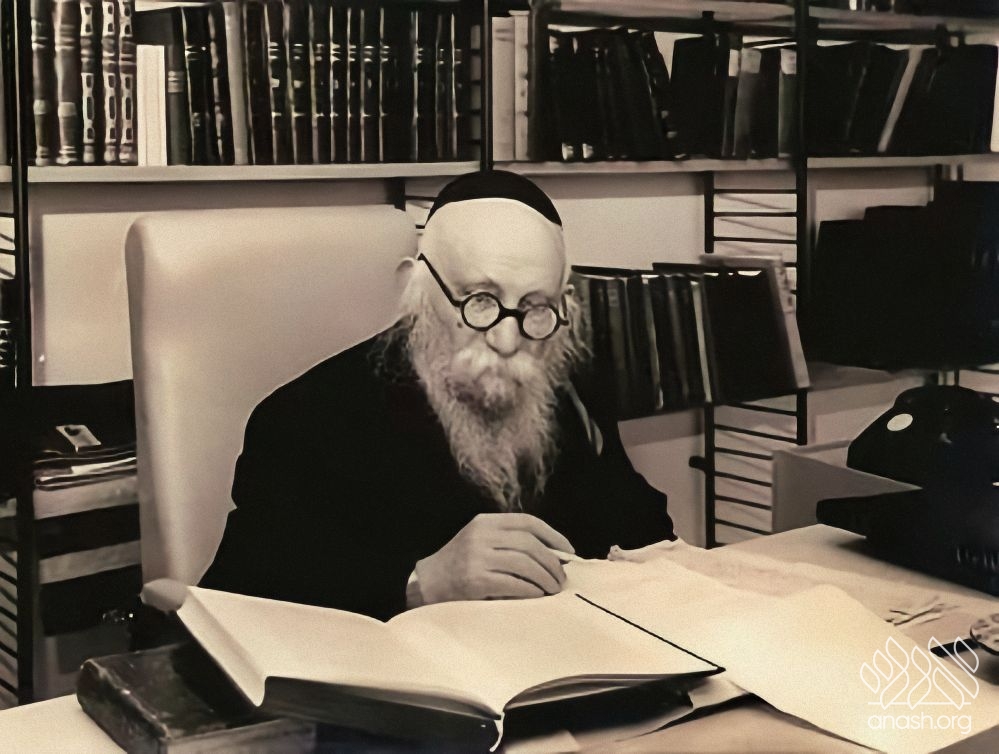
By Rabbi Shlomo Yosef Zevin, freely translated by Eli Rubin – Chabad.org
Translator’s preface: The following article was penned by a scholar with a masterful grasp of rabbinic literature in all its breadth and depth. Best known as the founding editor of the Encyclopedia Talmudit, Rabbi Shlomo Yosef Zevin (1886-1978) was also a prolific writer of book reviews, intellectual portraits of early-twentieth-century rabbis, accessible essays on a variety of halachic topics, and also as a transcriber of Hasidic stories, which he insightfully curated as companions to the weekly Torah portions and the festivals.
Rabbi Zevin was born into a Chabad family, studied at the Mir Yeshivah, and was ordained by the Rebbe of Chabad-Babroisk, Rabbi Shmaryahu Noach Schneersohn (1842-1923). From the mid 1920s onward he worked closely with the Rebbe of Chabad-Lubavitch, Rabbi Yosef Yitzchak Schneersohn (1880-1950). His bond with the latter’s son-in-law and successor, the Rebbe, Rabbi Menachem M. Schneersohn (1902-1994), of righteous memory, was especially strong, as evidenced in their decades of correspondence on matters both scholarly and communal. In the last section of this essay, Rabbi Zevin provides a glowing appraisal of the unique quality and universal appeal of the Haggadah commentary authored by the Rebbe, which was initially published in 1946. In earlier sections, he provides a comprehensive survey of Chabad literature on the Haggadah, beginning with the Tanya authored by Chabad’s founder, Rabbi Shneur Zalman of Liadi (1745-1812). Throughout, this essay features many illuminating encapsulations of key ideas and choice teachings.
The Hebrew essay was published in Rabbi Zevin’s three-volume collection Sofrim Ve’sefarim, in the section devoted to reviews and essays on Chabad publications, pages 263-271.
*
I – The Exodus in Chabad Thought and Worship
The Exodus from Egypt holds a central place in Chabad thought. Whether in the foundational published volumes of Chabad teachings (Tanya, Likutei Torah, Torah Or, etc.), or in the manuscripts and orally transmitted discourses, much is said of the Exodus — not merely as the remembrance of a past occurrence, but as a form of religious worship in the present.
The dictum found in the Haggadah, “In every generation you are obligated to see yourself as if you escaped from Egypt,” is paraphrased in Tanya as follows: “In every generation, and each and every day, it is as if you escaped from Egypt today.”1 And in Torah Or we read: “Each individual Jew must experience the escape from Egypt and the splitting of the Reed Sea every day … and as the Sages say, each day it shall be in your eyes as if you escaped from Egypt today.”2
I am unaware where precedent for this particular phrasing of the rabbinic dictum can be found, but perhaps the reference is simply to this dictum, “in every generation etc.,” as it is found in the Haggadah.3
Essentially, the entire task of the “beinoni,” the “ordinary” hero of the Tanya — described as the attainable ideal “towards which each person should strive”4 — is synonymous with the Exodus from Egypt itself. All of the spiritual efforts that are elaborated in such detail in the fifty-three chapters of Tanya are synonymous with the daily quest to become spiritually free from Egypt.
Here’s how the Tanya characterizes the task of the beinoni:
The beinoni is not disgusted by bad, for such an attitude is an affair of the heart, and thus all moments are not equal. Rather, the beinoni is instructed: “Turn away from bad, and do good” (Psalms 34:15). That is, in concrete practice — in action, speech, and thought — wherein the choice, ability, and wherewithal is given to each person to act, speak, and think even that which runs counter to the desire of the heart and is indeed its very opposite … 5
Coming back to this idea many chapters later, we read further:
This is the Exodus from Egypt, of which it is written that “the people fled” (Exodus 14:5). Seemingly this is quite strange; why was it necessary for them to flee? Had Pharaoh been told to send them free forever would he not have been forced to do so? But they fled because the bad was still at its full strength within the souls of the Jewish people … for their impurity did not cease till the Giving of the Torah at Sinai. Yet their purpose and desire was to free their Divine souls from exile while they were yet within “the other side” (sitra achara) which is the impurity of Egypt, and to cleave to G‑d.6
In other words, the beinoni’s mission is to flee from impurity while still within the realm of impurity; to unite with G‑d even without having achieved perfection.
On the title page of the Tanya we read that the entire volume is based on, and an explanation of, the principle that living up to G‑d’s expectation is within our reach, as is written: “It is very near to you, in your mouth and in your heart to do it.”7 In Chabad literature, we find exactly this reassurance about our ability to participate in the eternal exodus from Egypt, which occurs in each generation and every day:
Why do we mention the Exodus from Egypt at the end of the third paragraph of the Shema?
A person should not say — with false humility — “how can I reach the station of singular union with G‑d during Torah study and prayer, while I do not yet completely turn away from things that are bad etc.?”
This is what he shall take to heart: G‑d is the one who takes him out of the land of Egypt. This means that G‑d distinguishes and separates the good from the bad that is in his soul, so long as one does not do evil in actuality.8
In other words: A beinoni is not completely disgusted by the very notion of sin, as a tzaddik is. But we should not think this makes us incapable of uniting with G‑d. Rather we should realize that G‑d raises the good that we do, releasing us from the Egypt-like constraints of our unperfected souls.
Elsewhere, a similar point is made: In the Shema we proclaim G‑d to be not only the “one G‑d” but also “our G‑d.” This means that we each have a personal relationship with G‑d, whether or not we have achieved anything approaching spiritual perfection. This explains why we are all commanded:
“And you shall love the L-rd your G‑d” (Deuteronomy 6:5), literally, your G‑d — and a person should not say that he is distant from this. It is to preempt such an argument that we conclude the Shema with the verse, “I am the L-rd your G‑d, who took you out of Egypt” (Numbers 15:41) — which is the most abject place on earth wherein we became attached to the fifty gates of impurity — and the Holy One, blessed be He, freed us from there etc. … As a result, now too [we conclude the Shema with an affirmation of God’s statement] “I am the L-rd your G‑d.”9
Perhaps you might say: If so, the Exodus from Egypt remains only relevant to the beinoni. Is it relevant to tzaddik, who has already transformed the evil in their souls into good?
To this comes the response: Indeed, the Exodus is central to the spiritual work of the tzaddik too. As we read elsewhere:
There are many levels of Exodus from Egypt. That is, even for the tzaddik there exists the element of Exodus from Egypt, from the constraints, the boundaries that confine … 10
(Compare this with the statement in the Haggadah: “And even if we are all wise, the commandment obliges us to tell the story of the Exodus.” Even the wisest among us must learn to transcend our limitations.)
II – A Bibliographical Survey of Chabad Commentaries on the Haggadah
As we have seen, the Exodus from Egypt serves as the cornerstone of Chabad teachings. This is the case not only in discourses that relate directly to Passover, or to the portions of the Torah dealing with the Exodus. Rather, this is the central point of every concept and every explanation. It is perhaps for this reason that, until recently, no Chabad volumes have been dedicated specifically to commentaries on the Haggadah. However, various Chabad prayer books (siddurim) that contain accompanying commentary include explanations on the Haggadah too.
There are three prayer books of this sort:
(1) The Siddur of the Rav, Rabbi Schneur Zalman of Liadi, author of the Tanya [generally known as Siddur Im Da”ch]. The discourses on the Siddur were taught by the Rav, transcribed by his son, the Mitteler Rebbe (Rabbi DovBer Schneuri), and edited by the Tzemach Tzedek (Rabbi Menachem Mendel Schneersohn), who was the grandson of the Rav and son-in-law of the Mitteler Rebbe.11 It was first published in 1816, and has been republished many times since.12
(2) The Siddur Likutei Torah, by Rabbi Yehoshua Zelig Zak of Homil,13 which includes “explanations of the words of the entire liturgy gathered and selected from the works of the Alter Rebbe … copied in their original language, in short form equally accessible to every Jewish soul, to arouse the hearts to the service of G‑d, which is prayer.” These selections are short excerpts from long discourses, and are arranged to correspond with relevant passages in the siddur.
(3) The Siddur Meharid, by the Rebbe of Liadi, Rabbi Yitzchak DovBer of blessed memory (1833-1910), a grandson of the Tzemach Tzedek.14
All three of these siddurim include the text of the Haggadah, concluding after the yishtabach blessing. (As an aside, Chabad chassidim do not say the hymns that are included in other Haggadahs; immediately after the yishtabach blessing they drink the fourth cup, recite the blessing made after drinking wine, and then conclude with the exclamation, “Next year in Jerusalem!”) And, just as is the case for the rest of the liturgy in these siddurim, the Haggadah too is accompanied by chassidic explanations of the deeper meanings of the words.
***
We will take a closer look at these three Haggadah commentaries below. First, however, there are several additional publications we should mention:
A Chabad Haggadah was published in 1866 under the title Sod Kedoshim, which included “two immense and awesome explanations which were never previously published together with a Haggadah … and which are constructed in the Chabad manner.” But this is not a commentary on the Haggadah, it is rather an accompaniment to the Haggadah; that is to say, the publisher compiled the extant discourses on the Haggadah that are in the siddur of the Rav, together with other discourses from his student, the Rebbe of Strashele, Rabbi Aharon Halevi Horowitz (1766-1828), and appended them to the Haggadah.
The Mitteler Rebbe published a work that is devoted to the festival of Passover more generally, rather than to the Haggadah in particular, under the titles Sha’ar Ha’emunah and Ner Mitzvah Ve’torah Or. As stated on the title page, this volume is devoted to an exploration of “the substance of the commandment of faith, which is the foundation and the root of all the mitzvot,” aiding “each individual Jew to strengthen and greatly fortify their faith each and every day, as it is written ‘and atzaddik shall live by his faith.’” It also focuses on “the significance of matzah, and of the splitting of the sea, culminating with the Giving of the Torah.”
In the lengthy introduction to that work, the Mitteler Rebbe emphasizes that faith is fundamental to the story of the Exodus and to its spiritual significance:
The mainstay and foundation for all worship of G‑d is the commandment of simple faith specifically, and it is concerning this that we declare in the Haggadah, “And it is this that has stood strong for our forefathers and for us.” This refers to the commandment of faith specifically …
The main text of this work begins with an explanation of the statement of the Zohar that matzah is “bread of faith.” All the specific dimensions of faith, their relationship to chametz and matzah, and to the chain of events from the Exodus till the Giving of the Torah, are explained with profound depth over the course of sixty-nine chapters.
We should also mention the works of the amazingly penetrating Chabad chassid, Rabbi Yitzchak Izik Halevi Epstein of Homil, who is known as Rebbi Aizil Homiler (d. 1857) and as the author of Chonah Ariel. Among the “Ten Discourses” (Asarah Mamarot) that he authored (in addition to Chonah Ariel on the Torah), are two devoted to Passover: Discourse on the Exodus From Egypt and Discourse on Matzah and the Four Cups. Each of them fills a complete volume.
* * *
Just as Chabad teachings in general are composed of three elements — haskalah (explanation of mystical concepts, often using a psychological prism), avodah (application of such concepts in the practice of serving G‑d, especially in prayer), and derush (creative readings of classical texts to reveal a chassidic message) — so are the teachings that relate to the Passover Haggadah made up of these three elements.15
For the most part, all three domains are synthesized so that they draw on one another. Yet sometimes the haskalah is at the fore: The different faculties of the soul or psyche are analyzed, along with their particular modes of impulse and activation. The discourse soars into the supernal realms of the cosmos, from the sefirot and their devolution to Divine manifestations that entirely transcend the entire devolutionary order of the cosmos (seder hishtalshalut). Elsewhere, the main emphasis tends more towards questions of relevance and application, avodah. And in other places the primary focus is the interpretation of Biblical verses or of rabbinic aphorisms, derush.
III – Passover Discourses in the Siddur of the Rav
All in all, there are five discourses on the Haggadah in the Siddur of the Rav (generally referred to as Siddur Im Dach). Of these, two are prefaces to the Haggadah, under the heading Shaar chag hamatzot, and deal with the particular significance of matzah and of Passover more generally. Both are based on the verse “six days shall you eat matzah” (Deuteronomy 16:8), but the first has three sections. (They are respectively subtitled, “six days etc.”, “to understand the roots of the above concepts,” and “to understand with additional explanation the roots of the above concepts.”) The three discourses connected specifically with the Haggadah liturgy relate to the passages “we were slaves,” “and you shall tell your son,” and “this matzah.”
All of these discourses are quite lengthy and, like all the other discourses in the Siddur, they tend to dwell most centrally on haskalah. After all, they were transcribed by the Mitteler Rebbe, and this is a distinctive feature of all the many works that issued from his pen. The discourses on Passover are no exception.
***
The discourses that preface the Haggadah expansively explain the notion of matzah as “bread of faith.” The following is a summary of some central ideas:
Faith in the creation of heaven and earth, in the emergence of the created “something” from the Divine “nothing,” is understood to be universal rather than particular to the Jewish people. Therefore, the fact that there is a creative power within each created thing is not really to be regarded as a matter of faith. After all, this can be apprehended even by “eyes of flesh” (meaning through empirical observation and reasoned deduction). It is only required that one “remove the blinders from eyes of flesh, which otherwise tend to perceive what is secondary (i.e. the material world) as primary, and which don’t perceive the nullification of the secondary ‘something’ to the ‘nothing’ which is primary.” It was in order to achieve this that the entire prayer liturgy was established, with verses of praise (pesukei dezimrah) preceding the recitation of the Shema.
However, when the Shema itself is recited one fulfills the commandment of affirming the singularity of G‑d and arrives at a perception that is “loftier than all the earlier praises, all of which were just a preparation for this.” The affirmation made in the Shema goes beyond a merely rational recognition of G‑d as Creator. Instead, this “is the faith that is particular to the Jewish people, that they should believe in G‑d’s transcendence of the entire cosmos (sovev kol almin), which is far beyond the bounds of the cosmic order, and beyond the bounds of revelation and external manifestation.” This faith is rather an affirmation of G‑d’s “essence and being” declared by the Jewish people alone, since they are “a part of G‑d.”16
It is through eating matzah on Passover that this sort of faith is drawn into the souls of the Jewish people. This can be understood through the following example:
The Talmud states that “a child does not know how to call ‘Father!’ until he partakes of the taste of grain.” Even afterwards, however, the child does not understand “with true comprehension and knowledge, the qualitative concept [of paternity], how this is his father and how he fathered him etc.” A young child has no knowledge of any of this, but nevertheless calls, “Father, Father!” and indeed recognizes his father completely, to the point that “he will not turn to someone else to call them ‘Father’.” This sort of knowledge and recognition stems from a level of the psyche “that is suprarational” but is nevertheless drawn into the child’s consciousness and knowledge. Since the child’s recognition is not fully developed and rationally understood it is called “immature intellection” (katnut hamochin).
Similarly, when the Jewish people left Egypt, they were “in a state of great intellectual immaturity.” It is in reference to this state of childishness that the Haggadah cites the verse, “And I saw you sullied with blood” (Ezekiel 16:6). That is, with the blood of circumcision; the covenantal bond of faith in which male infants are initiated on the eighth day after birth. Another verse can similarly be read in this light: “When Israel was young, I loved him, and from Egypt I called to My son” (Hosea 11:1). It was through eating the matzah, “the taste of grain,” that the sort of faith “that is beyond knowledge — that is, the apprehension of the being of the infinite light (ohr eyn sof), blessed be He, which no thought can grasp — was introduced within their knowledge and recognition, at least to the degree that they know to cry ‘Father!’”17
In these introductory discourses, the mystical significance of “grain” is discussed in the explanatory style characteristic of Chabad teachings. The same applies to the distinction between chametz and matzah, and also to the distinction between the obligatory commandment to eat matzah on the first night of Passover and the matzah eaten voluntarily all seven days of the festival. Along the way, many kabbalistic concepts are explained as well. Among them: mochin de’abba (“the paternal mind”) and the distinction between gadlut rishon and gadlut sheni (the first and second stages of “maturity”).
***
The discourse on the passage, “We were slaves to Pharaoh in Egypt” (avadim hayinu), explains the kabbalistic association of “Pharaoh” (פרעה) with “the back of the neck” (הערף), which serves as the anatomical bridge between the head and the rest of the body. In Hebrew, these words are composed of the same letters. But what does this teach us about the nature of enslavement and redemption?
This question is addressed with the preface that there are two levels within desire. The inner dimension of desire is a sort of yearning (chefetz). Its external manifestation is will (ratzon). In the anthropomorphic symbolism of kabbalistic literature these are respectively symbolized by the face (chefetz) and the back of the neck (ratzon). Just as the face is a window into the inner world of each individual so chefetz manifests the inner countenance of G‑d. By contrast, to turn the back of your neck towards someone is to hide one’s face from them, only revealing a more superficial facet of one’s self.
Various examples are used to illustrate the way these two dimensions of desire are manifest in the realm of human experience. Thereby we are also given to understand how they are manifest above, as Divine yearning and Divine will. The Jewish people specifically draw their sustenance from the inner facet of Divine yearning, while other nations draw their sustenance from the external manifestation of Divine will. This is “the back of the neck” (הערף) from which Pharaoh (פרעה) was sustained.
While the Jewish nation was exiled in Egypt, their relationship with G‑d was mediated by Pharaoh’s “neck,” much as the neck mediates the relationship between the head and the body. When freed from Egypt, by contrast, the Jewish people entered a direct and intimate relationship with G‑d. In this discourse, this whole idea is adorned with the conceptual elaboration of profound Kabbalistic mysteries.18
***
The discourse on the passage, “And you shall tell your son,” addresses a famous question: How can the Haggadah attribute the commandment to eat matzah to the fact that “the dough of our forefathers did not have time to rise”? After all, several days before the Exodus the Jewish people were already commanded to eat the Paschal lamb together with matzah and maror!
To explain this, a distinction is drawn between the matzah eaten on the first night of Passover, at the Seder, and the matzah eaten during the remaining days of the festival. At the time of the Exodus, according to the Kabbalistic tradition elaborated in the school of Chabad, they were only commanded to eat matzah on the first night. The fact that we now eat matzah during the rest of Passover as well can therefore be attributed to the fact that after they left Egypt their dough didn’t have time to rise.19
At the end of this discourse, as if peripherally, we find an explanation of the Haggadah’s exhortation regarding the rasha, the wicked son: “Smash his teeth (shinav)!” The word rasha (רשע) is made of three letters, the middle of which is shin. So this can be read as an exhortation to remove the shin, leaving just two letters, which spell the word ra (evil). Once a wicked person is entirely reduced to evil, the evil can then be destroyed, and the destruction of evil is its repair.20
***
The discourse on the passage “this matzah” follows up with a question challenging the very premise that the matzah would not have had time to rise. According to the Torah’s narrative, the Jewish people traveled from Ramses to Sukkoth, where they baked the dough which hadn’t risen due to their hasty departure (Exodus 12, 37-9). Yet the travel distance between those locations is certainly long enough for the dough to have risen before it was baked!
But once “risen dough” is understood as a signifier of egotism this question is answered: The existential humility experienced when “the King of all kings, the Holy One, blessed be He, was revealed upon them” with such intimacy did not allow any haughtiness or bloatedness of spirit to result. According to Kabbalah, such humility is signified by the Hebrew word mah. Accordingly, the passage in the Haggadah, “This matzah that we eat is due to what (al shum mah)?” can be read as a statement: “This matzah that we eat is due to mah.”21
IV – The Haggadah in Siddur Likutei Torah
Siddur Likutei Torah, compiled by Rabbi Zak, includes nineteen selections on the Haggadah. These are excerpted from various texts in the corpus of Rabbi Shneur Zalman of Liadi, especially from the discourse in Likutei Torah beginning with the words, “To understand the passage in the Haggadah, this matzah.”22 Several segments from this discourse are excerpted in relation to different passages in the Haggadah.
Let’s look at some examples:
The Haggadah discusses when the obligation to tell the story of the Exodus begins. The verse states: “You shall say to your son on that day, saying, due to this did G‑d act for me, when I came out from Egypt” (Exodus 13:8). “That day,” suggests the Haggadah, might refer to the afternoon of the day prior to Passover, when it is yet daytime and when the Paschal lamb is slaughtered. However, the words “due to this” refers to the matzah and the maror, which we are commanded to eat after nightfall. The Haggadah accordingly concludes that the obligation to tell the story of the Exodus applies after nightfall, “at the time when matzah and maror are laid before you.”
Rabbi Shneur Zalman interprets this discussion as a comment about the dependence of free choice in the possibility of sin and failure. Matzah is bread made in a manner that safeguards it from becoming chametz, which signifies egotism, as already mentioned. In the ideal Messianic Era of the future, egotism will be an impossibility. So the work of safeguarding the humility signified by matzah is only possible in the exilic present.
Similarly, the numeric value of the word maror (מרור) is equivalent to that of mavet (מות), meaning death. “Physicality itself is called death and evil, for it deteriorates and decays. Spirituality, by contrast, is called life and virtue, therefore one must have bitter herbs (maror) and bitterness over the fact that one is drawn towards physicality.” Maror too is a feature of the exilic present, and not of the messianic future.
The passage cited in the Haggadah can now be read as follows: “Due to this,” due to our work “at the time when matzah and maror are laid before you” — when we are presented with the struggle against egotism, and with the freedom to choose between virtue and evil — we will merit the Messianic Era.
***
Another excerpt, from Torah Or,23 explains the verse: “And they made their lives bitter with hard labor…” (avodah kasha) through the lens of avodah. This is a classical example of how the meaning of the Hebrew word for “labor” is transformed in Chabad literature. In its original context it refers to the physical labor which the enslaved Jews were forced to perform by their Egyptian masters. Here it comes to signify spiritual labor, the labor of the heart, the work of prayer.
Every word of the verse is reconfigured accordingly: A crucial preface to the experience of love and awe in prayer is to contemplate the “bitter” situation of our “lives,” meaning our souls, sparks of Divinity that are exiled and constrained by the body, just as the Jews were once exiled and constrained in Egypt. This causes us “to cry out to G‑d in prayer, to wail with soulful bitterness.”
The final word of this particular verse is perach. Rabbi Shneur Zalman teaches that it has two meanings: The first is “toil and difficult labor,” which is required “to transform one’s habit and nature both in the negative sense of ‘turn away from evil’ (sur me’ra) and in the positive sense of ‘do good’ (aseh tov).” The second meaning is found when we split the word perach into the two words peh-rach: soft mouth. “So shall a person respond when his heart is aroused by anger, jealousy, haughtiness, or one-upmanship between fellows: The general rule is that a soft answer calms anger, and not only the anger of the other, but one’s own anger too … ”
V – Passover Teachings From the Chabad Courts of Liadi and Kopust
Now we come to Siddur Meharid by Rabbi Yitzchak DovBer, a grandson of the Tzemach Tzedek who was the last rebbe of Chabad-Liadi. Like in the Siddur of the Rav, here too the Hagaddah has a preface titled Shaar Chag Hamatzot, but in this case it deals with the preface to Passover, rather than with Passover itself. The topic is the significance of the month of Nissan more generally, and it leans more towards the derush element of Chabad literature.
The Mishnah states that the first day of Nissan is Rosh Hashanah for kings and for festivals. Through creative citations of the comments made by Rashi and Tosefot, this is interpreted as giving us a two-step devotional process. First we need to accept the sovereign authority of G‑d, the Ultimate King, which requires self-subjugation and stillness. Then we can walk forward, progressing upward in service of G‑d, as hinted in the Hebrew word for festivals, regalim, also meaning “feet” upon which we walk upon to move forward.
A lengthy discussion offers several explanations why “in Nissan they were redeemed, and in Nissan they will be redeemed in the future,” as well as the debate between Rabbi Yehoshua and Rabbi Eliezer, who opines that the Future Redemption will occur in Tishrei. All these explanations are in the Chabad style.
Moving from the preface to the Haggadah itself, we find three long and comprehensive discourses as well as two shorter ones. These focus on the following passages, explaining them in detail: 1) “This is the impoverished bread,” 2) “Why is this night different?” 3) “Of four sons the Torah spoke,” 4) “We are commanded to tell the story,” 5) “If he had but split the sea before us.” The second of these appears in two versions, both of which provide Kabbalistic interpretations for each of the four questions with additional explanation in the Chabad style.
Broad treatment is given to the four sons, encompassing all three of the classical elements of Chabad teachings. At the outset, this discourse takes up the question posed by the wise son, and what distinguishes it from the question posed by the wicked son. This becomes a question about why the soul must descend into the body, and further, to what end were the commandments given to us in the form of physical activities that cannot be fulfilled on a purely spiritual plane? After all, we are told that “Abraham our forefather fulfilled in the entire Torah” though he only did so spiritually.
Here we are given a long explanation of the great and superlative advantage that inheres in our actualization of the mitzvot far above the mitzvot fulfilled by Abraham. Afterwards it is explained that, according to the authoritative work Pri Etz Chaim, the four sons correspond to the four Kabbalistic worlds: atzilut, briyah, yetzirah, and asiyah. In terms of avodah, three of the sons are aligned with the three categories described in Tanya as the tzadik, the beinoni, and the rasha — the righteous person, the ordinary person, and the wicked person. These in turn are aligned with three categories of enslaved people discussed in Talmudic literature, which are interpreted as analogies for three levels of dedicated service to G‑d: the Canaanite slave, the Hebrew slave, and the Hebrew maidservant. The penetrating definitions of each of these forms of servitude in terms of the worship of G‑d are set forth in explanatory and extensive style.24
***
Discussions of the Exodus appear throughout the seven volumes of Magen Avot, by the Rebbe of Kopust, of righteous memory (Rabbi Shlomo Zalman Schneersohn, 1830-1900); not only in the discourses dedicated to Passover, but in those associated with various occasions across the entire year. Among those dedicated to Passover in the third volume, two take passages from the Haggadah as their opening: “this matzah” and “how many layers of goodness.”
The first of these takes up the themes of the Paschal sacrifice, matzah, and maror, as well as the distinction between matzah and chametz, and the distinction between matzah as spelled without a vav (מצה) and as spelled with a vav (מצוה), as well as the difference between itkafiya and it’hapcha — subjugation and transformation of the self and the world.
The “many layers of goodness” (better known as dayeinu) are explained, following lengthy prefaces, along the following lines: One verse says “G‑d is good to all” (Psalms 145:9), another says “G‑d is good to those who wait for him” (Lamentations 3:25). Accordingly, the external dimension of Divine goodness is bestowed on all, but the inner dimension is reserved for the Jewish people specifically, those who wait for him. It is from the inner dimension that the “many layers of goodness” flow. That’s why, in the Haggadah, we say, “How many layers of goodness are upon us.”
There are two forms of Divine beneficence: 1) “Enough” (dai), as in the aphorism of the Sages G‑d is called shadai, “because he said to the world ‘enough’ (dai).” This merely provides “enough” beneficence to fill the needs of creation. 2) “I will pour blessing upon you till enough has entirely been exceeded” (ad bli dai). This explains why we repeat the word dayeinu (“it would be enough for us”) so many times, thereby we draw upon ourselves blessings that entirely exceed enough.
In all cases, the Chabad explanation that is attached to these interpretations raises them out of the category of ordinary commentary, exalting them to the status of true illuminations from wise masters of truth.
VI – The Haggadah in the Sichot of the Rebbes of Chabad-Lubavitch
A remarkable form in which Chabad interpretations of the Haggadah are found is in the “sichot” (“talks”) delivered by the Chabad rebbes on the Seder night. The custom of the Chabad rebbes is to begin the first Seder directly after the evening prayer and not to prolong it any more than necessary, in order to be able to eat the afikomen before halachic midnight (chatzot). At the second Seder, on the second night of the festival which is celebrated only in the Diaspora, they would begin at a later hour, and would spend a long time explaining the Haggadah, elaborating on chassidic teachings, and inspiring their listeners to engage in avodah. The Chabad sichot delivered by the Rebbe Rayatz (Rabbi Yosef Yitzchak Schneersohn of Lubavitch, 1880-1950) on Passover 1943 have been published in a stand-alone pamphlet.25
In Chabad, a sichah is quite different to a discourse (maamer). In a discourse, topics are presented in a centralized and orderly fashion, and with a breadth of explanation. In a sichah they are presented piecemeal and pithily. Sometimes they come in the form of a hint in the spirit of “a hint suffices for the wise,” and there are breaks between one section and another. Sometimes, words of exhortation and rebuke that might be out of place in a discourse will find their home in a sichah. The Rebbe Rayatz used the sichah format a great deal, as did his son-in-law, the Rebbe (Rabbi Menachem Mendel Schneerson, 1902-1994).
***
Once, on the Seder night, when the Rebbe Rayatz reached the passage, “This is the impoverished bread that our forefathers ate,” he explained it based on the Kabbalistic interpretation of “fathers” as referring to the intellect. “Impoverished bread” refers to the exile. Thus the passage can be read as saying “exile has consumed our intellect.” To work with the intellect and use it to inspire an emotional experience of love and awe, the Rebbe went on, is to engage in the work of resurrecting the dead. There is nothing as cold as death, and intellect is cold, settled, orderly; the very opposite of excitement and emotion. So when Divine light illuminates the mind, this is the resurrection of the dead.
He further expounded on the avodah of intellect and the avodah of emotion, and on the distinction between them with regard to their impact on others: On the emotional level there is room for a sense of parity with the other. Emotionally, a lesser person can feel a sense of parity, or empathy, even with a very great personage. From an intellectual perspective, however, the lesser person is overawed by the greater personage. He feels overcome and excited, though he understands nothing. In explaining this, the Rebbe told two stories, one to illustrate how emotion can be shared even by people who otherwise have little in common and one to illustrate how intellect tends to have an overwhelming impact.26
***
“So that you remember the day of your Exodus from Egypt all the days of your life” (Deuteronomy 16:3). On this verse the Haggadah repeats the teaching of Ben Zoma: “All the days of your life — to include (lehavi) the nights.” The Rebbe explains this as follows: Lehavi, translated literally, means “to bring inside.” So the verse can be read to mean: “Life must be brought into the nights.” To this the sages added, “The days of your life [refers] to this world,” meaning life must be brought not only into the days and the nights, but into the world itself, so that it becomes alive with Jewishness. Here too the Rebbe shared an anecdote to illustrate the distinction between natural life in general and the natural life of a Jew, which should be permeated with awareness of G‑d.27
***
On the phrase, “one wise, one wicked,” the Rebbe commented: Every single Jew, whether he’s wise or whether he’s wicked, has the “One.” The One is G‑d, and every Jew has a G‑dly soul, a part of G‑d above, literally. If a person is wicked, this is a choice independently made, but G‑d has given that person too the “One” and perhaps with even greater potency. After all, “an oath is administered to him (משביעין אותו): be righteous and do not be wicked,” and the word for oath has the same letters as the word for “satisfaction” (שבע). Accordingly, this can be read as, “He is satisfactorily given the means to be righteous,” but he has chosen not to realize the potential inherent within him.
***
Relatedly, the current Rebbe shared the following idea in one of his sichot: Why is the wicked son placed directly after the wise son? Wouldn’t the appropriate thing be to place him last in the sequence, after “the one who doesn’t know how to ask”?
But in light of the following this is explained: The wicked son is included in the Seder in order to facilitate his repair, for “no one is banished from before G‑d” — and only the wise son can facilitate the wicked son’s repair.
The Rebbe further asked: Why do we begin the story of the Exodus with the “negative” preface, “to begin with our forefathers were idol worshippers” — after all, this has nothing to do with the Jewish people leaving Egypt?
But in light of the following this is explained: Aside from the four sons mentioned, there is a fifth son who doesn’t ask any questions due to utter indifference, not because he doesn’t know how to ask but because he has become so distant from his roots that he has no interest in the Seder, or in Judaism, at all. The fifth son can’t be given any answer because he doesn’t come to the Seder at all. Lest you might say “his hope is lost and his prospect gone”? No. You are forbidden to give-up on him, nor on anyone like him. You are obligated to provide all that can possibly be provided, and in the end he will return too. This explains why we start the story of the Exodus by declaring, “To begin with our forefathers were idol worshippers, and now the Omnipresent One has drawn us close to be in His service.” Thereby we include, repair, and raise up even those who consider themselves to be the children of Terach, following in his footsteps.
VII – A Pearl in the Cannon: The Chabad Haggadah for Everyone
It is a Chabad Haggadah unique in kind: The “Passover Haggadah” with “Selected Explanations and Customs” by the Rebbe, Rabbi Menachem Mendel Schneersohn, (now the Rebbe of Chabad).28 Its Chabad character is expressed in the liturgy (nusach) and in the customs (minhagim), but not so in the explanations, interpretations, and ideas. This Haggadah was not dedicated to that end, nor was that the intention of its author. In terms of “explanations and customs” — and, we should add, “laws and sources,” indeed, especially sources — this is an amazing Haggadah, with which few are comparable. In this respect it is fit for every Jew, for the non-chassid and the chassid alike.
If I weren’t worried about inciting the antipathy of the chassidim by applying a secular description to a holy work, I would say that this is a scientific work of the first rank. At the very least, it is a pearl in the canon of Haggadahs. Laid before us with great concision are the sources in the earlier and later authorities, for each paragraph, sentence, and idiom of the Haggadah. This is accompanied by a synopsis of the laws and customs that are relevant at that juncture of the Seder, and combined with fitting explanations from the choicest of the earlier and later commentaries.
Now, there is no study house without innovation. At many points the author introduces novel interpretations and explanations of his own. Some of them are halachic, some are Kabbalistic, and some relate to the simple interpretation of the text (peshat). Here is an example of a simple and straightforward interpretation, which none of the commentators previously arrived at. In the Haggadah, we read:
“And He saw our suffering,” this refers to the separation between husband and wife, as it is said: “G‑d saw the children of Israel, and G‑d took note.” (Exodus 2:25)
Many commentators asked: This verse doesn’t at all refer to separation between husband and wife, so why is it invoked as a prooftext? Here, however, we read that “the intention is understood simply” — this prooftext is only invoked in reference to the original statement that “G‑d saw our suffering,” and not in reference to the gloss that this suffering should be understood as “the separation between husband and wife,” which is merely a parenthetical interpolation. It is as if it were written, “And G‑d saw our suffering, as it is said: G‑d saw the children of Israel, and G‑d took note.”
Indeed, we find the same thing a few sentences later:
“And He saw our oppression (lachatz),” this refers to the pressure (dechak), as it is said: “I have also seen the oppression (lachatz) with which the Egyptians oppress you.” (Exodus 3:9)
Likewise, in the next section:
“And with great awe (morah gadol),” this refers to the revelation of the divine presence (shechinah), as it is said: “Has any G‑d tried to take for himself a nation from the midst of another nation … and with great awe.”
In these instances, too, the prooftexts say nothing about the meaning of lachatz or morah gadol, but they should be understood to refer only to the initial point. (Indeed, the classical commentators had difficulty explaining these passages as well.)
One’s obligation cannot be satisfied with nothing, accordingly we must cite a distinctly Chabad explanation as well. This one is sourced in Rabbi Schneur Zalman of Liadi’s Likutei Torah: Why do we place the bitter herbs in the center of the Seder plate? Wouldn’t it be more fitting to place it on the left, which according to kabbalah is the place of harshness? But this is explained as follows: “The bitterness elicits a manifestation of great mercy [on the part of G‑d], when you pour out your soul bitterly and arrive at a sense of great bitterness over your distance from G‑d, thereby you elicit great mercy” (the place of mercy, as is known, is in the center).29
All the customs of the Rebbe’s household that are recorded in this Haggadah are of great interest. Some of them are practiced by all Chabad chassidim, some are unique to the Rebbe’s household alone. In the main, these customs are also accompanied by explanations.
Here is the final custom: “The Passover Seder has ended” (chasal siddur pesach) is not said. And, in the name of the Rebbe Rayatz, the reason is recorded: Because in Chabad, the festival of Passover does not come to a conclusion; it continues eternally.
Footnotes
- Tanya, Chapter 47.
- Torah Or, Beshalakh, 64a. (Emphasis added by translator.)
- Also see Likutei Torah, Emor, 35b: “As the sages say ‘in every generation etc., that the Exodus from Egypt must occur every day.’”
- Tanya, Chapter 14.
- Tanya, Chapter 14.
- Tanya, Chapter 31. (The elaboration in the following paragraph is the translator’s.)
- Deuteronomy 30:14.
- Torah Or, Chayei Sarah, 16b. (The elaboration in the following paragraph is the translator’s.)
- Likutei Torah, Va’etchanan, 12c.
- Likutei Torah, Shelach, 48c. See further there, 50c, for a lengthy discussion of the many levels of Exodus from Egypt, each higher than the previous one.
- See the preface by the Mitteler Rebbe to the Siddur.
- Here we are referring to the Siddur as published together with chassidic discourses. The Siddur of the Rav was also published alone, without the discourses, both before 1816 and afterwards.
- Petrikov, 1907.
- Berditchev, 1913.
- The parenthetical explanations of the three three elements —haskalah, avodah, and derush — were added by the translator.
- Siddur Im Dach, 284c. (The specific citations to Siddur Im Dach, here and in the following notes, were added by the translator).
- Siddur Im Dach, 284d-285a.
- Siddur Im Dach, 293c-295a.
- Siddur Im Dach, 296c-d.
- Siddur Im Dach, 299d.
- Siddur Im Dach, 301a-d.
- Likutei Torah, Tzav, 11c-13a.
- Torah Or, Shemot, 51a-51d.
- On the connection between the three kinds of enslaved persons and their relationship to the Exodus from Egypt, see Magen Avot, by the Rebbe of Kopust, vol. 7, in the discourse beginning “Lehavin inyan kriyat yam suf.”
- Likutei Dibburim, Passover 1943, New York, 1943
- See Sipurei Chassidim – Mo’adim, 291 (301 in the 2000 edition).
- See Sipurei Chassidim – Mo’adim, ibid., (302 in the 2000 edition).
- New York, 1946 (it has since been reissued in additional editions).
- Likutei Torah, Shir Hashirim, 14d-15a.
 COMMENTS


We appreciate your feedback. If you have any additional information to contribute to this article, it will be added below.