




י״ט תשרי ה׳תשפ״ז | September 30, 2026
Should Mamdani Be Welcome in Crown Heights?
“The sight of New York City Mayor Zohran Mamdani visiting a sukkah in Crown Heights raises a question that goes well beyond the usual Chol Hamoed photo-op.”
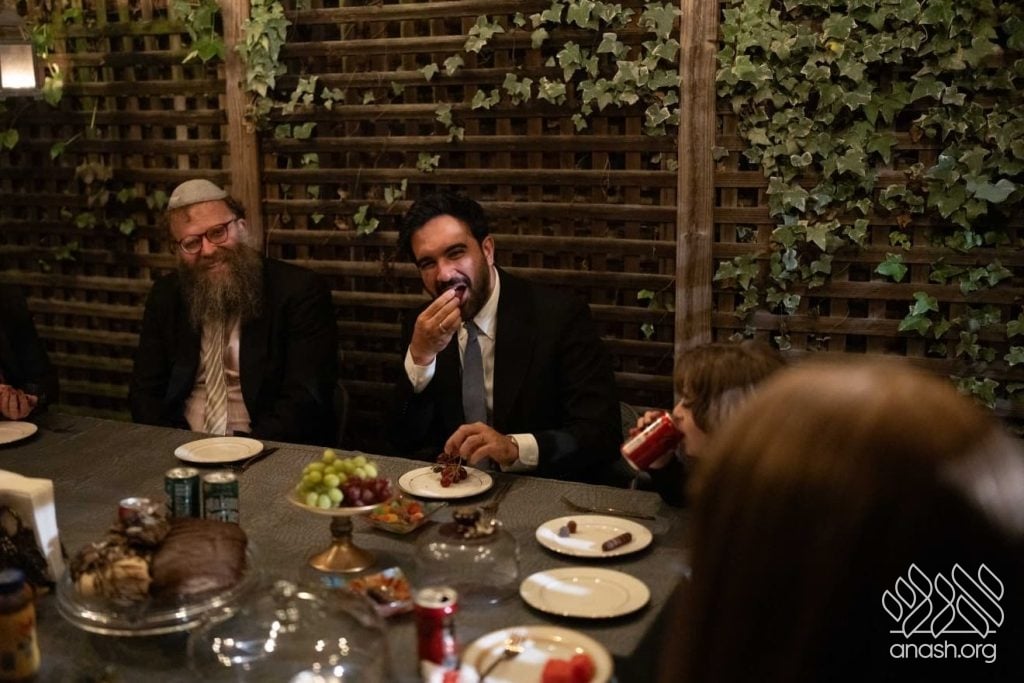 Credit: Mayor's Office
By a Crown Heights resident
The sight of New York City Mayor Zohran Mamdani visiting a sukkah in Crown Heights raises a question that goes well beyond the usual Chol Hamoed photo-op. Politicians of every stripe have long visited the neighborhood, particularly around Yom Tov, and political disagreement alone has never been reason to close the door. But Mamdani comes to Crown Heights carrying a record that makes this visit difficult to separate from the policies, priorities and associations that have defined his rise to City Hall.
The timing makes that especially difficult to ignore. Simchas Torah is just around the corner, bringing with it the anniversary of the massacre that took place on that very Yom Tov, when Hamas terrorists poured into communities in Eretz Yisroel and murdered, kidnapped and brutalized Jews.
For Crown Heights, terrorism claiming Jewish lives is not some distant or theoretical concern. Ari Halberstam HYD was murdered in NYC by an Anti-Israel terrorist. How can local askonim be insensitive to that?
A person in Mamdani’s close personal circle was revealed to have shown approval for social media posts glorifying or justifying the Oct. 7 attack, including material portraying the attack as an act of “resistance.” Mamdani officially condemned the attack, but Jewish New Yorkers are entitled to take notice of the attitudes and associations immediately around him.
Mamdani has also repeatedly insisted that his focus is New York City. Yet, he made arresting Israel’s prime minister a campaign promise, pursued the issue after taking office, and continued publicly targeting Netanyahu even after it became clear that City Hall did not have the authority to carry out what he had proposed.
If Mamdani’s concern is New York, why has Israel’s PM been singled out for such sustained attention? The world is filled with dictators, wars, atrocities and foreign leaders accused of terrible crimes. Yet it is Netanyahu whose presence in New York became a mayoral issue, and whose arrest Mamdani chose to elevate into a political promise. And that’s from the mayor who repeatedly says his job is to focus on New Yorkers.
The contradiction becomes more serious when it turns from rhetoric to the physical safety of Jews here in New York. Mamdani has now announced a major initiative to combat antisemitism, including millions of dollars in funding and additional money for security at shuls and other Jewish institutions. At the same time, he remains committed to dismantling the NYPD’s Strategic Response Group, a unit that has played a major role in responding to large demonstrations, civil disorder and threats that can quickly place Jewish communities and institutions in danger.
Jewish security professionals have warned that dismantling the SRG could leave a serious gap in protection when hostile demonstrations threaten to turn violent. Mamdani says its counterterrorism functions will be reassigned elsewhere, but that does little to answer the broader concern. Cameras, locks and grants have their place, but they are not a substitute for trained police officers when a violent mob is already outside a shul, school or Jewish neighborhood. Announcing money to “combat antisemitism” while dismantling one of the police resources relied upon when Jews actually need protection is a contradiction that deserves far more scrutiny.
There is also the matter of what Mamdani is actually bringing to Crown Heights. In the same week that he is making a friendly Chol Hamoed appearance in a sukkah, he was also in the neighborhood promoting the opening of a new facility for homeless New Yorkers with serious mental illness. Whatever arguments City Hall makes for the program, residents are entitled to consider that part of the mayor’s relationship with Crown Heights as well. A community should not be expected to judge an administration by a sukkah photograph while ignoring what that same administration is doing in the neighborhood outside it.
Jewish communal leaders have always maintained relationships with elected officials whose views they strongly opposed, both to represent their constituents and to advocate for the community’s needs. That doesn’t mean every politician who enters Crown Heights must agree with its residents on every issue. But a photo-op won’t change his record.
With Simchas Torah approaching, Mamdani came to be received as the mayor supporting the Jewish community. Crown Heightsers should look beyond the photo-op, at his priorities, his associations, and his policing agenda, and ask whether his actions toward Jewish New Yorkers match the message of friendship he is trying to convey.
 COMMENTS


Perhaps the best way to influence change in his agenda is by making friendships with him. The more he is exposed to our communities, the more our needs will be on his radar. And if he has a good time with us and feels supported, he may even want to help.
After all, idealism for a politician is quite fluid…
The premise of the question is foolish. he is the sitting Mayor of NYC, we have a very clear understanding of the Rebbe’s opinion about this, he is a Politician that is looking for any opportunity he can get.
That he was hosted in the Halberstam family Sukkah!!!
From the Rebbe’s letter (3 Sivan, 5744) to Prof. Alan Dershowitz, regarding politicians:
“P.S. I wish to refer to your characterization of the person as described in your letter.
“I trust you will agree that in regard to persons of influence, whether in Washington or elsewhere, the first objective should be to persuade and encourage such a person to use his influence in a positive way in behalf of any and all good causes which are important to us. We should welcome every public appearance which lends public support to the cause, especially when there is a likelihood that it may be the forerunner of similar pronouncements in the future. A case in point is the public stance of the very person who is the subject of your letter, on a matter which is surely close to your heart, as reported in the JTA Bulletin . . . (v. enclosure). I believe it is not the first of its kind, nor, I hope, the last.
“My experience with such people – though I have never personally met the said person – has convinced me that politicians are generally motivated more by expediency than by conviction. In other words, their public pronouncements on various issues do not stem from categorical principles or religious imperatives. Hence, most of them, if not all, are subject to change in their positions, depending on time, place, and other factors.
I believe, therefore, that the proper approach to such persons by Jewish leaders should not be rigid. As a rule, it does no good to engage in a cold war, which may often turn into a hot war; nor does it serve any useful purpose to brand one as an “enemy” or an “anti-Semite,” however tempting it is to do so even if that person vehemently denies it. It can only be counter-productive. On the contrary, ways and means should be found to persuade such a person to take a favorable stance, at least publicly. We haven’t too many friends, and attaching labels, etc. will not gain us any….”
My opinion is a sitting mayor who last week openly lied and spread falsehoods about the Jews in the land of Israel committing Genocide, and the rhetoric is causing antisemites to commit violence against Jews here in NYC , and he is not backing down, and because of this Jews are very wary of him, now Chabad comes out publicly and welcomes him to Crown Heights, and that is how the media covers this story, to me there is something very wrong ,
מי ברא אלה…
The Rebbe asked this.
Who are these self appointed “spokespeople”?