



ח׳ ניסן ה׳תשפ״ו | March 26, 2026
Suddenly the Rebbe Leaned Back and Began a Conversation
What began as a standard yechidus took an unexpected turn when the Rebbe shifted the tone and engaged young Reb Avrohom Gerlitzky in a conversation about his role in preserving the Rebbe’s Torah.

Rabbi Avrohom Gerlitzky has been a Talmudic lecturer at Crown Heights’s Oholei Torah yeshivah for over half a century, and is the author of the three-volume series Yemos HaMashiach B’Halacha. He was interviewed in January 2026.
The first time I ever wrote to the Rebbe was before my twelfth birthday. The Lubavitcher community in Montreal, where I grew up in the fifties, would all make a big trip to New York a couple of times a year in order to see the Rebbe and have an audience with him. I used to join those trips, but in 1960, when I was turning twelve, I decided to reach out to the Rebbe directly to ask for his blessing.
In his reply, the Rebbe referred to twelve as the age of a “mufla hasamuch le’ish.” In Halachic terminology, this refers to a twelve-year-old boy who — despite not yet being a Bar Mitzvah fully obligated in all of the commandments — is deemed capable of making an oath. As long as he understands what he is saying, his word is considered to be as legally binding as that of an adult.
“Ask your father and the head of your yeshivah to explain this concept, and the additional responsibility that comes with it,” wrote the Rebbe.
“My hope,” he continued, is that this will “increase your desire and wish for even greater diligence and dedication in Torah study, and to conduct yourself as befitting a student” of my yeshivah. Finally, he added a blessing for my success in this area, and that I influence my friends in this way, “by being a living example.”
Interestingly, the letter was also filled with corrections. It had been typed up by one of the Rebbe’s secretaries, in Hebrew, and written in the more formal third-person, as these letters generally were. However, the Rebbe had gone through the whole letter with his pen, changing everything to the more familiar second person: Instead of, “he should ask his father,” it was, “ask your father,” and so on.
A couple of years after that, I left Montreal to go to a yeshivah in Newark, New Jersey, and then, when I was sixteen, I went to study in 770. Meanwhile, my father in Montreal wanted to know what was happening in New York, and what the Rebbe was saying at his public farbrengens. In those days, before the times of faxes or even cassette tapes, people would only know about these things through the mail. So my father, and later my brother-in-law in Jerusalem, and some other friends who were living outside New York, encouraged me to write to them.
I started in 1965, writing privately to my father to describe the events I witnessed at 770. For example, I remember writing to him about the extraordinary Selichos on that year’s fast of Asara b’Teves, which the Rebbe led, while crying bitterly throughout the service.
But by the next year, it started to become more official. “If you’re already writing summaries of the Rebbe’s talks,” Reb Bentche Shemtov, a senior chasid, had suggested to me, “why don’t you make it so that everyone can learn them?”
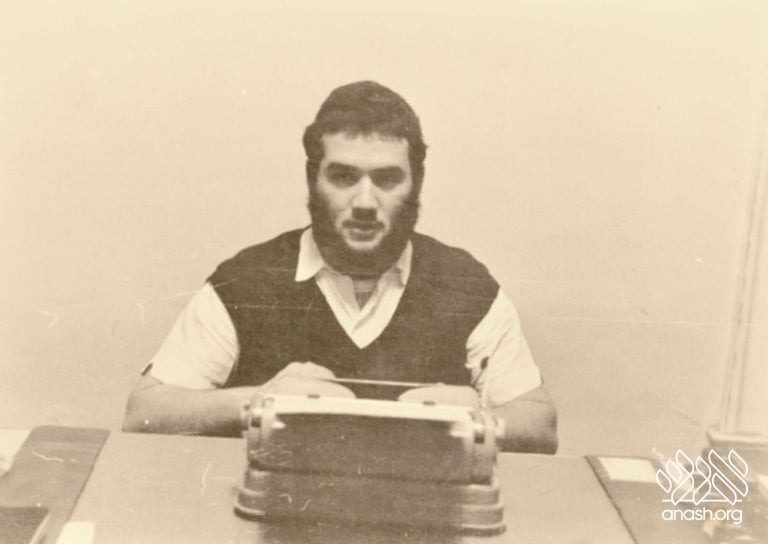
Whenever there was a farbrengen on Shabbat or one of the festivals — when no recordings could be made — the chasidic scholar Reb Yoel Kahn would later review the Rebbe’s addresses from memory. This was known as chazarah, the “review,” and I would sit nearby and take notes as I listened. Then, back at our dormitory, an apartment on top of Raskin’s fish market, a few yeshivah students — Nosson Wolf, Leibel Schapiro, Avrohom Levitansky, and others — would get together in the kitchen to review the farbrengen again, and I would stay up late on Sunday nights typing it up.
Eventually, we would have a Yiddish transcript of the farbrengen, called a hanachah. Rabbi Zev Katz, who had a very good Yiddish, would correct the language, and we would also add sources. At first, we used to put twenty copies of thin onionskin paper directly into the typewriter, to type up twenty copies at once, but later Reb Bentche brought a Gestetner machine for us to make copies in stencil. We would then send these to different people in Israel or England and all of the shuls in Crown Heights. We called them “Hanachos HaTemimim” — transcripts of the Rebbe’s talks, from the students of Yeshivas Tomchei Temimim.
I had been working on the hanachos for a couple of years when, in 1967, I had a yechidus with the Rebbe. Yeshivah students were able to have a yechidus with the Rebbe once a year, on their birthdays, although this time I went a little after I had turned nineteen.
For the most part, it was a regular yechidus. Before I went into the Rebbe’s room, I prepared a note, asking for his bracha, and in particular for success in my studies.
The Rebbe responded to my note, advising that my success in Torah study would come from having a chavrusa, a study partner, not by studying alone. He explained the advantages of learning with a chavrusa: First, when there is someone else waiting to study Torah with you, you feel more of a responsibility to be present. Additionally, when you have someone to discuss your learning with, everything becomes much clearer. Citing chasidic teachings, he told me that speech has a special clarifying power. Finally, the Rebbe gave me a blessing for my birthday.
Until this point, the Rebbe had been speaking in the style I was familiar with from other audiences. But then, he suddenly leaned back in his chair, while holding his pencil in his hand, and he began asking me questions about the hanachos. This was different: It was like the yechidus was over, and we were now having a conversation.
“How do you construct the talks?” the Rebbe asked, referring to the hanachos.
I found it very difficult to speak in front of the Rebbe, but he had asked me a question, so I answered. He went on to ask when I wrote them up, whether there was anyone who helped me, and so on. I told him how I would sit and write while the farbrengen was being reviewed, and about my friends who also worked on the hanachos.
The Rebbe then suggested that since I was involved with writing up the talks, I could also help with memorizing and being a part of the process of reviewing them at the chazarah. And in fact, shortly after that audience, Reb Yoel Kahn started asking me to come to his house on Shabbos afternoons, whenever there was a farbrengen, and the whole way there — as well as during the Shabbos meal — we would review the farbrengen together.
Finally, the Rebbe gave me a very nice bracha for success in this work, as well as for my Torah study in general, and the meeting was over.
On a number of occasions, the Rebbe expressed his frustration that people were not treating the Torah teachings he delivered during the farbrengens with the seriousness they deserved. “I spent the entire night on this!” he once exclaimed pointedly. But, on the other hand, when we would do our best to write up what he said and then distribute his teachings widely, he deeply appreciated it.
From that audience, I felt that the Rebbe was very happy with the hanachos — that there were people who were studying them. Knowing this gave me a special pleasure in that work, and motivated me to continue what I was doing.
 COMMENTS


We appreciate your feedback. If you have any additional information to contribute to this article, it will be added below.