




כ״ד תשרי ה׳תשפ״ו | October 15, 2025
Lebanon Calls for Peace, Freed Terrorists Leave Millionaires
War Summary, Day 740: All living hostages are home, Hamas is slow to return the bodies of hostages in violation of the agreement, terrorists leave prison as millionaires paid by the Palestinian Authority, IDF prepares plans in case Hamas refuses to disarm, Lebanon president says it’s time to talk with Israel, and massive smuggling problem continues over Egypt border.
0 living hostages remaining in Gaza.
19 bodies of hostages held in Gaza.
168 living hostages rescued.
66 hostage bodies rescued.
1,938 Israelis killed.
916 fallen IDF soldiers.
70 fallen Israeli police.
32,390 estimated projectiles fired at Israel.
1 Jewish nation united in prayer, charity, and good deeds.
Top Headlines
– All living hostages are home
– Hamas is slow to return the bodies of hostages, in violation of the agreement
– The hostages endured the worst, and emerged as heroes
– Terrorists leave prison as millionaires, paid by the Palestinian Authority
– Pro-Hamas propagandists romanticize terrorist prisoners as innocent hostages, lie about injured teen
– Rafah crossing opening delayed, to be operated by Gazans
– Hamas consolidating power in Gaza, executing civilians
– Anti-Hamas militia who worked with Israel remain in protected areas
– IDF to prepare plans in case Hamas refuses to disarm
– GHF centers close
– Lebanon president says its time to talk with Israel
– Massive smuggling problem over Egypt border
This was perhaps the most joyous Simchat Torah in Israel’s history. Israeli Jews of all stripes danced all over the country, from Kiryat Shemona to Hostage Square, to the site of the Nova Festival. Places which were symbols of war and destruction just days ago, were flipped to symbols of renewal and victory—with Torah scrolls held high and celebrated for the day it all began.
Hostages
For the first time since 2014 (when Avera Mengistu was captured by Hamas), there are no living Israeli hostages in Gaza.
After releasing 20 living hostages on Monday, Hamas released the bodies of four slain hostages:
Yossi Sharabi, 53
Cpt. Daniel Perez, 22
Guy Illouz, 26
Bipin Joshi, 23
Initially, Hamas said that they couldn’t find any more. Israel then refused to open the Rafah crossing and applied pressure on Hamas. Hamas then sent four more bodies on Tuesday. The IDF identified three of them as:
Staff Sgt. Tamir Nimrodi, 18
Uriel Baruch, 35
Eitan Levy, 53
The fourth body did not belong to an Israeli hostage. Hamas claims that it belonged to an IDF soldier who was captured in Jabalia in May 2024. The IDF denies that any soldier was captured then. Some claim that the body belongs to a former prisoner from a Palestinian Authority-controlled area, who was hired by the IDF as a mercenary to search for Hamas traps in Gaza.
On Wednesday night, Hamas sent two more bodies of hostages to Israel, without naming them. Israel is working to identify the hostages—a process which can take up to two days, but typically is much quicker.
**
Hamas claims that they have “adhered to what was agreed upon” in the hostage deal because they released all the bodies that they can access. They claim that the other bodies are either lost or buried too deep under rubble, and retrieving them would require heavy machinery not found in Gaza.
Israel does not believe Hamas, and (according to Israel Hayom) believes that Hamas can retrieve the bodies of more hostages. Israel has relayed this to U.S. President Trump and his negotiating team.
What to expect next:
– With some more pressure, Hamas might produce a few more bodies and slowly deliver them to Israel.
– There are a number of bodies which Hamas truly can’t reach, and a tiny few they may have actually lost track of. An international search team may be sent to Gaza to locate them. (Axios says the team would be coordinated by the U.S. and will include experts from Turkey.)
Former hostage Rom Braslavsky says that he was held together with the bodies of some hostages and saw them shortly before his release. He told the government coordinator for hostages that Hamas knows exactly where they are.
**
Small details of the horrors experienced by the newly released hostages have begun to emerge, and within them, glimpses of remarkable strength and heroism.
Avinatan Or, who is 2 meters tall (6’7”), was kept inside a tiny cage just 1.8 meters high, and smaller in width than a single bed. He couldn’t stand or lay straight for more than a year. During the entire two years of captivity, Avinatan was alone, with no idea what happened to his partner, Noa Argamani, or anyone else. Despite this all, Avinatan told Prime Minister Netanyahu that he was sure that he would be held for years until the war was finished, and he believed that the war should be won at the expense of the hostages—even if it meant his continued suffering.
Rom Braslavski was repeatedly pressured to convert to Islam in exchange for food. He endured horrific torture and violent beatings, as well as psychological abuse, all while told that it would get better if he just converted. He held strong and refused for two years. When Rom returned to his family, he kept repeating “I’m a Jew!” As soon as he got to the hospital, he put on tefillin and prayed.
Yosef Haim Ohana said that he and the hostage he was held with were also pressured to convert. They were given a radio and forced to listen to Muslim prayer and messages all day. But at one point, when guards weren’t listening, they tinkered with the radio wires and managed to tune into Israeli radio—and Yosef Haim heard his father being interviewed. It gave him new life to hear that his father was alive and waiting for him.
Eitan Mor was kept in harsh conditions but says that he always remembered the strength his parents imbued in him. In his later days of captivity, he was visited by Izz ad-Din al-Haddad, who became the head of Hamas’s military after the elimination of the Sinwar brothers. The arch-terrorist told Eitan that if there was a partial deal, Eitan would be sent first, “because your father doesn’t go to protests anyway.” Eitan’s father, Zvika Mor, headed the Tikva Forum, which supported military pressure and believed that protests harmed the efforts to retrieve the hostages.
Alon Ohel spent two years with shrapnel lodged in his right eye and head, causing him to lose sight in one eye. During captivity, he saw news reports about Israelis campaigning for his release, and it gave him hope. The same day he arrived at the hospital, he returned to his gift and played piano.
Matan Angrest was taken hostage as a young IDF soldier after battling Hamas terrorists for hours on end on October 7th. Because he was a soldier, Hamas subjected him to horrific torture. Still, just a day after he was released, he went to the funeral of his commander whose body was returned the same day. Matan spoke at the funeral and explained, “I can barely stand on my feet, but it’s an honor to be here. Daniel is a figure to be admired — my hero and the hero of all the people of Israel.”
**
In exchange for the hostages, Israel released 1,722 prisoners from Gaza who worked with Hamas, and 250 terrorists who were serving life sentences for murderous terror attacks.
Palestinian Media Watch reports that while in prison, the 250 terrorist murderers received “pay-for-slay” payments from the Palestinian Authority totaling over ₪229 million. 160 of the terrorists became millionaires while in prison.
**
Pro-Hamas propagandists have been filling social media with sob stories calling released terrorists “hostages,” and decrying that they were held in Israeli prison for decades, and some even lost limbs. A simple Google search of the names of any of these “hostages” will show you how many people they murdered, and that any lost limbs happened while they were murdering people—after which they were treated in Israeli hospitals.
However, there is one image going around of an autistic teenager returning to Gaza, who propagandists claim was held in Israeli prison. The truth is that the teen was shot at by Hamas while at a GHF aid distribution site. The IDF airlifted the teen and brought him to Israeli hospitals to be treated. He was returned to Gaza at the start of the ceasefire, not as part of any deal.
Gaza
The IDF delayed the opening of the Rafah Crossing due to Hamas’s violation of the agreement, with the slow release of hostage bodies. The crossing remains closed, with preparations still underway to open it.
The Rafah Crossing will only be open for Gazan nationals to enter or exit.
Channel 14 reports that once open, the Rafah Crossing will be managed by “Gazans approved by the IDF.” The Palestinian Authority (PA) claims that these workers will be people loyal to the PA.
Israeli officials told Channel 14 that the IDF will maintain control through supervision, and no one will pass through the border without IDF approval.
Aid deliveries are still directed through Israel for inspection, to prevent mass weapons smuggling.
**
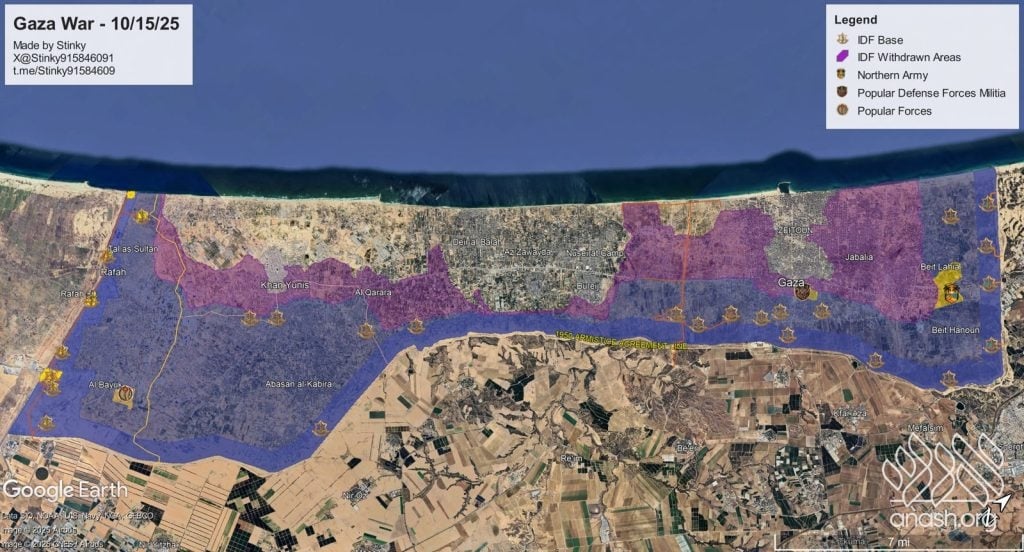
The IDF continues to control 58% of Gaza, in what’s referred to as the “Yellow Line.” From the moment the IDF withdrew to the Yellow Line, Hamas began to test it. Initially, the IDF only fired warning shots or even ignored approaching suspects, so as not to risk the hostage release. Once all living hostages were returned to Israel, the IDF began full enforcement.
The IDF repeatedly sends warnings to Gazan civilians to stay far from the Yellow Line.
Hamas typically sends women and children to the line first—and the IDF usually manages to get them to retreat without injury. Hamas then sends terrorists in civilian clothing, with hidden weapons.
On Tuesday, three suspects approached IDF forces in Shejaiya, within the Yellow Line, and ignored warning shots. They were then eliminated by the IDF.
Later, a similar incident happened in East Khan Younis, and one suspect was eliminated.
On Wednesday, suspects once again approached IDF positions in Shejaiya, and ignored warnings. Two suspects were eliminated after posing a threat.
**
There appear to be four anti-Hamas militia who collaborated with the IDF during wartime, and now remain under IDF protection within the Yellow Line. The most famous is Abu Shabab’s Popular Forces in East Rafah, with 600 fighters and 1,500 civilian residents. Smaller groups exist in east Khan Younis, the Shejaiya neighborhood of Gaza City, and northernmost Gaza.
Other anti-Hamas militia who did not collaborate with Israel remain in areas now under Hamas control, and have been fighting Hamas in recent days. One group, the Majaida clan, recently surrendered to Hamas and pledged to disarm.
Hamas sees the militia, especially those under IDF protection, as their top threat, and has been working to eliminate them all. It is possible that Hamas is trying to reach the militia in Shejaiya in order to get revenge.
Hamas has been carrying out mass public executions in Gaza City, in front of large crowds, as a horrific intimidation tactic. In these executions, the Hamas terrorists gather a collection of Gazans who they accuse of “collaborating with the enemy,” or theft of humanitarian aid. The people are then executed with no trial, often without even a name.
**
It is very clear that Hamas is not disarming and is actually regrouping and consolidating power wherever they can. They are weak, but still the most powerful group in Gaza, with full control over the civilians in most areas outside IDF control.
Defense Minister Israel Katz instructed the IDF to prepare a comprehensive plan to defeat Hamas, in case Hamas does not agree to the full ceasefire agreement, and the war needs to be resumed.
In a statement, Katz’s office wrote:
“Under Trump’s plan, Hamas must return all the fallen hostages in its possession and disarm, while Israel, together with the international force led by the US, will act to destroy all tunnels and terror infrastructure in Gaza to ensure that Gaza is demilitarized [to no longer pose] any threat to the State of Israel.
If Hamas refuses to implement the agreement, Israel, in coordination with the US, will return to fighting and act to achieve the complete defeat of Hamas, change the reality in Gaza, and attain all the objectives of the war.”
Most in the IDF (especially the officials I spoke to) warn that Hamas is not entirely defeated, and while weakened, still exists as a potential threat to Israel. Hamas leaders have already openly stated that they are preparing to attack Israel again.
What everyone is wondering is if and how the peace agreement could possibly disarm Hamas—and if it doesn’t, will Prime Minister Netanyahu need to defy U.S. President Trump in order to return to war?
On Monday, Trump made it pretty clear to the press and all who listened to his Knesset speech that he wanted the war to be completely over and for peace to begin. However, Trump did keep the threats to Hamas open. On Wednesday, he told reporters that if Hamas refused to disarm, he would allow Israel to finish the job.
On Wednesday evening, Adm. Brad Cooper, U.S. CENTCOM commander, issued a warning to Hamas, stating that CENTCOM expressed concern to Egypt and Qatar over Hamas’s executions and fighting throughout Gaza. This is the first time that CENTCOM issued a warning to Hamas.
**
In the meantime—cleanup has begun in Gaza. The general estimate is the full reconstruction of Gaza will take between 10 to 15 years. But already, heavy trucks bearing Qatari flags have been hard at work clearing up rubble from the streets.
**
Around 300 Hamas terrorists and Gazans who took part in the October 7th attack are being held in Israeli prison. As Israel prepares to bring them to trial, a national debate has sprung over whether or not to impose a death penalty.
Humanitarian Aid
Humanitarian aid continues to flow through Israel and enter Gaza only after Israeli inspection.
It appears that Gaza Humanitarian Foundation (GHF) sites may have been closed, as part of the agreement, since Hamas did not like them. Hamas demanded that aid be delivered by UN organizations who collaborate with them. The GHF itself hasn’t been closed and pledges to continue helping Gazans in innovative ways. Time will tell.
Lebanon
Lebanese President Joseph Aoun told local economic journalists that his country should begin negotiations with Israel: “We cannot remain outside the current path of crisis resolution in the region. Rather, we must be part of it.”
Aoun pointed out that the war did not accomplish anything and explained, “today, the general atmosphere is one of compromise, and negotiation is necessary.” (As reported by i24 News)
Other
Weapons and drug smuggling across the Egypt border continues to be a fast-growing problem. The security team of Kadesh Barnea, an Israeli town on the Israel-Egypt border, installed a system to monitor smuggling drones crossing the border in their area. In the three days around Rosh Hashana alone, the team tracked 550 (!!) drone smuggling attempts.
The smugglings are typically carried out by Bedouins in both Israel and Egypt and frequently carry large weapons.
 COMMENTS


We appreciate your feedback. If you have any additional information to contribute to this article, it will be added below.