




י״ד אלול ה׳תשפ״ה | September 6, 2025
First-hand Accounts of the Yeshivah in Lubavitch
In honor of 15 Elul, the 128th anniversary of the founding of Yeshivas Tomchei Temimim in Lubavitch, ‘Beyond the Margins of Chabad History’ presents two new first-hand accounts of the yeshivah in Lubavitch.
In honor of 15 Elul, the 128th anniversary of the founding of Yeshivas Tomchei Temimim in Lubavitch, ‘Beyond the Margins of Chabad History’ presents two new first-hand accounts of the yeshivah in Lubavitch.
By Shmuel Super
Introduction
The 15th of Elul, 5697, was a watershed moment in Chabad history. On this day, the Rebbe Rashab announced the founding of a new yeshivah in Lubavitch that would teach nigleh and Chasidus in a unique atmosphere of yiras shamayim and avodas Hashem.
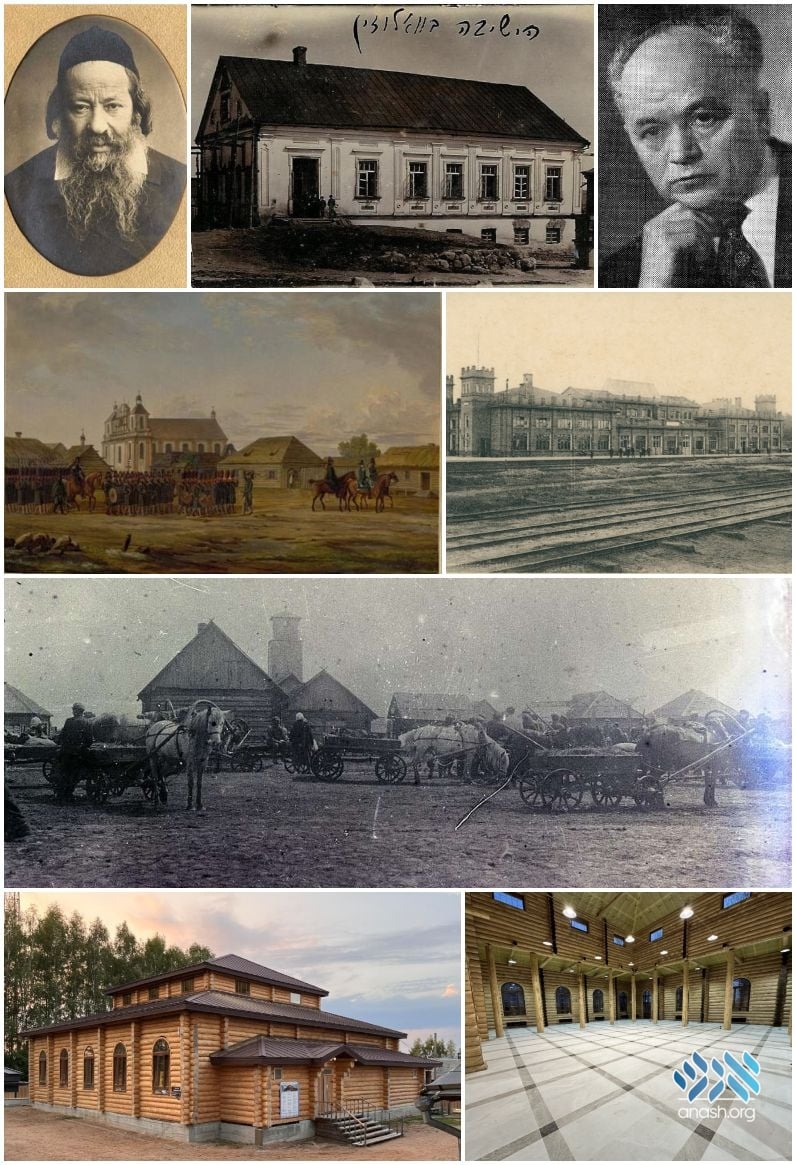
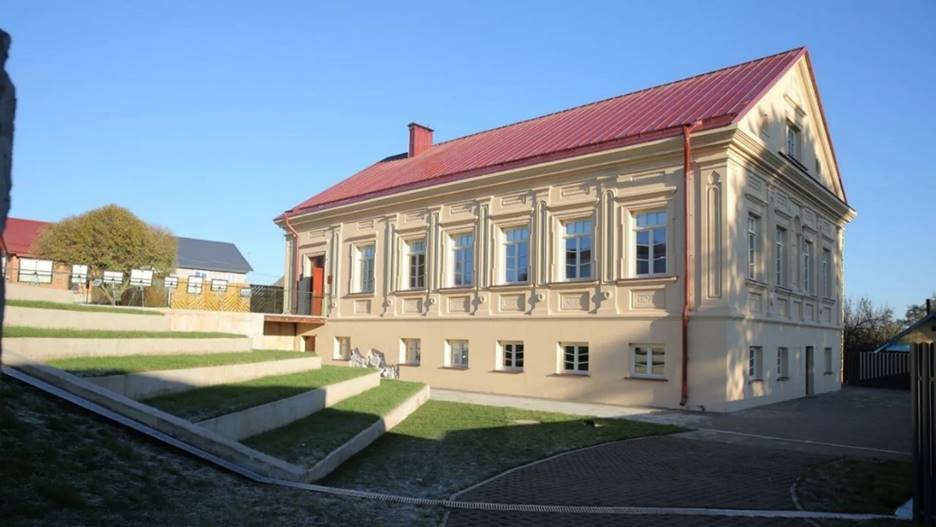
Today, as yeshivos are a standard part of frum and Chabad education, it is difficult to fully appreciate how revolutionary this concept was at the time. Of course, yeshivos of some form have existed since the days of Shem and Ever. But the framework of the modern yeshivah can be traced back to the yeshivah founded by in Valozhin by Harav Chaim Valozhiner in 5563.
Before this period, a yeshivah in Eastern Europe was an informal institution. Capable and willing young men would gather in their local beis hamedrash, or in a larger nearby town, and learn. The rov of the town would be available to answer their questions and give occasional shiurim.
This open and unstructured framework worked well for centuries in Eastern Europe. But R. Chaim Valozhiner, the leading talmid of the Vilna Gaon, identified a crisis in his generation. In a public letter published upon founding the Yeshivah, he explained that a double problem had developed: too many young men who wished to devote themselves to learning were unable to do so because they couldn’t afford to pay their living expenses, and too few good teachers were making themselves available to students.
R. Chaim’s solution was the establishment of a central organized yeshivah that would attract hundreds of talented bochurim from across the region and provide them with a structured learning schedule and framework. Instead of being dependent on the limited financial resources of the town it was located in, this yeshivah would fundraise across the region, enabling it to provide its talmidim with a stipend to cover their living expenses.
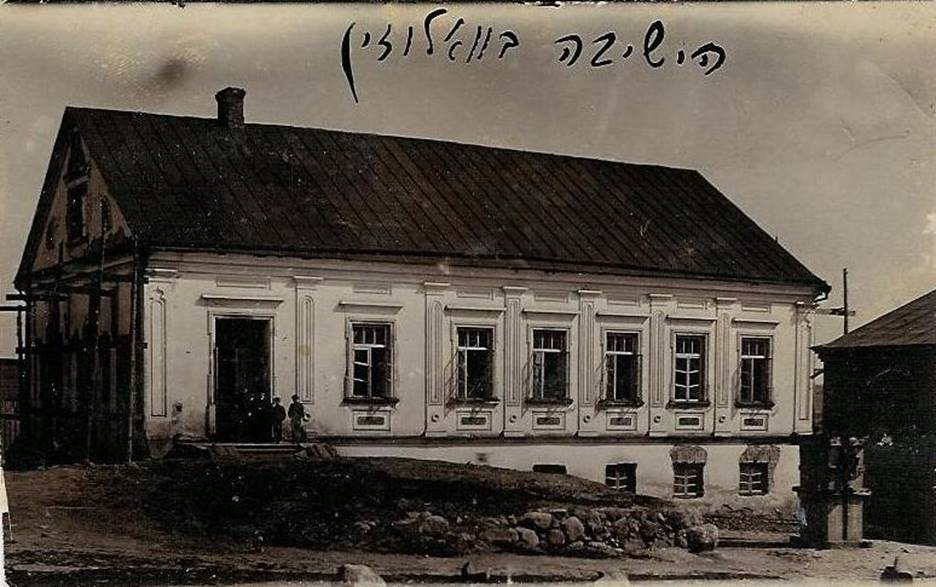
The new model of yeshivos was fortuitously well-positioned to address a new challenge that emerged in the following decades—the rise of haskalah. Secular education started to become more accessible to talented Jewish youth, and these fields of study offered structured and formal educational institutions. Yeshivos became a counterweight, offering elite-level Torah education in an organized framework, and yeshivos in the Valozhin model spread and expanded rapidly.
Despite the success of the Valozhin model, this new yeshivah framework was not quickly imitated in the Chabad strongholds of White Russia. The impact of haskalah and similar ideologies was less pronounced in these areas than in Lita (Lithuania), and the traditional loose model of a yeshivah remained viable.
In Lubavitch, there was an established phenomenon known as “yoshvim”. The yoshvim were young married men—typically 15–18 years old—who would spend a few months or years learning in the chatzer in Lubavitch and hearing chasidus directly from the Rebbe. During the nesius of the Tzemach Tzedek, some element of structure was introduced to this informal setting, but this form of yeshivah did not endure due to problems with the Russian government’s Cantonist military draft.
By the 5650s, however, times were changing rapidly in White Russia. Haskalah-style schools spread across the region, and the traditional, informal yeshivos struggled to compete in the battle for the best young minds. Some bochurim from Chabad families traveled to learn in Litvishe yeshivos, but this usually erased their Chabad identity.
At the same time, traditional frum Jews in White Russia had strong reservations about the modern yeshivah model. Concentrating large numbers of young, inquisitive minds in yeshivos also had the inadvertent effect of creating underground circles of bochurim within the yeshivos exploring secular studies and literature, transforming the bulwark against haskalah into a hotbed for it as well.
This was the background behind the Rebbe Rashab’s monumental decision in 5657 to establish Yeshivas Tomchei Temimim in Lubavitch. This yeshivah would follow the Valozhin model in terms of its structured framework, but it would also incorporate formal study of Chasidus. Moreover, this yeshivah would place a strong emphasis on the yiras shamayim of its students, and implement a very strict system of supervision to ensure that no outside literature and influences entered its holy walls.
The success of Tomchei Temimim speaks for itself, and requires no further elaboration. Lubavitch as we know it today was shaped by Tomchei Temimim, whose graduates became the pillars of Lubavitch across the world.
(The background information about Valozhin in this article is based on Shaul Stampfer’s excellent book Hayeshivah Halitait Behithavutah, ch. 1.)
Between Valozhin and Lubavitch
Our first article was written in 5667, celebrating two anniversaries: 100 years since the founding of the original yeshivah in Valozhin, and 10 years since the founding of the new Yeshivah in Lubavitch.
Earlier, we stated that 5563 was the year of Valozhin’s establishment, based on the date of R. Chaim Valozhiner’s public letter appealing for support for his new yeshivah. However, it seems that at this time, 5567 was the accepted year of Valozhin’s beginning. Shaul Stampfer notes that he has seen an official letterhead of the Valozhin yeshivah from this period bearing the year 5567 as the founding date of the yeshivah. Stampfer dismissed this as a mistake, but, as we will see, this year was acknowledged and marked publicly as the date of Valozhin’s founding 100 years later.
This article was written by a talmid of the yeshivah of Valozhin who came from a Chabad family and had also spent time in Lubavitch. The writer offers his personal perspective on the importance of both institutions, and presents a superficial harmonization of them. While not particularly nuanced or incisive, this previously unknown article relates an interesting personal experience and offers a rare first-hand impression of Tomchei Temimim in its early years.
It is worth noting that the Valozhin described in this article is not the same legendary Valozhin familiar to all. The original yeshivah in Valozhin closed by its rosh yeshivah, Harav Naftali Tzvi Yehudah Berlin (R. Hirsh Leib; the Netziv), in 5652, after coming under increasing pressure from the Russian government to introduce a secular curriculum. In 5655, the yeshivah was reopened under the leadership of Harav Refoel Shapira, the Netziv’s son-in-law. However, the new yeshivah was never successful in regaining the status of the original yeshivah as the premier institution of advanced Torah learning in Lita.
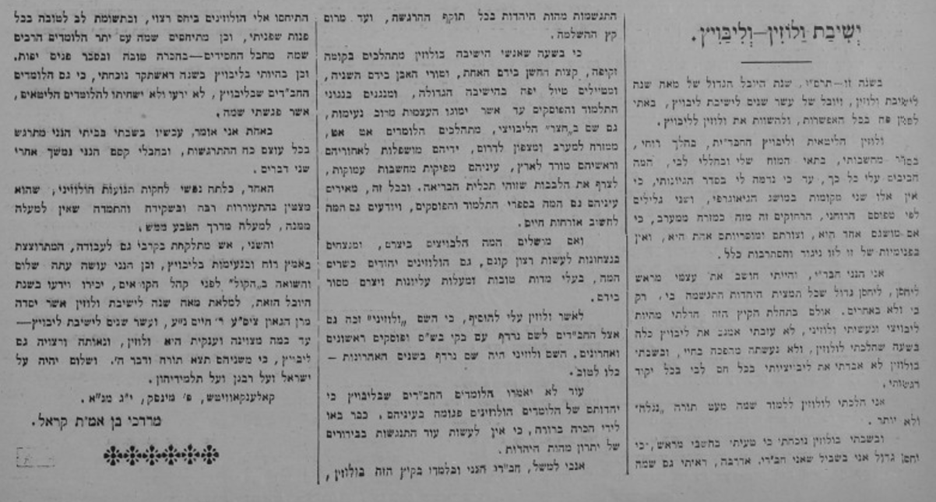
Following is the article, published in the Warsaw-based Kol Yaakov weekly newspaper on 28 Av, 5667 (August 8, 1907):
The Valozhiner Yeshivah and Lubavitch
This year, 5667, marks the grand jubilee of one hundred years since the founding of the Valozhin Yeshiva, and ten years since the establishment of the Lubavitcher Yeshiva. I have come to record my impressions, to the best of my ability, and to compare Valozhin with Lubavitch.
The Litvishe Valozhin and Lubavitch of Chabad are so dear to me, both in my feelings and intellect, in the chambers of my mind and the recesses of my heart, that it seems to me that these are not two separate places in the geographic sense, nor two provinces with differing spiritual character, as far apart as east from west. Rather, I perceive them as one unified concept, with a shared form and inner essence. There is no conflict or contradiction at all between their inner natures.
I am a Chabad chasid, and I used to think of myself as a pedigreed aristocrat, a member of the elite, in whom the entire essence of Yiddishkeit was realized. Only in me, and not in others. But at the beginning of this summer, I ceased being a Lubavitcher and became a Valozhiner. I did not, in fact, abandon Lubavitch completely when I went to Valozhin, and there was no upheaval in my life. While sitting in Valozhin, I did not lose my Lubavitch identity, with all the warmth of my heart and the full intensity of my feelings.
I went to Valozhin to study some nigleh—nothing more.
And while I sat in Valozhin, I realized that I had been mistaken in thinking beforehand that I was the elite because I was a Chabad chasid. On the contrary—there too I saw the embodiment of the essence of Yiddishkeit, with the full force of feeling and to the very heights of perfection.
For while the students of the Valozhiner yeshivah walk with upright posture, the Ketzos Hachoshen in one hand and the Turei Aven in the other, strolling gracefully through the great yeshivah and chanting the tunes of Gemara and poskim until your very bones melt from the sweetness, there too, in the Lubavitcher chatzer, the students walk slowly, from east to west and from north to south, their hands clasped behind them, their heads bowed toward the ground, their eyes radiating deep thoughts, contemplating the refining of the heart, which is the purpose of Creation. And yet, their eyes also shine with Gemara and poskim, and they also know how to navigate the paths of practical halachah.
As the Lubavitchers master their impulses and achieve victories in fulfilling the will of their Creator, the Valozhiners are also upright Jews, possessing fine character traits and lofty qualities, with their impulses under their control.
Concerning Valozhin, I must add that even among Chabad chasidim the very title “Valozhiner” has become synonymous with mastery of Shas and poskim, rishonim and achronim. In recent years, the title “Valozhiner” has become a term of pure praise.
No longer do the Chabad students in Lubavitch say that the Yiddishkeit of the Valozhiner students is flawed in their eyes. They have already reached a clear recognition that it is no longer worth debating whose Yiddishkeit is superior.
I, for instance, am a Chabad chasid. But when I studied in Valozhin this summer, the Valozhiners treated me with respect and kindness at every turn. And so they also relate to the many other students who come from the chasidishe camp—with good friendship and a pleasant countenance.
Likewise, when I was in Lubavitch last year, I saw that the Chabad students there did not denigrate or disparage the Litvishe students I met there.
Here is the message I proclaim: now, as I sit at home, I am overcome with a powerful emotion, drawn as if by ropes of enchantment toward two things.
On one hand, my soul longs to emulate the conduct of the Valozhiner, who excels with such great fervor, persistence, and unparalleled hasmadah—truly beyond the natural order.
At the same time, a fire burns within me for the avodah that pulses with spiritual vigor and sweetness in Lubavitch.
And so I now make peace and reconciliation in “Hakol” before the readers, that they may recognize and know, in this jubilee year—the hundredth anniversary of the founding of the Valozhin yeshivah by Maran Hagaon Reb Chaim of blessed memory, and the tenth anniversary of the Lubavitcher yeshivah—just how distinguished and mighty is Valozhin, and how wonderful and beloved is Lubavitch.
For from both of them, Torah and the dvar Hashem go forth. May there be peace among the Jewish people, their rabbonim, and their talmidim.
Kalenkovitch, Minsk District, 13 Menachem Av
Mordechai ben אמ”ת Kroll
***
Who is this dual citizen of Lubavitch and Valozhin, Mordechai Kroll? There are several people who share this name, including some with Chabad ties. However, the details all fit only one man—Harav Mordechai Kroll, the rov of Nova Basan, in what is now Ukraine.
An entry for R. Mordechai appears in the 5672 rabbinic yellow pages, Oholei Shem. The entries in this book are very reliable sources of information, as they are based on questionnaires filled out by the rabbonim themselves.
The Oholei Shem entry for R. Mordechai Kroll tells us that he was born in 5640, and was the grandson of R. Kulye the shochet of Niezhin, the right-hand man of Harav Yisrael Noach (Maharin) of Niezhin, the son of the Tzemach Tzedek. He received semichah from Harav Refoel Shapira, the rosh yeshivah of Valozhin, and from other rabbonim, including the venerable Chabad rov of Homel, Harav Hirsh Ber Lotker. The entry also mentions that R. Mordechai is a regular contributor to various newspapers and journals. His father’s name is given as Avraham Matisyahu, which explains the ben אמ”ת in his signature.
A Koidanover Tomim From Lita
While R. Mordechai Kroll spent time in Lubavitch, he was apparently not an actual talmid in the yeshivah. Our next account, however, is from a full-fledged tomim.
Noach Yitzchak Gotlib was born in Kovno, Lita, in 5664. His father, R. Tzvi (Hershele), was a prominent chasid of Koidonov, a Litvishe chasidus that is now extinct. R. Hershele served as a rosh yeshivah in Koidanov, and he also served for a time as a magid shiur for the younger bochurim in Tomchei Temimim in Lubavitch.
In a letter dated 27 Nisan 5667 to his son, the Frierdiker Rebbe, the Rebbe Rashab reports that “in the next few days someone will be coming from Kovno. He is highly acclaimed in learning, and previously served as a rosh yeshivah” (Igros Kodesh Harashab, vol. 4, p. 218). As the editor of the Igros notes, this is clearly referring to R. Hershele. One of the temimim who recalled studying in his class during 5667 was Harav Avraham Eliyahu Axelorod, a 14-year-old at the time (see Zikaron Lebnei Yisrael, p. 122).
R. Hershele left after a brief period of teaching, but in 5669 he returned and resumed teaching. One of his talmidim in 5669 was Harav Yisrael Jacobson, then a bar mitzvah boy (ibid., p. 20). It seems that R. Hershele’s second stint in Tomchei Temimim lasted for a few years at most, but in 5677 he was again teaching in a branch of Tomchei Temimim, this time in Cherson (ibid., p. 60).
As a result of R. Hershele’s connection to Lubavitch, two of his sons—Moshe Yosef and Noach Yitzchak—learned in Lubavitch. His daughter also married a tomim—the famous chasid Harav Yehoshua Aizik Baruch, who was killed by the Nazis in Kovno.
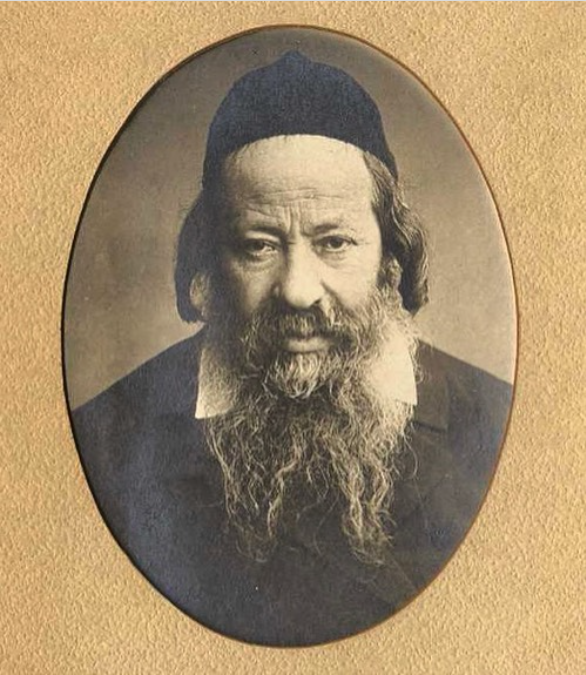
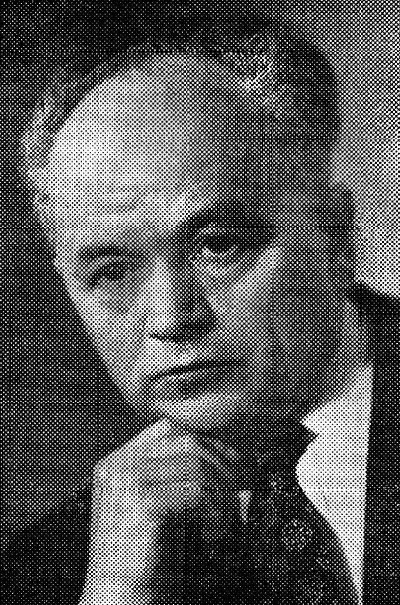
Our protagonist, Noach Yitzchak Gotlib, strayed from shemiras Torah umitzvos, and became a well-known Yiddish poet and writer. He emigrated to Canada in 5690 and lived there until his passing in 5727.
Noach Yitzchak wrote a little about his time in Lubavitch in his poetry. The writing is somewhat cryptic, but we can glean the following details: He learned in Lubavitch for two years, in 5674 and 5675, as a 10–11-year-old, and his father was not living in Lubavitch at this time. He writes that he learned well, but was eventually expelled from the yeshivah after the mashgiach caught him reading the secular Yiddish book Di Kliyatshe, by Mendele Mocher Seforim (A Menṭsh in di Himlen: Naye Lider un Poemes, p. 146).
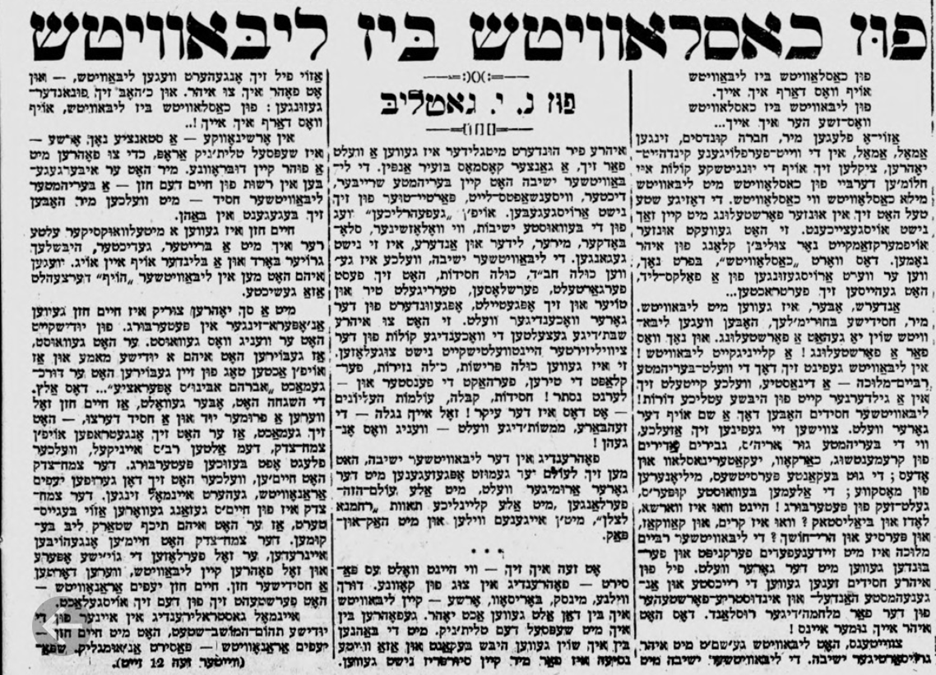
The following article by Noach Yitzchak Gotlib appeared in the Nayer Folksblat Newspaper in Lodz, Poland, 13 Sivan 5691 (May 29, 1931). It seems that the article was originally published in the Montreal-based Yiddish newspaper, the Keneder Adler, but that newspaper is unavailable online.
In this article, Gotlib describes his journey to Lubavitch, the characters he met along the way, and the Yeshivah. In the article, he writes that he was eight years old at the time, but since the source referenced above is part of a detailed chronology of his life, the ten-year-old version should be preferred.
Only part of the article is relevant to Tomchei Temimim, but we will translate it in full, including the colorful peripheral sections. Following the article, we will add some notes about some of the details it relates.
Credit is due to Mendel Nemanov for locating this article and much of the background information.
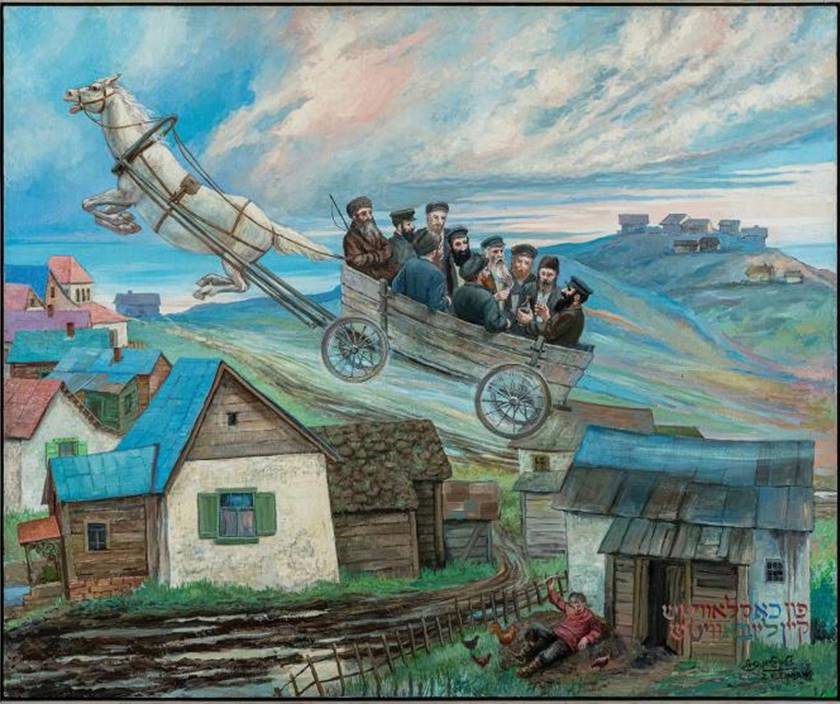
From Chaslavitch to Lubavitch
From Chaslavitch to Lubavitch—what do I need you for?
From Chaslavitch to Lubavitch—what do I hear of you…
That’s how we mischievous children would sing, once upon a time, in the distant, long-gone years of our childhood, repeating it enthusiastically with our boyish voices, all the while dreaming about Chaslavitch and Lubavitch.
Chaslavitch, as Chaslavitch, did not stand out in our imagination for anything in particular. It attracted our attention simply because of the sound of its name. The word “Chaslavitch,” especially when sung in a folk song, was an invitation to fantasize…
But Lubavitch was a different story. We young chasidishe bochurim did have an image of Lubavitch. And what an image it was! Lubavitch was no small matter! Lubavitch was home to the world-famous dynasty of rebbes—a royal lineage stretching across a golden chain of several illustrious generations!
Lubavitcher chasidim indeed have a reputation across the entire world. Among them are such figures as the world-famous Guraries, the mighty gevirim from Kremenchug, Charkov, Yekaterinoslav, and Odessa; the well-known Persitzes, millionaires from Moscow; and the universally recognized Kupers, loaded with money, from Peterburg!
Nu, what are Warsaw, Lodz, and Bialystok? What are Crimea, the Caucasus, Persia, and the Mountains of Darkness? The dynasty of the Lubavitcher rebbes was intertwined with and connected to the entire world. Many of its Chassidim were among the richest and most influential business and industrial leaders of pre-war Russia. There you go, first of all!
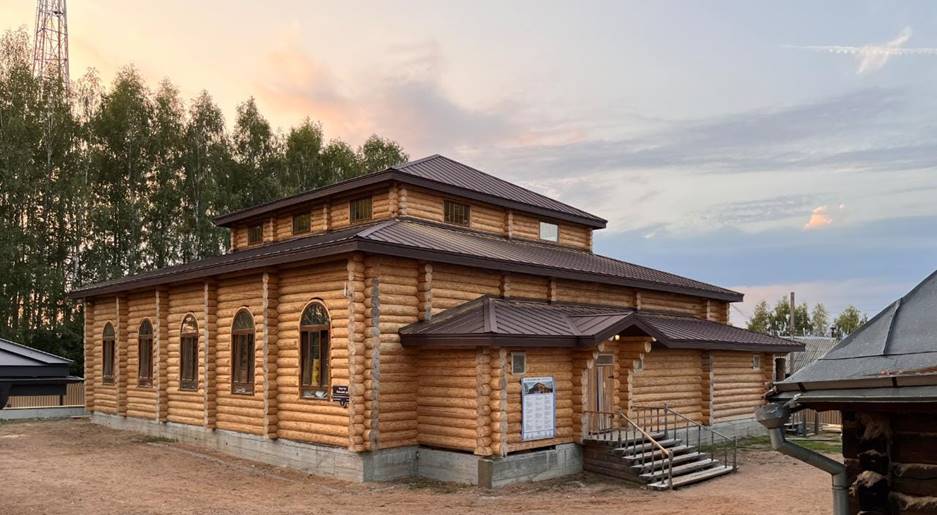
Secondly, Lubavitch was distinguished by its magnificent yeshiva. The Lubavitcher yeshiva, with its four hundred members, was a world unto itself, an entire cosmos in microcosm. The Lubavitcher yeshivah did not produce world-famous writers, poets, academic scholars, or political activists. It did not follow the “terrible” path of the famous yeshivas, like Valozhin, Slobodka, Mir, Lida, and others.
The Lubavitch yeshiva, which was entirely Chabad and entirely chasidus, was firmly enclosed, with locked doors and barred gates, separated and isolated from the entire mundane world.
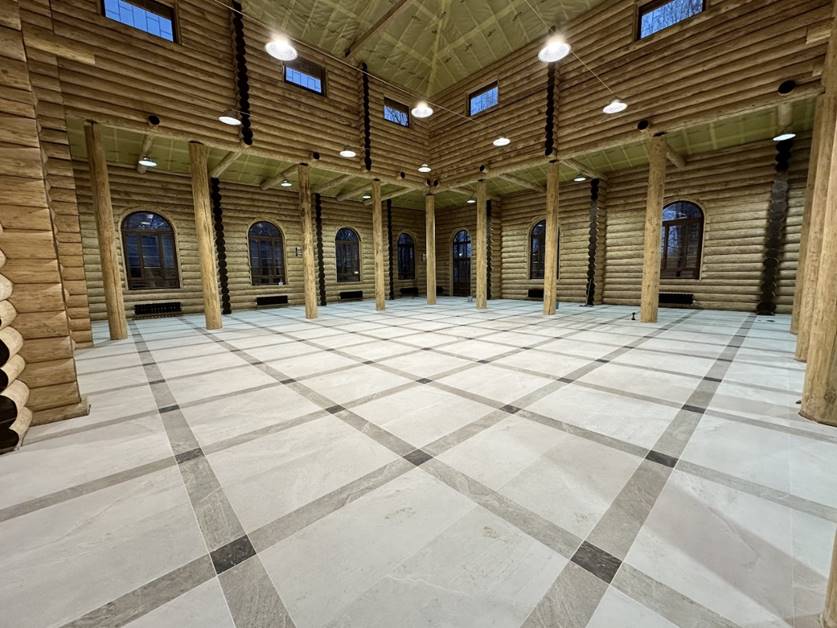
It did not allow the weekday sounds of modern civilization into its Shabbosdike tents. It was complete asceticism and complete renunciation—bolt the doors, shutter the windows, and learn nistar! Chasidus, Kabbalah, the higher worlds—this is the essence! The visible, tangible world should have little to do with you.
Upon entering the Lubavitcher yeshivah you had to forever renounce the entire surrounding world, with all of its worldly temptations; all of its petty taivos, rachmana litzlan; your personal will—the whole shebang.
*
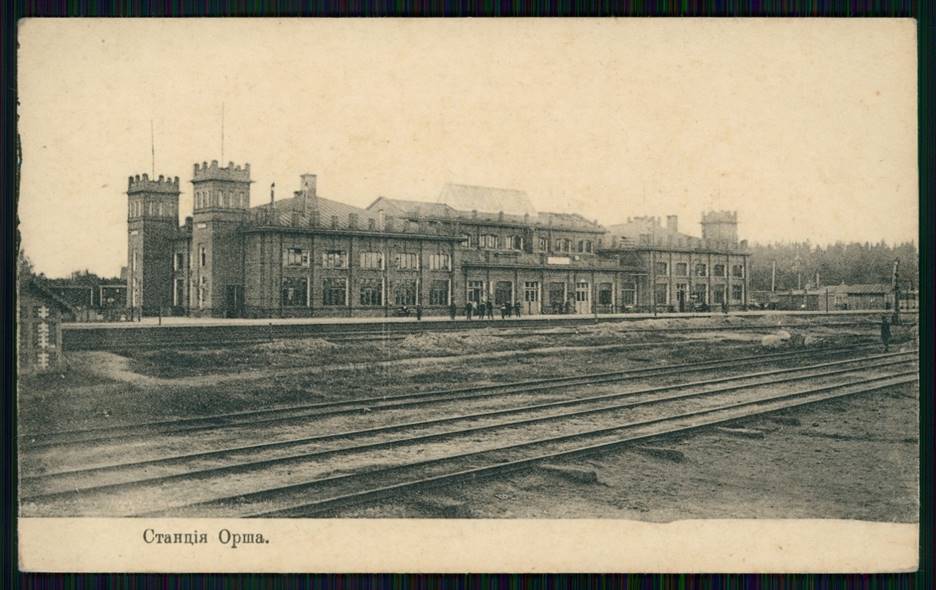
I picture myself now, as if it were happening today—riding a train from Kovno. Through Vilna, Minsk, Borisov, Orsha—to Lubavitch. I was eight years old at the time. I traveled with Shepsel the talis’nik. I was already quite well acquainted with trains, and such a long journey was not new to me.
I had heard so much about Lubavitch, and now I was going there. I hummed to myself, “From Chaslavitch to Lubavitch—what do I need you for!..
At Orshinovke—the station just past Orsha—Shepsel the talis’nik got off to travel with a carriage to Dubrove. He handed me over to the care of Chaim the chazan—a renowned Lubavitcher chasid we had met on the train.
Chaim the chazan was a middle-aged man. He was tall, with a broad, thick, and rather gray beard, and blind in one eye. They told the following story about him in the Lubavitcher chatzer:
Many years ago, Chaim the chazan had been an opera singer in Peterburg. He knew very little about Yiddishkeit. He knew that he had been born to a Jewish mother, and that on the eighth day after his birth he had undergone Avraham Avinu’s operation… That was all.
Divine Providence, however, wanted Chaim the chazan to become a frum Jew—and a chasid to boot. So it happened that he encountered the Tzemach Tzedek, the grandson of the Alter Rebbe, who visited Peterburg often. The Tzemach Tzedek once heard Chaim, then known as Yefim Aranovitch, sing. The Tzemach Tzedek was so moved by Chaim’s singing that he immediately became very fond of him. The Tzemach Tzedek began to speak with Chaim, urging him to leave the goyishe opera and travel to Lubavitch to become a chasidishe chazan there. Chaim the chazan—Yefim Aranovitch—laughed dismissively at the idea, of course.
Once, while traveling through one of the shtetlach within the Pale of Settlement, Chaim the chazan—Yefim Aranovitch—had a misadventure. One evening, as he was strolling through a distant, back alley, some drunken goyim burst out of a tavern, jumped on him, and began to pummel him. “Zhid!” They shouted at him, and one of them jabbed him in the eye with a stick. His eye popped out instantly.
From the hospital, Chaim the chazan—no longer Yefim Aranovitch!—emerged as a frum Jew and a passionate Lubavitcher chasid… He immediately traveled to Lubavitch and became the Rebbe’s permanent chazan there. He had a voice like a fiddle, and hearing him sing was a true delight. I heard him sing for the first time on the train.
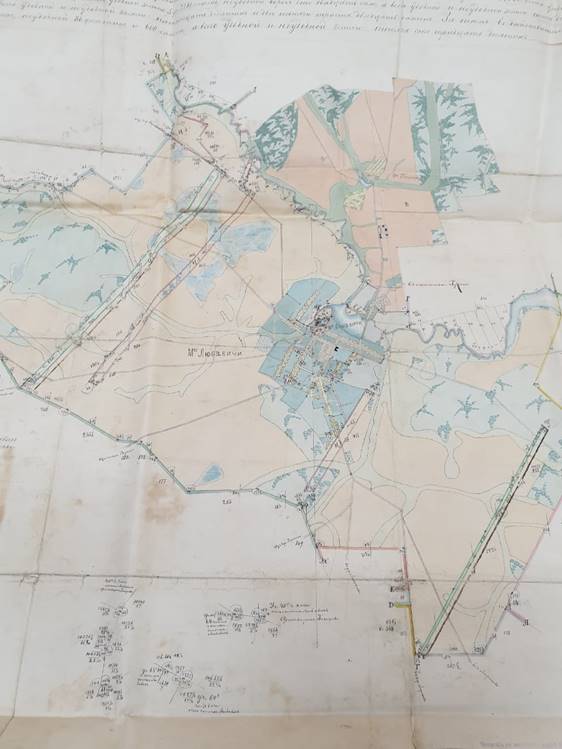
In Krasnoye, the second station after Orshinovke, we got off the train and took a wagon to Lubavitch, which is twenty-one versts from the station. Here I became acquainted with the first real “authority” of Lubavitch—Peise the balagoleh.
Peise the balagoleh was a terribly stout man, already in his sixties, with a sweaty, red, swollen face and a head of thick, disheveled gray hair. He spoke in a deep, hoarse voice, and a constant smell of cheap schnapps wafted from his mouth. It is interesting to relate how this older fellow came to become a balagoleh.
As a child, Peiske was a double orphan, with no family of his own in the shtetl. He would wander the streets and spend his nights in the bathhouse. Pinye—the Rebbe’s attendant—once found Peiske in the bathhouse, famished and shivering.
Pinye had no children of his own, so he took Peiske in. Once, Pinye brought Peiske to the Rebbe. The Rebbe tested Peiske in learning and saw that he was a complete am haaretz, barely able to read Hebrew. The Rebbe took Peiske under his wing and personally taught him.
Once, on a Shabbos—it was Parshas Vayakhel—the Rebbe called Peiske over for a test: “Nu, read and taitch for me the first section of today’s sedrah.” Peiske still couldn’t read Hebrew, so instead of “vayakhel,” he read the word as “vaikaheil.”
“No!” the Rebbe called out. “That’s not it! Read it again!” Peiske broke into a heavy sweat. He gathered all his strength and exclaimed, “vaikwakel!”
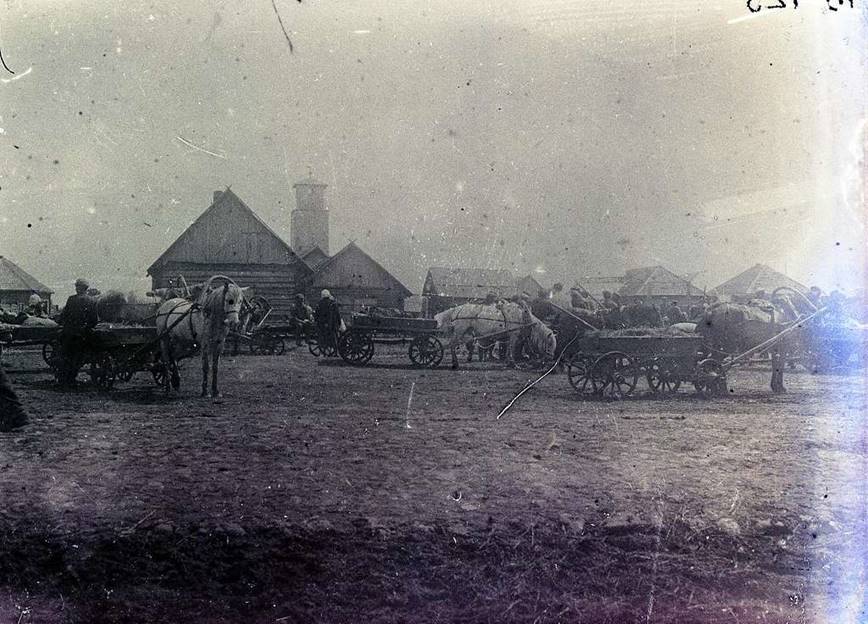
The Rebbe laughed heartily. “You can only be a balagoleh, Peiske!” And indeed, the Rebbe’s prophecy came true—Peiske became a balagoleh…
Peise the balagoleh was indeed a total am haaretz, but he was still a frum Jew—and a real fanatic. People tell this story about him: One erev Shabbos, he came late with his passengers and drove into Lubavitch after licht bentchen. Traveling past the Rebbe’s house, the Rebbe saw him through the window.
The Rebbe became very angry with Peise, and commanded him to unhitch the horses on the spot and not drive any further, because it was already Shabbos. Peise, of course, obeyed: he unhitched the horses in the middle of the street and remained seated next to them until motzei Shabbos…
Together with Chaim the chazan, I boarded Peise’s carriage. Peise himself climbed up onto the coach box, smacked his lips at his two “eagles,” and we set off on our way.
Green, fresh, early-summer fields stretched out before our eyes. It was a bright, sunny erev Shavuos day. Despite the sunny day and dry, refreshing breeze, the road was still quite muddy. In many spots, the mud was so deep and thick that the wagon and horses began to sink.
Peise had his work cut out for him. He would start by talking to his “eagles,” coaxing and urging them on: “Nu, Bulaner, move! And you, Viyatke, my little cat—cheer up! Lebediker!” But when the smooth talk failed, and the “eagles” stubbornly stood in the thick black mud with their foolish heads hanging down, Peise would fly into a rage and begin to pronounce “mi shebeirachs.”
He would curse all the way back to our ancestors. The curses and “well-wishes” would rain down, and their noise would mix with the sharp crack of his whip, the tapping of his heavy boots, and the scratching of his hairy neck. At last, the “eagles” would summon their courage and fly out victoriously from the devilish swamp.
Naturally, this journey took the entire day. We had to stop several times at an inn in order to drink, at least a few glasses of beer and to snack on some rock-hard, well-spiced gomolka cheese.
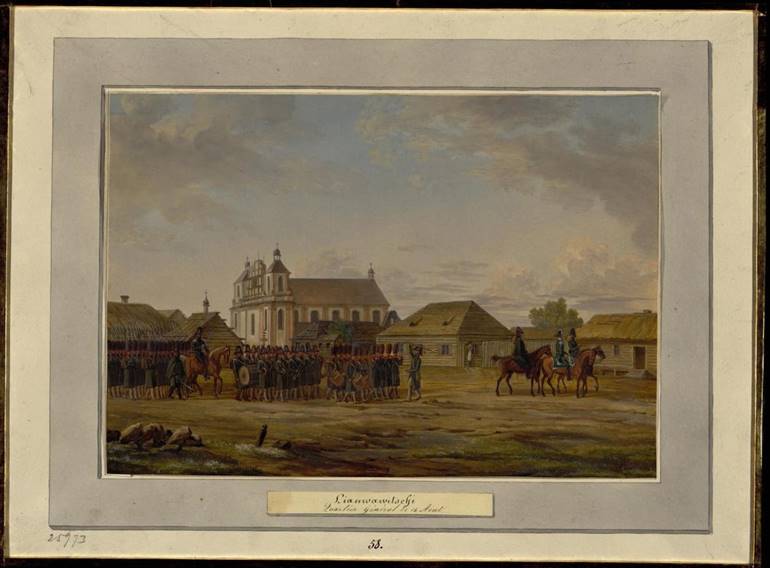
By nightfall, we began to see the first houses of Lubavitch. Straw roofs, small windows, set low to the ground, well poles. Dogs barking around—dogs are goyishe animals. Clearly these are goyishe homes.
Then we started to see pigs. Huge, greasy pigs wandering freely, lying as though in their father’s vineyard. In the thick, shiny mud, they oink, sniff, and smile up at the darkening sky… A long, black sow slinks past, and behind her runs a large drove of chubby, comically cheerful white piglets. I count them: exactly eighteen, chai… Pigs are also goyishe creatures. Clearly these are goyim living here as well.
And then we start to see goats. Goats of all colors, skinny, bearded, with big, sad, protruding eyes, and a bleating “meh-eh-eh…” Goats are already genuine, one-hundred-percent Yiddishe neshamos… And indeed, we began to see Jewish houses, with shingled roofs and mezuzos at the doors. Lights shine in the windows. It is already after sunset, Yom Tov, and, baruch Hashem, we are already in Lubavitch…
***
Lubavitch Personalities
Two Lubavitch personalities feature prominently in Gotlib’s account: “Chaim the chazan” and “Peise the balagoleh.”
“Chaim the chazan” clearly refers to R. Yechiel Halperin, a chazan in Lubavitch and a shadar on behalf of the yeshivah, who was indeed missing an eye (Reshimos R. Avraham Weingarten, Chanukah 5707, related by R. Shmuel Levitin). R. Yechiel was indeed a baal teshuvah, but Gotlib gives us an exaggerated legend about how this came about. The true story is related by the Frierdiker Rebbe in Sefer Hasichos 5705, pp. 25–26:
The chazan R. Yechiel Halperin’s grandfather was a chasid of the Alter Rebbe and was one of the first to travel to the agricultural colonies in the Yekaterinoslav region, settling in Golai Pal. . . .
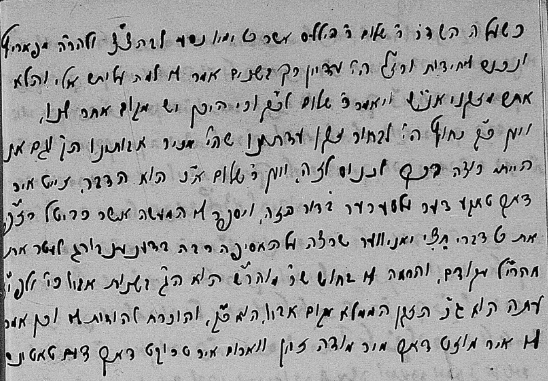
The National Library of Israel, Ms. Heb. 3278=28, p. 159
As time passed, and due to the life circumstances of the farmers, Yechiel was raised far from a proper Torah chinuch. A certain balabos helped him learn music because he had a good and pleasant voice. Afterward, he served as deputy director of the Maly Theater in Charkov. Once, the shadar R. Bere Wolf Kozevnikov came to Charkov, and when Yechiel heard from him about the chasidim, he was inspired, and immediately traveled to Lubavitch.
R. Yechiel arrived in Lubavitch in 5643, after the passing of the Rebbe Maharash. We know several minhagim thanks to R. Yechiel, as he was in Lubavitch for almost the entire first year after the passing of the Rebbe Maharash.
R. Yechiel later traveled to Moscow and served for many years as a chazan in one of the large shuls there.
In 5644, the Rebbe Rashab traveled to Moscow and stayed with R. Bere Monye’s, and R. Yechiel the chazan attended to him. On this occasion, the Rebbe Rashab taught R. Yechiel the chazan the “skarabove nusach” tunes for aleinu, hakohanim, atah konanta, slach lanu—ki anu amecha, and the pause in vekach hayah moneh achas.
R. Yechiel’s travels as a shadar brought him into contact with many elder chasidim, from whom he received a wealth of information and stories about the Rebbeim and chasidim. The stories he wrote were published by R. Yehoshua Mondshine in Migdal Oz, in the chapter titled Maasei Avosai.
Chabad researcher Yisrael Barda discovered R. Yechiel’s name on a 5702 list of internally displaced Russian refugees of World War II. According to this list, R. Yechiel was born in 5606. However, ages on Jewish Russian documents were often recorded inaccurately to help avoid the military draft.
*
Peise the balagoleh was a colorful character in Lubavitch, fondly remembered by many chasidim. A collection of stories about him was recently compiled by Mendel Teitelbaum and is published in the new Chabad journal, Sapir.
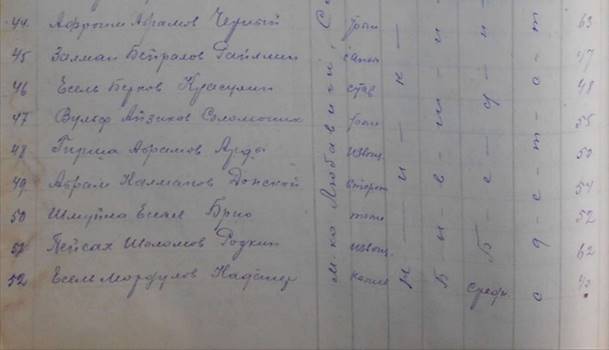
The stories about Peise paint a picture of an extremely simple man, beloved for his blunt straightforwardness and honesty. Interestingly, one of the stories recounts how the Rebbe Maharash rebuked him for traveling too close to the beginning of Shabbos (Likutei Sipurim, the Rebbe Maharash, 19). Mendel Teitelbaum also obtained a Russian document from 5684 listing his name.
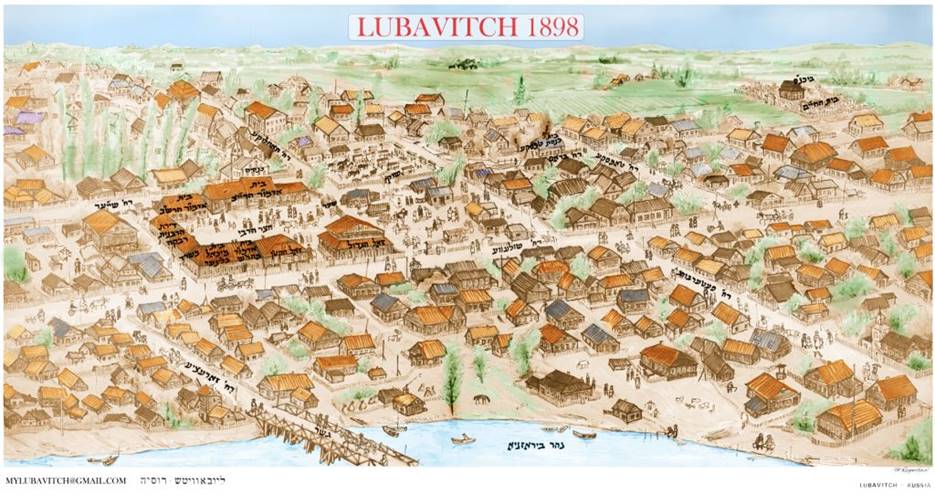
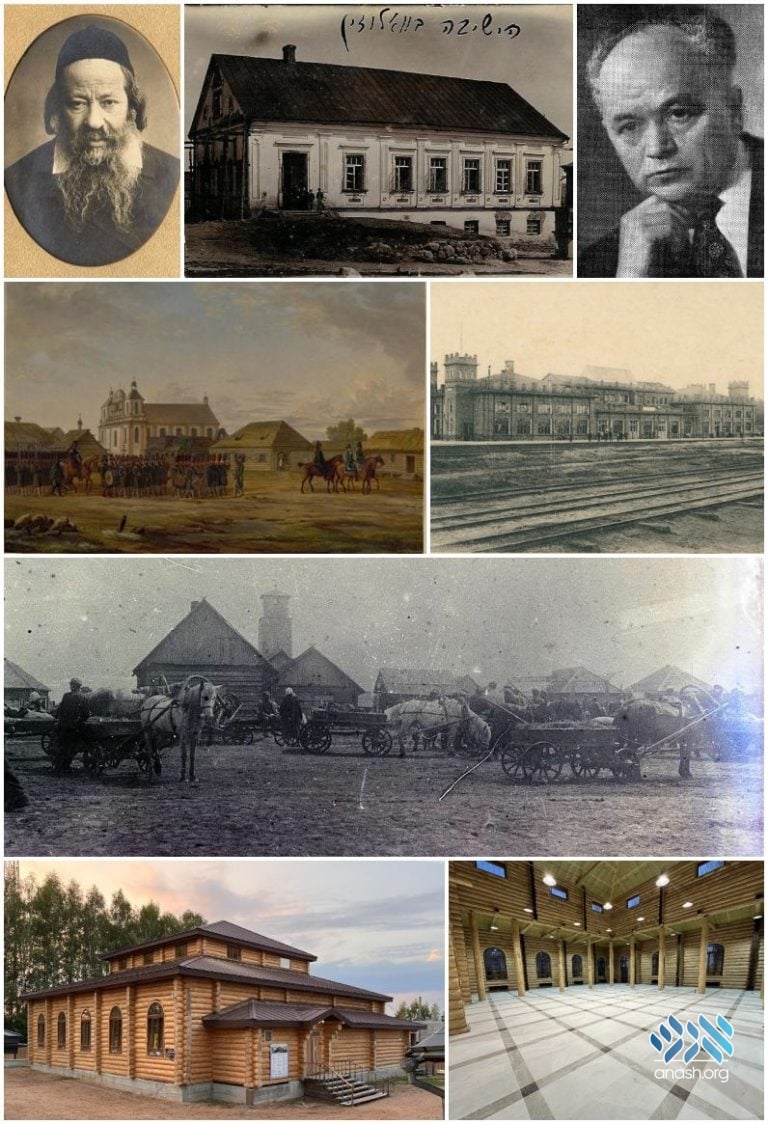
Thanks to Sholem Kubitshek for his help in locating the pictures of Lubavitch included in this article.
To view all installments of From the Margins of Chabad History, click here.
 COMMENTS


Kaydenev chasiduth is alive and well,contrary to this article.
The rebbe Rabbi Erlichh has built a flourishing chattzer in Bnai Brak with a yeshiva and kollel.the rebbe does outreach work and is a welcome visitor to the US,France and elsewhere.
I had the honor of speaking at a kabbolas panim for the rebbe several years ago.
Excellent article ישר כח
Great article.