The Australia series From the Margins of Chabad History continues, now relating the story of R. Chaim Yaakov Slonim of Chevron, a great-grandson of the Mitteler Rebbe who helped strengthen frum life in Ballarat and Melbourne at the turn of the century.
The first article of our Australia series told the stories of the first Chabad visitors to Australia—shadarim from Eretz Yisrael who visited between 1856 and 1878. The second article told the story of the fascinating and colorful story of R. Yosef Chaim Meizlish, the first Chabad chasid to settle in Australia. The present article is devoted to another early Chabad settler in Australia, R. Chaim Yaakov Slonim, a descendant of the Alter Rebbe.
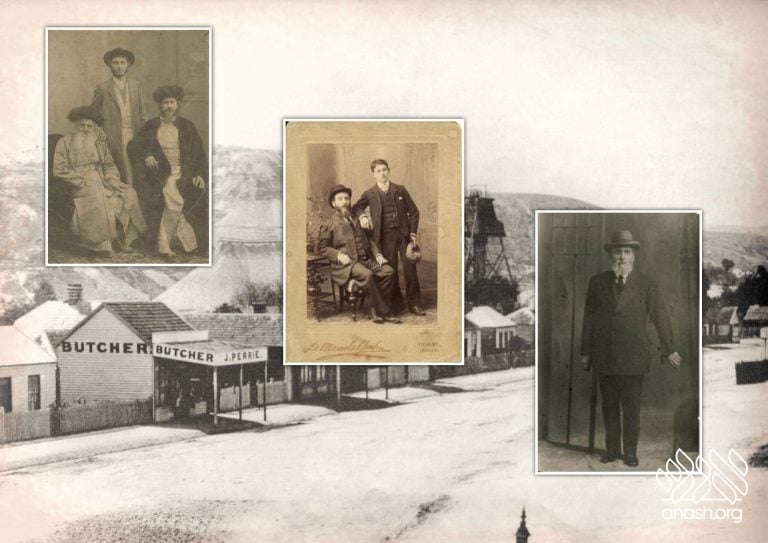
Harav Mordechai Dovber Slonim (L), his son Harav Shneur Zalman (R), and grandson R. Menachem Mendel Shmuel Slonim (ben R. Shneur Zalman) (C).
The famous Slonim family is Chabad royalty. The Mitteler Rebbe’s daughter Rebbetzin Menuchah Rachel (c. 5559-5648; 1798-1888) married Harav Yaakov Slonim (c. 5560-5617; 1800-1856), the son of Harav Zalman Reizes, a chasid of the Alter Rebbe and member of the wealthy and scholarly Slonim family of Shklov.
In around 5603-5605, the Tzemach Tzedek instructed the Slonim family, along with some other descendants of the Alter Rebbe, to move to Eretz Yisrael and settle in the holy city of Chevron. From the day of their arrival until the yishuv was destroyed in the massacre of 1929, the Slonim family were the leaders of the Chevron community and the most prestigious Chabad family in Eretz Yisrael. Until today, descendants of the family continue to play a prominent role in the Chabad community of Eretz Yisrael.
The best known of Rebbetzin Menuchah Rachel’s sons was Harav Mordechai Dovber Slonim. Born in Lubavitch in 5600 (1840), he was a child when the family settled in Chevron. Over the course of his long life (d. 5676; 1915), he served as the director of Kollel Chabad in Chevron and enjoyed a close relationship with the Rebbe Maharash and Rebbe Rashab.
Yaakov Slonim’s listing as a child on the Chevron Montefiore Census of 5626.
Harav Mordechai Ber’s patriarchal and sagely appearance became world-famous thanks to a series of pictures taken in Chevron in the early 1910s by Israeli photographer Shlomo Narinksy. When the pictures were included in a popular 1921 Palestine postcard series, they became classic stock portraits used to depict the Jews of the yishuv hayashan, or just old-time Jews in general. Interestingly, it is said that Harav Mordechai Ber bore a strong resemblance to his grandfather, the Mitteler Rebbe, of whom there is no picture.
Early Years in Chevron
The German passport of Sophie Bojarsky (Shosha Gittel Slonim), issued in Odessa, 1885.
Our protagonist R. Yaakov was born in Chevron in 5620 (1860), as the oldest son of Harav Mordechai Ber. At some point between the years 1885 and 1888, he married Shosha Gittel Boyarsky in Chevron.
Gittel was born in Konigsberg, Germany, in 1867 or 1868 to a prestigious Litvishe rabbonishe family. In 1885, young Gittel traveled alone to Eretz Yisrael, where her grandfather, Harav Shmuel Shlomo Boyarsky, had been living in Yerushalayim since 1857. Yaakov was over 25 at the time of their wedding, a relatively old age for the period.
We know that the chasunah took place before 1888, because Gittel knew Yaakov’s grandmother, Rebbetzin Menuchah Rachel, who passed in that year. She related a story about Rebbetzin Menuchah Rachel, which we will publish here, apparently for the first time.
R. Yaakov and Gittel Slonim with their children in Eretz Yisrael, c. 1896. (Courtesy of Yossi Wolko.)
In 1947, a young Yitzchak David Groner was sent to Australia to raise funds for Yeshivos Tomchei Temimim. Years later, he would go on to become Harav Yitzchak David Groner, the Rebbe’s shliach to Melbourne, but at this time, he was just a visitor. Before departing for this distant land, his mother, Menuchah Rachel Groner, a great-granddaughter of the original Rebbetzin Menuchah Rachel, told him that they had relatives in Australia he needed to visit, the family of Yaakov Slonim.
Upon arriving in Melbourne, R. Yitzchak David’s first stop was the Slonim home, where he met the elderly Gittel Slonim. Speaking about their shared ancestor, Gittel told him that Rebbetzin Menuchah Rachel would never get wet. Whenever it rained, she miraculously stayed dry. Gittel testified that she was an eyewitness to this when it rained at her wedding. Everyone present got wet, but when she touched Rebbetzin Menuchah Rachel, she felt that she was completely dry.
R. Yaakov Slonim’s signature on a decision of the Chevra Kadisha in Chevron, 12 Shevat 5645.
Rabbi Groner was very moved by this first-person account about his ancestor, particularly because he had heard from the Frierdiker Rebbe in a sichah just a few years earlier about this phenomenon that Rebbetzin Menuchah Rachel wouldn’t get wet. The Frierdiker Rebbe related the story behind this wonder: When Rebbetzin Menuchah Rachel embarked on her journey to Eretz Yisrael, she told the Tzemach Tzedek that she worried about the rain on the way, which could make her get sick. The Tzemach Tzedek dismissed her concern and told her, “Nu, so what? You’ll go between the raindrops” (Sefer Hasichos 5704, p. 22)
(As heard from Yossi Wolko and Andrew Sharpe, who heard the story from Rabbi Groner. Others who heard the story from Rabbi Groner do not recall whether it was related about Gittel’s own wedding.)
R. Yaakov Slonim lived the first 41 years of his life in Eretz Yisrael, but we don’t know much about his activities in this period. His name appears a few times in the ledger of the Chevron Chevra Kadisha, including once as a decision maker.
We also know that he was involved in the founding of Yeshivas Magen Avos, a Chabad yeshivah established in Chevron in 1889. His name appears on an appeal for funding addressed to the Vaad Hapekidim Veha’amarkalim of Amsterdam in Teves 5650 (1889-1890), and in a document signed on 13 Adar of the same year, he and the other directors of the yeshivah transferred responsibility for the mosad to Harav Shlomo Yehudah Leib Eliezerov (Toldos Chabad Be’eretz Hakodesh, p. 166).
R. Yaakov Slonim’s signature on an appeal by Yeshivas Magen Avos in Chevron to the Vaad Hapekidim Veha’amarkalim of Amsterdam, Teves 5650
Arriving in Australia
R. Yaakov and Mendel Slonim, shortly after arriving in Australia. (Courtesy of Yossi Wolko.)
On August 15, 1901, Yaakov Slonim arrived at the port of Melbourne, Australia on the Le Polynésien, together with his 12-year-old son, Menachem Mendel. Gittel and the family’s other children remained in Eretz Yisrael for the time being.
What led this scion of Chabad royalty, a great-grandson of the Mitteler Rebbe to make the journey from the holy city of Chevron to the most remote country in the world? We don’t know R. Yaakov’s precise individual circumstances, but we’ve already seen that others had made the same journey in search of a better livelihood, such as Yosef Chaim Myslis, who Yaakov would have known well growing up together in Chevron.
Le Polynésien, the boat that brought R. Yaakov to Australia.
One family tradition reports that R. Yaakov, who was living in Yaffo, had just been overlooked for a rabbinical position. Indeed, his younger brother Harav Shneur had been appointed as the rov of the chasidishe community in Yaffo a year earlier. But firm evidence is lacking.
The Bendigo Synagogue on Hopetoun Street, not long before it was demolished in 1926.
Another undocumented piece of family lore maintains that R. Yaakov had actually visited Australia in the 1890s to collect money for the Chabad community in Chevron. He had made good local contacts on his visit, so Australia was a natural choice for him as he sought an opportunity to make better parnasah.
Hargreaves Street, Bendigo, pictured in 1907.
At any rate, R. Yaakov and his son Mendel first lived in Bendigo, a thriving mining city in the state of Victoria. Living on Hargreaves Street, Yaakov worked as a draper, selling cloth and clothing. Family tradition relates that he gave up the opportunity of a partnership in a store in Bendigo because the store would be open on Shabbos. That little store was the first of what would later become the multi-billion-dollar Australian department store chain Myer, but Shabbos was more precious to R. Yaakov than money.
Ballarat
After living in Bendigo for three years, R. Yaakov and Mendel moved to Ballarat, another thriving city in regional Victoria. While Bendigo also had a shul during this period, and R. Yaakov helped lead the tefilos there, Ballarat’s Jewish community was better established and included a number of very frum families, including several who had also come from Eretz Yisrael.
Hummffray St., Ballarat, c.1900
Not long after moving to Ballarat, R. Yaakov’s name turns up for the first time in the Australian press, after he was hurt in a horse accident. The Bendigo Independent reported on the accident of their former resident (January 10, 1905):
AN EX-BENDIGONIAN INJURED. BALLARAT, Monday, January 9. A sensational bolt occurred this afternoon, resulting in a draper named Jacob Slonim, residing in Humffray Street, formerly of Hargreaves Street, Bendigo, meeting with serious injuries. Whilst driving down a hill the horse bolted, and, turning into Peel Street, the vehicle capsized, and Slonim was thrown into the water channel. He was unconscious when picked up and suffering from concussion of the brain and shock to the system. Tonight, however, he had greatly improved.
Another news report from this period recounts the story of theft from the Slonim’s cart, operated by Mendel.
R. Yaakov and Gittel Slonim (Courtesy of Yossi Wolko)
After a separation of almost five years, the family was finally reunited in April 1906, when Gittel (Gertrude) Slonim and the children arrived in Australia. It is possible that the initial plan had been for Yaakov to move to Australia temporarily, and the decision to resettle permanently was only made in 1906. Later this year, Yaakov applied for Australian citizenship.
Gittel and the children arrived on a boat from Berlin, presumably making a stop in Germany to visit Gittel’s family.
The family reunion in Australia was only partially complete, as Yaakov and Gittel’s oldest daughter, Shterna Beila, remained behind. Beila was 18 already, so she stayed with her grandparents in Chevron, where she would have better shiduch prospects. Indeed, Beila married her cousin Shneur Zalman Fondaminsky, a descendant of the Alter Rebbe’s son Harav Moshe, and the son of Harav Chaim Avraham Fondaminsky, a prominent figure in the Chevron community.
The Ballarat Synagogue, pictured around the time of its dedication in 1861. This is the oldest original shul building on mainland Australia.
With his learned background, Yaakov Slonim naturally became one of the leaders of the Jewish community in Ballarat, filling important functions in the community, including serving as the baal tokeah.
In 1906, the rabbi of the Ballarat Hebrew congregation, Reverend Israel Morris Goldreich, passed away, and a dispute arose in the community over the appointment of his successor.
One faction in the community wished to appoint R. Benzion Lenzer as the rabbi. Born in Krichev, White Russia, in 1872, R. Lenzer arrived in Australia in 1894, joining his older brother Yaakov (1858-1921), a talmid of Volozhin who had arrived in Australia three years earlier to serve as the rabbi of the East Melbourne Synagogue. Krichev was a Chabad stronghold, so it is possible that the Lenzer brothers had some chasidishe background.
R. Benzion Lenzer (1872-1937)
R. Benzion served as a shochet in Perth for a few years and arrived in Ballarat in 1905 to assist the elderly R. Goldreich. Now that R. Goldreich had passed, R. Benzion Lenzer was his natural successor.
But another faction in the community objected to R. Benzion’s appointment. The reasons for their objection to him aren’t completely clear, but it was the more traditionalist members of the community who opposed him. The Chief Rabbi of England, Rabbi Joseph Hertz, recommended Reverend Joseph Julius Rosin, a Latvian-born rabbi serving at the Wolverhampton Synagogue in England at the time, for the Ballarat position. A vote was finally held in 1908, and R. Benzion Lenzer was elected rabbi of the Ballarat Hebrew Congregation.
The traditionalist faction refused to accept the results and announced the formation of a breakaway shul. R. Yaakov Slonim was one of the members of the committee of the new shul. Melbourne’s Jewish Herald (September 4, 1908) reported on the events:
ANOTHER CONGREGATION FORMED; IMMEDIATE ACTION TAKEN.
Following the election of minister of the Ballarat Hebrew Congregation, an enthusiastic meeting of the supporters of the Rev. Mr. Rosin was held. Mr. H. J. Jones occupied the chair. About twenty-two persons were present, including the treasurer, hon. secretary, a trustee and two committeemen of the Ballarat Congregation.
Aaron Moshe Grinblat (1860-1919) was born in Salant, Lithuania, and moved to Yerushalayim. He immigrated to Australia in 1892.
Dissatisfaction was expressed at the result of the election held that day, and much sympathy was felt for the position in which the Chief Rabbi had been placed. It was unanimously resolved to form another congregation, and those present intimated the amount per week they intended to subscribe, which was considered sufficient to procure a shochet, teacher, etc. Large sums of money were promised, if found necessary to make the new congregation a success.
The board of management was then elected, as follow: President, Mr. Mark Rosenblatt; treasurer, Mr. Chas. Herman; hon. secretary, Mr. S. Spielvogel; committee, Messrs. A. H. Jones, R. S. Simmons, Z. Metz, A. M. Grinblatt, and J. Slonim. Power was given the above officers to arrange for services, and particularly each morning during the month of Ellul.
At a meeting of the committee of the new congregation it was recommended to call the congregation “Mikveh Yisrael.” It was also decided to take steps to register, etc., without delay.
The newly-formed congregation were successful in obtaining a Sepher Torah through the instrumentality of the treasurer, Mr. C. Herman, and services throughout the week mornings, as well as last Sabbath, were well attended.
R. Moshe Mordechai Levy (courtesy of Lainey Melnick)
The newly formed “Central Hebrew Congregation” of Ballarat appointed R. Moshe (Morris) Mordechai Levy to serve as their rabbi. R. Levy had an illustrious Chabad background—he was a member of the Meisels family, descendants of the Alter Rebbe’s chasid Harav Moshe Meisels. A nephew of R. Yosef Chaim Myslis, the subject of our previous article, R. Levy had been living in Perth with his uncle until the invitation came from Ballarat.
Under R. Levy’s leadership, the shul formed a daily Hebrew school, attended by 30-35 children. Soon after the founding of the new shul, Yaakov Slonim arranged for the purchase of a new Sefer Torah through his brother Harav Shneur, the rov of Yaffo. The Hebrew Standard of Australasia reported on the hachnasas Sefer torah (July 2, 1909):
BALLARAT. A special service was held on Sunday last by the Central Hebrew Congregation on the occasion of the dedication of a Sepher Torah. A large attendance of members was present. The Rev. M. M. Levy officiated and recited special psalms. The Torah was then taken from the Ark and carried round the Synagogue, while a choir of 30 voices sang hymns suitable to the occasion. The Sepher, which is a very fine one, was purchased by Rabbi Shmer Slonim on behalf of the Central Congregation in Jaffa, Palestine.
Harav Shneur Slonim (l) at a family chasunah during his later years. Seated to his right is his son Harav Yaakov Yosef Slonim (1880-1937), the last Ashkenazi Rov of Chevron. (Courtesy of Yossi Wolko.)
After the service an adjournment was made to the schoolroom, where the members were invited to partake of refreshments. Mr. M. Rosenthal occupied the chair, and he was supported on his right by Mr. H. S. Simmons. During the proceedings, Mr. J. Bernstein presented to the Congregation a handsome solid silver “Yod” for the new Torah. The gift was received with great applause. After a long toast list, the proceedings were brought to a close.
A 1910 article from The Hebrew Standard of Australasia gives us a window into the vibrant life of the new shul and the prominent role R. Yaakov Slonim played in it (November 4, 1910):
BALLARAT. The New Year holydays, Yom Kippur and Succoth, passed off very well here. The weather was all that could be desired and attendance at the Synagogue on all occasions was very satisfactory. The services at the Central Hebrew Congregation were conducted by Rev. M. M. Levy, assisted by Messrs. M. Rosenthal and J. Slonim, who carried out their duties in a manner that deserved great credit.
The Ballarat Hebrew Congregation, as it appears today. The shul continues to operate.
The honours of Chasan Torah and Berishis were bestowed on Rev. M. M. Levy and Mr. H. S. Simmons. On Wednesday afternoon Rev. Levy entertained a large number of friends at his residence, while on Shabbath Mr. H. S. Simmons did likewise.
The usual “Learning” of Hoshana Rabba was held at the residence of Mr. J. Bernstein and was well attended. Refreshments were served, with Mrs. Bernstein, Mrs. H. S. Simmons and Mrs. B. Stone seeing to the comfort of those present.
On Thursday night, October 27, the Young People’s Zionist Society held a Simchath Torah ball at the Fire Brigade Hall, at which many invitations were accepted. Dancing and games continued until the early hours of the morning. During the interval a short toast list was gone through, the chair being occupied by the President, Rev. M. M. Levy. The arrangements were carried out by the Hon. Secretary, Aub. M. Simmons, and the Treasurer, Sam Grinblat. . . .
R. Yaakov Slonim (Courtesy of Yossi Wolko)
The annual meeting and election of officers of the Central Congregation was held on Sunday, October 30. Mr. M. Rosenthal, President, occupied the chair and there was a large attendance. The balance sheet and reports, adopted on the motion of Messrs. J. Bernstein and J. Slonim, showed the past year had been successful, with a credit balance carried forward. Special mention was made of the good work done by Rev. M. M. Levy in the Synagogue services and Hebrew School. Progress in the children’s Hebrew education was noted, and his salary was increased. A special vote of thanks was passed to Mr. J. Slonim for his services as Baal Tekiah during the recent High Festivals.
Mr. Rosenthal declined renomination as President and thanked members for their support. He nominated Mr. H. S. Simmons, who was elected President. The other office-bearers elected were: Treasurer, Mr. M. Rosenthal; Hon. Secretary, Mr. S. Spielvogel; Committee, Messrs. A. H. Jones, Z. Metz, W. Grinblat, M. Gordon, and I. Berman.
After minor matters were addressed, a vote of thanks was passed to the chairman and the meeting closed. Members were later entertained by the newly elected President at his residence, where appropriate toasts were honoured and an enjoyable time was spent.
During this time, R. Yaakov Slonim was active in collecting money for Kollel Chabad in Eretz Yisrael. The Kollel Chabad contact list from 1908-1914 lists him as a contact, along with other leaders of the Ballarat breakaway shul, brothers Wolf and Aaron Moshe Grinblat, and Solomon Spielvogel.
The Ballarat contacts in the Kollel Chabad contact list. (Courtesy of Yisrael Barda.)
As none of the other contacts on the list have any Chabad connection of their own, it seems that R. Yaakov had solicited them for tzedakah for Kollel Chabad.
As motivated and passionate as the members of the breakaway shul were, ultimately, there were simply not enough Jews in town to maintain two separate shuls. The community had numbered only several dozen families to begin with, and by now it was dwindling, with families moving to the larger city of Melbourne. By the Yamim Noraim of 5674 (1913), the two shuls had merged back together, and R. Yaakov was once again leading the tefilos in the unified shul. The Hebrew Standard of Australasia, October 24, 1913:
The interior of the Ballarat Shul.
BALLARAT. The services for the High Holydays at the Synagogue were largely attended, when Rev. B. Lenzer, assisted by Mr. J. Slonim, officiated. Addresses were given by Rev. Mr. Lenzer on the first day of Rosh Hashanah, on Kol Nidrei night, and during the day on Yom Kippur. In honour of the Succoth festival, the usual number of Succahs have been erected, among them those of Rev. J. Lenzer, Messrs. J. Bernstein, M. Rosenthal, J. Slonim, W. Grinblat, and several others.
R. Yaakov’s name continues to show up in subsequent reports about Jewish life in Ballarat, regularly serving as the baal tokeah, chazan, and leining the megillah. When the rabbi was absent, R. Yaakov would substitute for him.
Melbourne
Approximately in 1920, R. Yaakov also left the dwindling Ballarat community and settled in North Carlton, a suburb in Melbourne heavily populated by Yiddish-speaking Jewish refugees from Eastern Europe that was quickly emerging as the beating heart of Jewish life in Australia.
R. Wolf Davis’s residence on 1 Drummond St., Carlton, and the first home of the Woolf Davis Chevra.
In Melbourne, R. Yaakov joined the Woolf Davis Chevra. Established by R. Klonymus Zev (Woolf) Davis (1828-1902), the pillar of the fully frum community in Melbourne, the Chevra was now run by his son-in-law, R. Yosef (Joseph Ernest) Stone.
The Chevra, also known as Stone’s Shul, was a genuine old-fashioned frum shul. The shul charged no money for seats and paid no money for rabbonim, chazanim, and the like. People donated to the shul as much as they liked, and all surplus funds were distributed to tzedakah, primarily for Eretz Yisrael.
Here R. Yaakov would have felt truly at home, and he served as the President of the Chevra, a chazan, baal koreh, and baal tokeia.
After over 20 years of separation, in 1924, R. Yaakov was finally reunited with his daughter Beila Fondaminsky (Fonda) when she arrived in Melbourne with her two daughters. The Australian Jewish Herald reported on the joyous reunion (February 1, 1924)
Mrs. Fonda, accompanied by her two younger children, Roma and Ziona, arrived from Palestine by the Esperance Bay last week. Mrs. Fonda is the daughter of Mr. and Mrs. J. Slonim, of “Beth-Sholem,” Station-street, North Carlton, formerly of Ballarat. The reunion was a very happy one, as Mrs. Fonda had not seen her parents for many years.
Two years later, Beila’s husband, Shneur Zalman, arrived on the Oronsay boat to join the family, bringing their other two children with him. Finally, after 25 years, the family was complete again. His own family reunited, R. Yaakov now embarked on a journey of his own, to visit his extended family in Eretz Yisrael, whom he hadn’t seen since he left in 1901.
Shneur Zalman Fonda (1886-1979)
The Australian Jewish Herald reported on the Slonim family’s arrivals and departure (April 8, 1926):
Mr S. S. Fonda, son-in-law of Mr J. Slonim, of “Beth-Sholem,” Station street, North Carlton, arrived on the Oronsay with his two children to join his wife. On the same boat, which sails on April 20, Mr Slonim is leaving for a pleasure trip to Palestine. During his sojourn there he will be the guest of his brother, Rabbi Shnaier Zelman Slonim, Chief Rabbi of Jaffa.
R. Yaakov spent most of the year in Eretz Yisrael, returning to Melbourne at the end of 1926. Melbourne’s Table Talk magazine reported (January 13, 1927):
A WELCOME HOME. There was a happy gathering of relatives and friends on December 21 at the home of Mr. and Mrs. G. Slonim, of “Beth-Sholem,” Station Street, North Carlton, on the occasion of the homecoming of Mr. Slonim from Palestine. After an absence of many years, Mr. Slonim had visited the Holy Land, renewed old friendships, and been united with his relatives once again. During the evening he had many interested listeners as he spoke of his trip.
Australian Jewish clergy at the dedication of the new St Kilda Synagogue, 13 March 1927. R-L: R. Jacob Danglow, R. Dr. Joseph Abrahams, R. Solomon Zvi Mestel, R. Francis L. Cohen, R. J. Falk, R. Israel Brodie
At supper, Rabbi Mestel, M.A., made an impressive speech of welcome, and referred to the great personal regard he had for Mr. Slonim. All relatives and friends expressed delight in having Mr. Slonim among them once again. Mr. Slonim thanked them all for their kind remarks and good wishes.
Passing
R. Yaakov passed away in Melbourne on 9 Adar, 5688 (1928). The Australian Jewish Herald published a lengthy obituary mourning this learned stalwart of the community, including the moving hesped delivered by R. Solomon Mestel, rabbi of the East Melbourne synagogue (March 15, 1928).
Mr. Jacob Slonim, who had been ill for the past six months, passed away on Thursday morning, March 1, at his late residence, “Beth Sholem,” 228 Station-street, North Carlton.
R. Yaakov Slonim (Courtesy of Yossi Wolko)
Born in Hebron, Palestine, 67 years ago, the late Mr. Slonim was possessed of a very profound knowledge of Jewish learning, excelling himself in Talmud and Kabala (mysticism). He received his earlier Hebrew education from his late father, Rabbi Mordecai Dave Slonim, afterwards entering the Yeshiva in Hebron, where he spent many years in hard study. The late Mr. Slonim belonged to the Chasidim, and was a great-grandson of the great Shneir Zalman Shnevison.
He occupied the position of President and Vice-President of the Woolf Davis Chevra, Pitt-street, Carlton, where he very ably acted as Baal Tefillah, Baal Keriah and Baal Tekiah. He was actively associated with the Melbourne Chevra Kadisha.
Early in 1926 he went for a trip to Palestine, and visited the old sacred and historic places, including his birthplace. He returned to Melbourne in December of the same year in splendid health, and as zealous as ever in collecting money for the charitable institutions in Palestine.
Pitt Street, Carlton, home to the Woolf Davis Chevra (Stone’s Shul) between 1920 and 1965.
The funeral, which was largely and representatively attended, left his late residence on Thursday afternoon. The cortege halted outside the Woolf Davis Chevra, where appropriate Psalms were read.
At the graveside, Rabbi S. M. Mestel, M.A., delivered the following address:—
My dear Friends,— Our community has been cast into great mourning. I can say in the words of the prophet Jeremiah, “I have seen the affliction in its great severity.” Severe is the blow which the death of Chayom Yaakob Slonim struck at his family, at his friends, at all that came in contact with him, and at the whole community. I mourn over him as one mourns over an only one. I exclaim, “Thy beauty, O Israel, upon thy high places is slain.” For with the demise of Chayom Yaakob Slonim a beautiful personality departed from our midst.
Beautiful was his exemplary Jewish home life. Beautiful were the family gatherings at his home, of which he was the adornment. Beautiful was his zeal towards our ancient literature. Beautiful was his activity as Gabbai of the “Woolf Davis Chevrah,” where he acted as Baal Tefillah, Baal Korei and Baal Tokeah. Beautiful was the good work he performed as a member of the Board of the Chevrah Kadishah. Beautiful were his deeds towards the poor in the Holy Land. Beautiful was the resignation, patience and faith with which he bore his suffering during the long months of his illness.
R. Yaakov Slonim (Courtesy of Yossi Wolko)
He considered his affliction as a chastisement of love inflicted upon him by our Father in Heaven as an atonement for sins that he may have committed. Of Chayom Yaakob Slonim we may say that which was said at the demise of one of the great Rabbis: “The angels were contending with the denizens of the earth for the possession of the body that contained a beautiful soul, and the angels carried off the victory, and Chayom Yaakob Slonim is gone where so many have gone before him.”
But there is a difference. Happy art thou, Chayem Yaakob Slonim, that thou hast been reared and brought up in the spirit of the Torah, and that thou hast toiled in the Law and hast endeavoured to do the will of thy Creator; that thou hast brought great sacrifices for thy religious convictions, particularly during the years thou hast spent in this country; that thou hast departed this life, leaving behind a good name.
The Psalmist says, “Dear in the eyes of the Lord is the death of His pious ones,” which could refer only to such a case as ours. The death of a father like Chayem Yaakob Slonim must serve as an urge to his children for excelling in good deeds. The father spent a life scattering far and wide deeds of piety and benevolence. May the hour of his demise prove, on the part of his children, the beginning of increased activity and usefulness in our community, and thus the more prove themselves descendants worthy of such a father.
Chayem Yaakob Slonim, farewell, and may thy soul be bound up with all the righteous that departed this life before thee.—Amen.
R. Yaakov’s wife Gittel outlived him, passing away over 20 years later on 14 Adar II, 5708 (1948). The Australian Jewish Herald carried an obituary for her (April 2, 1948):
Obituary—MRS. G. SLONIM.
A large number of people attended the funeral on Thursday of last week of Mrs. Gertrude Slonim, at which Rabbi J. L. Gurewicz officiated.
Harav Yosef Lipman Gurevich, rov of Carlton from 1932 until his passing in 1956.
Mrs. Slonim was born in Konigsberg, East Prussia, and was the daughter of Rabbi Avigdor Boyarski. In order to give her a real Jewish upbringing and education, her father sent her to his father, Rabbi Samuel Solomon Boyarski, of Jerusalem, and it was in Palestine that she married Jacob Haim Slonim, a member of the distinguished Slonim family of Palestine.
Mrs. Slonim inherited the true Jewish national and religious spirit of her family. At all available opportunities, she used to send help and sustenance to numerous associations and institutions in Palestine.
On Sunday night, Rabbi Gurewicz gave a Hesped after the Minyan. He paid tribute to the late Mrs. Slonim’s strong Jewish feeling.
The graves of R. Yaakov and Gittel Slonim (Courtesy of Yossi Wolko)
As the head of the Slonim family, she had imbued her children with a true Jewish outlook on life, and had kept all the members of the family as one single unit. “Her family can be comforted in their sad loss by following the example set by her, and thus enable her memory to live on.”
R. Yaakov Slonim (Courtesy of Yossi Wolko)
R. Yaakov Slonim’s mesiras nefesh for Yiddishkeit in Australia influenced the communities in which he lived, helping to raise the standard of Yiddishkeit in both Ballarat and Melbourne. His children were active members and leaders in the Melbourne Jewish community, including his son Mendel, who served as the President of the large Carlton United Hebrew Congregation and was a key player in the appointment of Harav Yosef Lipman Gurevitch from Vilna as the rov of Carlton, and the first genuine rov and talmid chacham to serve the Australian Jewish community long-term.
When Rabbi Groner made his aforementioned first visit to Australia in 1947, Mendel Slonim served as a treasurer for the collection, alongside Joseph Feglin, the son of R. Moshe Zaman Feiglin.
Many of R. Yaakov’s descendants continue to serve in prominent positions in the Australian Jewish community. Among them are the Wolko family of Melbourne, who have returned to their ancestor’s Chabad roots.
Thanks to R. Yaakov’s descendants, Yossi Wolko, Aaron Wolko, and Andrew Sharpe, for providing pictures, documents, and family traditions about their ancestor.
To view all installments of From the Margins of Chabad History, click here.
For additional exclusive content, follow the column on X: x.com/ChabadMargins
COMMENTS
We appreciate your feedback. If you have any additional information to contribute to this article, it will be added below.
The Australia series From the Margins of Chabad History continues, now relating the story of R. Chaim Yaakov Slonim of Chevron, a great-grandson of the Mitteler Rebbe who helped strengthen frum life in Ballarat and Melbourne at the turn of the century.
By Anash
Introduction
The first article of our Australia series told the stories of the first Chabad visitors to Australia—shadarim from Eretz Yisrael who visited between 1856 and 1878. The second article told the story of the fascinating and colorful story of R. Yosef Chaim Meizlish, the first Chabad chasid to settle in Australia. The present article is devoted to another early Chabad settler in Australia, R. Chaim Yaakov Slonim, a descendant of the Alter Rebbe.
Harav Mordechai Dovber Slonim (L), his son Harav Shneur Zalman (R), and grandson R. Menachem Mendel Shmuel Slonim (ben R. Shneur Zalman) (C).
The famous Slonim family is Chabad royalty. The Mitteler Rebbe’s daughter Rebbetzin Menuchah Rachel (c. 5559-5648; 1798-1888) married Harav Yaakov Slonim (c. 5560-5617; 1800-1856), the son of Harav Zalman Reizes, a chasid of the Alter Rebbe and member of the wealthy and scholarly Slonim family of Shklov.
In around 5603-5605, the Tzemach Tzedek instructed the Slonim family, along with some other descendants of the Alter Rebbe, to move to Eretz Yisrael and settle in the holy city of Chevron. From the day of their arrival until the yishuv was destroyed in the massacre of 1929, the Slonim family were the leaders of the Chevron community and the most prestigious Chabad family in Eretz Yisrael. Until today, descendants of the family continue to play a prominent role in the Chabad community of Eretz Yisrael.
The best known of Rebbetzin Menuchah Rachel’s sons was Harav Mordechai Dovber Slonim. Born in Lubavitch in 5600 (1840), he was a child when the family settled in Chevron. Over the course of his long life (d. 5676; 1915), he served as the director of Kollel Chabad in Chevron and enjoyed a close relationship with the Rebbe Maharash and Rebbe Rashab.
Yaakov Slonim’s listing as a child on the Chevron Montefiore Census of 5626.
Harav Mordechai Ber’s patriarchal and sagely appearance became world-famous thanks to a series of pictures taken in Chevron in the early 1910s by Israeli photographer Shlomo Narinksy. When the pictures were included in a popular 1921 Palestine postcard series, they became classic stock portraits used to depict the Jews of the yishuv hayashan, or just old-time Jews in general. Interestingly, it is said that Harav Mordechai Ber bore a strong resemblance to his grandfather, the Mitteler Rebbe, of whom there is no picture.
Early Years in Chevron
The German passport of Sophie Bojarsky (Shosha Gittel Slonim), issued in Odessa, 1885.
Our protagonist R. Yaakov was born in Chevron in 5620 (1860), as the oldest son of Harav Mordechai Ber. At some point between the years 1885 and 1888, he married Shosha Gittel Boyarsky in Chevron.
Gittel was born in Konigsberg, Germany, in 1867 or 1868 to a prestigious Litvishe rabbonishe family. In 1885, young Gittel traveled alone to Eretz Yisrael, where her grandfather, Harav Shmuel Shlomo Boyarsky, had been living in Yerushalayim since 1857. Yaakov was over 25 at the time of their wedding, a relatively old age for the period.
We know that the chasunah took place before 1888, because Gittel knew Yaakov’s grandmother, Rebbetzin Menuchah Rachel, who passed in that year. She related a story about Rebbetzin Menuchah Rachel, which we will publish here, apparently for the first time.
R. Yaakov and Gittel Slonim with their children in Eretz Yisrael, c. 1896. (Courtesy of Yossi Wolko.)
In 1947, a young Yitzchak David Groner was sent to Australia to raise funds for Yeshivos Tomchei Temimim. Years later, he would go on to become Harav Yitzchak David Groner, the Rebbe’s shliach to Melbourne, but at this time, he was just a visitor. Before departing for this distant land, his mother, Menuchah Rachel Groner, a great-granddaughter of the original Rebbetzin Menuchah Rachel, told him that they had relatives in Australia he needed to visit, the family of Yaakov Slonim.
Upon arriving in Melbourne, R. Yitzchak David’s first stop was the Slonim home, where he met the elderly Gittel Slonim. Speaking about their shared ancestor, Gittel told him that Rebbetzin Menuchah Rachel would never get wet. Whenever it rained, she miraculously stayed dry. Gittel testified that she was an eyewitness to this when it rained at her wedding. Everyone present got wet, but when she touched Rebbetzin Menuchah Rachel, she felt that she was completely dry.
R. Yaakov Slonim’s signature on a decision of the Chevra Kadisha in Chevron, 12 Shevat 5645.
Rabbi Groner was very moved by this first-person account about his ancestor, particularly because he had heard from the Frierdiker Rebbe in a sichah just a few years earlier about this phenomenon that Rebbetzin Menuchah Rachel wouldn’t get wet. The Frierdiker Rebbe related the story behind this wonder: When Rebbetzin Menuchah Rachel embarked on her journey to Eretz Yisrael, she told the Tzemach Tzedek that she worried about the rain on the way, which could make her get sick. The Tzemach Tzedek dismissed her concern and told her, “Nu, so what? You’ll go between the raindrops” (Sefer Hasichos 5704, p. 22)
(As heard from Yossi Wolko and Andrew Sharpe, who heard the story from Rabbi Groner. Others who heard the story from Rabbi Groner do not recall whether it was related about Gittel’s own wedding.)
R. Yaakov Slonim lived the first 41 years of his life in Eretz Yisrael, but we don’t know much about his activities in this period. His name appears a few times in the ledger of the Chevron Chevra Kadisha, including once as a decision maker.
We also know that he was involved in the founding of Yeshivas Magen Avos, a Chabad yeshivah established in Chevron in 1889. His name appears on an appeal for funding addressed to the Vaad Hapekidim Veha’amarkalim of Amsterdam in Teves 5650 (1889-1890), and in a document signed on 13 Adar of the same year, he and the other directors of the yeshivah transferred responsibility for the mosad to Harav Shlomo Yehudah Leib Eliezerov (Toldos Chabad Be’eretz Hakodesh, p. 166).
R. Yaakov Slonim’s signature on an appeal by Yeshivas Magen Avos in Chevron to the Vaad Hapekidim Veha’amarkalim of Amsterdam, Teves 5650
Arriving in Australia
R. Yaakov and Mendel Slonim, shortly after arriving in Australia. (Courtesy of Yossi Wolko.)
On August 15, 1901, Yaakov Slonim arrived at the port of Melbourne, Australia on the Le Polynésien, together with his 12-year-old son, Menachem Mendel. Gittel and the family’s other children remained in Eretz Yisrael for the time being.
What led this scion of Chabad royalty, a great-grandson of the Mitteler Rebbe to make the journey from the holy city of Chevron to the most remote country in the world? We don’t know R. Yaakov’s precise individual circumstances, but we’ve already seen that others had made the same journey in search of a better livelihood, such as Yosef Chaim Myslis, who Yaakov would have known well growing up together in Chevron.
Le Polynésien, the boat that brought R. Yaakov to Australia.
One family tradition reports that R. Yaakov, who was living in Yaffo, had just been overlooked for a rabbinical position. Indeed, his younger brother Harav Shneur had been appointed as the rov of the chasidishe community in Yaffo a year earlier. But firm evidence is lacking.
The Bendigo Synagogue on Hopetoun Street, not long before it was demolished in 1926.
Another undocumented piece of family lore maintains that R. Yaakov had actually visited Australia in the 1890s to collect money for the Chabad community in Chevron. He had made good local contacts on his visit, so Australia was a natural choice for him as he sought an opportunity to make better parnasah.
Hargreaves Street, Bendigo, pictured in 1907.
At any rate, R. Yaakov and his son Mendel first lived in Bendigo, a thriving mining city in the state of Victoria. Living on Hargreaves Street, Yaakov worked as a draper, selling cloth and clothing. Family tradition relates that he gave up the opportunity of a partnership in a store in Bendigo because the store would be open on Shabbos. That little store was the first of what would later become the multi-billion-dollar Australian department store chain Myer, but Shabbos was more precious to R. Yaakov than money.
Ballarat
After living in Bendigo for three years, R. Yaakov and Mendel moved to Ballarat, another thriving city in regional Victoria. While Bendigo also had a shul during this period, and R. Yaakov helped lead the tefilos there, Ballarat’s Jewish community was better established and included a number of very frum families, including several who had also come from Eretz Yisrael.
Hummffray St., Ballarat, c.1900
Not long after moving to Ballarat, R. Yaakov’s name turns up for the first time in the Australian press, after he was hurt in a horse accident. The Bendigo Independent reported on the accident of their former resident (January 10, 1905):
AN EX-BENDIGONIAN INJURED. BALLARAT, Monday, January 9. A sensational bolt occurred this afternoon, resulting in a draper named Jacob Slonim, residing in Humffray Street, formerly of Hargreaves Street, Bendigo, meeting with serious injuries. Whilst driving down a hill the horse bolted, and, turning into Peel Street, the vehicle capsized, and Slonim was thrown into the water channel. He was unconscious when picked up and suffering from concussion of the brain and shock to the system. Tonight, however, he had greatly improved.
Another news report from this period recounts the story of theft from the Slonim’s cart, operated by Mendel.
R. Yaakov and Gittel Slonim (Courtesy of Yossi Wolko)
After a separation of almost five years, the family was finally reunited in April 1906, when Gittel (Gertrude) Slonim and the children arrived in Australia. It is possible that the initial plan had been for Yaakov to move to Australia temporarily, and the decision to resettle permanently was only made in 1906. Later this year, Yaakov applied for Australian citizenship.
Gittel and the children arrived on a boat from Berlin, presumably making a stop in Germany to visit Gittel’s family.
The family reunion in Australia was only partially complete, as Yaakov and Gittel’s oldest daughter, Shterna Beila, remained behind. Beila was 18 already, so she stayed with her grandparents in Chevron, where she would have better shiduch prospects. Indeed, Beila married her cousin Shneur Zalman Fondaminsky, a descendant of the Alter Rebbe’s son Harav Moshe, and the son of Harav Chaim Avraham Fondaminsky, a prominent figure in the Chevron community.
The Ballarat Synagogue, pictured around the time of its dedication in 1861. This is the oldest original shul building on mainland Australia.
With his learned background, Yaakov Slonim naturally became one of the leaders of the Jewish community in Ballarat, filling important functions in the community, including serving as the baal tokeah.
In 1906, the rabbi of the Ballarat Hebrew congregation, Reverend Israel Morris Goldreich, passed away, and a dispute arose in the community over the appointment of his successor.
One faction in the community wished to appoint R. Benzion Lenzer as the rabbi. Born in Krichev, White Russia, in 1872, R. Lenzer arrived in Australia in 1894, joining his older brother Yaakov (1858-1921), a talmid of Volozhin who had arrived in Australia three years earlier to serve as the rabbi of the East Melbourne Synagogue. Krichev was a Chabad stronghold, so it is possible that the Lenzer brothers had some chasidishe background.
R. Benzion Lenzer (1872-1937)
R. Benzion served as a shochet in Perth for a few years and arrived in Ballarat in 1905 to assist the elderly R. Goldreich. Now that R. Goldreich had passed, R. Benzion Lenzer was his natural successor.
But another faction in the community objected to R. Benzion’s appointment. The reasons for their objection to him aren’t completely clear, but it was the more traditionalist members of the community who opposed him. The Chief Rabbi of England, Rabbi Joseph Hertz, recommended Reverend Joseph Julius Rosin, a Latvian-born rabbi serving at the Wolverhampton Synagogue in England at the time, for the Ballarat position. A vote was finally held in 1908, and R. Benzion Lenzer was elected rabbi of the Ballarat Hebrew Congregation.
The traditionalist faction refused to accept the results and announced the formation of a breakaway shul. R. Yaakov Slonim was one of the members of the committee of the new shul. Melbourne’s Jewish Herald (September 4, 1908) reported on the events:
ANOTHER CONGREGATION FORMED; IMMEDIATE ACTION TAKEN.
Following the election of minister of the Ballarat Hebrew Congregation, an enthusiastic meeting of the supporters of the Rev. Mr. Rosin was held. Mr. H. J. Jones occupied the chair. About twenty-two persons were present, including the treasurer, hon. secretary, a trustee and two committeemen of the Ballarat Congregation.
Aaron Moshe Grinblat (1860-1919) was born in Salant, Lithuania, and moved to Yerushalayim. He immigrated to Australia in 1892.
Dissatisfaction was expressed at the result of the election held that day, and much sympathy was felt for the position in which the Chief Rabbi had been placed. It was unanimously resolved to form another congregation, and those present intimated the amount per week they intended to subscribe, which was considered sufficient to procure a shochet, teacher, etc. Large sums of money were promised, if found necessary to make the new congregation a success.
The board of management was then elected, as follow: President, Mr. Mark Rosenblatt; treasurer, Mr. Chas. Herman; hon. secretary, Mr. S. Spielvogel; committee, Messrs. A. H. Jones, R. S. Simmons, Z. Metz, A. M. Grinblatt, and J. Slonim. Power was given the above officers to arrange for services, and particularly each morning during the month of Ellul.
At a meeting of the committee of the new congregation it was recommended to call the congregation “Mikveh Yisrael.” It was also decided to take steps to register, etc., without delay.
The newly-formed congregation were successful in obtaining a Sepher Torah through the instrumentality of the treasurer, Mr. C. Herman, and services throughout the week mornings, as well as last Sabbath, were well attended.
R. Moshe Mordechai Levy (courtesy of Lainey Melnick)
The newly formed “Central Hebrew Congregation” of Ballarat appointed R. Moshe (Morris) Mordechai Levy to serve as their rabbi. R. Levy had an illustrious Chabad background—he was a member of the Meisels family, descendants of the Alter Rebbe’s chasid Harav Moshe Meisels. A nephew of R. Yosef Chaim Myslis, the subject of our previous article, R. Levy had been living in Perth with his uncle until the invitation came from Ballarat.
Under R. Levy’s leadership, the shul formed a daily Hebrew school, attended by 30-35 children. Soon after the founding of the new shul, Yaakov Slonim arranged for the purchase of a new Sefer Torah through his brother Harav Shneur, the rov of Yaffo. The Hebrew Standard of Australasia reported on the hachnasas Sefer torah (July 2, 1909):
BALLARAT. A special service was held on Sunday last by the Central Hebrew Congregation on the occasion of the dedication of a Sepher Torah. A large attendance of members was present. The Rev. M. M. Levy officiated and recited special psalms. The Torah was then taken from the Ark and carried round the Synagogue, while a choir of 30 voices sang hymns suitable to the occasion. The Sepher, which is a very fine one, was purchased by Rabbi Shmer Slonim on behalf of the Central Congregation in Jaffa, Palestine.
Harav Shneur Slonim (l) at a family chasunah during his later years. Seated to his right is his son Harav Yaakov Yosef Slonim (1880-1937), the last Ashkenazi Rov of Chevron. (Courtesy of Yossi Wolko.)
After the service an adjournment was made to the schoolroom, where the members were invited to partake of refreshments. Mr. M. Rosenthal occupied the chair, and he was supported on his right by Mr. H. S. Simmons. During the proceedings, Mr. J. Bernstein presented to the Congregation a handsome solid silver “Yod” for the new Torah. The gift was received with great applause. After a long toast list, the proceedings were brought to a close.
A 1910 article from The Hebrew Standard of Australasia gives us a window into the vibrant life of the new shul and the prominent role R. Yaakov Slonim played in it (November 4, 1910):
BALLARAT. The New Year holydays, Yom Kippur and Succoth, passed off very well here. The weather was all that could be desired and attendance at the Synagogue on all occasions was very satisfactory. The services at the Central Hebrew Congregation were conducted by Rev. M. M. Levy, assisted by Messrs. M. Rosenthal and J. Slonim, who carried out their duties in a manner that deserved great credit.
The Ballarat Hebrew Congregation, as it appears today. The shul continues to operate.
The honours of Chasan Torah and Berishis were bestowed on Rev. M. M. Levy and Mr. H. S. Simmons. On Wednesday afternoon Rev. Levy entertained a large number of friends at his residence, while on Shabbath Mr. H. S. Simmons did likewise.
The usual “Learning” of Hoshana Rabba was held at the residence of Mr. J. Bernstein and was well attended. Refreshments were served, with Mrs. Bernstein, Mrs. H. S. Simmons and Mrs. B. Stone seeing to the comfort of those present.
On Thursday night, October 27, the Young People’s Zionist Society held a Simchath Torah ball at the Fire Brigade Hall, at which many invitations were accepted. Dancing and games continued until the early hours of the morning. During the interval a short toast list was gone through, the chair being occupied by the President, Rev. M. M. Levy. The arrangements were carried out by the Hon. Secretary, Aub. M. Simmons, and the Treasurer, Sam Grinblat. . . .
R. Yaakov Slonim (Courtesy of Yossi Wolko)
The annual meeting and election of officers of the Central Congregation was held on Sunday, October 30. Mr. M. Rosenthal, President, occupied the chair and there was a large attendance. The balance sheet and reports, adopted on the motion of Messrs. J. Bernstein and J. Slonim, showed the past year had been successful, with a credit balance carried forward. Special mention was made of the good work done by Rev. M. M. Levy in the Synagogue services and Hebrew School. Progress in the children’s Hebrew education was noted, and his salary was increased. A special vote of thanks was passed to Mr. J. Slonim for his services as Baal Tekiah during the recent High Festivals.
Mr. Rosenthal declined renomination as President and thanked members for their support. He nominated Mr. H. S. Simmons, who was elected President. The other office-bearers elected were: Treasurer, Mr. M. Rosenthal; Hon. Secretary, Mr. S. Spielvogel; Committee, Messrs. A. H. Jones, Z. Metz, W. Grinblat, M. Gordon, and I. Berman.
After minor matters were addressed, a vote of thanks was passed to the chairman and the meeting closed. Members were later entertained by the newly elected President at his residence, where appropriate toasts were honoured and an enjoyable time was spent.
During this time, R. Yaakov Slonim was active in collecting money for Kollel Chabad in Eretz Yisrael. The Kollel Chabad contact list from 1908-1914 lists him as a contact, along with other leaders of the Ballarat breakaway shul, brothers Wolf and Aaron Moshe Grinblat, and Solomon Spielvogel.
The Ballarat contacts in the Kollel Chabad contact list. (Courtesy of Yisrael Barda.)
As none of the other contacts on the list have any Chabad connection of their own, it seems that R. Yaakov had solicited them for tzedakah for Kollel Chabad.
As motivated and passionate as the members of the breakaway shul were, ultimately, there were simply not enough Jews in town to maintain two separate shuls. The community had numbered only several dozen families to begin with, and by now it was dwindling, with families moving to the larger city of Melbourne. By the Yamim Noraim of 5674 (1913), the two shuls had merged back together, and R. Yaakov was once again leading the tefilos in the unified shul. The Hebrew Standard of Australasia, October 24, 1913:
The interior of the Ballarat Shul.
BALLARAT. The services for the High Holydays at the Synagogue were largely attended, when Rev. B. Lenzer, assisted by Mr. J. Slonim, officiated. Addresses were given by Rev. Mr. Lenzer on the first day of Rosh Hashanah, on Kol Nidrei night, and during the day on Yom Kippur. In honour of the Succoth festival, the usual number of Succahs have been erected, among them those of Rev. J. Lenzer, Messrs. J. Bernstein, M. Rosenthal, J. Slonim, W. Grinblat, and several others.
R. Yaakov’s name continues to show up in subsequent reports about Jewish life in Ballarat, regularly serving as the baal tokeah, chazan, and leining the megillah. When the rabbi was absent, R. Yaakov would substitute for him.
Melbourne
Approximately in 1920, R. Yaakov also left the dwindling Ballarat community and settled in North Carlton, a suburb in Melbourne heavily populated by Yiddish-speaking Jewish refugees from Eastern Europe that was quickly emerging as the beating heart of Jewish life in Australia.
R. Wolf Davis’s residence on 1 Drummond St., Carlton, and the first home of the Woolf Davis Chevra.
In Melbourne, R. Yaakov joined the Woolf Davis Chevra. Established by R. Klonymus Zev (Woolf) Davis (1828-1902), the pillar of the fully frum community in Melbourne, the Chevra was now run by his son-in-law, R. Yosef (Joseph Ernest) Stone.
The Chevra, also known as Stone’s Shul, was a genuine old-fashioned frum shul. The shul charged no money for seats and paid no money for rabbonim, chazanim, and the like. People donated to the shul as much as they liked, and all surplus funds were distributed to tzedakah, primarily for Eretz Yisrael.
Here R. Yaakov would have felt truly at home, and he served as the President of the Chevra, a chazan, baal koreh, and baal tokeia.
After over 20 years of separation, in 1924, R. Yaakov was finally reunited with his daughter Beila Fondaminsky (Fonda) when she arrived in Melbourne with her two daughters. The Australian Jewish Herald reported on the joyous reunion (February 1, 1924)
Mrs. Fonda, accompanied by her two younger children, Roma and Ziona, arrived from Palestine by the Esperance Bay last week. Mrs. Fonda is the daughter of Mr. and Mrs. J. Slonim, of “Beth-Sholem,” Station-street, North Carlton, formerly of Ballarat. The reunion was a very happy one, as Mrs. Fonda had not seen her parents for many years.
Two years later, Beila’s husband, Shneur Zalman, arrived on the Oronsay boat to join the family, bringing their other two children with him. Finally, after 25 years, the family was complete again. His own family reunited, R. Yaakov now embarked on a journey of his own, to visit his extended family in Eretz Yisrael, whom he hadn’t seen since he left in 1901.
Shneur Zalman Fonda (1886-1979)
The Australian Jewish Herald reported on the Slonim family’s arrivals and departure (April 8, 1926):
Mr S. S. Fonda, son-in-law of Mr J. Slonim, of “Beth-Sholem,” Station street, North Carlton, arrived on the Oronsay with his two children to join his wife. On the same boat, which sails on April 20, Mr Slonim is leaving for a pleasure trip to Palestine. During his sojourn there he will be the guest of his brother, Rabbi Shnaier Zelman Slonim, Chief Rabbi of Jaffa.
R. Yaakov spent most of the year in Eretz Yisrael, returning to Melbourne at the end of 1926. Melbourne’s Table Talk magazine reported (January 13, 1927):
A WELCOME HOME. There was a happy gathering of relatives and friends on December 21 at the home of Mr. and Mrs. G. Slonim, of “Beth-Sholem,” Station Street, North Carlton, on the occasion of the homecoming of Mr. Slonim from Palestine. After an absence of many years, Mr. Slonim had visited the Holy Land, renewed old friendships, and been united with his relatives once again. During the evening he had many interested listeners as he spoke of his trip.
Australian Jewish clergy at the dedication of the new St Kilda Synagogue, 13 March 1927. R-L: R. Jacob Danglow, R. Dr. Joseph Abrahams, R. Solomon Zvi Mestel, R. Francis L. Cohen, R. J. Falk, R. Israel Brodie
At supper, Rabbi Mestel, M.A., made an impressive speech of welcome, and referred to the great personal regard he had for Mr. Slonim. All relatives and friends expressed delight in having Mr. Slonim among them once again. Mr. Slonim thanked them all for their kind remarks and good wishes.
Passing
R. Yaakov passed away in Melbourne on 9 Adar, 5688 (1928). The Australian Jewish Herald published a lengthy obituary mourning this learned stalwart of the community, including the moving hesped delivered by R. Solomon Mestel, rabbi of the East Melbourne synagogue (March 15, 1928).
Mr. Jacob Slonim, who had been ill for the past six months, passed away on Thursday morning, March 1, at his late residence, “Beth Sholem,” 228 Station-street, North Carlton.
R. Yaakov Slonim (Courtesy of Yossi Wolko)
Born in Hebron, Palestine, 67 years ago, the late Mr. Slonim was possessed of a very profound knowledge of Jewish learning, excelling himself in Talmud and Kabala (mysticism). He received his earlier Hebrew education from his late father, Rabbi Mordecai Dave Slonim, afterwards entering the Yeshiva in Hebron, where he spent many years in hard study. The late Mr. Slonim belonged to the Chasidim, and was a great-grandson of the great Shneir Zalman Shnevison.
He occupied the position of President and Vice-President of the Woolf Davis Chevra, Pitt-street, Carlton, where he very ably acted as Baal Tefillah, Baal Keriah and Baal Tekiah. He was actively associated with the Melbourne Chevra Kadisha.
Early in 1926 he went for a trip to Palestine, and visited the old sacred and historic places, including his birthplace. He returned to Melbourne in December of the same year in splendid health, and as zealous as ever in collecting money for the charitable institutions in Palestine.
Pitt Street, Carlton, home to the Woolf Davis Chevra (Stone’s Shul) between 1920 and 1965.
The funeral, which was largely and representatively attended, left his late residence on Thursday afternoon. The cortege halted outside the Woolf Davis Chevra, where appropriate Psalms were read.
At the graveside, Rabbi S. M. Mestel, M.A., delivered the following address:—
My dear Friends,— Our community has been cast into great mourning. I can say in the words of the prophet Jeremiah, “I have seen the affliction in its great severity.” Severe is the blow which the death of Chayom Yaakob Slonim struck at his family, at his friends, at all that came in contact with him, and at the whole community. I mourn over him as one mourns over an only one. I exclaim, “Thy beauty, O Israel, upon thy high places is slain.” For with the demise of Chayom Yaakob Slonim a beautiful personality departed from our midst.
Beautiful was his exemplary Jewish home life. Beautiful were the family gatherings at his home, of which he was the adornment. Beautiful was his zeal towards our ancient literature. Beautiful was his activity as Gabbai of the “Woolf Davis Chevrah,” where he acted as Baal Tefillah, Baal Korei and Baal Tokeah. Beautiful was the good work he performed as a member of the Board of the Chevrah Kadishah. Beautiful were his deeds towards the poor in the Holy Land. Beautiful was the resignation, patience and faith with which he bore his suffering during the long months of his illness.
R. Yaakov Slonim (Courtesy of Yossi Wolko)
He considered his affliction as a chastisement of love inflicted upon him by our Father in Heaven as an atonement for sins that he may have committed. Of Chayom Yaakob Slonim we may say that which was said at the demise of one of the great Rabbis: “The angels were contending with the denizens of the earth for the possession of the body that contained a beautiful soul, and the angels carried off the victory, and Chayom Yaakob Slonim is gone where so many have gone before him.”
But there is a difference. Happy art thou, Chayem Yaakob Slonim, that thou hast been reared and brought up in the spirit of the Torah, and that thou hast toiled in the Law and hast endeavoured to do the will of thy Creator; that thou hast brought great sacrifices for thy religious convictions, particularly during the years thou hast spent in this country; that thou hast departed this life, leaving behind a good name.
The Psalmist says, “Dear in the eyes of the Lord is the death of His pious ones,” which could refer only to such a case as ours. The death of a father like Chayem Yaakob Slonim must serve as an urge to his children for excelling in good deeds. The father spent a life scattering far and wide deeds of piety and benevolence. May the hour of his demise prove, on the part of his children, the beginning of increased activity and usefulness in our community, and thus the more prove themselves descendants worthy of such a father.
Chayem Yaakob Slonim, farewell, and may thy soul be bound up with all the righteous that departed this life before thee.—Amen.
R. Yaakov’s wife Gittel outlived him, passing away over 20 years later on 14 Adar II, 5708 (1948). The Australian Jewish Herald carried an obituary for her (April 2, 1948):
Obituary—MRS. G. SLONIM.
A large number of people attended the funeral on Thursday of last week of Mrs. Gertrude Slonim, at which Rabbi J. L. Gurewicz officiated.
Harav Yosef Lipman Gurevich, rov of Carlton from 1932 until his passing in 1956.
Mrs. Slonim was born in Konigsberg, East Prussia, and was the daughter of Rabbi Avigdor Boyarski. In order to give her a real Jewish upbringing and education, her father sent her to his father, Rabbi Samuel Solomon Boyarski, of Jerusalem, and it was in Palestine that she married Jacob Haim Slonim, a member of the distinguished Slonim family of Palestine.
Mrs. Slonim inherited the true Jewish national and religious spirit of her family. At all available opportunities, she used to send help and sustenance to numerous associations and institutions in Palestine.
On Sunday night, Rabbi Gurewicz gave a Hesped after the Minyan. He paid tribute to the late Mrs. Slonim’s strong Jewish feeling.
The graves of R. Yaakov and Gittel Slonim (Courtesy of Yossi Wolko)
As the head of the Slonim family, she had imbued her children with a true Jewish outlook on life, and had kept all the members of the family as one single unit. “Her family can be comforted in their sad loss by following the example set by her, and thus enable her memory to live on.”
R. Yaakov Slonim (Courtesy of Yossi Wolko)
R. Yaakov Slonim’s mesiras nefesh for Yiddishkeit in Australia influenced the communities in which he lived, helping to raise the standard of Yiddishkeit in both Ballarat and Melbourne. His children were active members and leaders in the Melbourne Jewish community, including his son Mendel, who served as the President of the large Carlton United Hebrew Congregation and was a key player in the appointment of Harav Yosef Lipman Gurevitch from Vilna as the rov of Carlton, and the first genuine rov and talmid chacham to serve the Australian Jewish community long-term.
When Rabbi Groner made his aforementioned first visit to Australia in 1947, Mendel Slonim served as a treasurer for the collection, alongside Joseph Feglin, the son of R. Moshe Zaman Feiglin.
Many of R. Yaakov’s descendants continue to serve in prominent positions in the Australian Jewish community. Among them are the Wolko family of Melbourne, who have returned to their ancestor’s Chabad roots.
Thanks to R. Yaakov’s descendants, Yossi Wolko, Aaron Wolko, and Andrew Sharpe, for providing pictures, documents, and family traditions about their ancestor.
To view all installments of From the Margins of Chabad History, click here.
For additional exclusive content, follow the column on X: x.com/ChabadMargins




 COMMENTS


We appreciate your feedback. If you have any additional information to contribute to this article, it will be added below.