




י״ג תשרי ה׳תשפ״ו | October 4, 2025
What’s Being Proposed in Trump’s Hostage Deal
Update on hostage deal: Hamas “agrees in principle” to Trump’s plan, which Trump took optimistically and asked Israel to halt its offensive to allow Hamas to locate the hostages within the timeframe set by Trump of 6 p.m. EDT this Sunday.
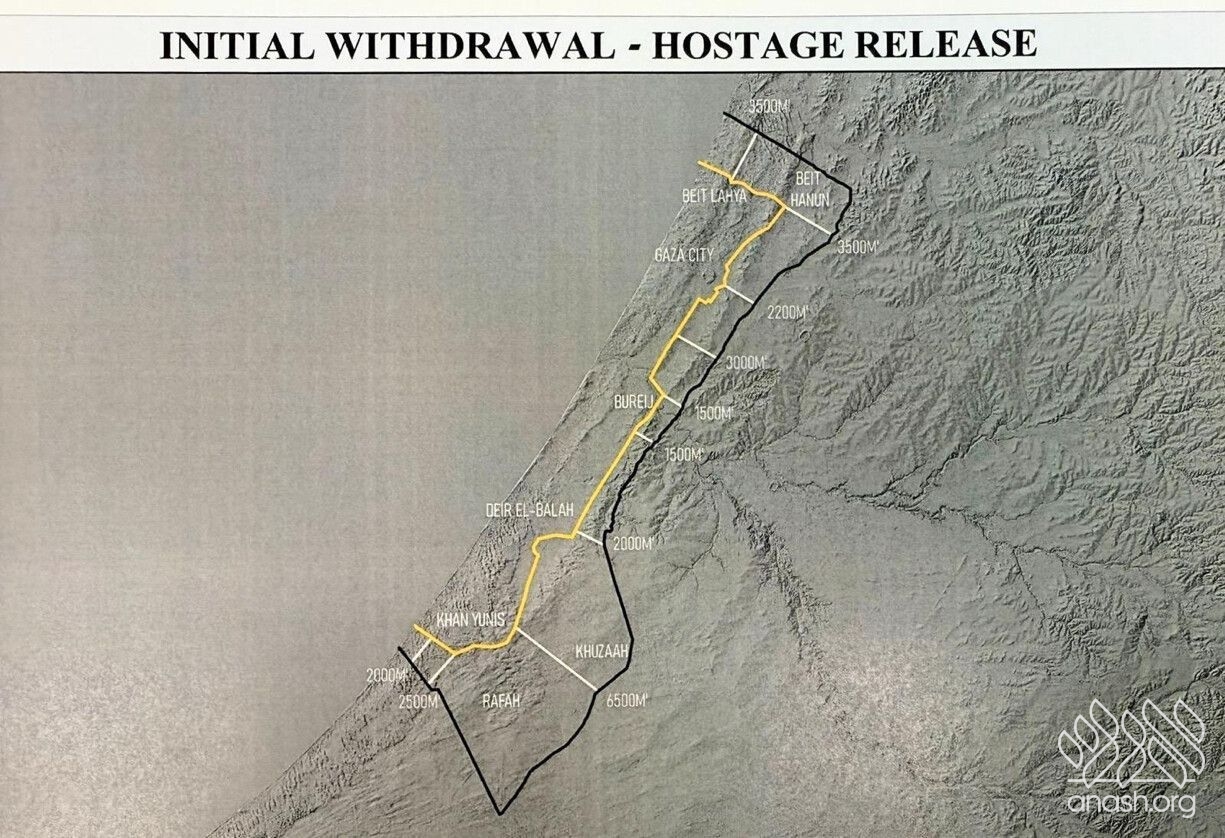 The more detailed first withdrawal lines, published by U.S. President Trump today.
Hostages – Deal Summary:
Hamas replied to U.S. President Trump’s 20-Step Plan: They agree “in principal,” but have many misgivings over the details. Hamas indicated that they would be okay with no longer governing Gaza, but they did not respond to the demilitarization aspect.
Trump took this response very optimistically, and asked that Israel halt operations in Gaza to allow Hamas to locate all the hostages. However, he warned that Hamas will not be allowed to stall talks, and the war will continue if they do so.
Prime Minister Netanyahu says that the IDF greatly reduced action in Gaza—to a near stop, and is sending a negotiating team, led by Minister Ron Dermer, to Egypt. During this pause, the IDF continues to control the Netzarim Corridor, and Gazans are unable to return northward to Gaza City.
Netanyahu also stressed that talks will be limited to just a few days, and after that, Hamas will be dismantled—either politically or militarily.
Trump also published a map showing what the first withdrawal lines would look like, if Hamas agrees to release all the hostages. The lines are similar to the IDF’s position at the end of Operation Gideon’s Chariot 1, abandoning the Netzarim Corridor and Beit Lahiya, as well as most of Gaza City. Approximately 68% of Gaza remains in IDF hands, including Rafah, half of Khan Younis, the eastern outskirts of Gaza City, and Beit Hanoun.
Hamas will not be allowed to retake these areas during the ceasefire, although there will not yet be any force in place to prevent them from doing so, with or without uniform.
There are four possible scenarios in the next few days:
- Hamas outright agrees to the deal.
- Hamas rejects the deal.
- Hamas manages to renegotiate some details, and then agrees.
- Hamas tries to renegotiate the deal, and then blames Israel when talks collapse.
If Hamas agrees to the deal, this is what is supposed to happen in the next, in order:
- A full ceasefire goes into effect.
- The IDF withdraws to the first withdrawal line (back to just 68% of Gaza). Some say that this happens after the hostages are released, but the text seems to indicate that it goes first.
- Humanitarian aid flows into Gaza at massive levels.
- Hamas releases all hostage—those alive, and those murdered. This is supposed to happen within 72 hours of Israel accepting the agreement, but that would already be this Sunday night. Expect a new 72-hour deadline to be announced.
- Israel then releases 250 notorious terrorists who are serving life sentences for murder, and 1,700 Gazans who were arrested since October 7th. The 1,700 Gazans are a collection of low-level Hamas terrorists and other collaborators. In addition, Israel will release the remains of 15 Hamas terrorists in exchange for every body of a hostage released.
— If these steps go smoothly, the next steps of the plan are expected to roll out. The next steps will take a lot more negotiation to sort out the details, and may go slower. (The draft of the steps were outlined clearly in an official White House publication—I’ll share them separately, and recommend reading.)
In summary:
- International organizations like the UN and Red Crescent will freely distribute aid in Gaza, with less IDF oversight.
- Governance will transition to a non-political Palestinian committee overseen by an international “Board of Peace” chaired by Donald Trump.
- A major economic redevelopment program and special trade zone will rebuild Gaza and create jobs.
- Hamas will be excluded from governance, all weapons and tunnels dismantled, and regional partners will ensure compliance.
- An international stabilization force (ISF)—led by Egypt and Jordan—will train Gazan police and secure borders.
- Israel will gradually withdraw from areas and hand them over to the ISF for demilitarization.
- The IDF will remain in the buffer zone along the border, including the Philadelphia Corridor bordering Egypt, for a longer period of time.
- The Palestinian Authority will be given an opportunity to take over control of Gaza in the future, if they follow a long de-radicalization and de-corruption plan spelled out by Trump’s 2020 peace proposal, and a Saudi-French proposal.
Note that Egypt and Jordan are currently the main sources of all terror and criminal weapons smuggled into Israel. Residents of Be’er Milka, an Israeli town bordering Egypt, say they hear smuggling drones flying from Egypt into Israel nearly nonstop at night. Border Police on the Jordanian border are constantly catching (or missing) large amounts of cross-border weapons smuggling. And almost all of Hamas’s weapons were smuggled into Gaza through Egypt, while Egypt willfully turned a blind eye. The two countries will be training and counseling the new “international stabilization force” that will be trusted to demilitarize and stop the smuggling into Gaza.
Until now, Hamas has insisted that they will never disarm. If they agree to this deal, it will be because they believe that the ISF will turn a blind eye, and won’t actually force them to fully disarm. Hamas would only agree to this if they believe that after a few quiet years, they can return to action.
— If Hamas refuses to agree to the plan, the IDF will continue with Operation Gideon’s Chariots 2 at full force. They will complete the dismantling of Hams through the entire Gaza, while trying to rescue the hostages through risky military operations, or by forcing individual Hamas squads to surrender.
In this plan too, Trump and Netanyahu indicate that the IDF will slowly hand sections of Gaza over to the ISF and eventually leave governance to the “Board of Peace” chaired by Trump. In this scenario, the IDF would thoroughly clear out each area before handing it over, removing all Hamas infrastructure and tunnels themselves.
If Hamas outright rejects Trump’s plan, then, allegedly, Israel will have full support from most Arab nations to complete the war. Knowing Hamas’s style, if they choose to reject the plan, they will first try to renegotiate details so that they can pin the failure on Netanyahu. Time will tell if that will work.
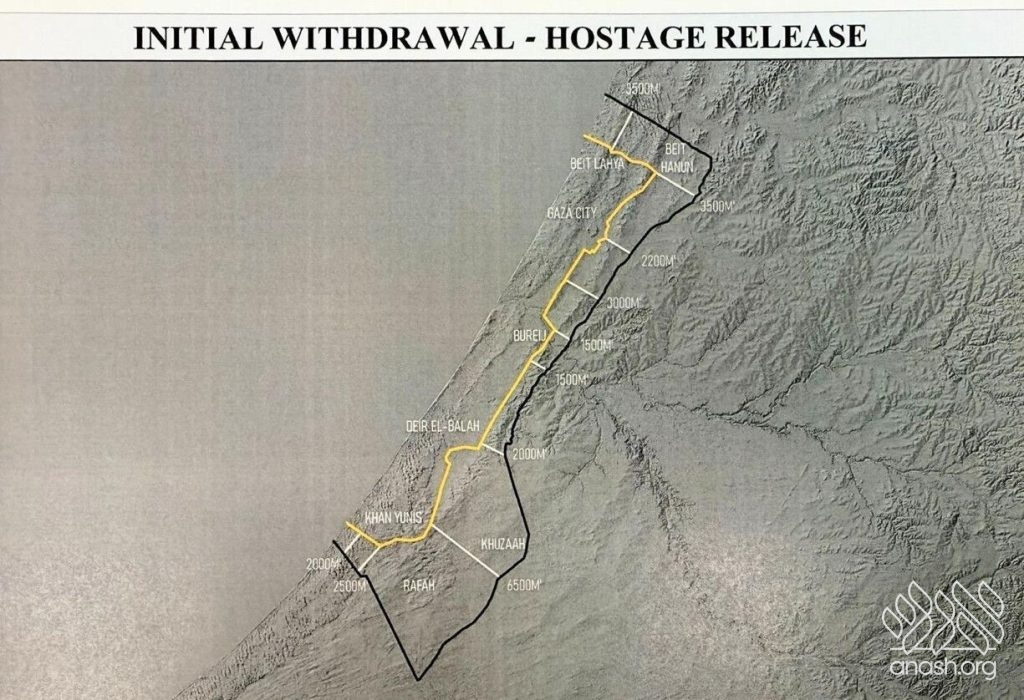
The more detailed first withdrawal lines, published by U.S. President Trump today.
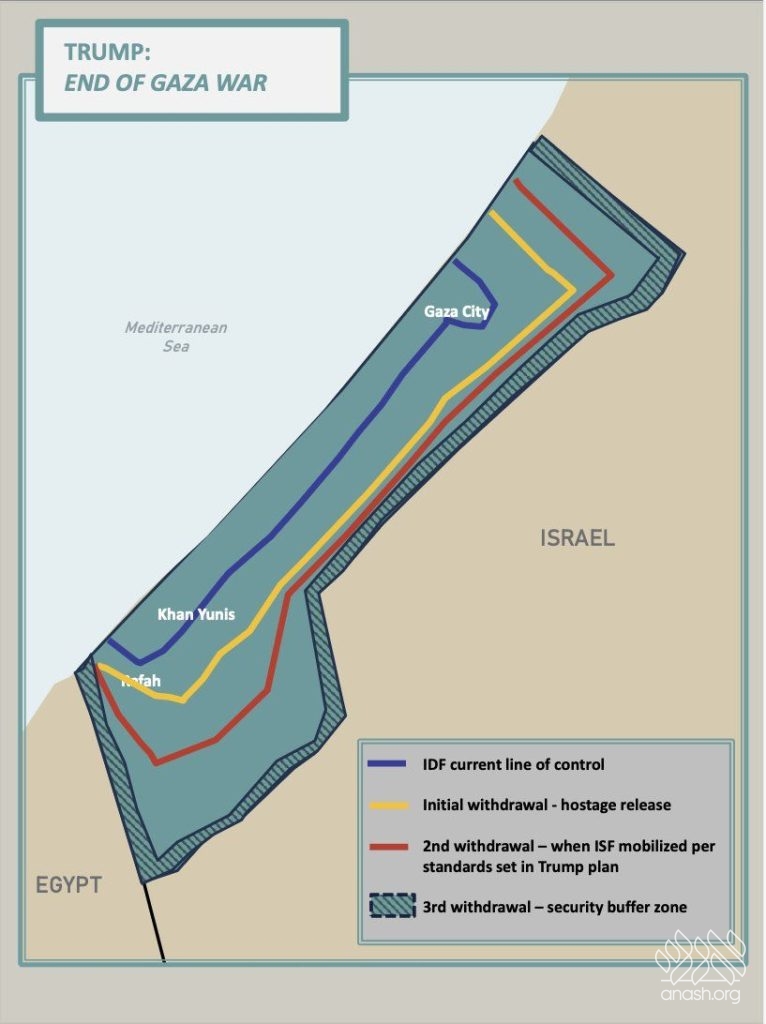
In red - the next withdrawal line, and a sketch of the buffer zone.
 COMMENTS


Thanks for this and would love to have more updates in the near future.