




ט״ז אב ה׳תשפ״ה | August 10, 2025
Walking Proudly as a Jew in a Muslim Country
Amid a sharp rise in antisemitism around the world since Oct. 7, Azerbaijan stands out for a different reason: Jews in this Muslim country walk safely, visibly and with pride. Shliach Rabbi Shneor Segal shares his experience of 15 years.
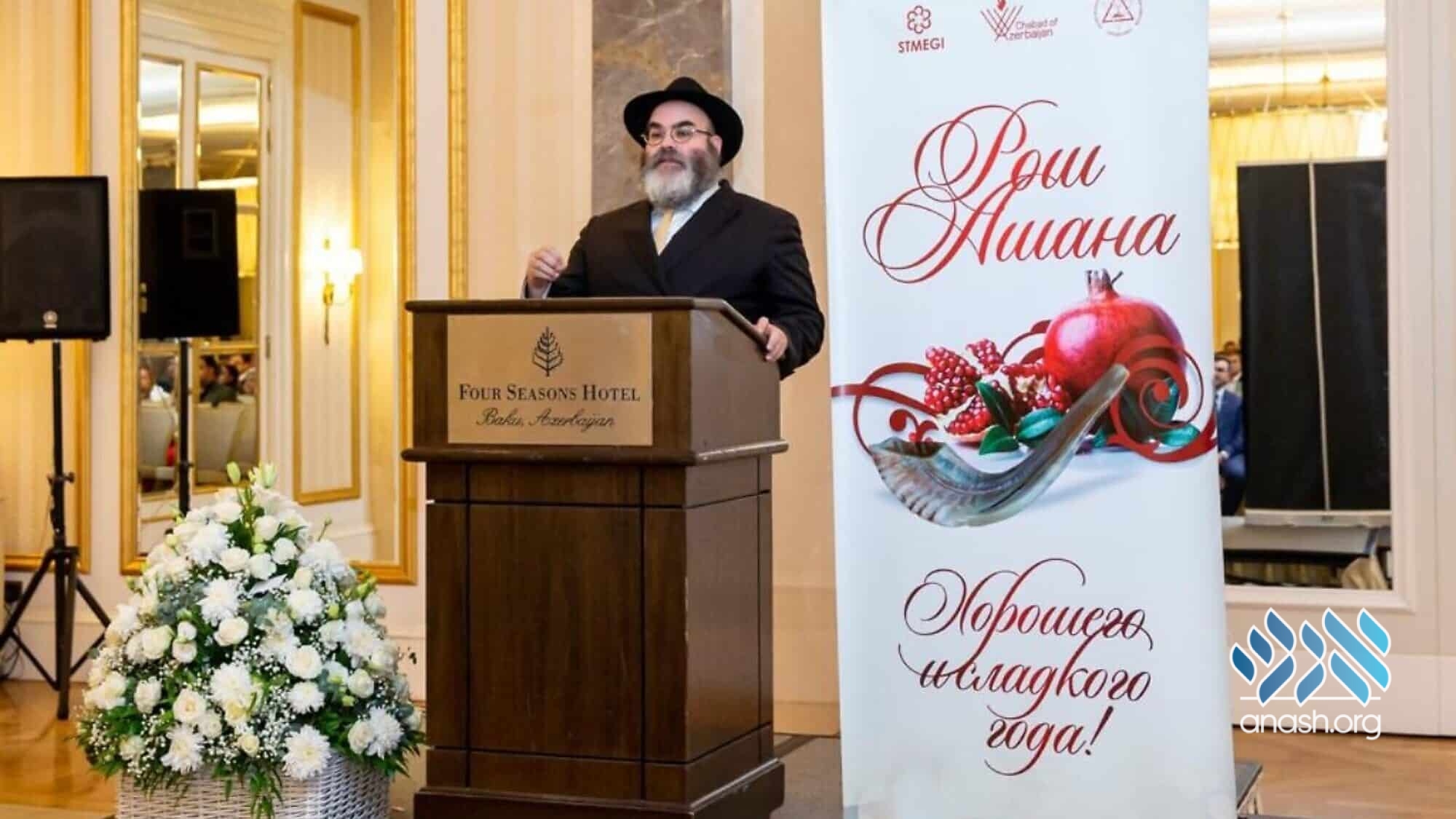
Amid a sharp rise in antisemitism around the world since Oct. 7, Azerbaijan stands out for a different reason: Jews in this Muslim country walk safely, visibly and with pride. Shliach Rabbi Shneor Segal shares his experience of 15 years.
Amid a sharp rise in antisemitism around the world since Oct. 7, 2023, Azerbaijan stands out for a different reason: Jews in this Muslim country walk safely, visibly and with pride.
For more than 15 years, Chabad’s Rabbi Shneor Segal has served as the chief rabbi of Azerbaijan’s Ashkenazi Jewish community and is based in Baku with his family. In an exclusive interview with JNS on July 21, he said his mission has remained steady: to strengthen Jewish identity in a country that has long made Jews feel at home.
“I’ve never once heard a negative word about being a Jew in Azerbaijan,” Segal said. “Not in the streets, not in offices, not anywhere. I walk in my full Chassidic dress and beard, and I’ve never felt unsafe.”
That sense of safety, he said, is not only anecdotal—it’s an everyday reality for Azerbaijan’s estimated 20,000 to 25,000 Jews. Most live in Baku, with smaller communities scattered throughout the country.
Azerbaijan is also home to the only exclusively Jewish village outside Israel, a community of Mountain Jews who live in the foothills of the southern Caucasus Mountains in Qirmizi Qasaba in the province of Quba. Azerbaijan’s lead singer for the 2025 Eurovision Song Contest, Asaf Mishiyev, comes from this community.
What unites the Jews of Azerbaijan is a deep sense of communal life, a shared history, and an unusually positive relationship with the Muslim majority population and the Azerbaijani government.
A unique Jewish-Muslim model
While many governments in the Muslim world keep their Jewish communities at arm’s length, Azerbaijan’s leadership embraces them openly, the chief rabbi said.
“Just before Passover, our matzah shipment was delayed because of port issues and the Azerbaijani holidays,” he said. “We reached out to the authorities. Within hours, they stopped everything to make sure our community had matzah in time. They didn’t have to do that, but they did.”
That level of support isn’t just about logistics. Rabbi Segal said it reflects a broader national ethos of multiculturalism that runs deep in the country’s political and social DNA.
He pointed out that Azerbaijan’s President Ilham Aliyev regularly speaks about the country’s diverse religious landscape and promotes the idea that different faiths can thrive together. In practice, that translates to open doors at every level—from ministries to municipal offices.
Segal recounted numerous instances of direct government support, from high-level meetings with the president to practical assistance during Jewish holidays.
“This isn’t just a photo op. It’s felt in real life,” he said. “Whether it’s education, religious needs or cultural events, the government is there for us.”
Iran’s threat, Azerbaijan’s resolve
That doesn’t mean the community is untouched by global antisemitism. Earlier this year, Azerbaijan uncovered a plot by Iranian agents to assassinate Segal. The country’s State Security Service arrested several suspects linked to Iran’s Quds Force, allegedly planning attacks against Jews and Israelis in Azerbaijan, including the chief rabbi.
Despite the gravity of the threat, Segal downplayed fear and emphasized resilience. “Since Oct. 7, the only thing that’s changed is that we take extra precautions,” he told JNS. “But day-to-day life here hasn’t changed. If anything, we feel even more supported by people on the street.”
In his view, the threat emanates not from within Azerbaijan, but from outside actors seeking to disrupt the harmony between Jews and Muslims in the country. “People from other countries may try to manipulate someone to do something negative. But here, the people understand, we’re family. We’re cousins, Jews and Muslims. And you don’t hurt family.”
Not just tolerance, but a blessing
The chief rabbi said he didn’t just see this as religious coexistence, but rather as a blessing. “We pray three times a day for peace. And you can feel it here. You feel it in the economy, in the culture, in the energy of the place,” he said. “There’s a kind of Divine blessing that comes from nations living together in peace.”
Segal believed this model should be exported globally, not through force, but through storytelling. “The world hears about Jewish-Muslim conflict all the time, but never about places like Azerbaijan. Conflict makes headlines. Harmony doesn’t,” he said. “We have to change that.”
The rabbi said that he would like Jewish organizations around the world to shift their focus—not just to fight antisemitism but to amplify places where Jews live in peace and dignity. He said he had discussed this recently with the leaders of two Jewish organizations from abroad.
“They said, ‘Rabbi, what do you want from us?’ I said, ‘I want you to start dealing with the positive part of where you know what to do. Not only dealing with the problem of antisemitism, but supporting and reviving and spreading the word of places that have no antisemitism.’ I think this might make a real change. Because, you know, if it can be done somewhere, it can be done everywhere.”
A message to Diaspora Jewry
Segal said he had a message for Jews around the world, especially those who may be unfamiliar—or even suspicious—of a Jewish community in a Muslim-majority country. “Come see for yourself,” he said. “Walk around proudly as a Jew. You’ll be respected here, and you’ll respect the people in return. It’s a beautiful country with beautiful people.”
He saw a broader lesson in the Azerbaijani experience. “Respect begins with how we talk to our children. If we speak only about hatred, they’ll learn hatred. But if we speak about tolerance, about places where people live together in peace, that’s what they’ll learn.”
In a world hungry for good news, the rabbi believes that Azerbaijan has something powerful to offer: not just a safe haven for Jews, but a model of harmony the rest of the world might one day learn from.
Jewish Agency’s honorary ambassador
Roman Gurevich, the Jewish Agency for Israel’s honorary ambassador to Azerbaijan, told JNS that “Azerbaijan is a unique country, one that shows the world how people of different ethnicities and religions can live together peacefully, in an atmosphere of mutual respect.”
Gurevich, who now lives with his family in Israel, was born and raised in Baku in a prominent Jewish family. His father, Alexander Gurevich (Grich), was a well-known TV host and producer, writer and poet who produced a five-part television series on President Heydar Aliyev, the current president’s father.
“This secular Muslim nation, where generations of my family have lived, worked and flourished, has always cherished and respected its Jewish citizens,” Gurevich said. “Few in the world are aware of the Azerbaijani phenomenon—a deep-rooted culture of care and respect toward the Jewish people. For centuries, Muslims and Jews have lived in close friendship and peaceful coexistence in Azerbaijan.”
He also noted the strong ties between Israel and Azerbaijan. “Today, the Republic of Azerbaijan continues to strengthen its friendship with the State of Israel,” he said. “Following the Oct. 7 tragedy, ordinary citizens of Baku brought flowers and lit memorial candles at the Israeli Embassy—out of sincere sympathy and solidarity with our grief.”
Gurevich said the unique tolerance and multiculturalism of Azerbaijani society are deeply rooted both in the national character and in the consistent policies of the country’s leadership.
“In a world increasingly shaken by waves of hatred, xenophobia and antisemitism, Azerbaijan remains a rare example of interethnic harmony and genuine respect for other cultures. This is not only a historical tradition, but also a working model—worthy of close study by experts in international relations,” he said.
Gurevich said these values are clearly and consistently reflected in Azerbaijan’s foreign policy.
“Baku is increasingly becoming a venue for dialogue between countries in conflict or deep mistrust. Leaders of nations that often hold opposing views—from Israel, Turkey and Pakistan to Syria, the United States, China and others—turn to Baku because they trust Azerbaijan’s leadership and are willing to engage in frank conversation,” he said.
International Diplomatic Academy
Because Azerbaijan is widely regarded as a credible mediator in resolving complex international disputes, Gurevich suggested it might be a good idea to establish an “International Diplomatic Academy” in Baku. “The academy that would welcome practicing diplomats from around the world—to learn how to build trust and promote their countries’ interests based on tolerance, law and mutual respect.”
Gurevich said he was sure that Azerbaijan would be glad to share its valuable experience with other countries.
“Perhaps, if more diplomats received such training, there would be fewer conflicts and more trust in the world,” he said. “One of the academy’s departments could be devoted to Jewish heritage and the fight against antisemitism. This would be especially meaningful to me.”
He added, “But for Syrians, Americans, Pakistanis or the French naturally, their own national priorities would be most relevant. And this is the true strength of such an academy: it would speak to every
student in their own language—through professionalism, respect and justice. After all, the ability to listen, to understand and to respect one’s counterpart is the foundation of any lasting international stability.”
Gurevich noted that Aliyev had told the 3rd Shusha Global Media Forum on July 19: “Trust does not mean agreeing. Trust means simply believing that if a person has said something, this is what will be the case.”
This article originally appeared on JNS, and is republished with permission
 COMMENTS


We appreciate your feedback. If you have any additional information to contribute to this article, it will be added below.