



י״ט אלול ה׳תשפ״ה | September 11, 2025
Tomchei Temimim Is Not About Perfection
Some push themselves in learning and davening and grow arrogant, while others become humbler, kinder, and more tolerant; why is that? Tomchei Temimim isn’t about perfection – about being complete relative to other people or a standard. It’s about temimus – to live as a Yid was originally created to live. An article by Rabbi Avrohom Katz.
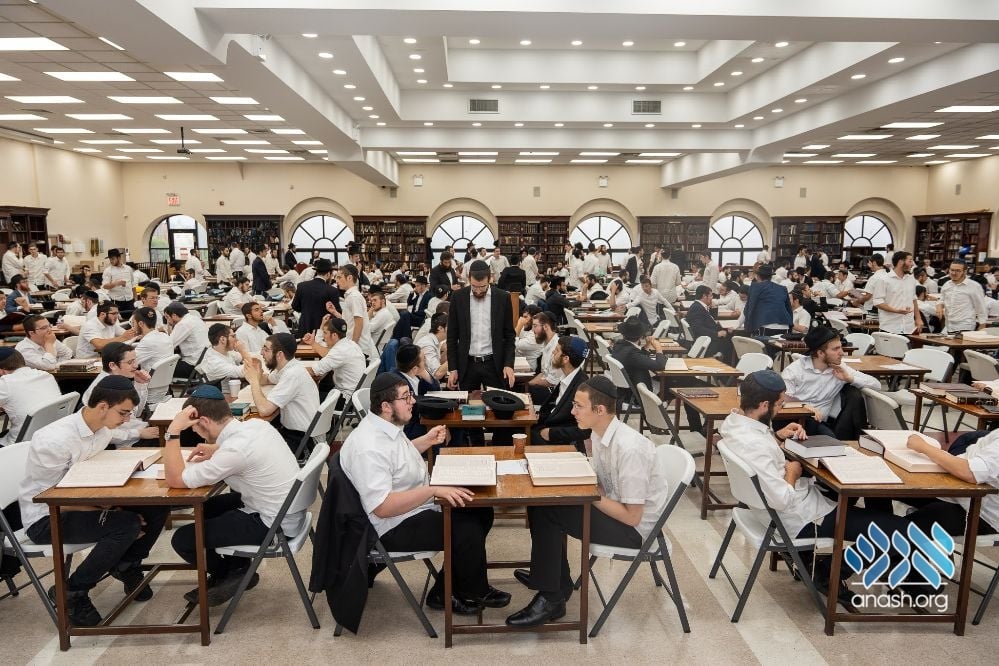
Some push themselves in learning and davening and grow arrogant, while others become humbler, kinder, and more tolerant; why is that? Tomchei Temimim isn’t about perfection – about being complete relative to other people or a standard. It’s about temimus – to live as a Yid was originally created to live.
By Rabbi Avrohom Katz – Postville, Iowa
What is the difference between shleimus and temimus?
Many people wonder what exactly is special about the approach of Chassidus in general, and what is special about a yeshiva that is founded on the principles and values of Chassidus. Although much has already been said regarding this, here is another “spin” on answering this question.
Let’s start by looking at the approach of Chassidus in the context of the meaning of the word tam/tamim relative to the word shalem/shleimus. This will help us understand why a yeshiva founded on the values of Chassidus is specifically called Tomchei Temimim, and about the approach of Chassidus in general.
The idea of shleimus is the completion of something relative to something else. Two people can be completely at peace with each other. A vessel in the Beis Hamikdosh – when it’s filled with something else – is called complete. Shleimus is a completion in the context of something relating to something else.
The idea of temimus comes from “hishalech lifonai veheye tomim” – a completion of something relative to its original state of being. Having a Bris Milah doesn’t add shleimus; it allows a Yid to return to his natural state of connection with Hashem, like in teshuva. A korban without a mum is a tam, not a sholeim – it is in its original state, how Hashem created animals to be.
“Tomim tihyeh im Hashem Elokecha” means to be wholeheartedly sincere and uncomplicated in serving Hashem, because that is who you are. It is what you always wanted: to make Hashem happy for no other reason than that you truly love Him and are connected to Him.
Tomchei Temimim isn’t about shleimus and perfection – about being complete relative to other people or relative to a certain standard you approve of. It is about temimus – to discover, experience, and internalize the natural, inner connection with Hashem that He created inside of us, and to live as a Yid was originally created to live. This is a complete connection with Hashem revealed from the inside out, instead of creating an image of who we think we should become from the outside in.
The idea of Tomchei Temimim is to support and guide us in this journey.
One application of this idea:
Some people push themselves in learning and davening and become arrogant – they are “holier than thou,” thinking they know better than everyone else. Others, by contrast, become much kinder, more humble, and more tolerant. Why is that?
Although several factors may play a role, one of them is what we just explained:
When someone adds learning and kavana in davening because he wants shleimus, perfection according to a certain standard, he may start to feel superior to those who are less “perfect.” But a tomim is someone who wants to grow in Yiddishkeit because this is who he really is deep down. It has nothing to do with attaining perfection relative to an external standard or to anyone else.
Instead of feeling better than others, he feels rachmanus for those who struggle – those pulled down by the yetzer hara – just like he himself experiences. Or he is honest with himself and realizes that people who don’t learn or daven as much may not be worse; perhaps they have a more difficult situation. They may even be better than him because at least they are fighting the yetzer hara.
So, is the effect of Torah and davening a sam hachayim or, chas v’shalom, the opposite? That depends on your approach: Are you seeking to become a professional in religious activities, a master in your religious career, or is your goal to be true to who you really are, deep in your inner connection with Hashem?
 COMMENTS


thanks for bringing some solid toichen to the site
So, this is what has always bothered me about how growing up in a shpitz chabad moissad – in my case it was oholei torah –
The motive was always about becoming the ‘best’…
The top student,
Most mishnayos baal peh… etc.
While this sounds like a cool idea, and it motivates kids,
At some point i began to wonder: what is the difference between us and misnagdim?
They are trained from day 1 to learn torah so that they become a “gadol”..
And i am being trained to learn so that i can outshine my peers.
So,
This obviously makes no sense
Great stuff from the great Rabbi Katz
Thank you for writing and posting! מים קרים!