



כ״ב מרחשון ה׳תשפ״ו | November 12, 2025
The Rebbe’s Response to Kristallnacht: Pride, Light, and Defiance
Article by Rabbi Yitzchok Wolf: As a child of Holocaust survivors, I cannot ignore what I am seeing and hearing today. The lessons of history call us not to despair, but to action, to strengthen, to teach, and to celebrate what it truly means to be a Jew.
By Rabbi Yitzchak Wolf – Chicago, Illinois
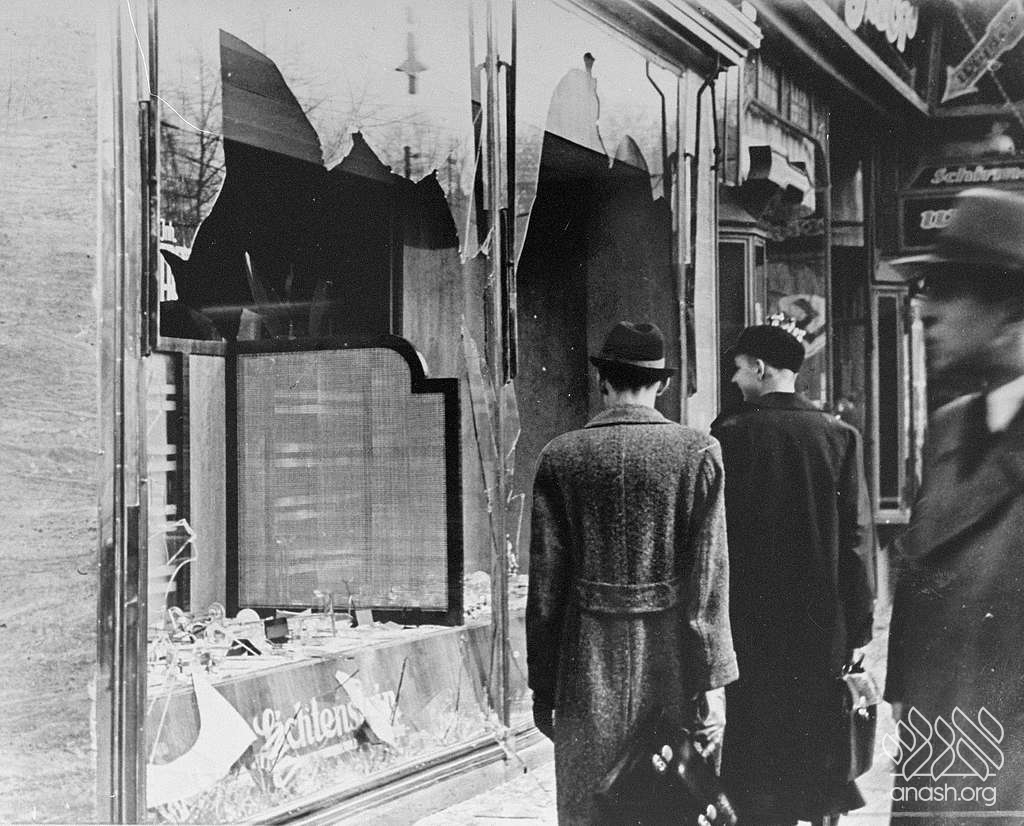
It was just the other day that we marked Kristallnacht – the night in 1938 when the Germans unleashed a brutal, state-orchestrated riot against the Jews of Germany. Even the very name Kristallnacht sends shivers down my spine. As the son of Holocaust survivors, the documented memories and echoes of that dark time are deeply personal.
My mother, born in Auschwitz in 1915, and my father, who grew up on the outskirts of Krakow, often shared with me stories of their early lives, of peaceful childhoods in a calm, vibrant society where families lived with hope and purpose. And then, almost overnight, everything began to change.
By 1933, although they did not live in Germany, the ominous ripple effects of Nazi hatred were already spreading into Poland, transforming the lives of Jews everywhere. It may have taken place in Germany, but its impact reverberated loudly through every major town across Poland.
The antisemitism was everywhere. As children, my parents attended public school for the first half of the day, then spent their afternoons learning Torah with a melamed. But even those mornings in public school were filled with humiliation and hostility. Teachers themselves often joined in the mockery – hurling slurs, calling the Jewish kids “Zhyd,” tearing up their schoolwork, and singling them out simply for being who they were.
After Kristallnacht, my father told me, the young men, barely seventeen or eighteen years old felt they had simply had enough. They went to the elders and pleaded for permission to take up arms. There had already been shootings here and there; they wanted to fight back. But the elders urged restraint. “It will pass,” they said again and again. “Don’t take the law into your own hands, you’ll only make things worse.” Time and again, the youth were told to be patient, to wait for calmer days.
We know how it ended. Most of the Jews from my father’s town, on the outskirts of Krakow, were murdered. My parents were among the few who managed to escape, finding refuge in Russia in 1940.
As a child of survivors, I cannot ignore what I am seeing and hearing today. The voices of hate echo once again – in the streets, in universities, and across the public sphere. They claim it’s about Israel, but it is not. It is about Jews. And what is most disturbing is that this hatred is not confined to the fringes.
It is being echoed by people once considered respectable, by figures on both the right and the left who have traded integrity for popularity. When I hear public voices, whether political commentators or media personalities, speak with such intellectual dishonesty about Jews and Israel, I am deeply shaken.
Because to me, everything I heard from my parents about the 1930s feels as though it is unfolding again. Unfolding in Europe, unfolding in the United States, unfolding before our very eyes.
Yet even in these turbulent times, we are not without hope. Though we live in galus, we take comfort in the teachings of our Rabbeim, that while our bodies may dwell in galus, our souls have never truly been confined by it. We must not allow ourselves to become galus Yidden in spirit.
Our mission is not only to spread Yiddishkeit to others, but to cultivate within ourselves, our children, and those around us a deep, unwavering pride in who we are, what we represent, and what we stand for. When we encounter another Yid, they should see in us the joy, the simcha, and the quiet strength that come from living as proud Jews.
We do not fear the forces arrayed against us, not because of physical power or might but because we embody confidence, dignity, and emuna.
This, I believe, maybe one of the reasons the Rebbe so strongly encouraged the public celebration of Chanukah – to illuminate the darkness, to strengthen Jewish pride, and to rekindle within us the courage and resolve of the Chashmonaim. Public pirsumei nisa is more than symbolic – it is an act of spiritual defiance, a statement that the Jewish spirit cannot be dimmed.
Through Torah and mitzvos, through joy and steadfastness, we proclaim that our identity is unshakable, our faith enduring, and our courage alive.
Our mission as chassidim and shluchim is clear: to bring the light of Torah, mitzvos, and authentic Jewish pride into every corner of the world. Even amid adversity, we stand strong, joyful, and proud, not defined by the hatred around us, but by the eternal values, faith, and courage that flow through our heritage.
The lessons of history call us not to despair, but to action, to strengthen, to teach, and to celebrate what it truly means to be a Jew.
 COMMENTS


Wonderful article. May it be spread and appreciated far and wide like the wellsprings of chassidus, and the learning of Torah, and practice of mitzvoth. We want Moshiach now.
Calling a Jewish kid Zhyd in Polish, Czech, Slovakian and many others slavic languages (besides Ukrainian and Russian) doesn’t consider to be slur.
It is a normal word to call a Jew.
Moreover in Jewish tradition we are not calling city known in German Auschwitz we are a calling it Ushpitzin.
The last thing in 30 in central Europe there was many Jewish groups fithing antisemitism with the fist….
From the right to left….