




י״א כסלו ה׳תשפ״ו | December 1, 2025
The Bullying That Goes Ignored Until It’s Too Late
As a Chassidishe educator who has worked with children in Chabad schools, I’ve seen firsthand how subtle bullying can go unnoticed. The hardest part? It was nearly impossible to gather concrete evidence.
By a survivor of bullying who teaches in a Chabad school
As a Chassidishe educator who has worked with children in Chabad schools, I’ve seen firsthand how subtle bullying can go unnoticed.
Following the discussion in my recent article about the hidden nature of bullying, I felt it important to explore another real case that brings the issue into even sharper focus.
A father recently shared an incident from a Chabad school that illustrates a type of bullying teachers often find hard to address. Not because they aren’t attentive, but because this form of bullying is subtle, often happening quietly during recess, breaks, or other moments when teachers are nearby but cannot watch every interaction. These small, nuanced moments can easily go unnoticed, even by the most dedicated mechanech.
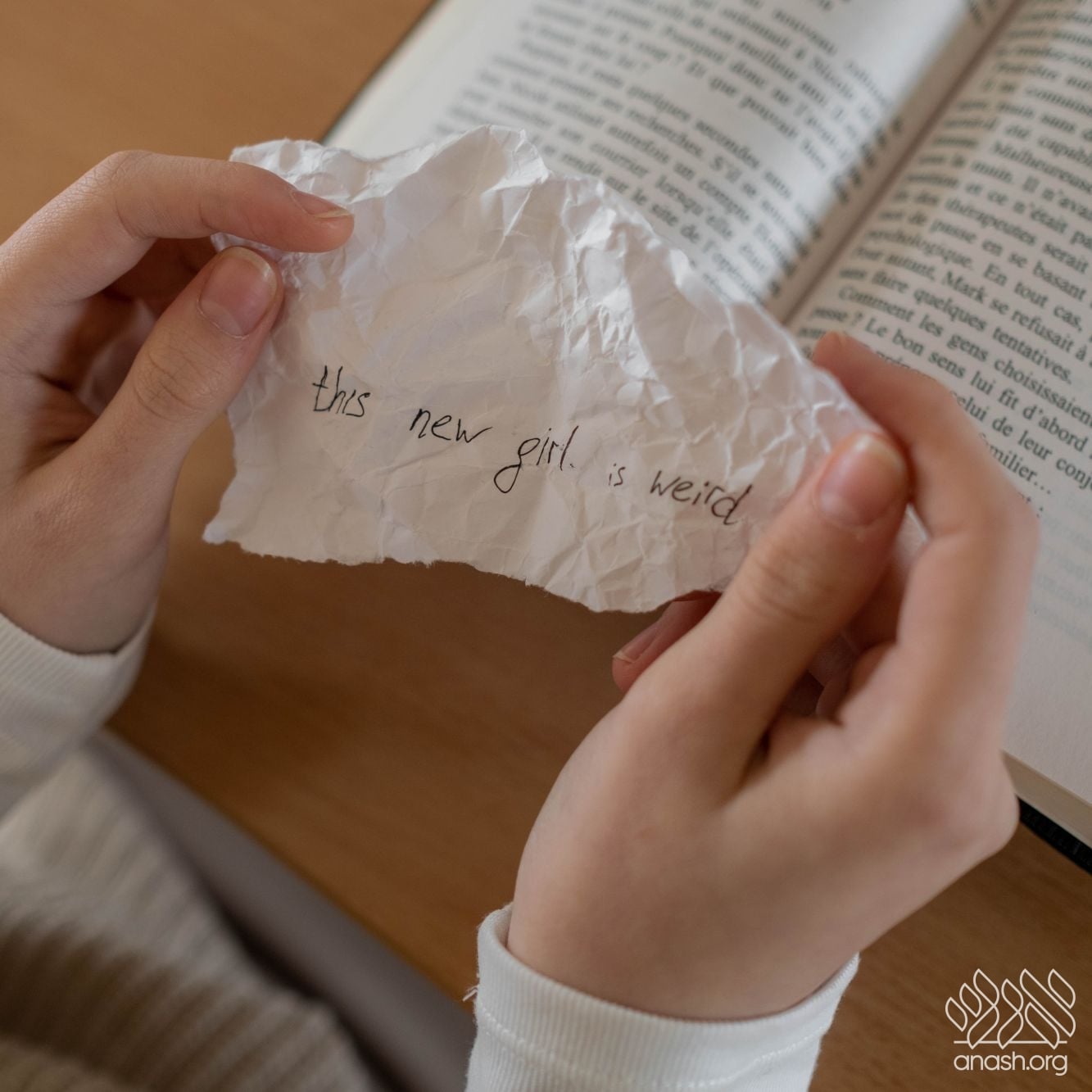
In this case, a boy decided to exclude another child from friendships. This wasn’t physical aggression or name-calling. It was social bullying – a slow, almost invisible form of exclusion that erodes a child’s social connections without leaving a single obvious moment to call out.
Whenever the innocent boy began a conversation with another student, the bully would walk over and, with his naturally charming tone, start speaking to the same child – effectively cutting the victim out. His voice drew people in, and the neglected boy found himself suddenly alone.
During playtime or group activities, the bully would speak loudly over the victim whenever the boy tried to contribute. He ignored him, turned away, and used subtle social cues to block him out. The child was being robbed of friendships by someone who knew exactly how to dominate a social space while appearing completely innocent.
The hardest part? It was nearly impossible to gather concrete evidence. The bully could innocently say, “What did I do wrong? I was only talking.” And technically, he wasn’t breaking any obvious “rule.” This left the school struggling to figure out how to respond.
From experience, about 70% of bullying happens in gray areas. These are situations where children can deny wrongdoing or make excuses to the teacher:
- A hurtful comment followed by: “Relax, it was just a joke.”
- A shove explained as: “We were playing.”
- Or, like in this case, the boy telling the teacher: “I was only having a conversation. Am I not allowed to talk?”
These situations are difficult to address because everything is deniable. Nothing is obvious. Everything can be excused. Unless we change our approach.
The key to stopping this type of bullying is to define the questionable behaviors instead of trying to prove intentions. Chassidus teaches that in avodas Hashem there are no gray zones – something is either aligned with the right path or it isn’t. The same principle applies here.
Instead of waiting for “evidence,” teachers create crystal-clear behavioral expectations, such as:
- “You may not interrupt two boys who are speaking to each other.”
- “When someone else is talking, you must wait your turn.”
- “You may not make faces or social gestures to push someone away.”
These statements don’t accuse the child of bullying – they simply set boundaries.
And yes – the child may protest, “Why me? Everyone interrupts sometimes!”
A teacher must be confident enough to remember: I am protecting a child who is being unfairly excluded. This is my responsibility. Addressing subtle bullying often requires firmer limits with the child creating the problem. That’s not being unfair—it’s doing justice.
This story continues the conversation we’ve begun, and there is still much more to uncover about how to protect children from the quieter forms of harm.
May we merit the day when there will be no more pain, and only joy will fill the air with the coming of Moshiach speedily in our day!
 COMMENTS


I have to point out the irony here. Just last week, this site published an article giving Rabbi Dalfin a platform to openly mock and disparage another speaker in our community—simply for loving cats and sharing a video of himself playing with one.
How is publicly ridiculing someone for a harmless interest any different from the bullying behavior you’re now speaking out against?
Last week, bullying was apparently acceptable when it came from one adult speaker targeting another. This week, we’re being told to be hyper-vigilant about bullying among children. But children learn what is and isn’t okay by watching adults. If we model and platform this behavior among adults, we’re teaching kids that mockery and public ridicule are acceptable—we’re just telling them not to do what we do.
If we’re going to take bullying awareness seriously, it needs to start with the content we choose to publish and promote. We can’t champion kindness and respect while simultaneously amplifying voices that tear others down.
An apology article is in order!
There’s bullying and there’s standing up for what’s right and the distinction is quite clear and if standing up for what’s right is called bullying then I guess you can say that this comment is bullying to the highest degree.
“Standing up for what’s right” means calling out harmful behavior or holding people accountable for genuine wrongdoing.
Mocking someone for loving cats isn’t standing up for anything. What principle was being defended? What harm was being addressed? It was just mean-spirited ridicule over a harmless interest.
You can’t tell children that bullying is wrong while adults in influential positions model the exact behavior you’re condemning.
I think you’re bullying rabbi dalfin by calling him out in the comments like this… maybe you should call him privately
Sorry,
Speakers dont have immunity.
They carry a big achrayus, and when they’re actions are missleading and can cause harm – there is no choice but to call them out.
That has nothing to do eith bullying.
please understand that all the learning
gemora
mishnayos
chidon all worthless if the middos are not encouraged
middos are the essence of a chossid, and good middos should be taught because they are not always inherited from patents. a broken hurt child …weather a boy or girl is disaster 10 years down the road.
if a partent complains to a morah or rebbe or bus morah take action.
crearte projects vchulu.
the rebbe ddnt farbreng in lamed hey becuase of yingle thta was being bullied… along story no place for it here.
be kind to a student and give him an uplifitng hand.
Couldn’t agree more with this comment
This should be read and read again by every teacher, parent and leader of kids organizations
Bullying is a terrible thing. What you’re describing is a form of covert narcissism. They’re nice to who they want to be nice to and they’re very good at hiding their negative behavior, often aging victim. It’s time for schools to teach what gaslighting is, what manipulation looks like, what passive aggressive behaviors can be and what it means when you’re questioning what happened.
Victims of bullies are usually the nice ones and the healthy ones. The bullies are usually the ones who have a mental illness or personality disorders. Crazy stuff!
It’s hard to learn the hard way and I really feel that it’s time for schools to start teaching social skills, social interactions and red flags.
Good point.
It’s so interesting that I see it’s all about boy bullying another boy and 100% it’s terrible and should be stopped at all costs however i personally think and possibly others may too what’s even worse is the Hanhalla protecting the bullies and not only that join in and make as if the victim is the one who’s messed up to these Hanallah with all due respect you may know a lot of Torah you may know a lot of Chassidus but unfortunately if you treat bullying like a “I know it all” then you will never know how to properly sympathise with the victim you will not know how to show the victim love and care assuming you will just treat it like a case in חושן משפט there’s 2 sides to the story! And I understand that at times (but rarely) that could be the case however Imagine how the victim feels when hearing that?! Like he’s lying saying a half truth the next time he’s being bullied he won’t go over to you he will keep it inside and it could ח״ו have lasting negative effects because he feels like he has nobody protecting and providing him safety .
Worse unfortunately they may smirk at you like your probably messed up for speaking up against the popular bullies looking at you as different because you are extremely sensitive …
Sorry but when it comes to bullying there’s no 2 sides there’s evil and it’s your responsibility to stop it – ובערת הרע מקרבך
The only 2 sides to keep in mind:
1. When a victim goes over to you show and provide him a sense of safety and sympathy so the victim feels like he is heard don’t look around the room making yourself uninterested show that you care your with him that he knows he has someone who is providing him a sense of safety .
2. You need to stop bullying at all costs .
Absolutely!!
Wow!! Whoever this is, speak up more, some Mechanichim really need to hear this, it’s scary
Cannot understand how they even landed as Mechachim in the first place
There should be like a check that you have to pass in order to step into a school or classroom – like are you a nice person who has good middos and healthy, and will properly deal with bullying
A very important article — defining the “gray areas” and giving children guidance about them is vital. The author pinpointed the precise kind of bullying I experienced as a child long ago in public school. As the author writes, making faces and social gestures to push someone away are hugely painful. Here’s another example, which children may say out loud,or sometimes just by making a face or exaggerated gesture and hitting them with the ball, striking them out, etc.: “Oh, it’s Yukel Todros’s turn — let’s get him out before he even has a chance to play!” Imagine the impact on the child when this happens almost every day at recess, for weeks or months on end. And don’t forget this one: one child might cut in front of another in the line at lunch, etc. on most days, saying with a mean smile, “Yukel, I’m sure you don’t mind if I cut in front of you, right?” As teachers and other adults become aware of these damaging behaviors, give them a name, and stop them in their tracks, the adults will truly be mechayeh nefashos, restore life to children who may suffer so deeply.
Teaching students skills can be helpful, but nothing can replace good old intervention by a supervising adult. If you see wrongdoing, speak up and stop it. ויקם משה ויושיען
We don’t focus on opposing loshon horo, we focus on fomenting Ahavas Yisroel, and so too for bullying. Start putting in the work as a mechanech to develop the true chasidishe ahavas reyim among your students, work on their middos, and just like all darkness and loshon horo, מאליו מתבטל.
Yes!! So important!! Such great comments on here!!
In theory that’s a very good idea. However, the reality is that many children are coming to school with baggage of pain. They are desperate to release their pain.
Just telling them “Ahavas Yisroel” may not be enough to hold them back from bullying.
Many times children who bully are very good boys, they’re just desperate to let out their pain (on others). There needs to be authority in place to stop bullying.
With that said, I think that teaching Ahavas Yisroel and empathy are definitely very important factors.
Yes — bullies often are in terrific pain themselves and desperate to let it out. Many years after I was bullied in public school, where I was the only Jew, I realized that the bully’s mother had gotten divorced and had remarried — a Jewish man. The bully must’ve been incredibly unhappy about the divorce and took out that pain on me, the Jewish kid. Takeaway: teachers, and adults, need to be aware of kids in pain and address their issues, or get someone to help such kids. (Another reason to stop intermarriages!)
This is why there needs to be supervison by recess where teachers are constantly walking around. I am trying to tell this to my son’s yeshiva. Bullying usually happens by recess when kids know supervison is low and they can get away with it. 3 rebbis for 100 kids is not enough!!!
The comment about setting clear rules is good for kids or even older who actually didn’t realize that is a gray area. It doesn’t have to be only one on one, these can be told to the whole class. The younger the better.
Yes! Yes! This is EXACTLY what has been happening to my daughter!! Subtle. And she has no friends left. The bullies are “me? I’m so nice ! What did I do?” And their mothers are no better. It’s heartbreaking.
I feel your pain.