The name of Harav Eliyahu Dovid, the rov of Niezhin, is known to Chabad talmidei chachamim as a close associate of the Tzemach Tzedek’s son, Harav Yisrael Noach of Niezhin, and a leading Chabad posek in his time. But his full name and biography have remained a mystery until today—his 133rd yartzeit.
Harav Eliyahu Dovid of Niezhin has long been known as an important Chabad posek in the time of the Tzemach Tzedek and the following generation, with over twenty teshuvos written by him published in Yagdil Torah. A number of these teshuvos are written on behalf of the Tzemach Tzedek’s son, Harav Yisrael Noach (Maharin), who served as a rebbe in Niezhin after his father’s histalkus—evidence of their close relationship.
But the identity and biography of this rov remained a mystery. From dates and places mentioned in his teshuvos, R. Sholom Ber Levine was able to deduce that in 5608 he lived in Dobromosil, between 5608 and 5611 he was a rov in Samov, and between 5631-5644 in Niezhin (Tzemach Tzedek—Mafteichos, p. 164). The name of his father, R. Moshe, is known from his signature and is also mentioned in a story about the Tzemach as Moshke Dan’s, a misnaged from Orsha who was an expert in Russian law (Likutei Reshimos Umaasiyos, no. 44). No other information was known about Harav Eliyahu Dovid.
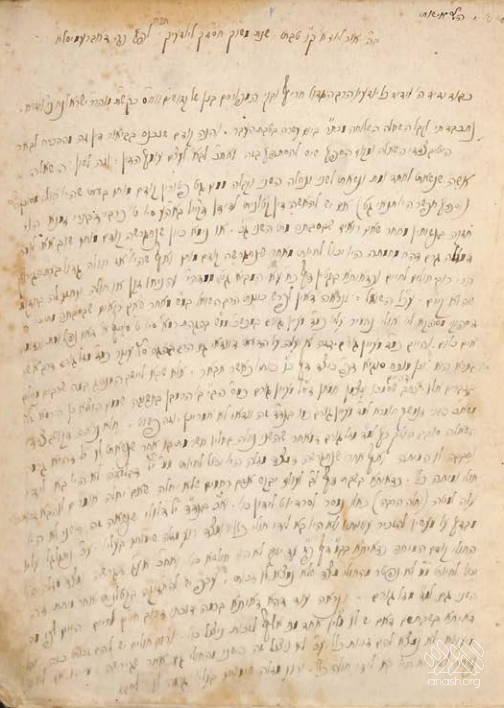
Library of Agudas Chassidei Chabad, ms. 1332, p. 1. The library possesses three of Harav Eliyahu Dovid’s notebooks containing teshuvoshe sent and received (ms. 1331-1333). The teshuvah pictured here was written in 5607 at the request of Maharin of Niezhin, for a case forwarded to the Tzemach Tzedek. Like many of the teshuvos in these notebooks, it has not yet been published.
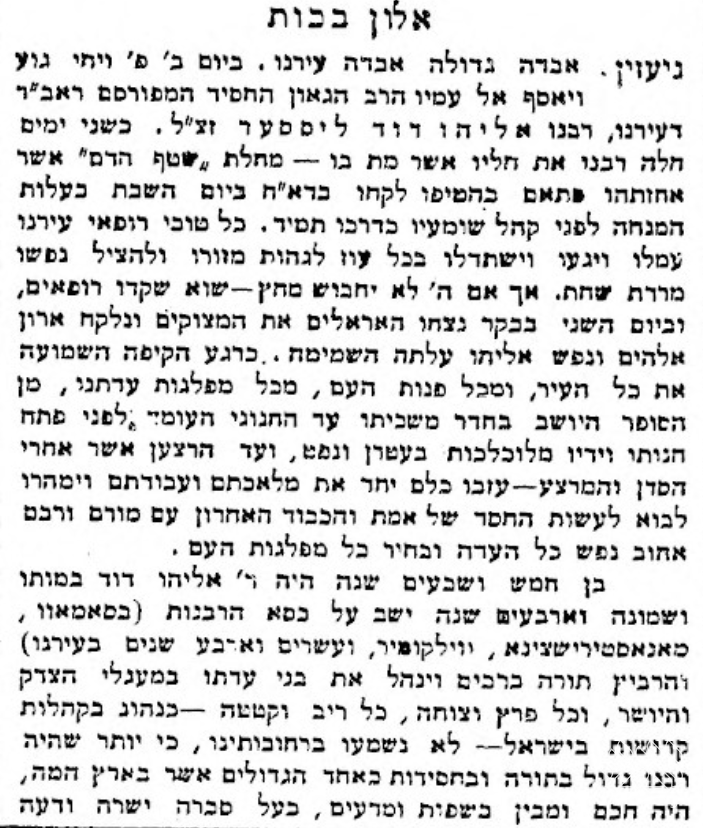
In honor of his 133rd yartzeit on 7 Teves, we present an obituary for Harav Eliyahu Dovid that appeared in the Hatzefirah newspaper of 1 Shevat 5653 (January 19, 1893). This obituary provides us with his full name, a list of places where he served as rov, and a description of his remarkable multifaceted personality:
Niezhin. A great loss has befallen our city. On Monday, Parshas Vayechi, the soul of our rov and gaon, the renowned chasid, the Rosh Av Beis Din of our community, Rabeinu Eliyahu Dovid Lisser, זצ”ל, expired, and he was gathered to his people.
For two days, he suffered from the illness that claimed his life. He was suddenly afflicted by a hemorrhage while he was speaking, delivering a maamar Chasidus on Shabbos evening to his listeners, as he always did.
All the finest physicians in our city labored hard and strove with all their might to heal him and save his life from descending to the abyss. But if Hashem does not bind the wound, the toil of doctors is in vain. On Monday morning, the angels prevailed over the righteous mortals, and the holy aron was taken; the soul of Eliyahu ascended to Heaven.
The news spread throughout the city at once. All circles of people, from every faction of our community—from the writer sitting in his quiet study, to the shopkeeper standing at the entrance to his store with hands stained from tar and kerosene, to the cobbler sitting behind his anvil and awl—all abandoned their work and rushed to perform chesed shel emes and accord the final honor to their teacher and rov, who was beloved by the entire community, and treasured by all factions of the people.
R. Eliyahu Dovid was seventy-five years old at his passing, and he served as a rov for forty-eight years (in Samov, Monastyrshchina, Vilkomir, and for twenty-four years in our city). He taught Torah to the public and led his flock in the paths of justice and honesty. No breach or outcry, no quarrel or dispute—of the kind that is customary in holy Yiddishe kehilos—was heard in our streets.
For in addition to his great stature in Torah and chasidus, as one of the greats of the land, he was also wise and knowledgeable of languages and the sciences, a man of sound logic and a balanced, composed mind. With his insight and prudence, he knew how to conduct communal life, to sow the seeds of peace, and to draw favor from all who dwelled in our city.
And like the man from Heaven, in which each person tasted what they desired, so too was our rov: across all factions of our large and diverse community, every group found in him what they sought. The chasid enjoyed his chasidus, the Torah scholars his Torah knowledge, the wise men his wisdom, and the maskilim his general knowledge. Every broken-hearted and downtrodden person found in him drops of comfort for their suffering soul.
May Hashem grant us rest from our sorrow and sadness, and may He send comfort to the mourners of our city and to all who revere and honor our rov’s great name. תנצב”ה.
Tzvi Alatin
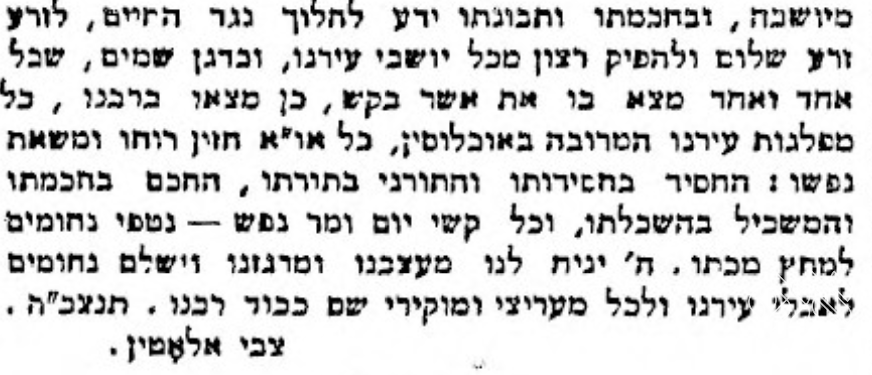
The original article, printed in Hatzefirah, 1 Shevat 5653 (January 19, 1893).
This obituary allows us to construct a biographical outline of Harav Eliyahu David’s life. He was born in 5578 and began serving as a rov in 5605, at the age of 27. The first towns in which he served are listed here as Samov, Monastyrshchina, Vilkomir, but based on the above, Dobromosil should also be added to the list, perhaps as the first. In 5629, he was appointed as the rov of Niezhin, apparently in conjunction with the move of Harav Yisrael Noach to the city at this time.
*
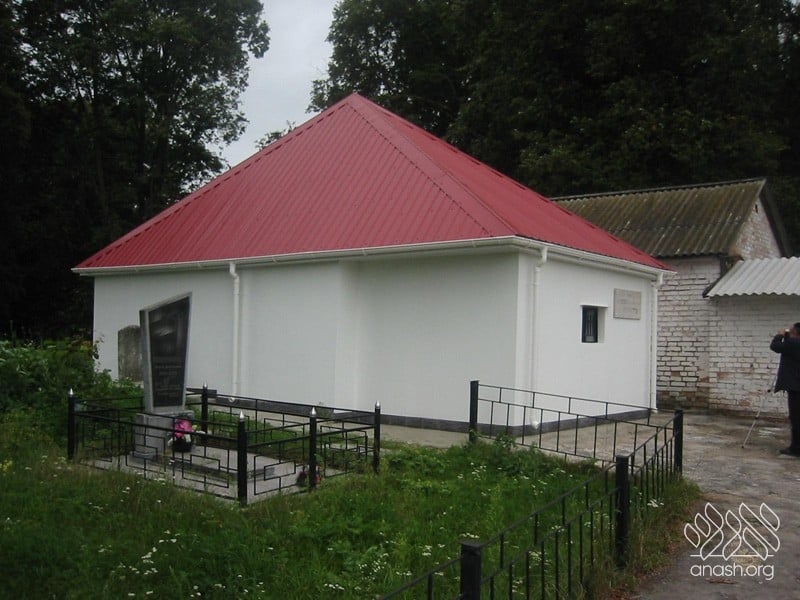
The ohel of the Mitteler Rebbe in Niezhin, as it appears today.
The Yeshiva in Niezhin
It is known that Niezhin was home to a highly-regarded yeshivah for many years. One source ascribes the founding of the yeshivah to R. Levi Yitzchak Schneersohn, the son of Harav Menachem Nochum of Niezhin, the Mitteler Rebbe’s oldest son. Information about this yeshivah was collected by Yisrael Barda in Hatamim (Beis Moshiach), vol. 47, pp. 72-73.
R. Levi Yitzchak Schneersohn of Niezhin, the son of Harav Menachem Nochum of Niezhin, and grandson of the Mitteler Rebbe. Sefer Hatze’etzaim, p. 134.
The following newspaper article provides us with additional information about the yeshivah and credits Harav Eliyahu Dovid and Maharin as founders. This article about the state of the city of Niezhin in 5655 was written by a local resident named Shmuel Dovber Pikus, and we will quote the section that is of interest from a Chabad perspective.
In our city, there are 4,000 Jewish men, not including children. . . .
The yeshivah, founded many years ago by the venerable rov ז”ל, and the rebbe and tzadik R. Y. N., נבג”מ, still stands firm. About forty bochurim from the town and the surrounding area learn there, hearing a daily shiur from the Rosh Yeshivah, the distinguished R. Dovid Dovber Karabelnik, a man swift and capable in his work, who performs Hashem’s work faithfully and sincerely. But there is much neglect in the yeshivah, for he alone is the teacher and mashgiach; no one else shoulders any of the responsibilities.
Many people come to daven at the kever of the Mitteler Rebbe, whose resting place is in Niezhin. It is an established custom that before people go to the cemetery, they immerse themselves in water. Therefore, the gvir and yerei shamayim R. Yitzchak Helfgot, who stands at the helm of every good and beneficial undertaking, arose and was stirred to action.
He gave a loan to the community of Niezhin from his own pocket and built a stone building with a mikveh paved with marble, with separate facilities for men and women. He also installed machinery and pipes to heat the mikveh. The water flows in and out through specially constructed channels and pipes, so that fresh, pure water constantly replaces the old. Each day, he personally supervises the workers and directs the labor.
Now the mikveh stands completed in its full splendor and beauty, like those in the great cities. After being reimbursed from the mikveh’s income, he transferred ownership of it to the community.
After the passing of the old rov, ז”ל, a machlokes arose in the city—a machlokes not leshem shamayim. The chasidim, who are the majority, demanded a rov thoroughly steeped in the teachings of Chasidus, and until a final decision could be reached, they brought in a rov from Berezna. The Litvaks who had settled in Niezhin argued that the community must appoint a rov great in Shas and poskim. The maskilim among the younger generation sought Torah together with derech eretz—enlightenment joined with emunah. Thus the city was divided into three camps, the community split into factions, and the entire populace was in turmoil.
Rabonim of every stripe flocked to the city from the four corners of the land, yet all left disappointed. The camps battled fiercely—not with physical force, but with thunderous voices, fiery rhetoric, and bombastic pronouncements.
This went on until the arrival of the gaon, the Rav of Gluchov. Then the conflict ceased, the voices fell silent, and the city grew calm. All parties united around one opinion, and the entire community accepted him with love and goodwill, bringing the strife to an end.
For besides his greatness in Shas and poskim, rishonim and achronim—like one of the greatest in the land—he is also deeply versed in Chasidus, a scholar of Hebrew, knowledgeable of languages, and possesses noble character traits. Through his great humility, his pleasant speech, and the spirit of grace that rests upon him, he draws every heart to love him. Chasidim and maskilim walk arm in arm to the rov’s home to hear Torah and wisdom, his considered and refined words, delivered pleasantly with insight and fine discernment.
The rov from Berezna also remained in his position in peace. Their salaries were set at six hundred rubles for one, and four hundred rubles for the other.
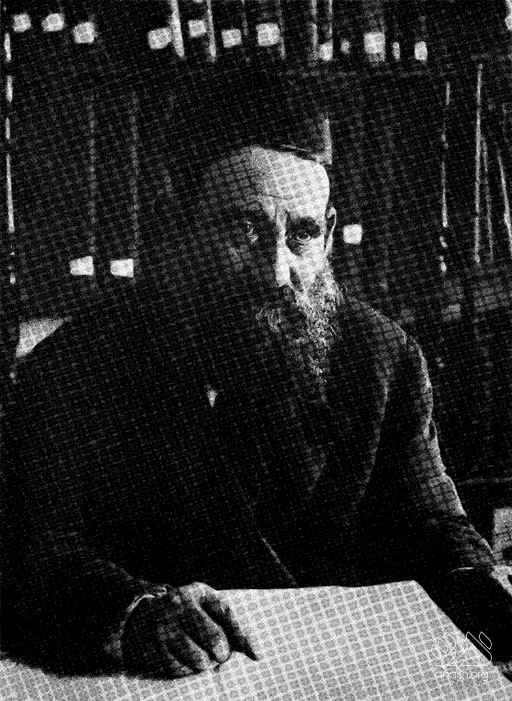
Harav Shlomo Aharonson
The rov from Gluchov who filled Harav Eliyahu Dovid’s place was Harav Shlomo Aharonson (5623-5695), later a rov in Kiev and Tel Aviv. Harav Shlomo Aharonson was a Chabad chasid, but not mekushar to any specific rebbe, and was a prominent figure in the Religious Zionist Mizrachi party.
The rov from Berezna who served as a moreh tzedek in Niezhin was Harav Yitzchak Dovid Viderevitch (Oholei Shem, p. 128).
*
The Yeshiva’s Gemach
One of the famous talmidim of the yeshivah in Niezhin during the lifetime of Maharin was Harav Yehudah Leib Tzirelson, later the rov of Kishinev and mechaber of many seforim.
A report Harav Yehudah Leib sent to the Hakol newspaper in 5637, while he was a 17-year-old talmid in the yeshivah, sheds some light on life in the yeshivah and the role of the rov, Harav Eliyahu Dovid. Written in beautiful flowery Hebrew, the article describes the gemilus chasadim performed by the bochurim of the yeshivah, headed by Harav Eliyahu Dovid. Here is the relevant piece, in English translation:
Behold, a truly pleasant sight may be seen in our city of Niezhin. A group of fine bochurim who study Torah diligently, graced with perceptive minds, saw and understood that our city is a commercial hub to which people of all types and levels of society turn from every direction.
Among them are some who have no money left in their pockets by the time they arrive, nothing at all with which to sustain themselves even for a few days, and not enough to carry out the business for which they have come. Their shame prevents them from knocking on doors and asking for help from generous individuals.
Therefore, these bochurim established—on their own and with their own funds—a society which they called Chevras Hachnasas Orchim. Every pleasant-hearted bochur, whose spirit is moved by his fellow’s pain, contributes weekly to this society from his own money, each according to his ability. In time, some older townsmen joined as well, lending strength and support to the young men, so that this act of tzedakah could grow and flourish.
The bochurim charted their path wisely, with sound judgment. They appointed gabaim and accountants from their midst, even drafting bylaws and recording them in a ledger, as is customary.
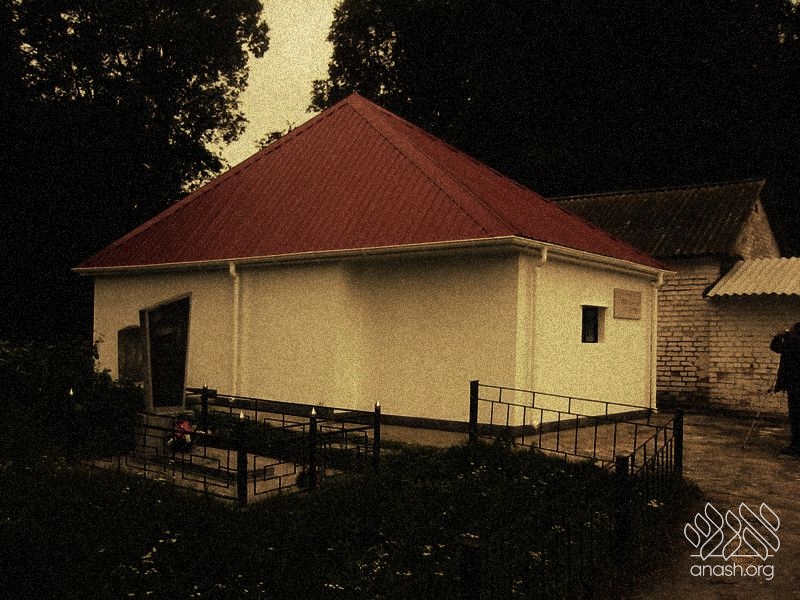
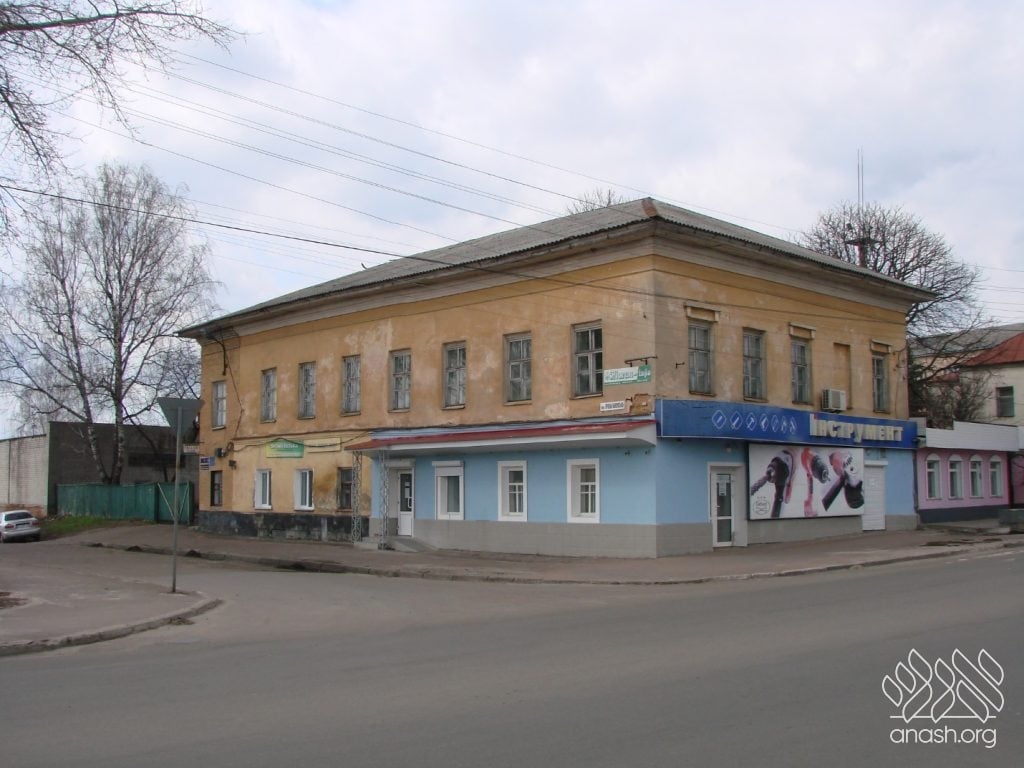
Two buildings in Niezhin are known as the “Schneersohn Synagogue.” The building pictured above is on Furmanska St. Its size and lack of a second floor indicate that it may have been a zal used to host hundreds of chasidim who came for yamim tovim.
Nevertheless, they did not rely solely on their own eyes and judgment. They placed at their head, as supervisor and final authority, the local rov and moreh tzedek, for he is better placed to determine which supplicants are genuinely deserving of support, as there are also fraudsters around. The amount and form of each donation is likewise determined by the rov, and his word is final.
From the day this society was founded—even though it is quite recent—several travelers who arrived empty-handed without a penny for their sustenance have already received proper assistance from it. Without delay, all of their needs were provided for the duration of time they must spend in our city.
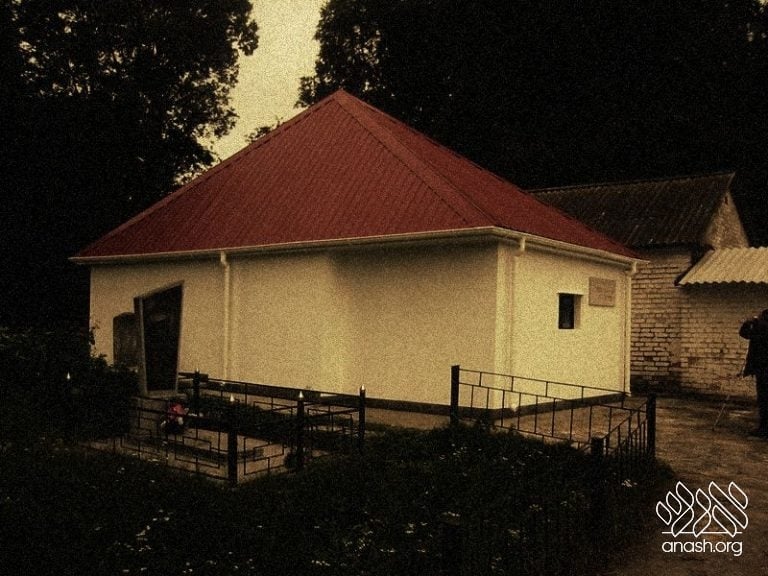
A second building in Niezhin known as the “Schneersohn Synagogue.”
The charitable activities of Harav Tzirelson and his fellow bochurim show us that the yeshivah in Niezhin was very much integrated with the local kehillah, with its talmidim taking the initiative to solve local problems. This reflects the traditional informal yeshivah model common in the area at this time, and is very different from the modern yeshivos in Lita and later in Lubavitch. In the modern model, the yeshivah is completely independent of the local kehillah, and its talmidim don’t play any role beyond its walls.
Taken together, these articles paint a picture of Harav Eliyahu Dovid as a multifaceted rov. Previously, we only knew him as a great chasidishe gaon, but now we have a new appreciation for him as a leader deeply involved in communal affairs and beloved by all members of his diverse kehillah.
To view all installments of From the Margins of Chabad History, click here.
For additional exclusive content, follow the column on X: x.com/ChabadMargins
KJKJûó
COMMENTS
We appreciate your feedback. If you have any additional information to contribute to this article, it will be added below.
The name of Harav Eliyahu Dovid, the rov of Niezhin, is known to Chabad talmidei chachamim as a close associate of the Tzemach Tzedek’s son, Harav Yisrael Noach of Niezhin, and a leading Chabad posek in his time. But his full name and biography have remained a mystery until today—his 133rd yartzeit.
By Anash
Harav Eliyahu Dovid’s Biography
Harav Eliyahu Dovid of Niezhin has long been known as an important Chabad posek in the time of the Tzemach Tzedek and the following generation, with over twenty teshuvos written by him published in Yagdil Torah. A number of these teshuvos are written on behalf of the Tzemach Tzedek’s son, Harav Yisrael Noach (Maharin), who served as a rebbe in Niezhin after his father’s histalkus—evidence of their close relationship.
But the identity and biography of this rov remained a mystery. From dates and places mentioned in his teshuvos, R. Sholom Ber Levine was able to deduce that in 5608 he lived in Dobromosil, between 5608 and 5611 he was a rov in Samov, and between 5631-5644 in Niezhin (Tzemach Tzedek—Mafteichos, p. 164). The name of his father, R. Moshe, is known from his signature and is also mentioned in a story about the Tzemach as Moshke Dan’s, a misnaged from Orsha who was an expert in Russian law (Likutei Reshimos Umaasiyos, no. 44). No other information was known about Harav Eliyahu Dovid.
Library of Agudas Chassidei Chabad, ms. 1332, p. 1. The library possesses three of Harav Eliyahu Dovid’s notebooks containing teshuvoshe sent and received (ms. 1331-1333). The teshuvah pictured here was written in 5607 at the request of Maharin of Niezhin, for a case forwarded to the Tzemach Tzedek. Like many of the teshuvos in these notebooks, it has not yet been published.
In honor of his 133rd yartzeit on 7 Teves, we present an obituary for Harav Eliyahu Dovid that appeared in the Hatzefirah newspaper of 1 Shevat 5653 (January 19, 1893). This obituary provides us with his full name, a list of places where he served as rov, and a description of his remarkable multifaceted personality:
Niezhin. A great loss has befallen our city. On Monday, Parshas Vayechi, the soul of our rov and gaon, the renowned chasid, the Rosh Av Beis Din of our community, Rabeinu Eliyahu Dovid Lisser, זצ”ל, expired, and he was gathered to his people.
For two days, he suffered from the illness that claimed his life. He was suddenly afflicted by a hemorrhage while he was speaking, delivering a maamar Chasidus on Shabbos evening to his listeners, as he always did.
All the finest physicians in our city labored hard and strove with all their might to heal him and save his life from descending to the abyss. But if Hashem does not bind the wound, the toil of doctors is in vain. On Monday morning, the angels prevailed over the righteous mortals, and the holy aron was taken; the soul of Eliyahu ascended to Heaven.
The news spread throughout the city at once. All circles of people, from every faction of our community—from the writer sitting in his quiet study, to the shopkeeper standing at the entrance to his store with hands stained from tar and kerosene, to the cobbler sitting behind his anvil and awl—all abandoned their work and rushed to perform chesed shel emes and accord the final honor to their teacher and rov, who was beloved by the entire community, and treasured by all factions of the people.
R. Eliyahu Dovid was seventy-five years old at his passing, and he served as a rov for forty-eight years (in Samov, Monastyrshchina, Vilkomir, and for twenty-four years in our city). He taught Torah to the public and led his flock in the paths of justice and honesty. No breach or outcry, no quarrel or dispute—of the kind that is customary in holy Yiddishe kehilos—was heard in our streets.
For in addition to his great stature in Torah and chasidus, as one of the greats of the land, he was also wise and knowledgeable of languages and the sciences, a man of sound logic and a balanced, composed mind. With his insight and prudence, he knew how to conduct communal life, to sow the seeds of peace, and to draw favor from all who dwelled in our city.
And like the man from Heaven, in which each person tasted what they desired, so too was our rov: across all factions of our large and diverse community, every group found in him what they sought. The chasid enjoyed his chasidus, the Torah scholars his Torah knowledge, the wise men his wisdom, and the maskilim his general knowledge. Every broken-hearted and downtrodden person found in him drops of comfort for their suffering soul.
May Hashem grant us rest from our sorrow and sadness, and may He send comfort to the mourners of our city and to all who revere and honor our rov’s great name. תנצב”ה.
Tzvi Alatin
The original article, printed in Hatzefirah, 1 Shevat 5653 (January 19, 1893).
This obituary allows us to construct a biographical outline of Harav Eliyahu David’s life. He was born in 5578 and began serving as a rov in 5605, at the age of 27. The first towns in which he served are listed here as Samov, Monastyrshchina, Vilkomir, but based on the above, Dobromosil should also be added to the list, perhaps as the first. In 5629, he was appointed as the rov of Niezhin, apparently in conjunction with the move of Harav Yisrael Noach to the city at this time.
*
The ohel of the Mitteler Rebbe in Niezhin, as it appears today.
The Yeshiva in Niezhin
It is known that Niezhin was home to a highly-regarded yeshivah for many years. One source ascribes the founding of the yeshivah to R. Levi Yitzchak Schneersohn, the son of Harav Menachem Nochum of Niezhin, the Mitteler Rebbe’s oldest son. Information about this yeshivah was collected by Yisrael Barda in Hatamim (Beis Moshiach), vol. 47, pp. 72-73.
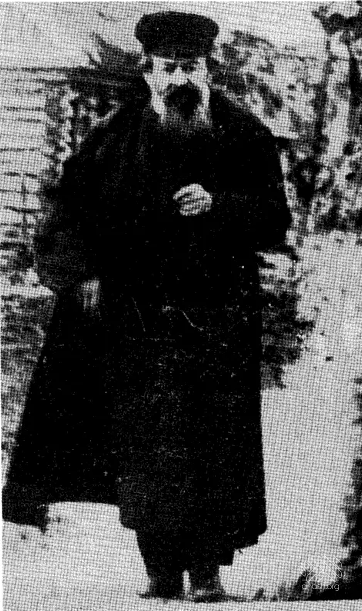
R. Levi Yitzchak Schneersohn of Niezhin, the son of Harav Menachem Nochum of Niezhin, and grandson of the Mitteler Rebbe. Sefer Hatze’etzaim, p. 134.
The following newspaper article provides us with additional information about the yeshivah and credits Harav Eliyahu Dovid and Maharin as founders. This article about the state of the city of Niezhin in 5655 was written by a local resident named Shmuel Dovber Pikus, and we will quote the section that is of interest from a Chabad perspective.
In our city, there are 4,000 Jewish men, not including children. . . .
The yeshivah, founded many years ago by the venerable rov ז”ל, and the rebbe and tzadik R. Y. N., נבג”מ, still stands firm. About forty bochurim from the town and the surrounding area learn there, hearing a daily shiur from the Rosh Yeshivah, the distinguished R. Dovid Dovber Karabelnik, a man swift and capable in his work, who performs Hashem’s work faithfully and sincerely. But there is much neglect in the yeshivah, for he alone is the teacher and mashgiach; no one else shoulders any of the responsibilities.
Many people come to daven at the kever of the Mitteler Rebbe, whose resting place is in Niezhin. It is an established custom that before people go to the cemetery, they immerse themselves in water. Therefore, the gvir and yerei shamayim R. Yitzchak Helfgot, who stands at the helm of every good and beneficial undertaking, arose and was stirred to action.
He gave a loan to the community of Niezhin from his own pocket and built a stone building with a mikveh paved with marble, with separate facilities for men and women. He also installed machinery and pipes to heat the mikveh. The water flows in and out through specially constructed channels and pipes, so that fresh, pure water constantly replaces the old. Each day, he personally supervises the workers and directs the labor.
Now the mikveh stands completed in its full splendor and beauty, like those in the great cities. After being reimbursed from the mikveh’s income, he transferred ownership of it to the community.
After the passing of the old rov, ז”ל, a machlokes arose in the city—a machlokes not leshem shamayim. The chasidim, who are the majority, demanded a rov thoroughly steeped in the teachings of Chasidus, and until a final decision could be reached, they brought in a rov from Berezna. The Litvaks who had settled in Niezhin argued that the community must appoint a rov great in Shas and poskim. The maskilim among the younger generation sought Torah together with derech eretz—enlightenment joined with emunah. Thus the city was divided into three camps, the community split into factions, and the entire populace was in turmoil.
Rabonim of every stripe flocked to the city from the four corners of the land, yet all left disappointed. The camps battled fiercely—not with physical force, but with thunderous voices, fiery rhetoric, and bombastic pronouncements.
This went on until the arrival of the gaon, the Rav of Gluchov. Then the conflict ceased, the voices fell silent, and the city grew calm. All parties united around one opinion, and the entire community accepted him with love and goodwill, bringing the strife to an end.
For besides his greatness in Shas and poskim, rishonim and achronim—like one of the greatest in the land—he is also deeply versed in Chasidus, a scholar of Hebrew, knowledgeable of languages, and possesses noble character traits. Through his great humility, his pleasant speech, and the spirit of grace that rests upon him, he draws every heart to love him. Chasidim and maskilim walk arm in arm to the rov’s home to hear Torah and wisdom, his considered and refined words, delivered pleasantly with insight and fine discernment.
The rov from Berezna also remained in his position in peace. Their salaries were set at six hundred rubles for one, and four hundred rubles for the other.
Harav Shlomo Aharonson
The rov from Gluchov who filled Harav Eliyahu Dovid’s place was Harav Shlomo Aharonson (5623-5695), later a rov in Kiev and Tel Aviv. Harav Shlomo Aharonson was a Chabad chasid, but not mekushar to any specific rebbe, and was a prominent figure in the Religious Zionist Mizrachi party.
The rov from Berezna who served as a moreh tzedek in Niezhin was Harav Yitzchak Dovid Viderevitch (Oholei Shem, p. 128).
*
The Yeshiva’s Gemach
One of the famous talmidim of the yeshivah in Niezhin during the lifetime of Maharin was Harav Yehudah Leib Tzirelson, later the rov of Kishinev and mechaber of many seforim.
A report Harav Yehudah Leib sent to the Hakol newspaper in 5637, while he was a 17-year-old talmid in the yeshivah, sheds some light on life in the yeshivah and the role of the rov, Harav Eliyahu Dovid. Written in beautiful flowery Hebrew, the article describes the gemilus chasadim performed by the bochurim of the yeshivah, headed by Harav Eliyahu Dovid. Here is the relevant piece, in English translation:
Behold, a truly pleasant sight may be seen in our city of Niezhin. A group of fine bochurim who study Torah diligently, graced with perceptive minds, saw and understood that our city is a commercial hub to which people of all types and levels of society turn from every direction.
Among them are some who have no money left in their pockets by the time they arrive, nothing at all with which to sustain themselves even for a few days, and not enough to carry out the business for which they have come. Their shame prevents them from knocking on doors and asking for help from generous individuals.
Therefore, these bochurim established—on their own and with their own funds—a society which they called Chevras Hachnasas Orchim. Every pleasant-hearted bochur, whose spirit is moved by his fellow’s pain, contributes weekly to this society from his own money, each according to his ability. In time, some older townsmen joined as well, lending strength and support to the young men, so that this act of tzedakah could grow and flourish.
The bochurim charted their path wisely, with sound judgment. They appointed gabaim and accountants from their midst, even drafting bylaws and recording them in a ledger, as is customary.
Two buildings in Niezhin are known as the “Schneersohn Synagogue.” The building pictured above is on Furmanska St. Its size and lack of a second floor indicate that it may have been a zal used to host hundreds of chasidim who came for yamim tovim.
Nevertheless, they did not rely solely on their own eyes and judgment. They placed at their head, as supervisor and final authority, the local rov and moreh tzedek, for he is better placed to determine which supplicants are genuinely deserving of support, as there are also fraudsters around. The amount and form of each donation is likewise determined by the rov, and his word is final.
From the day this society was founded—even though it is quite recent—several travelers who arrived empty-handed without a penny for their sustenance have already received proper assistance from it. Without delay, all of their needs were provided for the duration of time they must spend in our city.
A second building in Niezhin known as the “Schneersohn Synagogue.”
The charitable activities of Harav Tzirelson and his fellow bochurim show us that the yeshivah in Niezhin was very much integrated with the local kehillah, with its talmidim taking the initiative to solve local problems. This reflects the traditional informal yeshivah model common in the area at this time, and is very different from the modern yeshivos in Lita and later in Lubavitch. In the modern model, the yeshivah is completely independent of the local kehillah, and its talmidim don’t play any role beyond its walls.
Taken together, these articles paint a picture of Harav Eliyahu Dovid as a multifaceted rov. Previously, we only knew him as a great chasidishe gaon, but now we have a new appreciation for him as a leader deeply involved in communal affairs and beloved by all members of his diverse kehillah.
To view all installments of From the Margins of Chabad History, click here.
For additional exclusive content, follow the column on X: x.com/ChabadMargins








 COMMENTS


We appreciate your feedback. If you have any additional information to contribute to this article, it will be added below.