



כ״ח תמוז ה׳תשפ״ה | July 24, 2025
Signs of Life in Organ Donors Prompts System Overhaul
After some shocking instances where patients showed signs of life before organ removal, HHS Secretary Robert F. Kennedy Jr. announced a sweeping overhaul of the U.S. organ transplant system to protect the sanctity of life, addressing many practices that conflict with halachic standards.
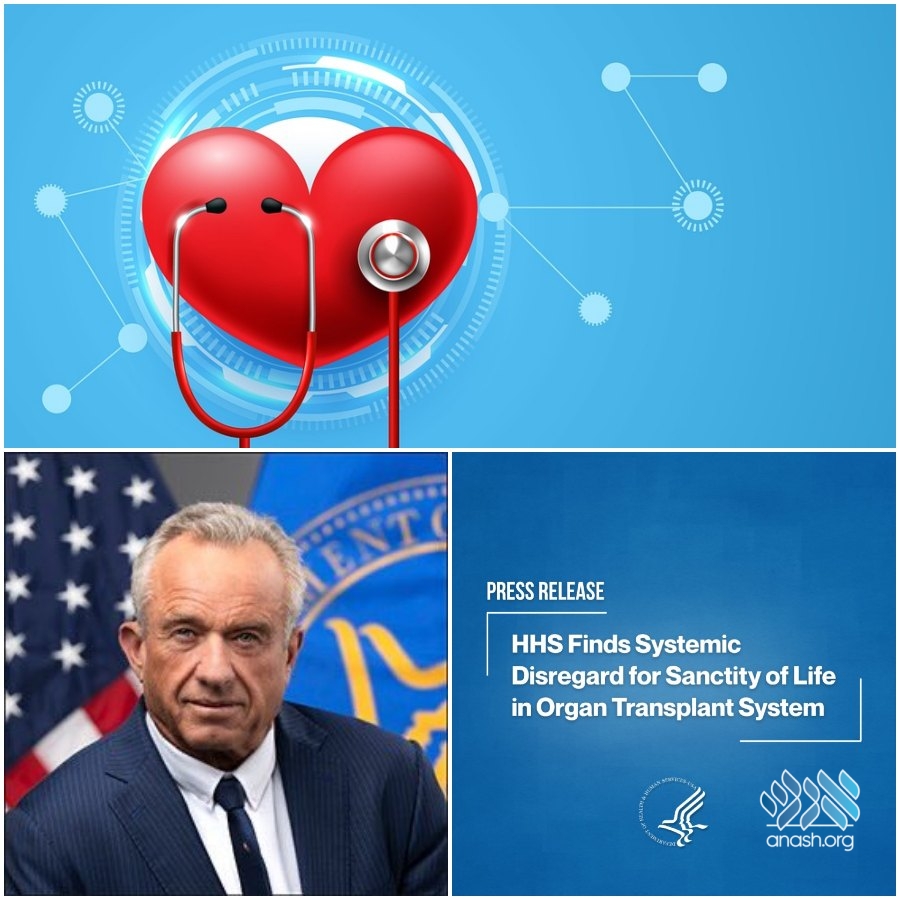
On Monday, HHS Secretary Robert F. Kennedy Jr. announced a sweeping overhaul of the U.S. organ transplant system to protect the sanctity of life, also addressing practices conflicting with halachic standards. The follows shocking cases of patients showing signs of life before organ removal.
By Anash.org reporter
On Monday, HHS Secretary Robert F. Kennedy Jr. announced a major effort to overhaul the U.S. organ transplant system after a federal investigation uncovered serious problems at an organ procurement organization (OPO) that serves Kentucky, southwest Ohio, and parts of West Virginia.
The investigation, conducted by the Health Resources and Services Administration (HRSA), looked at 351 cases where organ donation had been authorized but ultimately did not take place. Of those, 103 cases (29.3%) raised major concerns. In 73 cases, patients showed neurological signs that were incompatible with organ donation. In at least 28 cases, organs may have been taken before the patient was legally declared dead.
“Our findings show that hospitals allowed the organ procurement process to begin when patients showed signs of life, and this is horrifying,” Kennedy said.
“The organ procurement organizations that coordinate access to transplants will be held accountable. The entire system must be fixed to ensure that every potential donor’s life is treated with the sanctity it deserves.”
The federal probe – made public ahead of a House Oversight Subcommittee hearing the following day – cited a “concerning pattern of risk.” At Tuesday’s hearing, HRSA Acting Director Carole Johnson and Secretary Kennedy testified before lawmakers. Subcommittee Chair Rep. Lisa McClain (R-Mich.) called the findings “truly horrific,” warning that criminal accountability could follow. She emphasized that this was not merely a case of bureaucratic reform but a potential matter of life, death, and justice.
Investigators had flagged weak neurological assessments, poor coordination with hospital staff, mishandled consent procedures, and inaccurate cause-of-death reporting, especially in overdose cases. A particularly disturbing 2021 case involved a Kentucky patient who began moving and showed signs of life during organ retrieval prep. He survived, highlighting grave procedural errors.
To address these issues, Kennedy’s administration is mandating reforms including a full root-cause review of what went wrong, strict compliance with the five-minute wait after cardiac death, clear standards for donor eligibility, and a rule that allows any staff member to stop a procurement if something seems off. The OPO in question could lose its certification if it doesn’t make the required changes.
HHS is working with Congress and the national transplant system to roll out the reforms. More hearings and changes are expected as federal authorities try to rebuild public trust.
According to halacha, organ donation from the dead raises serious concerns, including desecrating the body (nivul hames), benefiting from the dead (hana’ah), and the obligation to bury the body intact (kevurah). Many halachic authorities permit such donations when they directly save a life (pikuach nefesh), and some even consider it a mitzvah – but only if the donor is unquestionably considered dead according to halacha.
The major debate centers around brain death, which hospitals often treat as sufficient for declaring someone dead. While some poskim accept brain-stem death as halachic death – since the person can no longer breathe on their own – many leading halachic authorities strongly disagree. They hold that as long as the heart is still beating and blood is circulating (even with machines), the person is still alive.
Accordingly, removing organs from a brain-dead patient is considered murder. Even preparing to harvest organs before the heart stops completely is seen as extremely serious and possibly forbidden.
 COMMENTS


The problem is that you can’t harvest an organ once the body is actually dead ..