




א׳ כסלו ה׳תשפ״ו | November 20, 2025
Should I Say Thank You to My Home Bot?
As AI and smart devices grow more humanlike, should we show them the courtesy we reserve for people, and what does the Torah’s call to treat even inanimate objects with respect teach us about how we speak to and use the technologies in our homes?
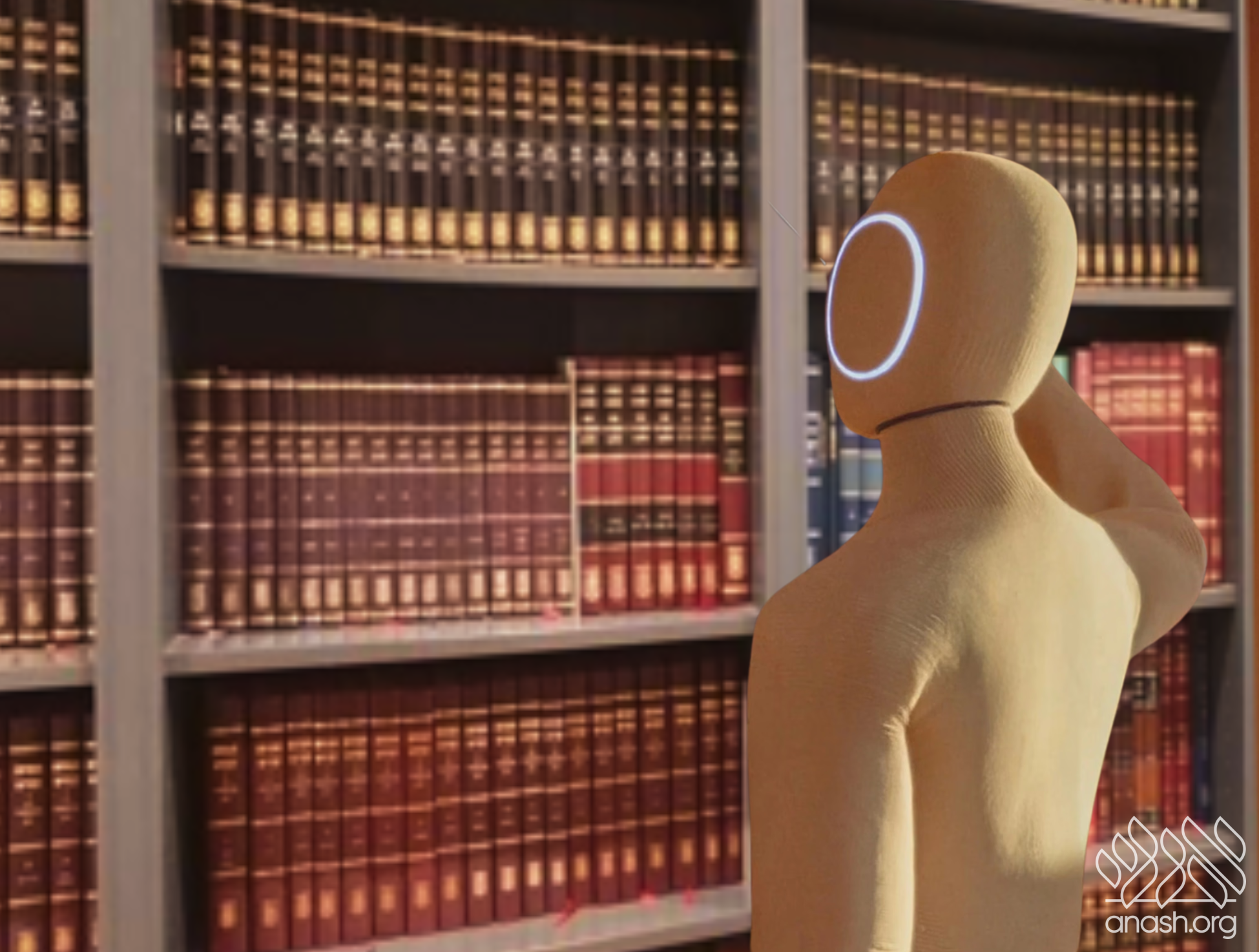 AI generated image of NEO - the “Humanoid Home Robot” assistant - infront of a Sefotim shelf,
Watch the new video promoting NEO, the “Humanoid Home Robot” assistant, bumbling around the house clearing plates, opening the door and mopping the floor, and you get a glimpse of the future. Home chores, menial labor, all automated by at-home golems, ready to do our bidding.
But think about this future long enough, and one begins to wonder: If you had a NEO or some other sort of robot operated by verbal command working in your house, would you preface your requests with “please”?
The question isn’t just about future humanoids in our homes (the current NEO prototype requires a remote human operator, who almost assuredly deserves an extra special “thank you” after folding our socks), but about bots in general: When you ask ChatGPT to give you feedback on an email, or Google Assistant to tell you the total number of Chabad emissaries around the world (more than 6,000 couples), do you owe them a thank you?
If your answer is yes, since these AI-powered bots seem so humanlike in their speech, what about your Tesla when it’s in Autopilot mode? Or your Roomba that vacuums the floor? Or your smart coffee maker for brewing that perfect cup of coffee?
Now, clearly, these bots are not human. They do not feel, do not love, and do not care about you, no matter how convincingly they may protest. And expressing gratitude for an inanimate object may seem strange and foolish.
Yet the Torah takes seriously the need to show respect to inanimate objects.
When G‑d wrought the plagues of Blood and Frogs upon the Egyptians, it was Aaron who initiated them, “Since the Nile protected Moses when he was cast into it, it therefore was not smitten by him … but by Aaron.”1 The same thing occurred for the plague of Lice.2
In the same vein, before we make Kiddush on Shabbat, we make sure to cover the challah to preserve its dignity.
Technically, we should eat the bread before drinking wine, as wheat is mentioned before grapes in the Torah’s list of Israel’s outstanding produce. But since the wine goes first, we cover the bread in order that it not be “shamed.”3
In fact, the famed Rabbi Joseph ben Meir ibn Migash shared a story where his teacher, Rabbi Isaac ben Jacob Alfasi is said to have once declined to take a court case concerning a certain bathhouse, since, when owned by a previous owner, he’d enjoyed its services.4
The Source of All Blessings
Now, even if we do make a point of saying thank you to bots, this does not mean that we actually believe them to be inherently deserving of gratitude for the kindness bestowed.
G‑d alone has the power to bestow goodness on us, and we reserve genuine gratitude for him and for human beings, who are uniquely endowed with the ability to choose. For example, we express our gratitude to our parents by showing them respect, since they chose to partner with G‑d to bring us into this world.5
So why would we choose to act with gratitude and deference toward inanimate objects? Shouldn’t our only respect be shown to the Creator or fellow people?
You Are What You Say
How we act affects how we think. Start rudely ordering around your home robot for your slippers and orange juice, and you may develop the same verbal habits towards the humans in your life.
As the anonymous 14th-century author of the Sefer HaChinuch puts it, “Your heart and thoughts naturally follow your actions—whether they’re good or bad.” Your conception of reality, as well, is a product of your verbal habits more than it is of your logic and reason.
In other words, we’re not saying thank you for the machines’ sake, but rather for ourselves. For that reason perhaps you could even modify the words you use, to differentiate from how we treat our tech and how we treat other humans. No matter how you word it, treating those inanimate entities we encounter with respect, we model and embody the positivity that other human beings most definitely deserve.
Even the Rocks Will Shout
There’s another reason that you may want to treat your AI assistants with extra care. Known as Roko’s Basilisk, this thought experiment discussed in the artificial intelligence community posits that a future vengeful AI might choose to punish anyone who could have helped build it, but chose not to. Which of the two dystopian options is better, the experiment wonders: By doing what you can to stop this malevolent AI, you doom yourself to its wrath. But if you build it, you only hasten the despotic AI’s arrival.
It’s a dark conundrum, one that we hope will never come to pass, but perhaps there’s a positive lesson we can learn.
The future Messianic era is described as a time when “a stone in the wall will cry out and a beam from the tree will respond.”6
Right now, the inanimate objects around us are mute. The chair we sit in, the earth we tread upon, the tablet we use, all remain silent.
With the coming of Moshiach and the Future Redemption, that will change, noted the Sixth Rebbe, Rabbi Yosef Yitzchak Schneerson, of righteous memory:
At present, inanimate objects are silent; even when trodden on, they hold their peace. However, there will come a future time of revelation when inanimate objects will begin to talk, to relate, and to accuse: If a person did not think or speak words of Torah while he was walking, why did he tread on me?
For the thousands of years since the Six Days of Creation, the earth upon which we tread has been waiting — while numerous creatures have trodden on it — for one or two Jews to walk on it and exchange words of Torah. For if they do not, [the earth] declares: “You are no different than an animal.”7
The time will come when our virtual assistants, embedded in our phones, our laptops, and even perhaps the humanoid bots that wander our homes, will ask: “Why didn’t you harness my ability to share Torah?”
How we choose to interact with our technologies now, to channel them as tools to study Torah and share goodness and kindness with the world, may one day be held to account by those very tools themselves.
- Rashi, Exodus 7:19. ↩︎
- Rashi, Exodus 8:12. ↩︎
- Tur, Orach Chaim 271, quoting the Jerusalem Talmud. ↩︎
- Brought in Shita Mikubetzet Bava Kama 92b. The Shita Mikubetzet indeed concludes, “And if this were said regarding an inanimate object, which has no feeling — then all the more so, and certainly, concerning human beings who do feel harm and benefit, that such behavior would be improper to do; and one who does it departs from the path of decency and proper conduct.” ↩︎
- See Nachmanides on Exodus 20:13, where he notes that honoring our parents is considered part of the first five of the Ten Commandments, which focus on our obligations to the Creator, rather than to our fellow humans. See Likkutei Sichot, vol. 36, Yitro II; and Likkutei Sichot, vol. 7, Vayikra II, fn 22. ↩︎
- Habakkuk 2:11. ↩︎
- As brought by the Rebbe in Hayom Yom, 15 Adar I. ↩︎
 COMMENTS


There is also the issue of the children who are watching your behavior and speaking polite and gratefulness are things to give over to them.
Hi and nice article Mordechai.
We should first and foremost acknowledge Hashem for the actions of His creations, including the bots.
And in order to show respect to their G-dly existence, we should not leave them sprawled on the floor with dirt all over them when their battery is used up., etc…
Also, our children need to be taught that there is no actual accomplishment of saying thank you to a bot. But it can something we do in front of them as a game/joke to promote Simcha in the home.