In honor of the approaching yom tov of Purim, From the Margins of Chabad History presents two unknown accounts of Purim with the Rebbeim—from Lubavitch with the Rebbe Rashab and Riga with the Frierdiker Rebbe.
In honor of the approaching yom tov of Purim, From the Margins of Chabad History presents two unknown accounts of Purim with the Rebbeim—from Lubavitch with the Rebbe Rashab and Riga with the Frierdiker Rebbe.
Purim 5675—Lubavitch
Our first Purim account comes from the famous Yiddish poet and writer, Noach Yitzchak Gotlib. Noach Yitzchak Gotlib was born in Kovno, Lita, in 5664. His father R. Tzvi (Hershele) was a prominent chasid of Koidonov, a Litvishe chasidus that is now extinct. R. Hershele served as a rosh yeshivah in Koidanov, and he also served a few stints as a magid shiur for the younger bochurim in Tomchei Temimim in Lubavitch.
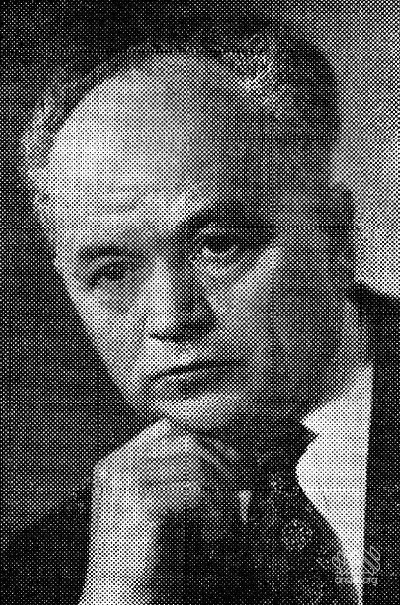
Noach Yitzchak Gotlib
Noach Yitzchak wrote a little about his time in Lubavitch in his poetry. The writing is somewhat cryptic, but we can glean the following details: He learned in Lubavitch for two years, in 5674 and 5675, as a 10–11-year-old, and his father was not living in Lubavitch at this time. He writes that he learned well, but was eventually expelled from the yeshivah after the mashgiach caught him reading the secular Yiddish book Di Kliyatshe, by Mendele Mocher Seforim (A Menṭsh in di Himlen: Naye Lider un Poemes, p. 146).
Noach Yitzchak Gotlib eventually strayed from shemiras Torah umitzvos, and became a well-known Yiddish poet and writer. He emigrated to Canada in 5690 and lived there until his passing in 5727.
We have already published two articles by Gotlib about his time in Lubavitch: one about his arrival at the yeshivah, and a second describing tashlich with the Rebbe Rashab. The present article, the final one we have been able to locate, appeared in the Nayer Folksblat newspaper in Lodz, Poland, 14 Adar II, 5695 (March 19, 1935). It seems that the article was originally published in the Montreal-based Yiddish newspaper, the Keneder Adler, but that newspaper is unavailable online.
The Rebbe Rashab was not usually present in Lubavitch for Purim. R. Foleh Kahn, who learned in Lubavitch for ten years, recalled that the only year the Rebbe Rashab celebrated Purim in Lubavitch during this period was 5675. We can therefore date Gotlib’s account to this year.
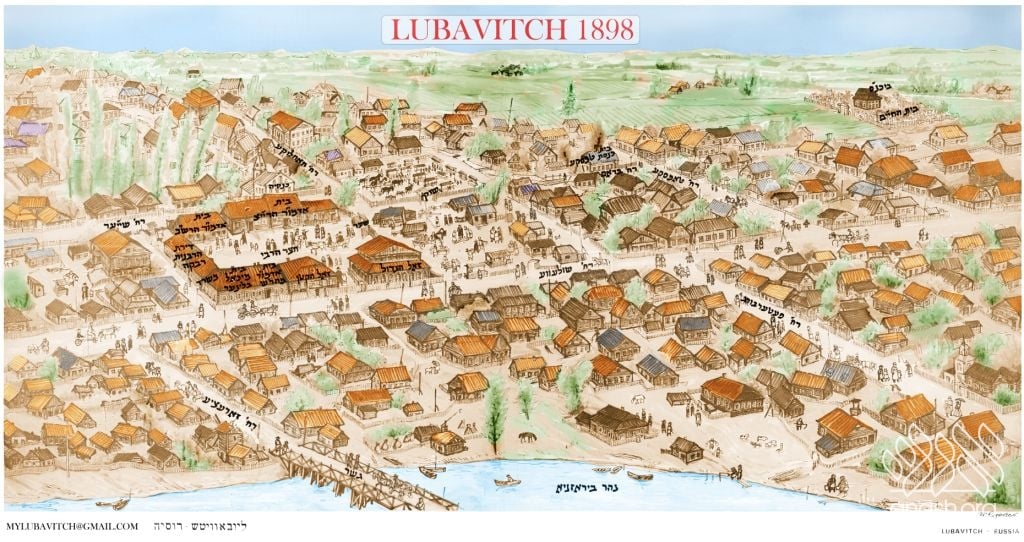
A map of the village of Lubavitch, produced by R. Yochanon Gurary, based on the memories of temimim from Lubavitch.
The sichos of the Rebbe Rashab from this Purim are recorded in Toras Shalom, pp. 219-221. The reshimos of Harav Baruch Shneur Schneersohn complement the record (Reshimos Harabash, pp. 133-137). The maamar the Rebbe Rashab delivered, dibur hamaschil Megillah Nikreis, is published in Sefer Hamaamarim 5675, pp. 311-319.
Some temimim who learned in Lubavitch that year wrote a very brief description of the yom tov: R. Foleh Kahn, Lubavitch Vechayaleha, p. 51; R. Yisrael Jacobson, Zikaron Lebnei Yisrael, p. 51; and R. Yehuda Chitrik, Reshimos Devarim, p. 363.
Unlike these curt and dry descriptions, Gotlib gives us a colorful picture of the chaotic and boisterous nature of Purim in Lubavitch, and of the farbrengen at the Rebbe Rashab’s house. We will only cite some of the highlights of the article, and readers who wish to read the rest can do so in the original Yiddish.
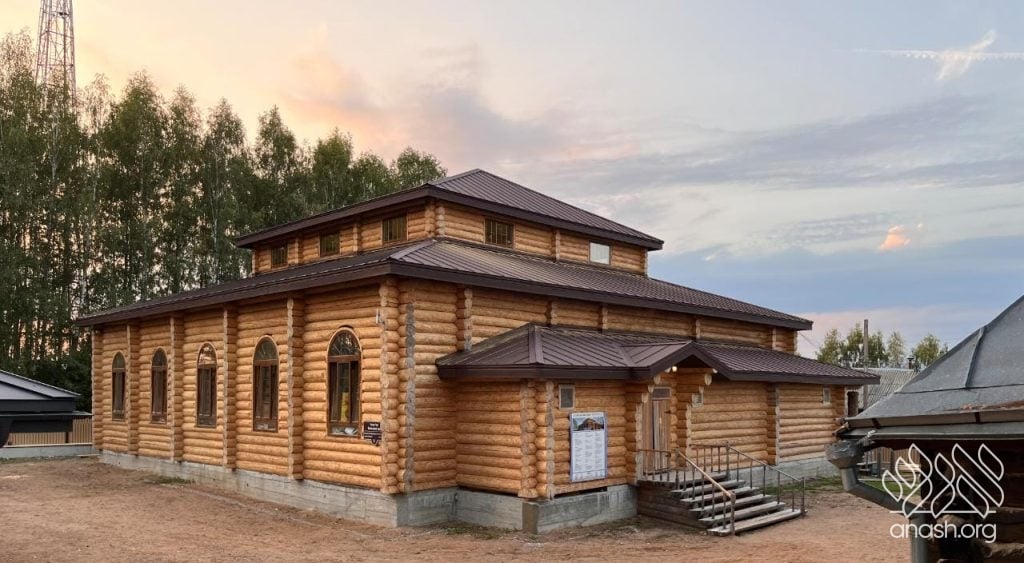
The newly constructed replica of the zal of Yeshivas Tomchei Temimim in Lubavitch.
Our first excerpt gives us some background about Purim in Lubavitch:
The most joyous yomim tovim that the chasidishe town of Lubavitch would celebrate were Yud-Tes Kislev and Purim. Yud-Tes Kislev was the greatest yom tov in Lubavitch, the “chaghachagim.” On the nineteenth day of the month of Kislev, the Alter Rebbe, the author of the Tanya, R. Shneur Zalman of Liadi, was freed from imprisonment in Petersburg, where he had been incarcerated because of a libel that the misnagdim had leveled against him. On that day, Lubavitch—and together with it, the entire Chabad world—would go chodorom.
Such a historic day is no small matter at all! However, the time of year somewhat interfered with the yom tov. Yud-Tes Kislev falls in the heart of winter, when the first snowstorms rage and the first biting frosts sting the faces and hands of the renowned Lubavitcher yeshivah bochurim. At such a time of year, one cannot freely let loose and revel outdoors. The yom tov of Yud-Tes Kislev is therefore celebrated indoors, within closed walls.
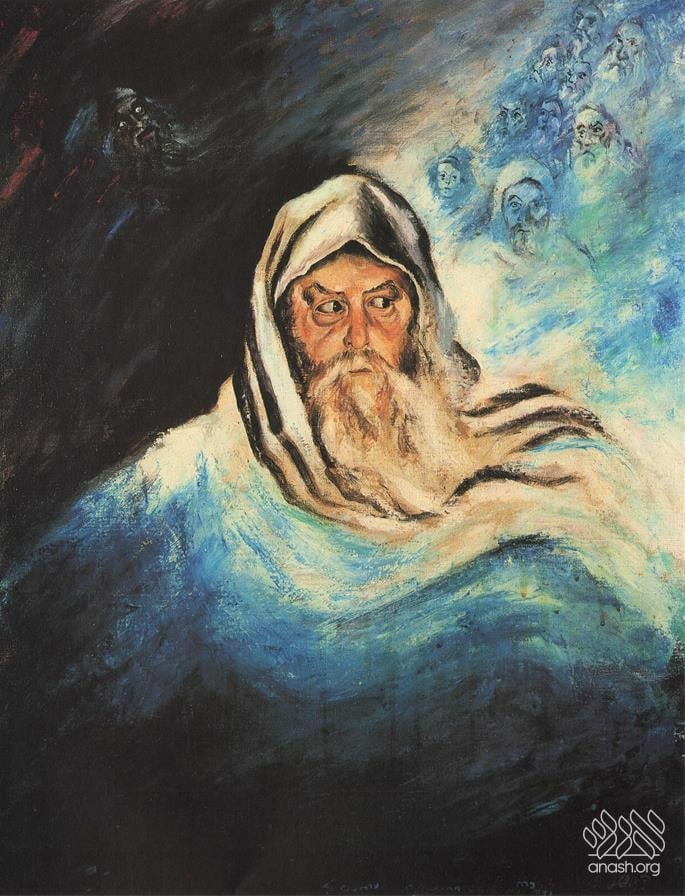
R. Hendel Lieberman’s post-Yud shvat painting of the Frierdiker Rebbe also depicts the Rebbe Rashab and Rebbetzin Shterna Sarah behind him. While the representation of the Rebbe Rashab doesn’t show much detail, it is notable that this is the only illustration of him by someone who knew him.
Purim, however, is different. Although Purim-time is still wintery—cold and snowy—you can’t compare it to Yud-Tes Kislev time. By Purim, you can already sniff a hint of spring.
“Mishenichnas Adar marbim besimchah.” Lubavitch begins preparing for the joyful, exuberant yom tov of Purim. . . .
After describing Taanis Esther, leading up to Purim, Gotlib describes Purim night in the yeshivah.
The evening of Taanis Esther, after the Megillah—when Haman has already received his proper share of banging and stomping—the crowd pours noisily into the kitchen, where all the tables are already festively prepared, covered with snow-white tablecloths and laden with giant hamantaschen and dozens of delicious dishes. Mashkeh stands plentifully on the tables. Everyone takes their seats and eagerly begins eating and drinking. The breaking of the fast proceeds with great pomp. Everyone is still, more or less, in full possession of their senses, and the crowd keeps itself within limits. . . .
On Purim day, after davening and hearing the Megillah, the bochurim went to the Rebbe Rashab’s house for the farbrengen. Gotlib describes the scene:
With bottles of mashkeh in their hands and songs on their lips, the bochurim make their way to the Rebbe’s home.
At the Rebbe’s home there is a ruckus, a lively commotion, like a marketplace. Many chasidim have arrived, and the gabaim have work to do. They stand by the door and keep watch. First they let in the distinguished people, the great gevirim.
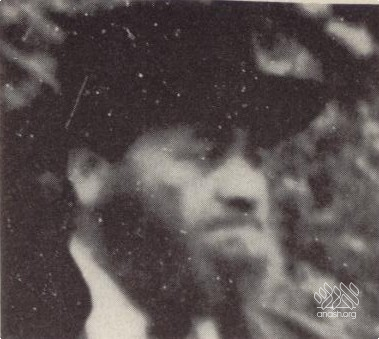
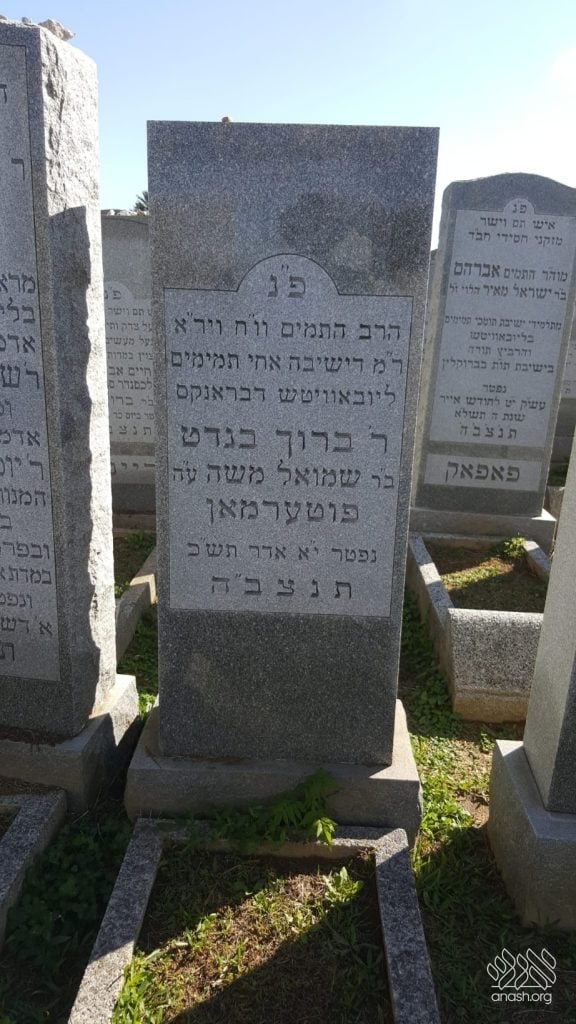
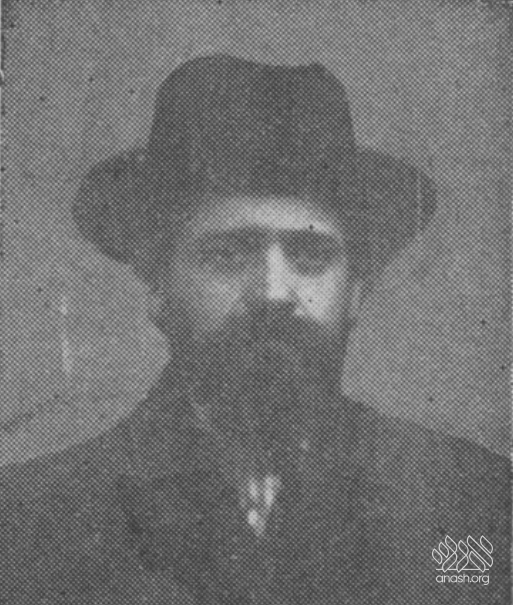
“Baruch Bendet,” mentioned here with the curious nickname “the lazy,” is probably Harav Baruch Bendet Putterman, a tomim from Lubavitch who later moved to America. R. Baruch served as the rov of Congregation Yeshiva B’nei Migdol Zion in the Bronx and as a rosh yeshivah of the local branch of Tomchei Temimim. (Picture courtesy of Yisrael Barda.)
The yeshivah bochurim, however, do not want to wait. At another time, they would have received a proper share of slaps from the two strong, broad-shouldered gabaim. But today, on Purim, they have no fear of blows—none at all. Their youthful blood is racing. They are already quite intoxicated, and they battle with the gatekeepers with such force that the massive gabaim give way and are flung aside in all directions. The path is cleared, and the Rebbe’s home fills up, packed to the brim.
Suddenly, the Rebbe appears, accompanied by his personal attendant. The Rebbe is in a cheerful mood. His eyes shine more than usual, his holy face glows more than ever, and his red, fiery beard radiates with such light, with such brilliance, that everyone becomes truly uplifted. An honor guard is made for the Rebbe, but without the severe solemnity reserved for other yomim tovim—after all, it is Purim.
The Rebbe takes his seat at the head of the table. Closest to him sit the distinguished people, and the ordinary people sit behind them. The Rebbe makes a bracha over a cup of aged, expensive wine, delivers a brief maamar related to the theme of the day, and instructs the lazy Boruch Bendet to sing a nigun.
The crowd is set alight. After the first nigun comes a second, then a third. After that, one person begins to speak in gramen, another tells jokes, while waving around an empty bottle. The crowd is holding their sides from laughter, and the Rebbe, too, smiles—smiling with every crease of his radiant face.
R. Baruch Putterman passed away in 5720 and is buried near the Ohel. (Picture courtesy of Yisrael Barda.)
Gotlib’s description of the chaotic scene at the entrance is echoed in R. Foleh Kahn’s brief description: “The Purim seudah was held in the Rebbe Rashab’s dining room, which was smaller than the other rooms. The Rebbe requested that not everyone should be allowed in, and when the room filled they closed the doors. But the crowding was so intense that they broke the door.”
In the remainder of the article, Gotlib describes the bochurim leaving the Rebbe’s home after nightfall and continuing on to the home of R. Shilem the mashgiach for the traditional yeshivah Purim farbrengen.
*
Purim 5694—Riga
Our next article describes Purim almost 20 years later, with the Frierdiker Rebbe in Riga. After being forced to leave Russia in 5688 (1927), the Frierdiker Rebbe spent almost six years based in Riga. Ahead of Tishrei 5694, the Frierdiker Rebbe moved permanently from Riga to Poland, where he remained until World War II. We discussed some aspects of this period in a previous article.
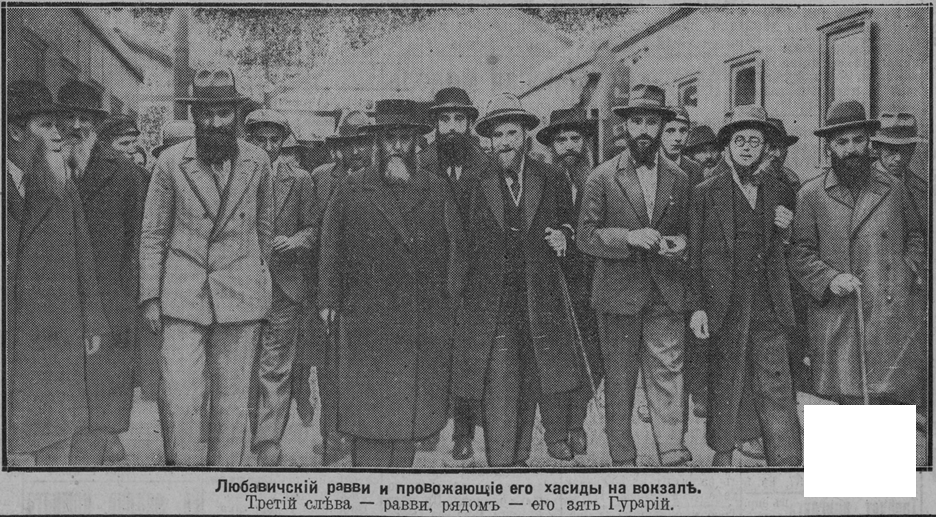
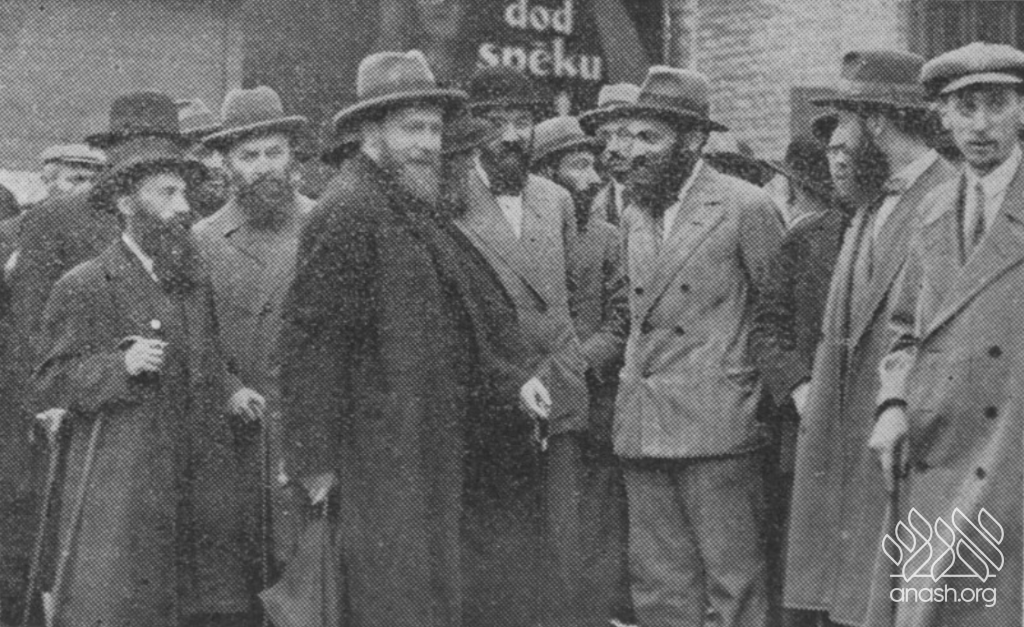
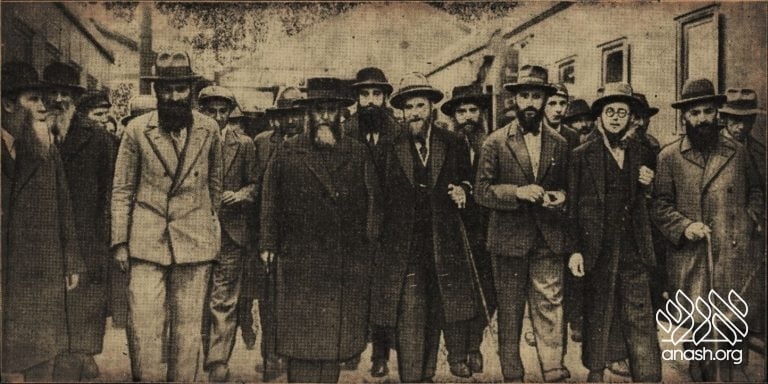
The Frierdiker Rebbe at the Riga train station on his way to Poland for Tishrei 5692.
In Adar of 5694, just six months after leaving Riga, the Frierdiker Rebbe returned for a brief visit. On 2 Adar 5694 (February 16, 1934) the Riga-based Morgen Post reported the news of the Frierdiker Rebbe’s upcoming visit and detailed its purpose.
The Lubavitcher Rebbe is Coming to Riga to Collect Funds for His Matzah Campaign
As we have learned, the Lubavitcher Rebbe, R. Schneersohn, will be traveling to Riga in a few weeks’ time around Purim, to meet with his chasidim here. “Times have changed,” say the Orthodox Jews of Riga. “In the past, chasidim would travel to their rebbes, but now the rebbes travel to their chasidim.”
The Rebbe’s visit, however, will not be purely ceremonial. He will also be collecting funds here for his matzah campaign, as well as seeking support to maintain his hoyf, which—due to the “competition” of other rebbes in Poland—finds itself in a very difficult state.
Indeed, the Fierdiker Rebbe arrived in Riga shortly before Purim and spent a few days in the city. A sichah the Frierdiker Rebbe gave to women in Riga is published in Sefer Hasichos 5694, pp. 336-339, and the four maamarim he delivered are publishes in Sefer Hamaamarim Kuntreisim, vol. 2. However, the sichah of the Purim farbrengen is not recorded.
The Frierdiker Rebbe at the Riga train station. The Fierdiker Rebbe is turned away from the camera, in between Rashag and R. Mordechai Dubin.
The present article describing Purim with the Frierdiker Rebbe in Riga 5694 does not report any of his words, but it describes the scene and general atmosphere in detail. Written by Moshe Rubin, this article appeared in Riga’s Batog newspaper on 15 Adar 5694 (March 2, 1934).
Yesterday’s Purim Seudah with the Lubavitcher Rebbe
As is known, the gabaim of the various chasidishe minyanim, together with several distinguished balebatim, invited the Lubavitcher Rebbe to spend Purim in Riga. The Rebbe accepted the invitation and arrived on Wednesday evening, accompanied by his son-in-law, R. Gur-Aryeh. He settled in at the home of the well-known communal activist Leib Kadish, on Krišjāņa Barona Street.
That very Wednesday evening, many of the Lubavitcher Rebbe’s chasidim gathered at his residence. Although the Rebbe was tired from the journey, he nevertheless said a little Chasidus. And as is always done when people come to the Rebbe, they said a little lechaims and rejoiced with a few nigunim.
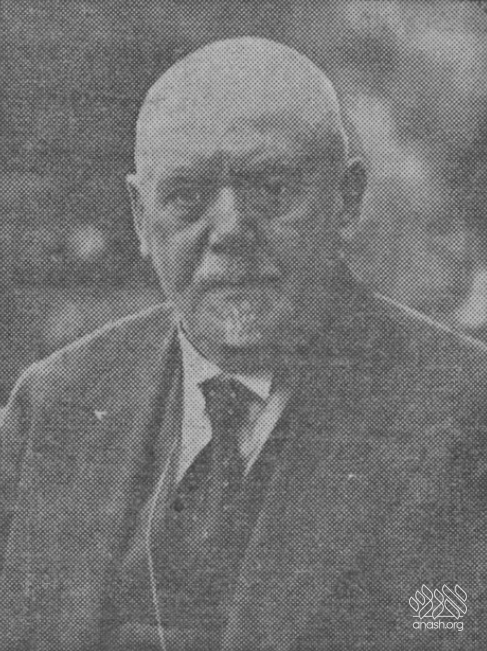
Leib Kadish(5624-5694) was a prominent Riga gvir and askan. He passed awaya few weeks after the Frierdiker Rebbe’s stay at his house.
The main celebration with the Lubavitcher Rebbe took place last night, when a full and proper Purim seudah was held. Well before the meal began, the chasidim were already assembled, waiting for the Rebbe to emerge from his room, take his place at the table, and begin the seudah.
The seudah was scheduled to begin at six o’clock. Exactly on time, the Rebbe emerged, accompanied by his son-in-law, Gur-Aryeh. He greeted his chasidim and, with slow steps, walked across the room and sat down at the table. The chasidim immediately surrounded the Rebbe, some pressing up very close to him, waiting for him to say something.
Meanwhile, the Rebbe’s attendants were working on all fronts. Some were preparing the tables, setting out the small cups, and hanging up coats; others were busy in the kitchen, moving about among the crowd and directing each arriving person who entered to his place.
The Rebbe sat quietly for a while, deeply absorbed in thought, until the first Lubavitcher nigun was heard. The young and old chasidim sang, and with each passing minute the singing grew more impassioned, signaling that the Purim seudah at the Rebbe’s table had truly begun.
One by one, the chasidim entered the kitchen to wash, quickly recited hamotzi, and turned to the mashkeh. One after another they rose, said “lechaim” to the Rebbe, and the Rebbe answered each one very softly, “lechaim, lechaim.” The chasidim drank, and all the while did not take their eyes off the Rebbe.
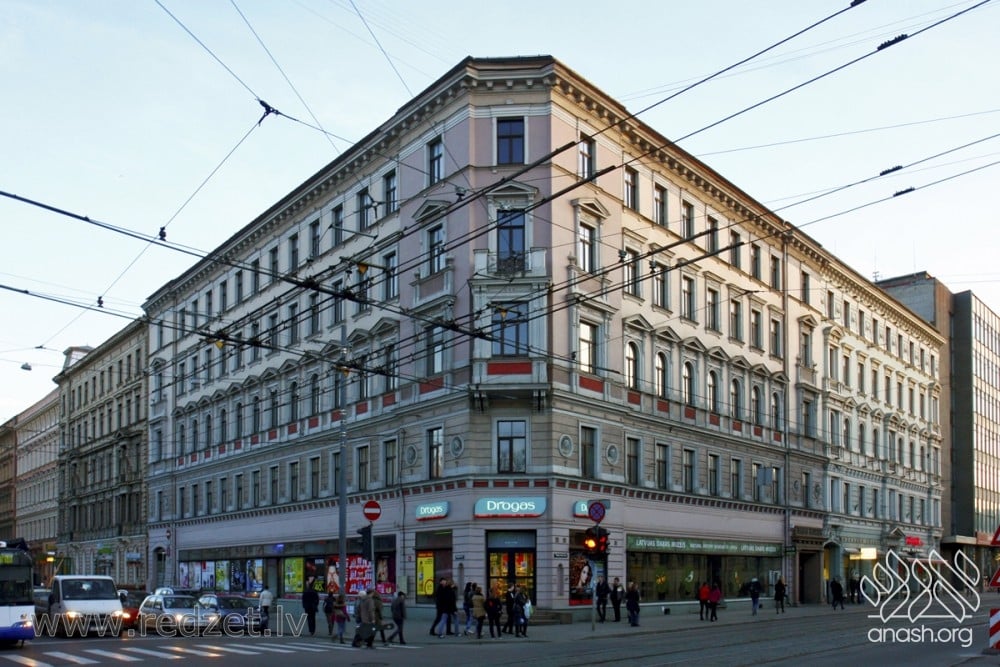
The Frierdiker Rebbe stayed and farbrenged at the home of Leib Kadish, at Krišjāņa Barona 4. The house included a shul.
The Rebbe’s son-in-law poured the Rebbe a little wine. He took a small sip, slowly set down the cup, and began to speak. The crowd pushed aside the food and drink and strained their ears to listen to what the Rebbe was saying. The Rebbe did not speak loudly; he was slightly hoarse, and people stood on benches—if they can’t hear clearly, at least they should see the Rebbe.
After fifteen minutes of speaking, another lechaim is made. People take a bite of fish, and a second Lubavitcher nigun begins. This time, the leaders are the yeshivah bochurim from the Riga yeshivah and the very young boys from the Lubavitcher cheder, who had come to the seudah in very large numbers. All of them wear small yarmulkes perched on the tops of their heads and stand tightly around the Rebbe, following his every glance. Gradually, the older chasidim also begin to sing, snapping their fingers in the classic chasidishe style.
The room in which the seudah is taking place is by now quite crowded with people. People squeeze into every corner, standing as they make a lechaim. But no one drinks before first saying lechaim to the Rebbe. There is also no lack of guests at the seudah—various visitors who, having heard that the Rebbe had arrived, came to rejoice a little together with his chasidim.
A group of about ten Lubavitcher chasidim also came from Dvinsk. They had been waiting for the Rebbe there since Wednesday, and traveled with him on to Riga for the Purim seudah.
R. Chatche Feigin, the Frierdiker Rebbe’s “technical secretary” mentioned in the article.
Suddenly, it becomes quiet again. The Rebbe continues saying Chasidus, this time for quite a while and somewhat louder, enough that he can now be heard from a distance. From time to time, someone attempts to interject with a question. The Rebbe pauses to consider for a moment, and then answers everyone. Opposite the Rebbe stands his technical secretary, who listens very intently to every word and nods his head as the Rebbe completes a thought. A shamash serves the Rebbe a portion of fish; he eats while he continues to speak, and as he finishes, they begin a third nigun, sung loudly and vigorously.
Singing alone, however, does not satisfy the chasidim. They link arms and break into a lively dance with full enthusiasm. The chasidim also want to draw the Rebbe into the center. He stands up. The huddle grows, they sing and dance, grabbing a small cup of spirits along the way, wishing one another “may it be so again next year,” and continuing to rejoice—old and young alike—deep into the night.
The article concludes with a report of a conversation the journalist had with the Frierdiker Rebbe’s son-in-law and right-hand man, Rashag, about the contemporary state of the Jewish people across Europe.
Just before the seudah began, we had a brief conversation with the Lubavitcher Rebbe’s son-in-law, R. Gur-Aryeh, about Polish Jewry, Eretz Yisrael, the relief appeal for Russian Jews, and finally about the German-Jewish refugees and German Jewry.
“Even today,” says Gur-Aryeh, “the hardship among the Jews in Poland is still felt very strongly. The crisis has not yet fully passed, although some signs of improvement can be felt. The Polish Jew, however, lives with Jewish concerns at heart, and there is a strong Jewish atmosphere. As the largest Jewish center in Europe, Poland has a large religiously inclined Jewish population. There are many religious schools, yeshivos, and Talmud Torahs. Religious sentiment is also growing among the youth.”
With regard to Eretz Yisrael, religious Jews today relate to it with far greater attentiveness than in previous years. Religious Jews are now traveling from Poland to Eretz Yisrael in very large numbers, especially religious youth, who wish both to learn and to work. There is currently a strong movement for the development of Eretz Yisrael among Poland’s religious youth.
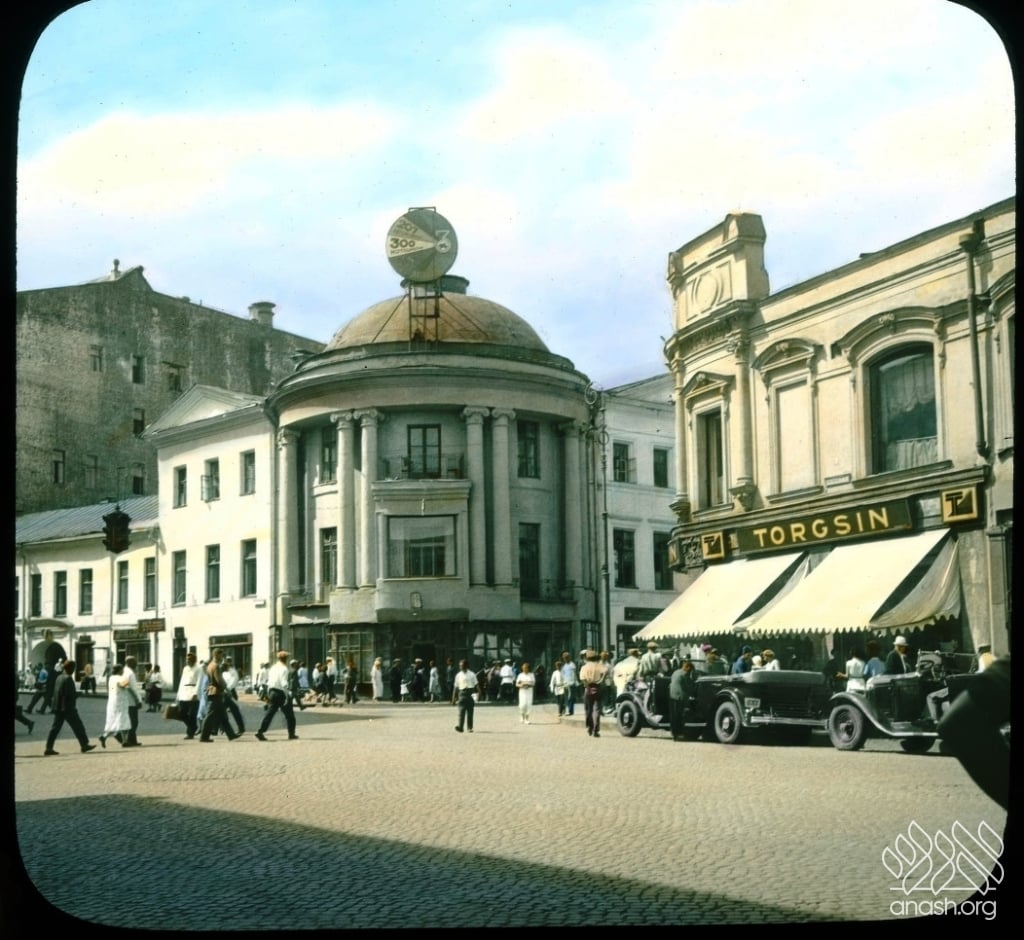
A Torgsin store in Moscow, 5691. Regular Soviet stories in this period worked on a rationed, non‑market basis, and the produce was low quality and subject to chronic shortages. Torgsin was a parallel system that accepted only foreign currency, gold, silver, and jewelry and carried better and more reliable produce. Foreigners were able to send hard currency to the Soviet Union, which was then converted into Torgsin vouchers for their family or friends.
The relief appeal for the Russian Jews, which the Lubavitcher Rebbe has recently undertaken in Warsaw, has resonated widely among Polish Jewry. The Lubavitcher Rebbe, who is only the initiator of the matter, has handed the issue over to the Warsaw community, which has selected a special committee that will carry out the appeal, and then coordinate with the Torgsin stores. The assistance will be given in the form of monetary support.
“The issue of German Jewry is a very difficult one,” Gur-Aryeh concludes. “The first priority must be caring for the German-Jewish refugees who are in a number of countries. The committee, headed by Professor Chaim Weizmann, is doing very important work. Experience has already shown that the German-Jewish refugees who have settled in Eretz Yisrael gradually establish themselves there and, most importantly, return to Judaism. The issue of the fate of German Jewry has also caused, to some extent, a weakening of the relief efforts on behalf of Russian Jewry.”
The Lubavitcher Rebbe will remain in Riga for several more days. From there, he will return to Warsaw.
To view all installments of From the Margins of Chabad History, click here.
For additional exclusive content, follow the column on X: x.com/ChabadMargins
COMMENTS
We appreciate your feedback. If you have any additional information to contribute to this article, it will be added below.
Koidenov now “extinct”?
The Koidenover Rebbe in Bnei Brak would tell you otherwise.
In honor of the approaching yom tov of Purim, From the Margins of Chabad History presents two unknown accounts of Purim with the Rebbeim—from Lubavitch with the Rebbe Rashab and Riga with the Frierdiker Rebbe.
By Anash
In honor of the approaching yom tov of Purim, From the Margins of Chabad History presents two unknown accounts of Purim with the Rebbeim—from Lubavitch with the Rebbe Rashab and Riga with the Frierdiker Rebbe.
Purim 5675—Lubavitch
Our first Purim account comes from the famous Yiddish poet and writer, Noach Yitzchak Gotlib. Noach Yitzchak Gotlib was born in Kovno, Lita, in 5664. His father R. Tzvi (Hershele) was a prominent chasid of Koidonov, a Litvishe chasidus that is now extinct. R. Hershele served as a rosh yeshivah in Koidanov, and he also served a few stints as a magid shiur for the younger bochurim in Tomchei Temimim in Lubavitch.
Noach Yitzchak Gotlib
Noach Yitzchak wrote a little about his time in Lubavitch in his poetry. The writing is somewhat cryptic, but we can glean the following details: He learned in Lubavitch for two years, in 5674 and 5675, as a 10–11-year-old, and his father was not living in Lubavitch at this time. He writes that he learned well, but was eventually expelled from the yeshivah after the mashgiach caught him reading the secular Yiddish book Di Kliyatshe, by Mendele Mocher Seforim (A Menṭsh in di Himlen: Naye Lider un Poemes, p. 146).
Noach Yitzchak Gotlib eventually strayed from shemiras Torah umitzvos, and became a well-known Yiddish poet and writer. He emigrated to Canada in 5690 and lived there until his passing in 5727.
We have already published two articles by Gotlib about his time in Lubavitch: one about his arrival at the yeshivah, and a second describing tashlich with the Rebbe Rashab. The present article, the final one we have been able to locate, appeared in the Nayer Folksblat newspaper in Lodz, Poland, 14 Adar II, 5695 (March 19, 1935). It seems that the article was originally published in the Montreal-based Yiddish newspaper, the Keneder Adler, but that newspaper is unavailable online.
The Rebbe Rashab was not usually present in Lubavitch for Purim. R. Foleh Kahn, who learned in Lubavitch for ten years, recalled that the only year the Rebbe Rashab celebrated Purim in Lubavitch during this period was 5675. We can therefore date Gotlib’s account to this year.
A map of the village of Lubavitch, produced by R. Yochanon Gurary, based on the memories of temimim from Lubavitch.
The sichos of the Rebbe Rashab from this Purim are recorded in Toras Shalom, pp. 219-221. The reshimos of Harav Baruch Shneur Schneersohn complement the record (Reshimos Harabash, pp. 133-137). The maamar the Rebbe Rashab delivered, dibur hamaschil Megillah Nikreis, is published in Sefer Hamaamarim 5675, pp. 311-319.
Some temimim who learned in Lubavitch that year wrote a very brief description of the yom tov: R. Foleh Kahn, Lubavitch Vechayaleha, p. 51; R. Yisrael Jacobson, Zikaron Lebnei Yisrael, p. 51; and R. Yehuda Chitrik, Reshimos Devarim, p. 363.
Unlike these curt and dry descriptions, Gotlib gives us a colorful picture of the chaotic and boisterous nature of Purim in Lubavitch, and of the farbrengen at the Rebbe Rashab’s house. We will only cite some of the highlights of the article, and readers who wish to read the rest can do so in the original Yiddish.
The newly constructed replica of the zal of Yeshivas Tomchei Temimim in Lubavitch.
Our first excerpt gives us some background about Purim in Lubavitch:
The most joyous yomim tovim that the chasidishe town of Lubavitch would celebrate were Yud-Tes Kislev and Purim. Yud-Tes Kislev was the greatest yom tov in Lubavitch, the “chaghachagim.” On the nineteenth day of the month of Kislev, the Alter Rebbe, the author of the Tanya, R. Shneur Zalman of Liadi, was freed from imprisonment in Petersburg, where he had been incarcerated because of a libel that the misnagdim had leveled against him. On that day, Lubavitch—and together with it, the entire Chabad world—would go chodorom.
Such a historic day is no small matter at all! However, the time of year somewhat interfered with the yom tov. Yud-Tes Kislev falls in the heart of winter, when the first snowstorms rage and the first biting frosts sting the faces and hands of the renowned Lubavitcher yeshivah bochurim. At such a time of year, one cannot freely let loose and revel outdoors. The yom tov of Yud-Tes Kislev is therefore celebrated indoors, within closed walls.
R. Hendel Lieberman’s post-Yud shvat painting of the Frierdiker Rebbe also depicts the Rebbe Rashab and Rebbetzin Shterna Sarah behind him. While the representation of the Rebbe Rashab doesn’t show much detail, it is notable that this is the only illustration of him by someone who knew him.
Purim, however, is different. Although Purim-time is still wintery—cold and snowy—you can’t compare it to Yud-Tes Kislev time. By Purim, you can already sniff a hint of spring.
“Mishenichnas Adar marbim besimchah.” Lubavitch begins preparing for the joyful, exuberant yom tov of Purim. . . .
After describing Taanis Esther, leading up to Purim, Gotlib describes Purim night in the yeshivah.
The evening of Taanis Esther, after the Megillah—when Haman has already received his proper share of banging and stomping—the crowd pours noisily into the kitchen, where all the tables are already festively prepared, covered with snow-white tablecloths and laden with giant hamantaschen and dozens of delicious dishes. Mashkeh stands plentifully on the tables. Everyone takes their seats and eagerly begins eating and drinking. The breaking of the fast proceeds with great pomp. Everyone is still, more or less, in full possession of their senses, and the crowd keeps itself within limits. . . .
On Purim day, after davening and hearing the Megillah, the bochurim went to the Rebbe Rashab’s house for the farbrengen. Gotlib describes the scene:
With bottles of mashkeh in their hands and songs on their lips, the bochurim make their way to the Rebbe’s home.
At the Rebbe’s home there is a ruckus, a lively commotion, like a marketplace. Many chasidim have arrived, and the gabaim have work to do. They stand by the door and keep watch. First they let in the distinguished people, the great gevirim.
“Baruch Bendet,” mentioned here with the curious nickname “the lazy,” is probably Harav Baruch Bendet Putterman, a tomim from Lubavitch who later moved to America. R. Baruch served as the rov of Congregation Yeshiva B’nei Migdol Zion in the Bronx and as a rosh yeshivah of the local branch of Tomchei Temimim. (Picture courtesy of Yisrael Barda.)
The yeshivah bochurim, however, do not want to wait. At another time, they would have received a proper share of slaps from the two strong, broad-shouldered gabaim. But today, on Purim, they have no fear of blows—none at all. Their youthful blood is racing. They are already quite intoxicated, and they battle with the gatekeepers with such force that the massive gabaim give way and are flung aside in all directions. The path is cleared, and the Rebbe’s home fills up, packed to the brim.
Suddenly, the Rebbe appears, accompanied by his personal attendant. The Rebbe is in a cheerful mood. His eyes shine more than usual, his holy face glows more than ever, and his red, fiery beard radiates with such light, with such brilliance, that everyone becomes truly uplifted. An honor guard is made for the Rebbe, but without the severe solemnity reserved for other yomim tovim—after all, it is Purim.
The Rebbe takes his seat at the head of the table. Closest to him sit the distinguished people, and the ordinary people sit behind them. The Rebbe makes a bracha over a cup of aged, expensive wine, delivers a brief maamar related to the theme of the day, and instructs the lazy Boruch Bendet to sing a nigun.
The crowd is set alight. After the first nigun comes a second, then a third. After that, one person begins to speak in gramen, another tells jokes, while waving around an empty bottle. The crowd is holding their sides from laughter, and the Rebbe, too, smiles—smiling with every crease of his radiant face.
R. Baruch Putterman passed away in 5720 and is buried near the Ohel. (Picture courtesy of Yisrael Barda.)
Gotlib’s description of the chaotic scene at the entrance is echoed in R. Foleh Kahn’s brief description: “The Purim seudah was held in the Rebbe Rashab’s dining room, which was smaller than the other rooms. The Rebbe requested that not everyone should be allowed in, and when the room filled they closed the doors. But the crowding was so intense that they broke the door.”
In the remainder of the article, Gotlib describes the bochurim leaving the Rebbe’s home after nightfall and continuing on to the home of R. Shilem the mashgiach for the traditional yeshivah Purim farbrengen.
*
Purim 5694—Riga
Our next article describes Purim almost 20 years later, with the Frierdiker Rebbe in Riga. After being forced to leave Russia in 5688 (1927), the Frierdiker Rebbe spent almost six years based in Riga. Ahead of Tishrei 5694, the Frierdiker Rebbe moved permanently from Riga to Poland, where he remained until World War II. We discussed some aspects of this period in a previous article.
The Frierdiker Rebbe at the Riga train station on his way to Poland for Tishrei 5692.
In Adar of 5694, just six months after leaving Riga, the Frierdiker Rebbe returned for a brief visit. On 2 Adar 5694 (February 16, 1934) the Riga-based Morgen Post reported the news of the Frierdiker Rebbe’s upcoming visit and detailed its purpose.
The Lubavitcher Rebbe is Coming to Riga to Collect Funds for His Matzah Campaign
As we have learned, the Lubavitcher Rebbe, R. Schneersohn, will be traveling to Riga in a few weeks’ time around Purim, to meet with his chasidim here. “Times have changed,” say the Orthodox Jews of Riga. “In the past, chasidim would travel to their rebbes, but now the rebbes travel to their chasidim.”
The Rebbe’s visit, however, will not be purely ceremonial. He will also be collecting funds here for his matzah campaign, as well as seeking support to maintain his hoyf, which—due to the “competition” of other rebbes in Poland—finds itself in a very difficult state.
Indeed, the Fierdiker Rebbe arrived in Riga shortly before Purim and spent a few days in the city. A sichah the Frierdiker Rebbe gave to women in Riga is published in Sefer Hasichos 5694, pp. 336-339, and the four maamarim he delivered are publishes in Sefer Hamaamarim Kuntreisim, vol. 2. However, the sichah of the Purim farbrengen is not recorded.
The Frierdiker Rebbe at the Riga train station. The Fierdiker Rebbe is turned away from the camera, in between Rashag and R. Mordechai Dubin.
The present article describing Purim with the Frierdiker Rebbe in Riga 5694 does not report any of his words, but it describes the scene and general atmosphere in detail. Written by Moshe Rubin, this article appeared in Riga’s Batog newspaper on 15 Adar 5694 (March 2, 1934).
Yesterday’s Purim Seudah with the Lubavitcher Rebbe
As is known, the gabaim of the various chasidishe minyanim, together with several distinguished balebatim, invited the Lubavitcher Rebbe to spend Purim in Riga. The Rebbe accepted the invitation and arrived on Wednesday evening, accompanied by his son-in-law, R. Gur-Aryeh. He settled in at the home of the well-known communal activist Leib Kadish, on Krišjāņa Barona Street.
That very Wednesday evening, many of the Lubavitcher Rebbe’s chasidim gathered at his residence. Although the Rebbe was tired from the journey, he nevertheless said a little Chasidus. And as is always done when people come to the Rebbe, they said a little lechaims and rejoiced with a few nigunim.
Leib Kadish(5624-5694) was a prominent Riga gvir and askan. He passed awaya few weeks after the Frierdiker Rebbe’s stay at his house.
The main celebration with the Lubavitcher Rebbe took place last night, when a full and proper Purim seudah was held. Well before the meal began, the chasidim were already assembled, waiting for the Rebbe to emerge from his room, take his place at the table, and begin the seudah.
The seudah was scheduled to begin at six o’clock. Exactly on time, the Rebbe emerged, accompanied by his son-in-law, Gur-Aryeh. He greeted his chasidim and, with slow steps, walked across the room and sat down at the table. The chasidim immediately surrounded the Rebbe, some pressing up very close to him, waiting for him to say something.
Meanwhile, the Rebbe’s attendants were working on all fronts. Some were preparing the tables, setting out the small cups, and hanging up coats; others were busy in the kitchen, moving about among the crowd and directing each arriving person who entered to his place.
The Rebbe sat quietly for a while, deeply absorbed in thought, until the first Lubavitcher nigun was heard. The young and old chasidim sang, and with each passing minute the singing grew more impassioned, signaling that the Purim seudah at the Rebbe’s table had truly begun.
One by one, the chasidim entered the kitchen to wash, quickly recited hamotzi, and turned to the mashkeh. One after another they rose, said “lechaim” to the Rebbe, and the Rebbe answered each one very softly, “lechaim, lechaim.” The chasidim drank, and all the while did not take their eyes off the Rebbe.
The Frierdiker Rebbe stayed and farbrenged at the home of Leib Kadish, at Krišjāņa Barona 4. The house included a shul.
The Rebbe’s son-in-law poured the Rebbe a little wine. He took a small sip, slowly set down the cup, and began to speak. The crowd pushed aside the food and drink and strained their ears to listen to what the Rebbe was saying. The Rebbe did not speak loudly; he was slightly hoarse, and people stood on benches—if they can’t hear clearly, at least they should see the Rebbe.
After fifteen minutes of speaking, another lechaim is made. People take a bite of fish, and a second Lubavitcher nigun begins. This time, the leaders are the yeshivah bochurim from the Riga yeshivah and the very young boys from the Lubavitcher cheder, who had come to the seudah in very large numbers. All of them wear small yarmulkes perched on the tops of their heads and stand tightly around the Rebbe, following his every glance. Gradually, the older chasidim also begin to sing, snapping their fingers in the classic chasidishe style.
The room in which the seudah is taking place is by now quite crowded with people. People squeeze into every corner, standing as they make a lechaim. But no one drinks before first saying lechaim to the Rebbe. There is also no lack of guests at the seudah—various visitors who, having heard that the Rebbe had arrived, came to rejoice a little together with his chasidim.
A group of about ten Lubavitcher chasidim also came from Dvinsk. They had been waiting for the Rebbe there since Wednesday, and traveled with him on to Riga for the Purim seudah.
R. Chatche Feigin, the Frierdiker Rebbe’s “technical secretary” mentioned in the article.
Suddenly, it becomes quiet again. The Rebbe continues saying Chasidus, this time for quite a while and somewhat louder, enough that he can now be heard from a distance. From time to time, someone attempts to interject with a question. The Rebbe pauses to consider for a moment, and then answers everyone. Opposite the Rebbe stands his technical secretary, who listens very intently to every word and nods his head as the Rebbe completes a thought. A shamash serves the Rebbe a portion of fish; he eats while he continues to speak, and as he finishes, they begin a third nigun, sung loudly and vigorously.
Singing alone, however, does not satisfy the chasidim. They link arms and break into a lively dance with full enthusiasm. The chasidim also want to draw the Rebbe into the center. He stands up. The huddle grows, they sing and dance, grabbing a small cup of spirits along the way, wishing one another “may it be so again next year,” and continuing to rejoice—old and young alike—deep into the night.
The article concludes with a report of a conversation the journalist had with the Frierdiker Rebbe’s son-in-law and right-hand man, Rashag, about the contemporary state of the Jewish people across Europe.
Just before the seudah began, we had a brief conversation with the Lubavitcher Rebbe’s son-in-law, R. Gur-Aryeh, about Polish Jewry, Eretz Yisrael, the relief appeal for Russian Jews, and finally about the German-Jewish refugees and German Jewry.
“Even today,” says Gur-Aryeh, “the hardship among the Jews in Poland is still felt very strongly. The crisis has not yet fully passed, although some signs of improvement can be felt. The Polish Jew, however, lives with Jewish concerns at heart, and there is a strong Jewish atmosphere. As the largest Jewish center in Europe, Poland has a large religiously inclined Jewish population. There are many religious schools, yeshivos, and Talmud Torahs. Religious sentiment is also growing among the youth.”
With regard to Eretz Yisrael, religious Jews today relate to it with far greater attentiveness than in previous years. Religious Jews are now traveling from Poland to Eretz Yisrael in very large numbers, especially religious youth, who wish both to learn and to work. There is currently a strong movement for the development of Eretz Yisrael among Poland’s religious youth.
A Torgsin store in Moscow, 5691. Regular Soviet stories in this period worked on a rationed, non‑market basis, and the produce was low quality and subject to chronic shortages. Torgsin was a parallel system that accepted only foreign currency, gold, silver, and jewelry and carried better and more reliable produce. Foreigners were able to send hard currency to the Soviet Union, which was then converted into Torgsin vouchers for their family or friends.
The relief appeal for the Russian Jews, which the Lubavitcher Rebbe has recently undertaken in Warsaw, has resonated widely among Polish Jewry. The Lubavitcher Rebbe, who is only the initiator of the matter, has handed the issue over to the Warsaw community, which has selected a special committee that will carry out the appeal, and then coordinate with the Torgsin stores. The assistance will be given in the form of monetary support.
“The issue of German Jewry is a very difficult one,” Gur-Aryeh concludes. “The first priority must be caring for the German-Jewish refugees who are in a number of countries. The committee, headed by Professor Chaim Weizmann, is doing very important work. Experience has already shown that the German-Jewish refugees who have settled in Eretz Yisrael gradually establish themselves there and, most importantly, return to Judaism. The issue of the fate of German Jewry has also caused, to some extent, a weakening of the relief efforts on behalf of Russian Jewry.”
The Lubavitcher Rebbe will remain in Riga for several more days. From there, he will return to Warsaw.
To view all installments of From the Margins of Chabad History, click here.
For additional exclusive content, follow the column on X: x.com/ChabadMargins





 COMMENTS


Koidenov now “extinct”?
The Koidenover Rebbe in Bnei Brak would tell you otherwise.