



כ״ג אדר ה׳תשפ״ו | March 12, 2026
New Records Reveal Frierdiker Rebbe’s Battle for US Soldiers
Newly surfaced files reveal how the Frierdiker Rebbe vigorously fought for the spiritual welfare of American Jewish soldiers during World War II. Telegrams and letters with the National Jewish Welfare Board highlight his uncompromising commitment to kashrus and his demand that Jewish institutions uphold their religious and moral responsibilities.
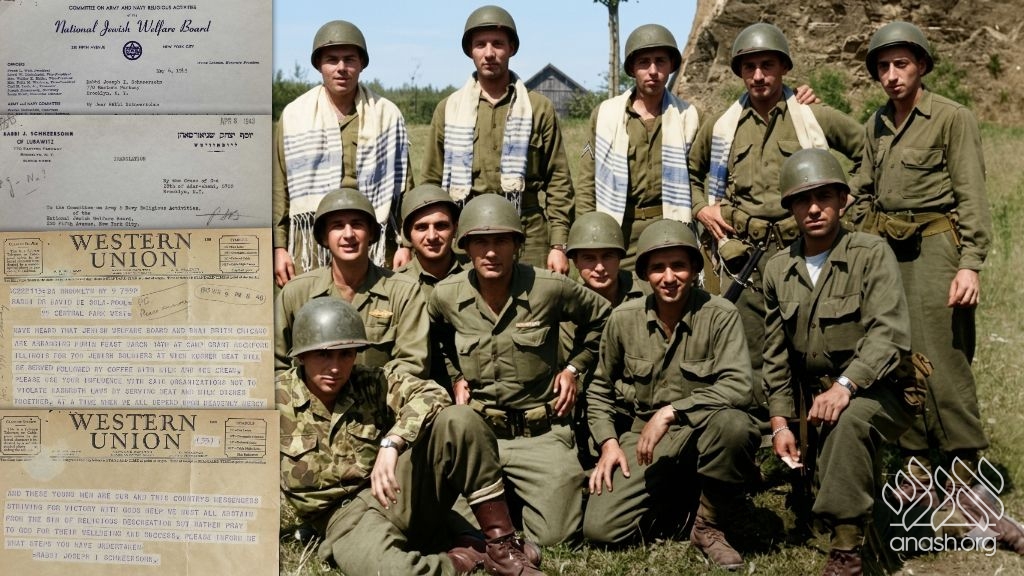
Fascinating documents that newly surfaced shed light on a major saga in which the Frierdiker Rebbe tirelessly fought for the spiritual welfare of American Jewish soldiers serving in World War II.
The series of telegrams and letters exchanged with the National Jewish Welfare Board (JWB) reveals the Frierdiker Rebbe’s uncompromising concern for kashrus and his determination to hold Jewish institutions accountable to their moral responsibilities.
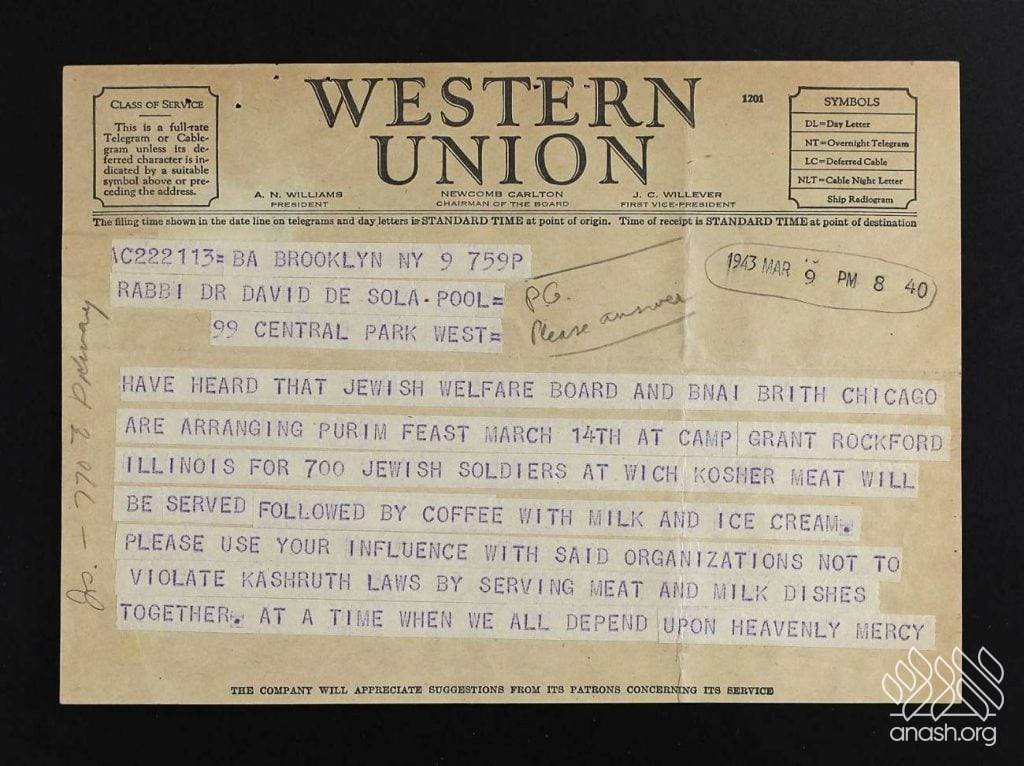
The saga unfolded in 1943, during the midst of World War II, after the Frierdiker Rebbe received reports about a “Purim Feast” planned by the JWB at Camp Grant in Rockford, Illinois, for 700 Jewish soldiers. According to the reports, the feast was set to include both dairy and meat dishes in clear violation of halacha.
Wasting no time, the Frierdiker Rebbe immediately sent a telegram to Rabbi Dr. David de Sola Pool of the JWB. Founded 26 years prior, the JWB supported Jewish servicemen in the U.S. armed forces by recruiting and training rabbis for military chaplaincy, providing religious resources, and overseeing Jewish community centers and cultural programming.
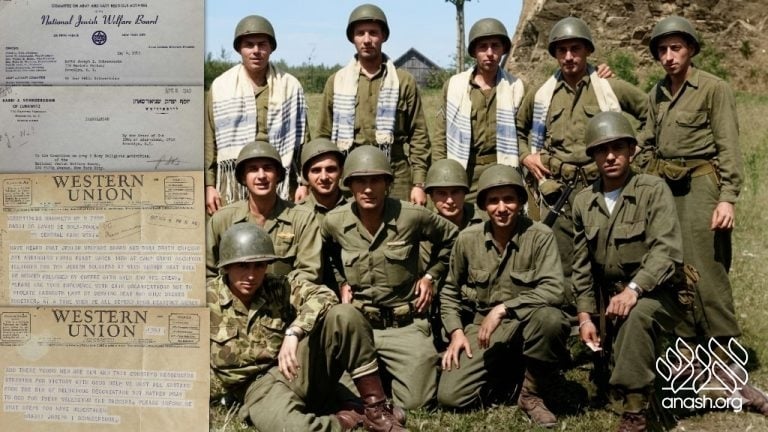
The telegram, dated March 9, 1943, reads: “KOSHER MEAT WILL BE SERVED FOLLOWED BY COFFEE WITH MILK AND ICE CREAM. PLEASE USE YOUR INFLUENCE WITH SAID ORGANIZATIONS NOT TO VIOLATE KASHRUS LAWS BY SERVING MEAT AND MILK DISHES TOGETHER. AT A TIME WHEN WE ALL DEPEND UPON HEAVENLY MERCY… WE MUST ALL ABSTAIN FROM THE SIN OF RELIGIOUS DESECRATION.”
“Please inform me what steps you have undertaken,” the Frierdiker Rebbe concludes.
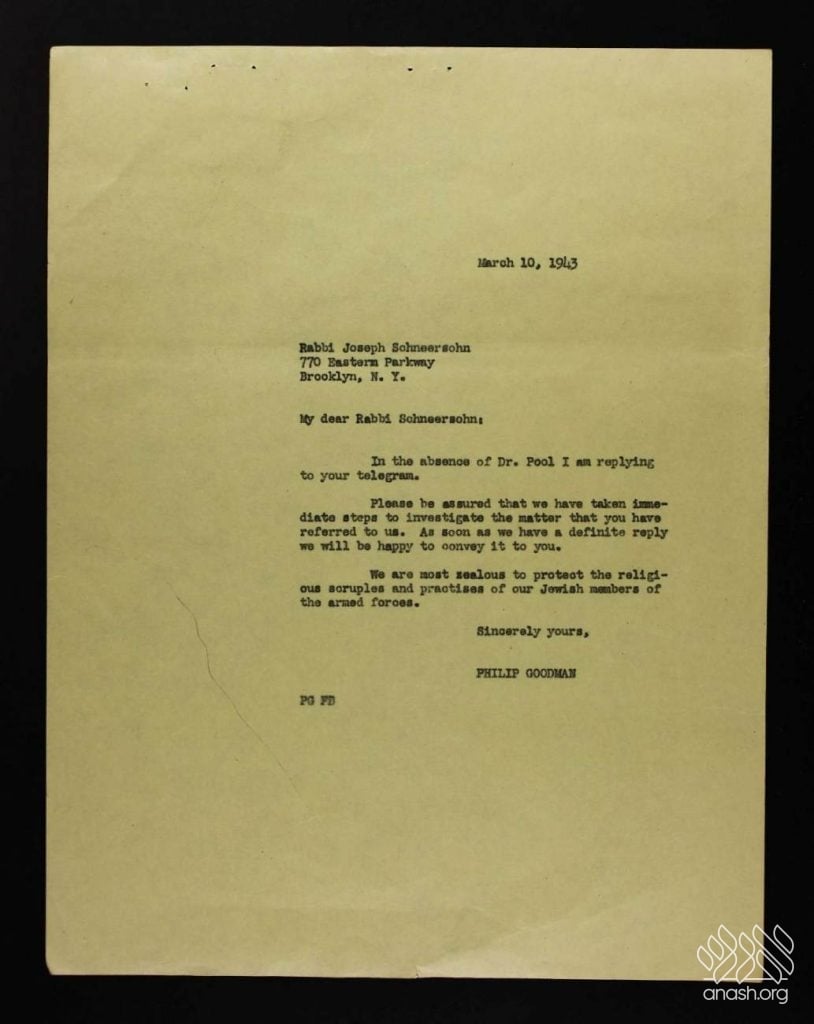
The following day, Philip Goodman, an Orthodox rabbi serving in the Armed Services Division and a senior official at the JWB, responded by telegram: “My dear Rabbi Schneersohn, Please be assured that we have taken immediate steps to investigate the matter that you have referred to us… We are most zealous to protect the religious scruples and practices of our Jewish members of the armed forces.”
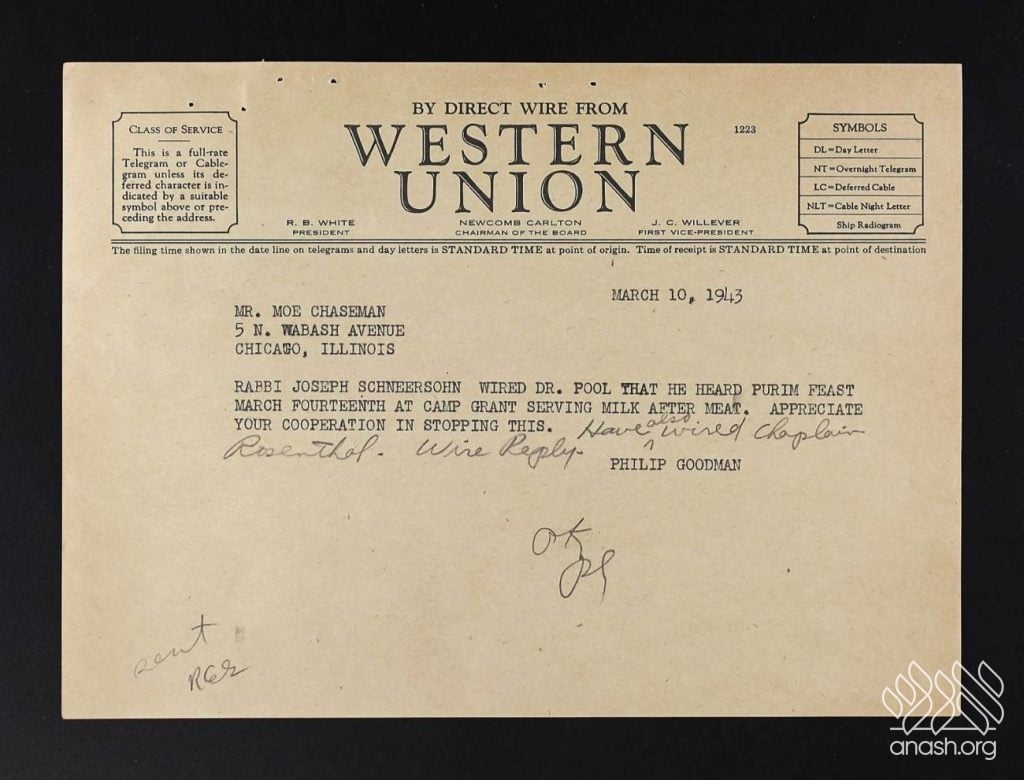
Goodman simultaneously contacted Chaplain Norbert Rosenthal at Camp Grant and Moe Chaseman, a regional JWB administrator in Chicago, instructing them to investigate and ensure that no kashrus violations would occur, writing, “it would be appreciated if you could advise us by wire that the necessary steps have been taken to eliminate the milk and ice cream, or whatever else needs to be done, so that we can reassure Rabbi Schneersohn.”
Despite the JWB’s national assurances, a disconnect emerged at the local level.
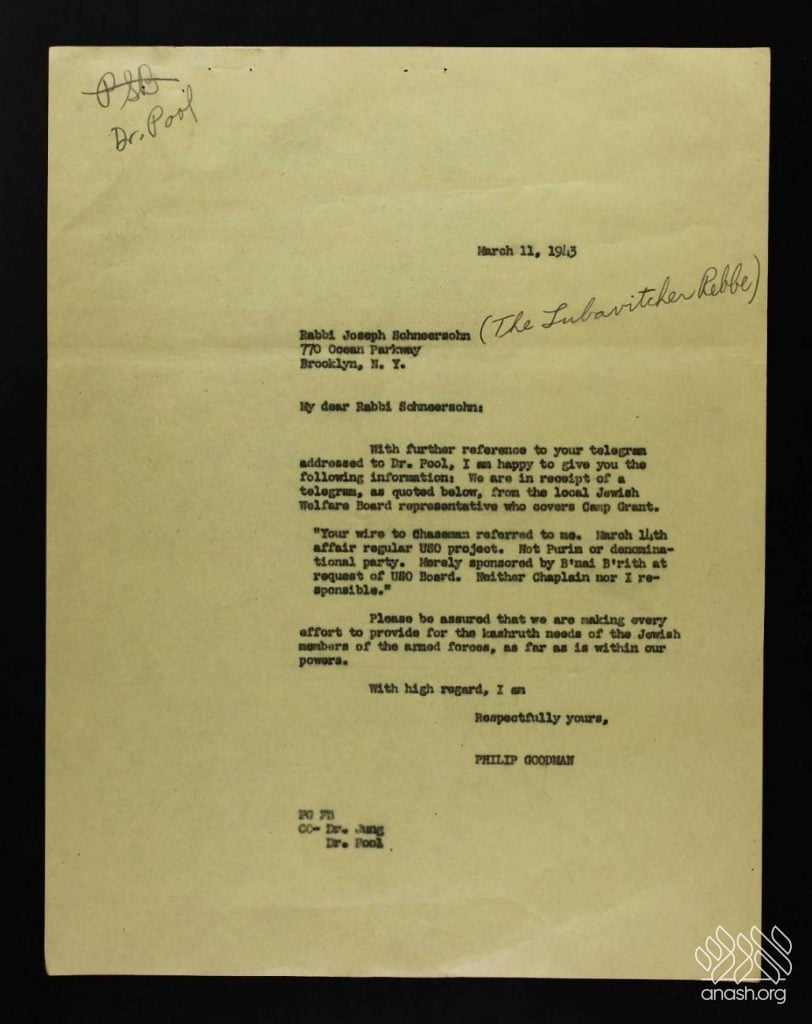
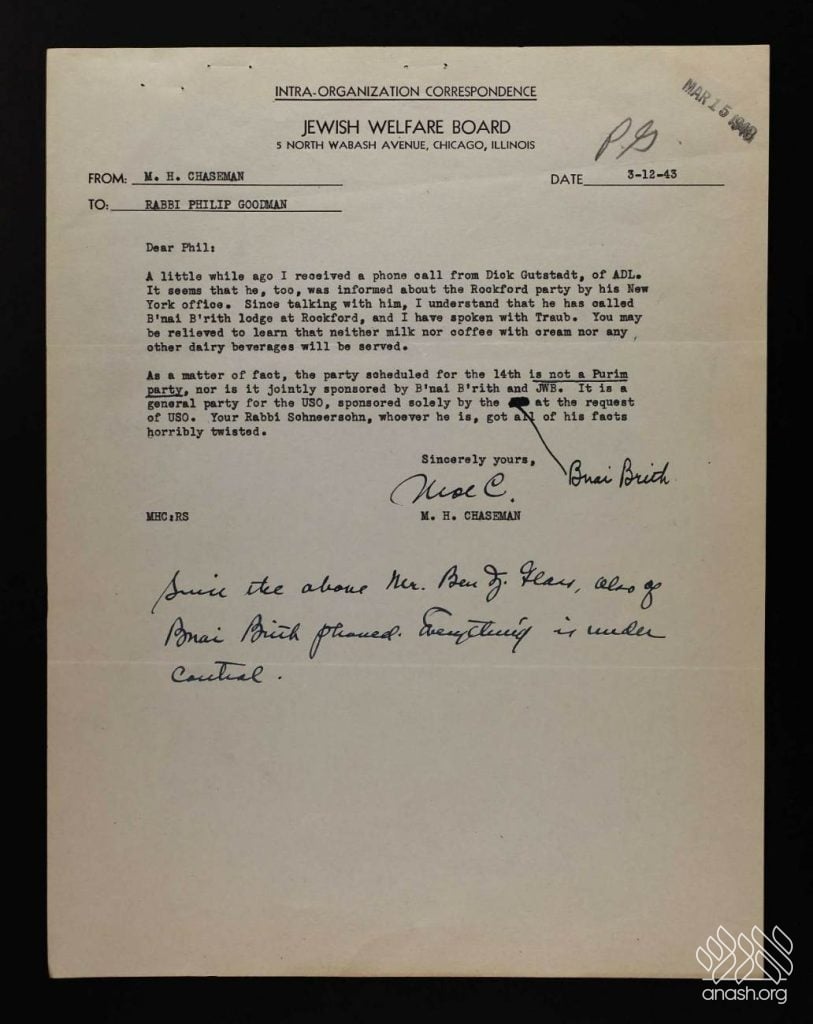
On March 11th, David E. Traub, the JWB Director at Camp Grant, attempted to dismiss the Rebbe’s concern, writing to Goodman that the event was a “Regular USO project. Not Purim or denominational party.” He added that because the event was sponsored by B’nai B’rith, “neither I nor the chaplain [am] responsible.”
In an internal letter on March 13th, Traub elaborated: “The facts… should be corrected. Of the 700 soldiers expected, only 150 are Jewish, and as a stranger, I cannot upset the status quo of the majority of this Jewish community. The menu still stands as planned.”
He added that “No, I don’t know Schneerson and I, too, am wondering who he is. I think he’s to be respected for asserting himself on principle, but I suggest that hereafter he get his facts straight.”
Philip Goodman proceeded to convey the response of Traub to the Frierdiker Rebbe while once again reassuring that “we are making every effort to provide for the kashruth needs of the Jewish members of the armed forces, as far as is within our powers.”
Moe Chaseman also got upset, writing that the Rebbe “got all of his facts horribly twisted,” but ultimately writing that “you may be relieved to learn that neither milk nor coffee with cream nor any other dairy beverages will be served.”
He added that besides speaking to Traub, he had also received a phone call from Dick Gutstadt of ADL as well as from Mr. Ben J. Glass, also of B’nai B’rith.
It is quite evident that the Frierdiker Rebbe put in significant efforts and applied much pressure to resolve the issue. It can also be noted that this was all taking place during wartime, and yet the incredible speed and turnaround of the telegrams show the Frierdiker Rebbe’s urgency.
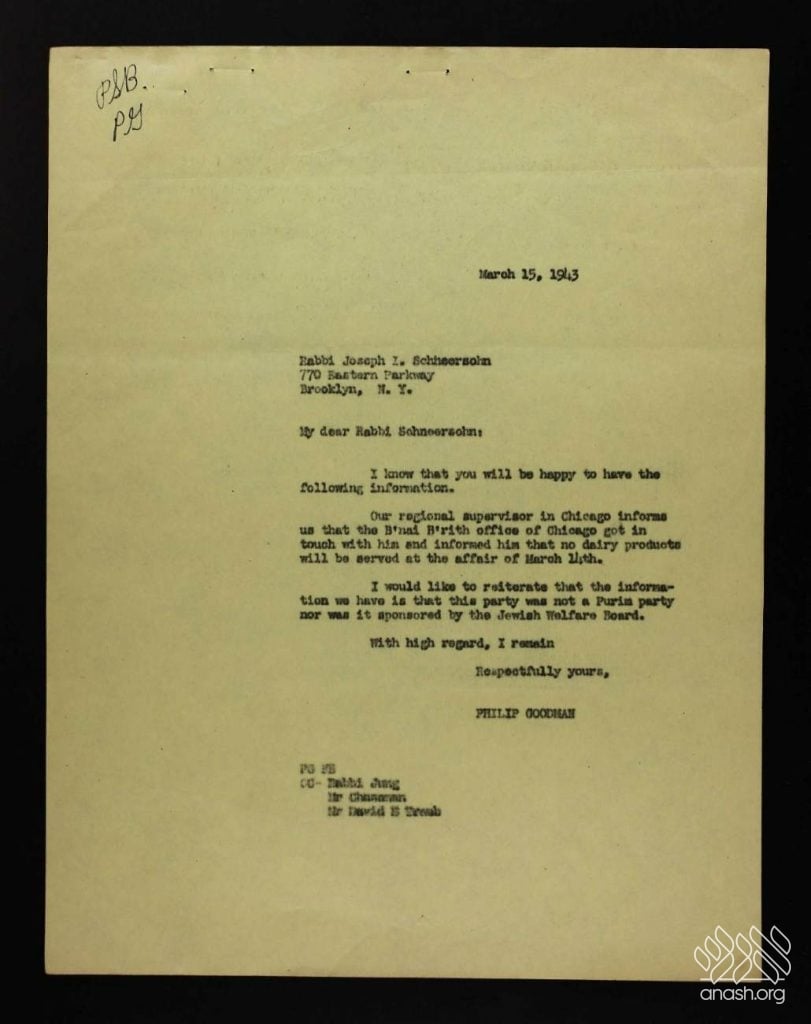
Finally, on March 15, Goodman was able to inform the Frierdiker Rebbe of the good news:
“I know that you will be happy to have the following information. Our regional supervisor in Chicago informs us that the B’nai B’rith office of Chicago got in touch with him and informed him that no dairy products will be served at the affair of March 14th.”
It seems that Goodman intended to write that no dairy products were served at the Purim party held the previous day, as is evident from the continuation of the letter.
In an internal letter to Traub and Chaseman, Goodman attempted to placate them, explaining the significance of who the Frierdiker Rebbe is and why he should be listened to:
”I suppose we should say ‘All’s well that ends well.’ Rabbi Schneersohn is the Lubavitcher rabbi, world famous chassid, with thousands of followers in this country.”
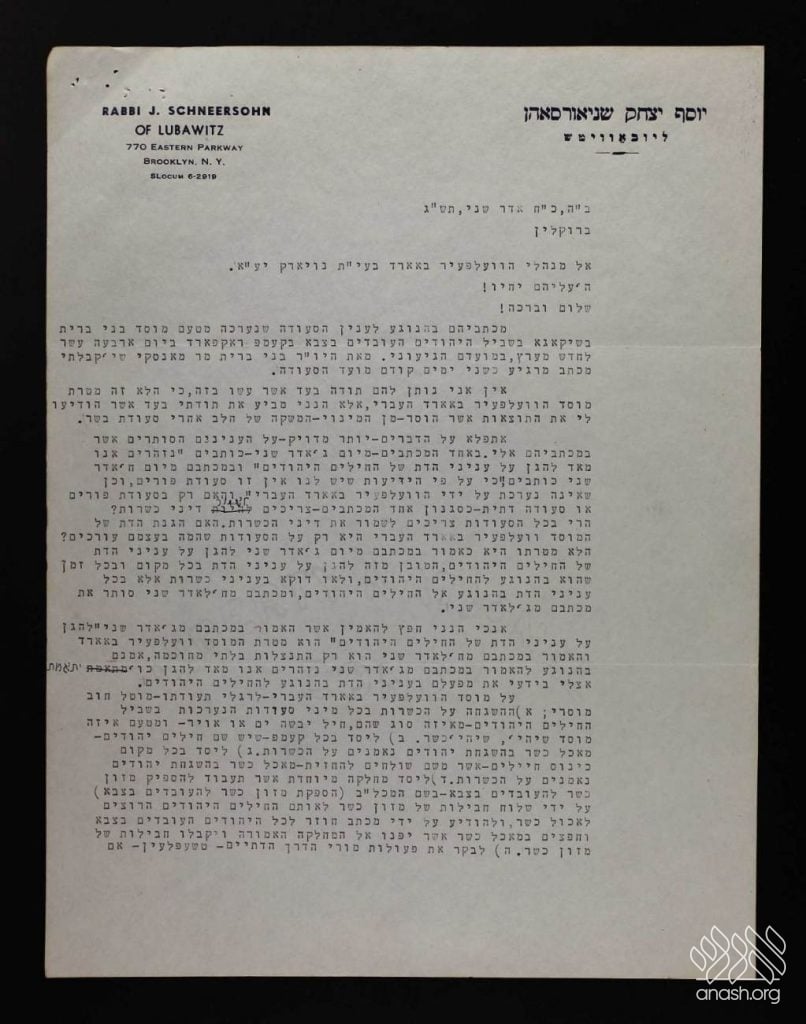
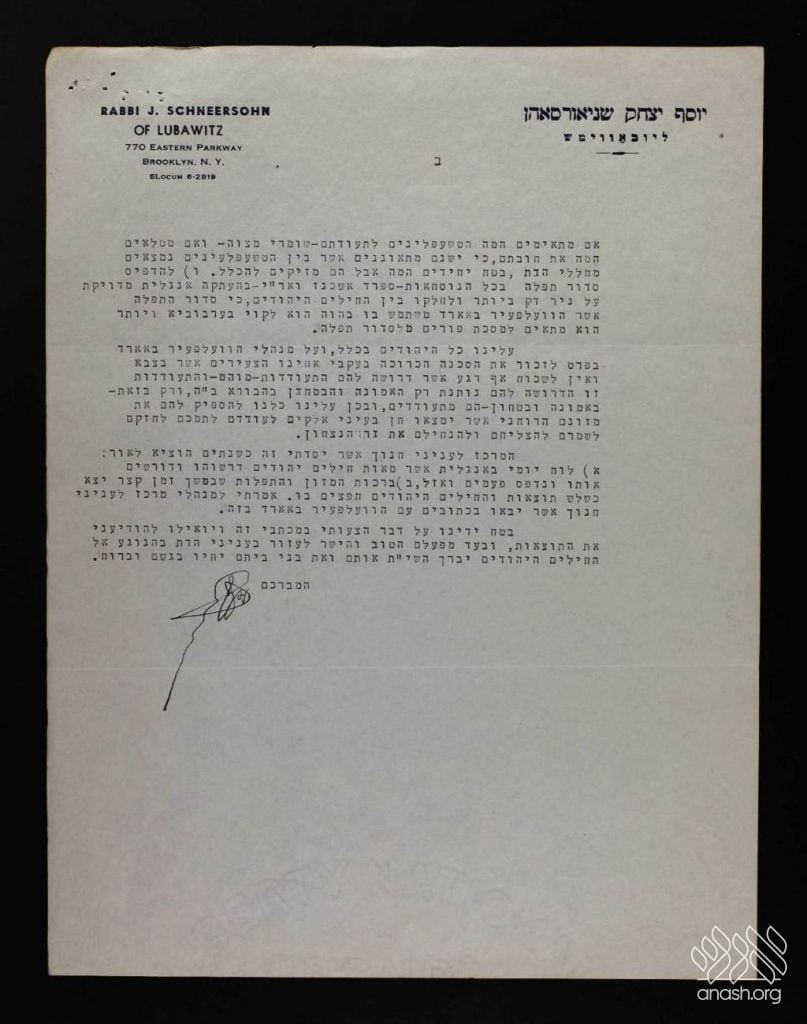
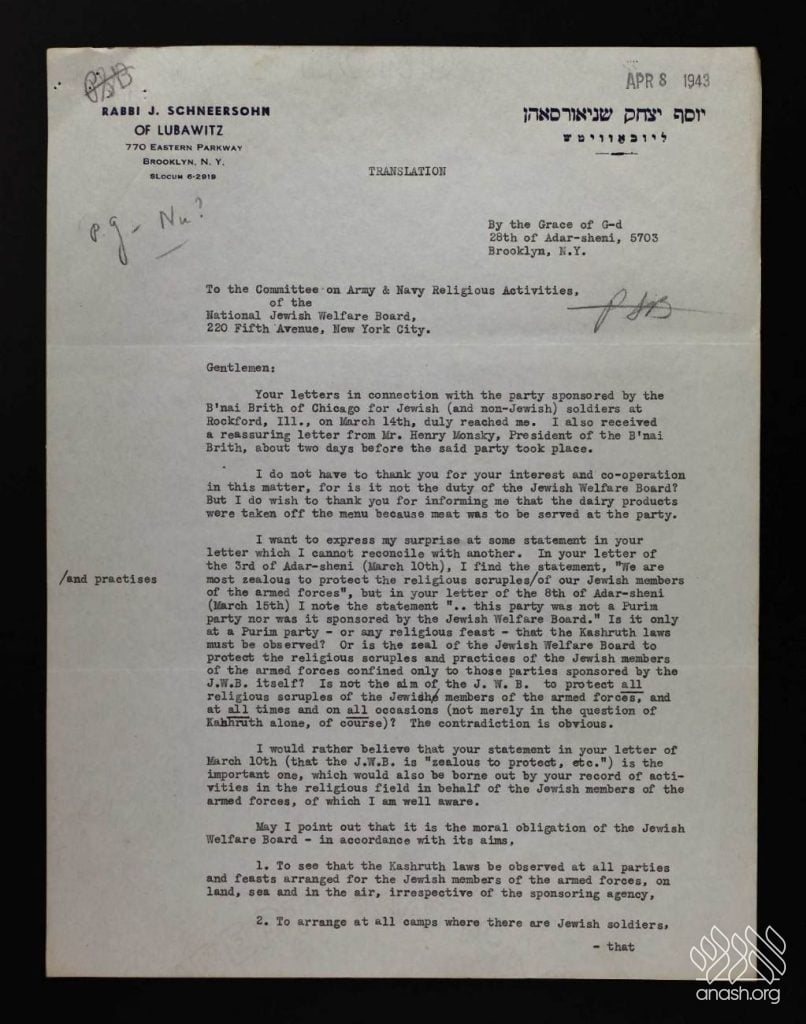
The Frierdiker Rebbe was unsatisfied with partial measures and the general state of affairs and on 28 Adar Sheni, 5703 (April 4, 1943), he sent two very similar letters addressing the National Jewish Welfare Board (JWB). One was in Hebrew, addressed to the directors of the JWB in New York, and the other in English, addressed to the Committee on Army & Navy Religious Activities of the JWB.
The letters begin with the Rebbe expressing gratitude and acknowledgment “for informing me that the dairy products were taken off the menu because meat was to be served at the party.”
The Frierdiker Rebbe then expresses concern over seemingly contradictory statements from the JWB. In one letter, they had written: “We are most zealous to protect the religious scruples and practices of our Jewish members of the armed forces,” but in another: “…this party was not a Purim party nor was it sponsored by the Jewish Welfare Board.”
“Is it only at a Purim party—or any religious feast—that the Kashruth laws must be observed?” the Frierdiker Rebbe asks. “Is not the aim of the J.W.B. to protect all religious scruples of the Jewish members of the armed forces, and at all times and on all occasions?”
“The contradiction is obvious.”
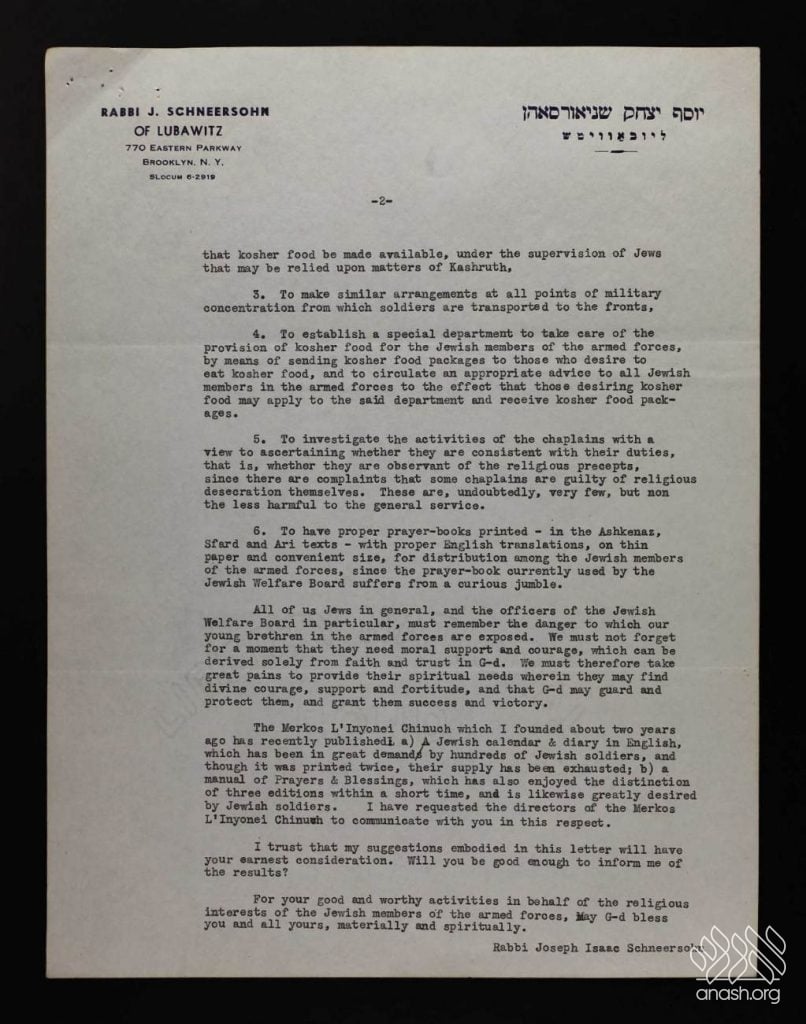
The Frierdiker Rebbe then proceeds to outline six moral obligations for the JWB to fulfill in order to safeguard the religious welfare of Jewish soldiers:
- Ensure kashrus at all meals for Jewish servicemen, regardless of who organizes them—land, sea, or air.
- Provide kosher food at all camps where Jewish soldiers are stationed, under the supervision of reliable Jews.
- Arrange kosher meals at military assembly points for soldiers moving to the front.
- Establish a special department to provide kosher food packages for soldiers requesting them, notifying all Jewish servicemen of this service.
- Supervise chaplains’ activities to ensure they properly fulfill their religious duties, preventing “religious desecration,” even if such cases are rare.
- Print proper siddurim in all rites – Ashkenaz, Sefard, and Ari – with accurate English translations, as the current JWB prayer book “suffers from a curious jumble.”
The Rebbe emphasizes the broader spiritual and moral responsibility of the JWB, specifically in these harrowing war times, writing:
“All of us Jews in general, and the officers of the Jewish Welfare Board in particular, must remember the danger to which our young brethren in the armed forces are exposed. We must not forget for a moment that they need moral support and courage, which can be derived solely from faith and trust in G-d. We must therefore take great pains to provide their spiritual needs …”
The Frierdiker Rebbe then informs them that Merkos L’Inyonei Chinuch, which “I founded about two years ago,” has already published: A daily English calendar and diary, and manuals of prayers and blessings, both in high demand by Jewish soldiers.
The Frierdiker Rebbe concludes: “I have requested the directors of the Merkos L’Inyonei Chinuch to communicate with you in this respect.”
While the JWB debated its responsibilities, the Frierdiker Rebbe had already begun filling the void.
Goodman replied to the Frierdiker Rebbe’s letter saying that “We are referring this matter to the proper committee so that due consideration may be given to the contents of your letter.”
“Your interest in the welfare of the Jewish members of the armed forces of the United States is sincerely appreciated,” he added.
On May 6, 1943, Rabbi Leo Jung, chair of the JDC Cultural Committee and founder and president of The Rabbinic Council of the UOJCA, formally replied to the Frierdiker Rebbe’s letter.
While attempting to defend the JWB’s earlier statements as “correction of information” rather than contradiction, Jung conceded to several of the Rebbe’s points and announced that a revised edition of the siddur would be issued that month, “which should meet the needs of the soldiers and sailors.”
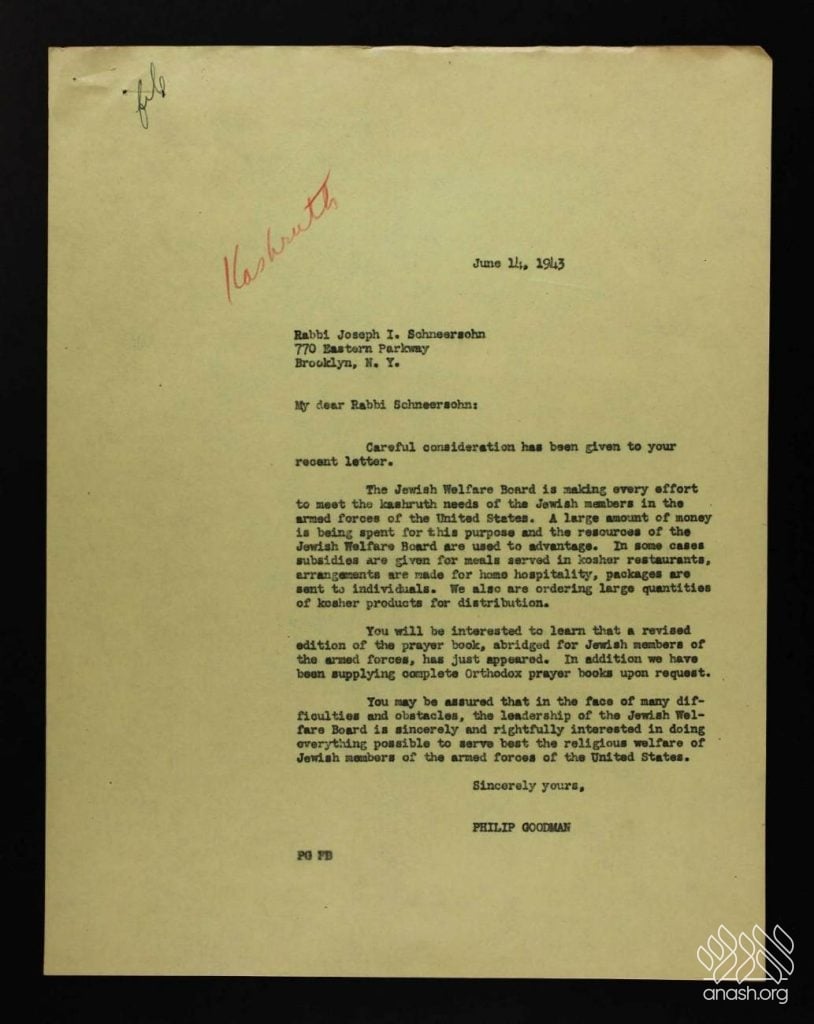
One month later (June 14, 1943), Goodman confirmed that the revised edition of the siddur had appeared and that the JWB was spending a “large amount of money” to meet the kashrus needs of the Jewish servicemen, including “subsidies are given for meals served in kosher restaurants, arrangements are made for home hospitality, [and] packages are sent to individuals.”
The peaceful but clear vindication was the result of the Frierdiker Rebbe’s refusal to let the matter rest.








 COMMENTS


We appreciate your feedback. If you have any additional information to contribute to this article, it will be added below.