



י״ג טבת ה׳תשפ״ו | January 1, 2026
Living with Paradox in Bondi Junction
Ever since I was young, I have been intrigued by the paradoxical. Two meanings or realities that contradict each other or don’t make sense together, yet coexist.
By Mrs. Sarah Chanah Sufrin – Bondi Junction
Ever since I was young, I have been intrigued by the paradoxical. Two meanings or realities that contradict each other or don’t make sense together, yet coexist.
Think true/false logic riddles, Mobius strips, the double slit experiment, Schrodinger’s cat, and on and on.
I grew up hearing my parents answer multiple-choice questions in the affirmative. (“Do you want chocolate, vanilla, or strawberry?” “Yes.”) I now enjoy the amused satisfaction of having successfully transmitted this trademark quirk to my own children.
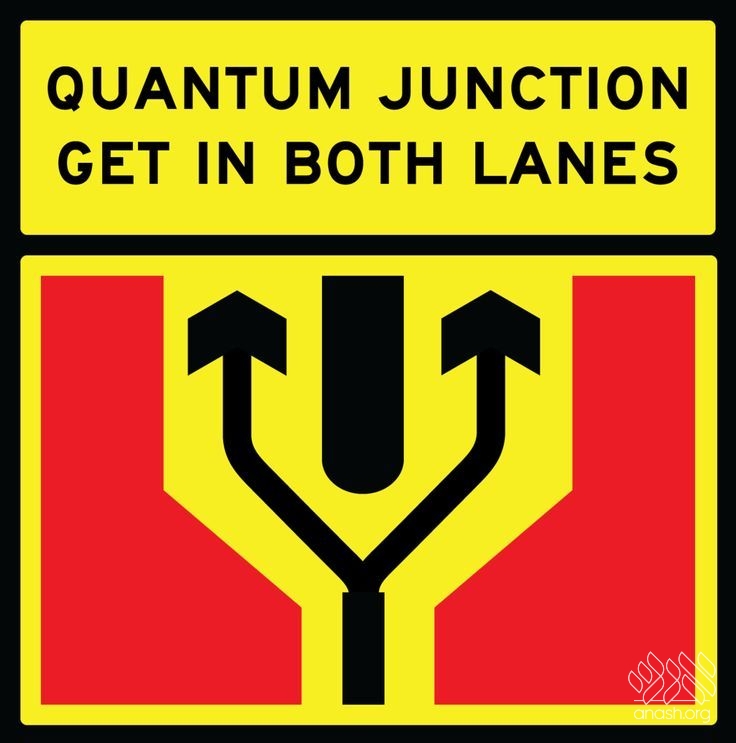
A family favourite meme is a nonsensical traffic warning sign depicting the inverse of a merge, with text reading “Quantum Junction: Get In Both Lanes”.
These are just a few examples of when our experience of the world does not comply with the rules we expect it to follow.
I think part of why paradoxes have always interested me is because they generate a bit of intellectual discomfort. You can’t wrap your head around them, but you keep trying to – much like a mosquito bite you keep coming back to scratch.
Recently, I am living in a paradox. We all are. Layer upon layer, a swirling cyclone of paradoxes. We have reached the Quantum Junction and must get in both lanes. My lifelong fascination has not prepared me for this AT ALL.
We have experienced the absolutely unbearable. Yet we are bearing up and showing up to help each other through.
Our faith has been attacked. But our faith has strengthened like never before.
I am devastated and heartbroken. And since the final night of Chanukah when 20,000+ people came together to light the Menorah and declare Shema Yisrael in unison, I am elated and uplifted.
These emotions do not make sense together (not much makes sense at the moment), but they are all true regardless.
Like Rabbi Elazar said to his father Rabbi Shimon: “Weeping is lodged in one side of my heart, and joy is lodged in the other side.”
The contradictions continue. I am tired to the bone after too many draining days have blurred into sleepless nights. Yet I was on such a high from the incredible Kiddush HaShem (sanctification of G-d’s name) created by the powerful and emotional Chanukah event, the largest in the world, that I could not sleep all night afterwards.
The irony that these are the thoughts running through my mind as I sit in the US consulate obtaining a passport for my daughter is not lost on me. It highlights another paradox in my own life. I’m a born and bred 5th-generation American, and lived there until adulthood. I had no reason to be unhappy with my country of origin and was reasonably patriotic. But I have zero emotional attachment to my American citizenship.
Contrast that with my being Australian – I first set foot in this country when I was 21, and it took a further 6 years until I gained citizenship. But I LOVE this country. I love it proudly, fiercely even. For the last couple years I’ve been mentally counting down, looking forward to when I could finally say I’ve lived in Australia longer than I’ve lived anywhere else in the world. I crossed that threshold in August, and smile to myself whenever it comes up.
I don’t know why I love this country so much. Maybe because all my children have been born here. Maybe because it’s the country I came to on Shlichus, as an emissary of the Lubavitcher Rebbe, and it’s where I feel I belong until Moshiach brings us all home. Maybe because the Rebbe reportedly had a particular love, a soft spot so-to-speak, for Australian Jewry. Maybe it’s just because it really is “the lucky country.”
Australia itself contains many paradoxes. One presented itself to me as we sang 20,000 strong before the fully lit Menorah, “we are one, but we are many…”. One isn’t many, and many aren’t one. Yet both of these statements are true at the same time. We are one – united as a nation with many shared values, but we are many – a multicultural society with room for all our vibrant uniqueness. (I know it hasn’t always felt this way in the last couple years, but I believe it can and will again.)
Don’t confuse “we are one but we are many” with America’s “E Pluribus Unum” (out of many, one). They are not the same. E Pluribus Unum means everyone arrives different and turns into the same thing. The American melting pot. Assimilate, amalgamate. No Minister for Multiculturalism in the US of A. My way or the highway.
Australia’s take says we can live with paradox, with two truths, the collective truth and the individual truth. Kind of like the Menorah in the Beis Hamikdash. The flames of the three outer branches on each side pointed inwards to the centre flame, which pointed upwards. The pointing upwards represents our service of HaShem. All the lights point together as one. But each flame remains separate and distinct. We all serve God together, yet we each serve with our own individuality.
I shouldn’t be surprised at seeing Australia and the Menorah have paradox perspective in common. Chanukah in Australia is a bit of a paradox. Chanukah is the festival of lighting up the night, shining in the darkness. But with the long summer days, we find ourselves watching the clock, waiting impatiently for the darkness we are charged with illuminating.
HaShem, you brought the darkness early this year. It was not the type we were waiting for. It is darker, thicker, heavier, more intense than ever. A darkness that chokes as well as blinds. Nevertheless, we are lighting it up. Brighter than bright.
Chanukah itself is the holiday of paradox and contradiction. The few vanquishing the many. The weak victorious over the mighty. The pure overpowering the profane. The righteous winning over the wicked.
This theme goes beyond the battlefield to the miracle of Chanukah, the light of the Menorah itself.
After Antiouchus’s soldiers defiled the entire supply of olive oil, one small jug was found still pure and unsullied. It was enough for one day but miraculously lasted for eight. We commemorate this by celebrating Chanukah for 8 days. But why? If there was enough oil for one day, then only 7 days of the light were miraculous.
Many of our sages throughout the years have offered reasoning for why we celebrate 8 days. Some say the 8th day is for the miracle of winning the war. Some say it is for the miracle of finding a jar of pure oil in the first place. Some say the oil burned 1/8 of the way down on each of the days. Explanations abound.
The Rebbe analyses this and explains how each of these answers is insufficient, before presenting a novel, radical, paradoxical understanding: the oil was indeed burning and fuelling the flames. Yet the volume of the oil was not in any way diminished. It was burning and not burning, not burning yet burning, for all 8 days, hence we celebrate for 8 days.
HaShem, You are Nosei Hafachim, you can abide by opposites, you can carry the contradictory. And now You are testing us, the ones made in your image, challenging us to do the same. And we are doing it.
We don’t understand it, but we are doing it.
Like the oil in the temple, we are burnt and consumed but not diminished as we glow.
Like the olives that must be squeezed, pressed, pulverised, to release their illuminating oil, we too are Kosis LaMaor, crushed to be a source of light.
HaShem, we will best You at Your paradox game. When you challenge us with darkness, we will spread light until the darkness is defeated for all eternity.
We are shattered and broken beyond all recognition. But we are shining brighter than ever before.
 COMMENTS


Captivating article, and a pleasure to read! Yasher koach
Very nice article!
Well done!
Beautiful article! I just wanted to point out that the Rebbe mentioned this line e pluribus unum a few times in sichos and explained it exactly the opposite of the way the author does here.
( Sichos Kodesh 5740 vol. 2. Pg. 58. Sichos Kodesh 5738 vol. 2
pg. 130. Sichos Kodesh 5741 vol. 2 pg. 176)
Thanks for this, I appreciate it and will look it up. What I wrote about E pluribus unum was not based on any source, just my feelings and observations about the “melting pot” vs. the “multicultural society”. Happy to learn more!