



י״ז כסלו ה׳תשפ״ו | December 6, 2025
Learning the Rebbe’s Chassidus is Meant to Change You
Ahead of Yud Tes Kislev, Anash.org presents an interview with Rabbi Shlomo Kaplan, Rosh Yeshiva of Oholei Torah and mashpia in 770, discussing how to approach the study of Chassidus, how it can transform one’s life, and why learning the Rebbe’s Torah is essential.
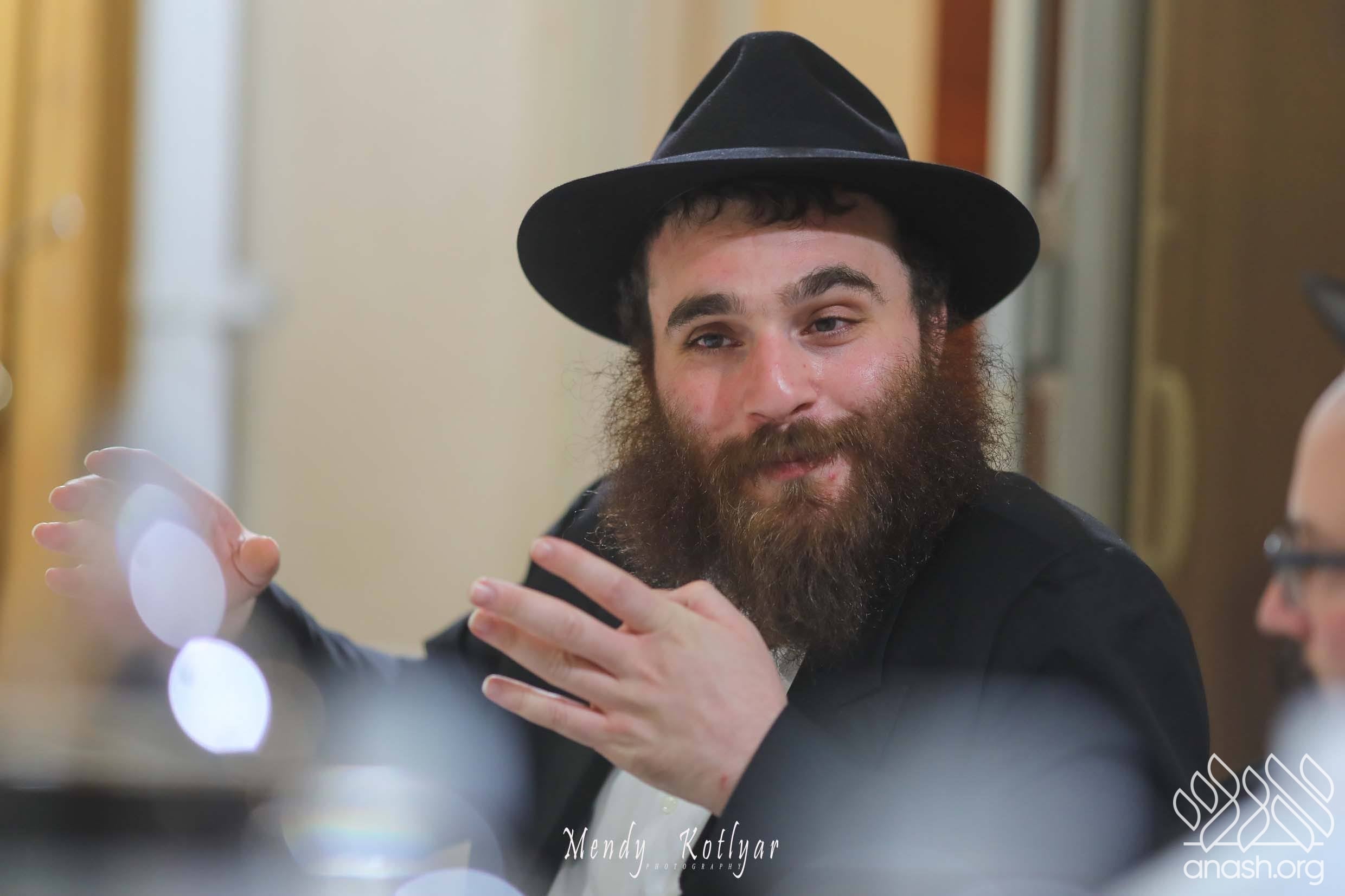
In a fascinating and thought-provoking interview in a previous Bnei Heichala journal, Rabbi Shlomo Kaplan, Rosh Yeshiva of Oholei Torah and mashpia at 770, discusses how to approach the study of Chassidus, how it can transform one’s life, and why learning the Rebbe’s Torah is essential.
Anash.org is pleased to present a portion of the interview in English.
*
Why is learning the Rebbe’s Torah considered such an essential path to hiskashrus?
The idea that one of the key ways to connect to the Rebbe is through studying his Torah is explicitly stated in a number of sources. One of the most well-known is in the Hayom Yom of 24 Sivan, which says that hiskashrus – bonding with the Rebbe – is achieved through learning his maamarim and reading his sichos talks.
But this is not just something we do because we were told to. As the Rebbe explained many times, just as with the Torah in general- about which it says “Ana nafshi kesavis yehavis” (Hashem “put His soul into His Torah”) – so too with the Torah of a tzaddik. The Rebbe “put himself” into his teachings. When we learn them, we’re connecting to him on the deepest level.
That said, there are those who may treat this idea superficially, almost like a segulah – “Since it’s says clearly that learning the Rebbe’s Torah connects us to him, and everyone wants that connection, so we learn.” But really, it’s worth contemplating this more deeply and appreciating what it truly means.
There’s a story told about the chossid Reb Hendel, who was a mashpia in Lubavitch. When a portrait of the Alter Rebbe was first publicized, it caused a stir among Chassidim. But Reb Hendel remarked that he wasn’t in a rush to see the picture – because, he said, he already knew what the Alter Rebbe looked like from the Tanya. That, he felt, was the real image of the Alter Rebbe.
There’s a lot to take out from this story, but the idea is that, just as with Hashem, where our limited human minds can’t grasp Him directly – and so He placed Himself within His Torah to make a connection possible – the same applies to tzaddikim. When a tzaddik shares Torah, he is placing his very self into it. And through learning the Torah of the Rebbe, we come close and truly connect.
What’s the explanation behind this idea? What does it mean that the Rebbe put himself into his Torah?
To understand this, we first need to explain what it means that through learning Chassidus in general, we grasp Elokus. Hashem is completely beyond definition, and He is the true infinite. Yet, He is present within the Torah that He gave the Jewish people, and through it, we are able to grasp Him. Because through learning Chassidus, a person unites with ein sof – with Hashem Himself – as is explained at length in the Sicha of “Inyana Shel Toras HaChassidus”.
The Rebbe Rashab once said that when he would shut himself in his room and learn Likutei Torah, “he felt Atzmus”. The Rebbe added to that (in Likutei Sichos vol. 16, Mishpatim I), saying that the story was told and passed down to us because “a trace of it” applies and is expected of every single person. Of course, there are different levels, but when a Jew learns Chassidus, it brings them to a deep awareness of the truth of Elokus.
Besides the possibility of feeling Elokus through this learning, it also awakens a feeling for our own essence – our nefesh haelokis – for which all of existence was created. Through learning Chassidus, a Jew begins to sense that he is one with Hashem. That’s what learning Chassidus does – it gives us a sense, a feeling, of Elokus.
The same is true when a Jew learns a maamar of the Rebbe. It strengthens that awareness of Elokus. When we say that the Rebbe “put himself into his Torah,” we mean that he put his very essence – his yechida – into it (as explained in the sicha of 2 Iyar 5710). And because he is the neshoma klolis, every Jew is a branch from his neshoma, where the ultimate truth of elokus is revealed.
So when a chossid learns the Rebbe’s teachings and they really penetrate and become internalized, it becomes easier to feel this truth – that he, like every Jew, is a branch of that greater truth, a product of that larger reality. By learning the Rebbe’s Chassidus, that truth of Elokus is drawn into the person so deeply that their whole sense of reality begins to shift.
If this something that can be felt right away, in any maamar or at any level of learning?
It’s definitely not simple – it’s not something a person attains in a minute. But this is the goal, and a chossid should know that he has the ability to invest himself in it and reach that level.
Many Jews hear about the Rebbe and develop deep admiration for him because they’re moved by his care for the physical needs of Jews around the world. Without a doubt, that’s a tremendous thing – Ahavas Yisrael and care of the nasi hador for his people. But the truth is, that’s only part of something much deeper and more essential. If that’s the full extent of someone’s awareness of the Rebbe, then it’s a very superficial understanding.
In the sicha of 2 Iyar 5710, at a farbrengen for students of Tomchei Temimim, the Rebbe spoke about this very idea – that a bochur is expected to have a different kind of recognition of the Rebbe, unlike those who are impressed by the miracles he performs. Is it wrong that the Rebbe performs miracles? Of course not. But that’s an external aspect compared to the inner truth.
Because what are we really talking about here? Not recognition of who the Rebbe is, but recognition of who you are. Since to you miracles are a big deal, when you hear that the Rebbe does miracles, you consider him a big deal. But that greatness is only relative to your standards.
As for the Rebbe’s true essence – you have no awareness of it. And you can’t really have that awareness unless you learn his maamarim with real effort and depth. Like any area of Torah, there are different levels of learning, and to truly learn the Rebbe’s Torah, it has to be serious and deep – not superficial.
At that farbrengen, the Rebbe said that learning has to be done with depth, and added that even outwardly it should be noticeable on a bochur – there should be a sense of “v’niflinu,” that he’s different, apart from everyone else. This happens through learning Chassidus. It should be clear that the bochur is completely immersed in it.
It’s specifically through delving deeply into the Rebbe’s Chassidus that one comes to truly recognize the Rebbe as he really is. Because through learning Chassidus, instead of your natural values determining what matters and what doesn’t, the Rebbe’s reality begins to shape your whole framework. And as mentioned, the Rebbe didn’t just speak about learning Chassidus – the Rebbe asked that the learning must be deep.
What does it mean to learn chassidus with depth?
Of course, there are many levels of depth, each person according to their capacity. But first and foremost, it means taking the learning seriously – learning each maamar multiple times, and above all, paying close attention to what it’s actually saying.
Here’s an example to help explain: if someone comes over to you and says the same thing to you several times, you won’t just think about what he’s saying – you’ll start thinking about why he’s repeating it so much. If someone asks you once to learn together, you’ll think he just wants to learn something then. But if he keeps asking again and again, you’ll naturally start thinking deeper – why does he keep turning to me? Maybe he wants to be friends.
Sometimes we hear what people say and that’s it. But if we think about what’s behind what they’re saying, we start understanding things on a whole different level – it’s a much deeper understanding of their words.
The same applies to learning the Rebbe’s Torah. This is especially relevant to bochurim who are in yeshiva. A balabos who learns a maamar Shabbos morning, or even half an hour every day, he still has many things on his mind – he has bills to pay and a family to support. So even if he learns a bit in the morning, his mind isn’t really clear and focused. The learning is more about starting the day with something true, but it doesn’t become his ultimate essence. A bochur, on the other hand, can become completely absorbed in learning. The learning becomes who he is.
That’s why it’s not enough to just go through the maamar a few times or to fill up time. Depth means clearing your head and being present, each person according to their level. It means starting to think not just about the words, but about the underlying ideas – not just what the Rebbe says, but why he says it, and why he repeats certain points.
To notice that, your head needs to be clear and focused. Only in that way does the maamar become the core of your day. The learning isn’t a side thing – you’re in it, you’re present, you’re giving it your time and your mind in a way that allows you to really concentrate.
When you learn a maamar, it should be in a way that feels like this is the only thing in your life at that moment – absorbing what it says and letting it penetrate you. This is true for all of Chassidus, but especially for a maamar of the Rebbe.
When someone works hard and learns in depth a maamar from Sefer Hamaamarim Melukat, for example, the perspective the Rebbe teaches us to have on life becomes his way of seeing things too.
You could say this is also part of what the Rebbe meant in that farbrengen when he said the learning should be with depth. It doesn’t mean becoming a Chassidic intellectual who understands the deepest concepts. It means pausing to think about what’s in front of you, what the maamar is really saying, each person in their own way. Not just going over it again and again, and not just looking for a question and an answer.
Practically speaking, if a bochur finds a maamar that really speaks to him, it’s worth sticking with it – not rushing to the next one, but holding on to it, learning it again and again, letting it speak for itself. That way, he can absorb and feel it more deeply and make it part of himself.
How should one approach long hemshechim or analytical maamarim that delve into lofty concepts in Elokus – especially when it’s difficult to see a direct, practical takeaway for avodas Hashem?
There are different aspects to this question, and it depends on each person’s situation and where they’re holding. It’s something to discuss with a mashpia. But I want to point out one general idea: in Chassidus, there is deep value and impact on avodas Hashem even in the learning itself – just through being engaged in it.
Without getting into distinctions between different areas of Torah, generally speaking, nigleh – the revealed part of Torah – focuses mainly on practical guidance for a Jew’s daily life: what to do, what not to do, and all the intricate details of each mitzvah. Because of this, it’s possible for someone to learn a great deal of nigleh and still not truly recognize the Giver of the Torah. He can become so absorbed in the details that he loses sight of the fact that the Torah is Hashem’s Torah.
This is what the Gemara refers to when it says the destruction of the Beis Hamikdash happened because “they learned Torah but didn’t make a bracha on it first.” They were fully engaged with Torah and followed all its mitzvos, but they forgot the main point, the awareness of Hashem Himself.
That’s what the Rebbe Rashab explains in Kuntres Etz HaChayim: that the purpose of learning Chassidus is to remember the One who gave the Torah. When we learn Chassidus, we’re learning about Hashem Himself, about the inner intent of creation, the essence of the Jewish soul, and the essential bond between the Jewish people, the Torah, and Hashem. And when that’s what you’re learning, you can’t forget it.
There’s another key point in Chassidus: it creates a bond between the Jew and Elokus. Because of that, the learning and the effort itself carry enormous weight – even if you don’t immediately focus on the practical takeaways. The purpose of Chassidus is to connect us to Hashem, and just through learning it and working to understand it, we become closer to Him. That’s why the constant habit of asking “what’s the takeaway for my avodas Hashem” or “how does this help me with my issues” can actually take away from the learning.
When we’re always looking for how the maamar speaks to me and affects my life, we’re once again pulled back into the details and we miss the core.
In the Hayom Yom for 26 Elul, the Rebbe writes that a chossid’s avodah begins with “soaking” – “being immersed in the Rebbe’s words.” If someone’s first instinct is to figure out what’s being demanded of him, what life advice the maamar gives, or how it can boost his energy for the next Yom Tov – that’s not truly soaking in the Rebbe’s words.
Isn’t it worthwhile to prepare for Yomtov by learning a maamar, or to do a mitzvah with the deeper meaning explained in Chassidus? Or in other words – why not look for maamarim that speak directly to the challenges I’m dealing with in my avodas Hashem?
This is a mistaken approach. Chassidus does indeed give flavor and chayus to every mitzvah, illuminates every Yomtov, and enlivens even daily avodah. And when a mitzvah is performed only because it’s written in Shulchan Aruch, it can be dry and lack chayus. At the same time, it’s important to understand how studying Chassidus helps all aspects of serving Hashem.
This is explained at length in Inyana Shel Toras HaChassidus, where the main idea is that Chassidus is not a collection of life tips; it reveals and connects every Jew to the inner essence of his neshama. As a result, a chayus in everything else follows naturally. Because when a Jew is connected to elokus and truth, everything changes.
Therefore, focusing on seeking immediate results from each maamar isn’t the main purpose of learning Chassidus, because such an approach still centers around the question, “What does this maamar do for me?” – even if that “me” is spiritual and lofty. The real goal of learning Chassidus is that through it, a person connects with his very essence – which is one with Hashem’s —and as a result, his entire yiddishkeit is uplifted and becomes alive in a much higher way.
That’s why learning Chassidus is not just about understanding an idea once. One must study Chassidus repeatedly, deeply and thoroughly. If the goal was merely to add chayus to the the 613 mitzvos, then after a certain period of study, one could say the mission is complete: we’d have a clear understanding of the inner meaning of Rosh Hashanah, the intent behind tefillin, the perspective on Shabbos, and so on. Yes, review might be needed to retain the knowledge, but ongoing study wouldn’t be essential – just as someone who knows the Shulchan Aruch in detail doesn’t need to constantly review practical halachah if he already knows what to do.
Today there are many books that collect “life advice” from Tanya and Chassidus. There’s nothing wrong with that, of course – but it’s clear to everyone that this isn’t the goal of chassidus. The goal is to bring the Jew closer to the reality of Hashem, to make Hashem a real and present part of a Jew’s life. And to internalize that reality requires repeated study, serious engagement, and mental effort. That’s because the awareness of Hashem – the certainty and natural feeling that elokus is the true and exclusive reality – runs counter to our human instincts, and only constant effort can instill this recognition within us.
Again, it’s true that in practice, what we learn sheds light on the Yomtov or mitzvah at hand – but that’s a result of ongoing study. Through this, chassidus naturally begin to illuminate a person’s life. But to make that the main goal, or to constantly seek out maamorim with an immediate payoff for one’s current personal struggle, shifts the focus away from what matters most.
The Rebbe once shared (at the Simchas Torah meal, 5731) that the first edition of Likkutei Torah had over three thousand printing errors. Chassidim would spend many hours learning a discourse, only to realize eventually that a printing mistake had distorted the meaning. Sometimes, they would spend an entire Shabbos on a maamar, until they had to conclude it must have a typo.
In the Rebbe Rashab’s time, Likkutei Torah was reprinted with thorough proofreading, and Chassidim were overjoyed. But when the printer – Reb Anshil Aranowitz – brought the new edition to the famous Chossid Reb Dov Tzvi (“Radatz”) Chein, the rabbi of Chernigov and a serious oved Hashem, he found that the Radatz wasn’t pleased. When asked why, he answered, “You don’t understand the whole point! The essence of Chassidus isn’t intellectual clarity – it’s that the intellect should be immersed and absorbed in Chassidus. When there were mistakes, learning required great effort and many attempts to understand, until one might have to admit there’s a printing error. But now, people will rush through the discourse, understand it easily – so what will they do next?”
That’s how Chassidim viewed the study of Chassidus – as avodah in its own right. They didn’t learn in order to extract personal benefit or immediate help in their avodah. The learning itself was the avodah. Chassidus reveals how “it is very near to you” – but what is “it”? Hashem Himself. Chassidus reveals how Hashem is near to you, and the entire goal of chassidus is to explain how He is close – to help you feel less comfortable in your own default reality. In other words: practical advice in Chassidus doesn’t challenge your reality, because it speaks directly to it. But awareness of Hashem’s reality necessarily does.
A common claim heard from many, especially bochurim, is the difficulty in learning Chassidus – sometimes they feel that they simply aren’t capable of learning Chassidus seriously. Is there some truth to this?
It’s possible that this feeling comes from forgetting what’s expected of a bochur in Tomchei Temimim. If a bochur thinks from the outset that he’s not really capable and that nothing major is expected from him, then he won’t even try to aim high. The issue is that sometimes we don’t realize what we’re really capable of – and based on that, we don’t realize what’s expected from us.
Nowadays, it seems to have become accepted that when a bochur enters yeshiva and finds things hard, people immediately accommodate him. Sometimes even the mashgiach will tell the new bochurim on the first day that he understands that today’s generation is full of energy and therefore it’s hard to expect them to sit and learn for long stretches, or to learn a full seder in depth. But the truth is, when a bochur doesn’t feel that people expect more from him – even though in reality he is capable of learning with consistency and achieving great things – this in itself weakens him.
The same goes for learning Chassidus. A bochur needs to know that he has real potential. Even today, a bochur can reach a point where he feels, at least a little, what the truth is, what Elokus is, and what the Rebbe is all about. But for those things to really settle inside him, he needs to put in serious time and effort.
We need to value our time and realize that deep, lasting change doesn’t come from learning superficially or just to check a box. You have to be immersed in the learning, learn properly and in depth. But when a bochur values the fact that he’s involved in this subject – and that by learning Chassidus he’s getting to know the Rebbe’s pnimius – then he’ll naturally invest more of himself. He has to appreciate what he’s involved in and understand that we’re dealing with the most elevated thing there is. And through that, we stand face to face with the truth.
To sum it up: learning Chassidus isn’t just about getting advice or help with a specific issue in avodas Hashem. It’s something much bigger. We’re meant to put time and energy into it because it connects us to Elokus. Still, the reality is that we all face struggles in avodas Hashem. So the question is – can we better understand what long-term, deep learning of Chassidus gives a person, and how it helps even with the day-to-day avodah?
First of all – as mentioned before – this kind of conversation doesn’t replace speaking to a mashpia. Since these are very personal matters, each person has to speak to his own mashpia, who can guide him on what’s appropriate for him specifically. But even so, it can be said, at least briefly, that often the learning itself helps a person deal with challenges. Because through learning Chassidus, a person can simply mature in his ruchniyus.
Here’s a simple example: A young child plays with a toy car. He thinks he’s really driving, moving from place to place, maybe imagining he’s in a police car and he really feels like it’s a whole experience. But just a few years later, as the child matures, he loses interest in those toys. He now understands what a real car is, what a real police force is, what a real truck is and he has no interest anymore in the things that used to take up his whole world. As the child grows, he naturally lets go of the imaginary world he used to be so into, because he now experiences reality differently.
That’s how it works with Chassidus too. Chassidus teaches that from the perspective of Ein Sof, everything is “k’lo chashiv” – it’s all insignificant. Compared to true infinity, the whole world and everything in it has no real value. And when a bochur puts himself into learning Chassidus properly, slowly but surely, he begins to lose interest in the outside world and in the things that once distracted him. He starts to feel that things he used to care so much about are just empty toys with no substance. To grow up in ruchniyus means to start feeling – even just a bit – that there’s something real out there that’s not limited by time, space, or any worldly boundaries. That’s the effect of learning Chassidus.
Of course, Hashem made us in a way that we don’t completely lose interest in the physical world. No one is saying that anyone who learns Chassidus will instantly get rid of all his taavos and become a perfect tzaddik who despises evil completely – not at all. But still, there’s a huge difference between someone who does something because it really means something to him, and someone who does it just because he’s pulled toward it and feels he has no choice.
To give a low-level example: a person might love tasty food – but he doesn’t consider it to be a lofty value. No one writes on a person’s matzeiva that every morning he had an omelet with cheese, seasoned to perfection. Everyone understands that this doesn’t deserve to be memorialized as something meaningful. Maybe there are people who dream about such things at night – but it’s totally possible to reach a point where they take up less and less space in your life.
And that’s the point: the more a bochur learns Chassidus, the more he internalizes the feeling and awareness of what’s truly real. What Torah is, what mitzvos are, who Hashem is, what the neshama is – and through that, he’ll start to feel – even just a bit – the smallness and emptiness of worldly things.
And going back to the earlier question – this is how the mitzvah ends up looking different, the Yomtov feels different. The maamar you learned before the yomtov will naturally shine a light on the yomtov itself – even if, while learning, you weren’t focused on your specific struggles or thinking how exactly these ideas would play out in your personal avodah right now.
To conclude, how can we actually apply everything we said in learning the Rebbe’s Torah in a more internal and real way?
The most important point is simply to learn in a way that you feel it’s your life. As was mentioned earlier, one of the strongest messages in the Rebbe’s Torah is the idea of removing the split between different “worlds” or areas in life and bringing the deepest truths into your everyday, down-to-earth life. This approach is tied to an avodas Hashem that comes from the innermost point of the neshama – its very essence. Meaning, when a person learns the Rebbe’s Torah, he draws this truth into himself and it begins to shape the way he sees the world. His entire perspective begins to shift, and that changes the way he behaves in all areas of life.
Of course, Chassidus also includes clear guidance on what to do in practical terms – there are direct instructions and certain things that need to be carried out as a result of the learning. But the main goal is something deeper: a shift in your whole inner mindset. What is my basic sense of self? How do I see myself and how do I look at the world around me?
The Rebbe doesn’t speak about something separate from life – his Torah is about life itself. The sichos are filled with discussions about the purpose of creation, the essence of a Jew, the meaning of Torah and mitzvos. They’re not focused on trying to understand some far-off, spiritual realm that’s removed from your experience, but rather on the truth of the world we live in right now. And still, it’s understood this kind of change doesn’t happen overnight. There’s no point in constantly checking to see if you’re “progressing” in some visible way. The focus is to learn, and to trust that the learning will do its work.
The Rebbe’s Torah includes everything. Like we said earlier, it speaks in every “language” and reaches every layer of a person’s life. There’s no part of your life the Rebbe doesn’t address and illuminate. Our job is to learn and let the learning affect us. Over time, you’ll start to feel your life is being lifted. You’ll begin to sense that your life has a purpose and a mission – that you have a role to play as a tomim, as a chossid. The awareness that everything you go through is part of a deeper plan, and that there’s a purpose behind it all – this understanding can completely change your life. And the more you learn, the more that awareness will seep in.
All that’s left is to learn and let the Torah become part of you. If you learn properly and with depth, even if not in every sicha and not immediately from day one, you’ll begin to feel: this is your life. It’s not some other world, holy and removed, that needs to be brought into your reality – it’s one single truth.
That’s the whole purpose of learning Chassidus: that the truth of Elokus should penetrate the person, his mind, his emotions, his day-to-day life. That he should be a chossid, and that it should fill his whole being.
*
Bnei Heichala is available at Crown Heights seforim stores or online here.
 COMMENTS


We appreciate your feedback. If you have any additional information to contribute to this article, it will be added below.