




כ״ה תשרי ה׳תשפ״ו | October 16, 2025
“It’s Hard to Understand How a Person Can Think Otherwise”
As a bochur, Rabbi Avrohom Wineberg struggled to grasp how every detail of creation is guided by Divine Providence, and he brought his question to the Rebbe. What followed was a five-minute explanation so profound that he rushed to write it down word for word—and the Rebbe later returned it with handwritten notes.
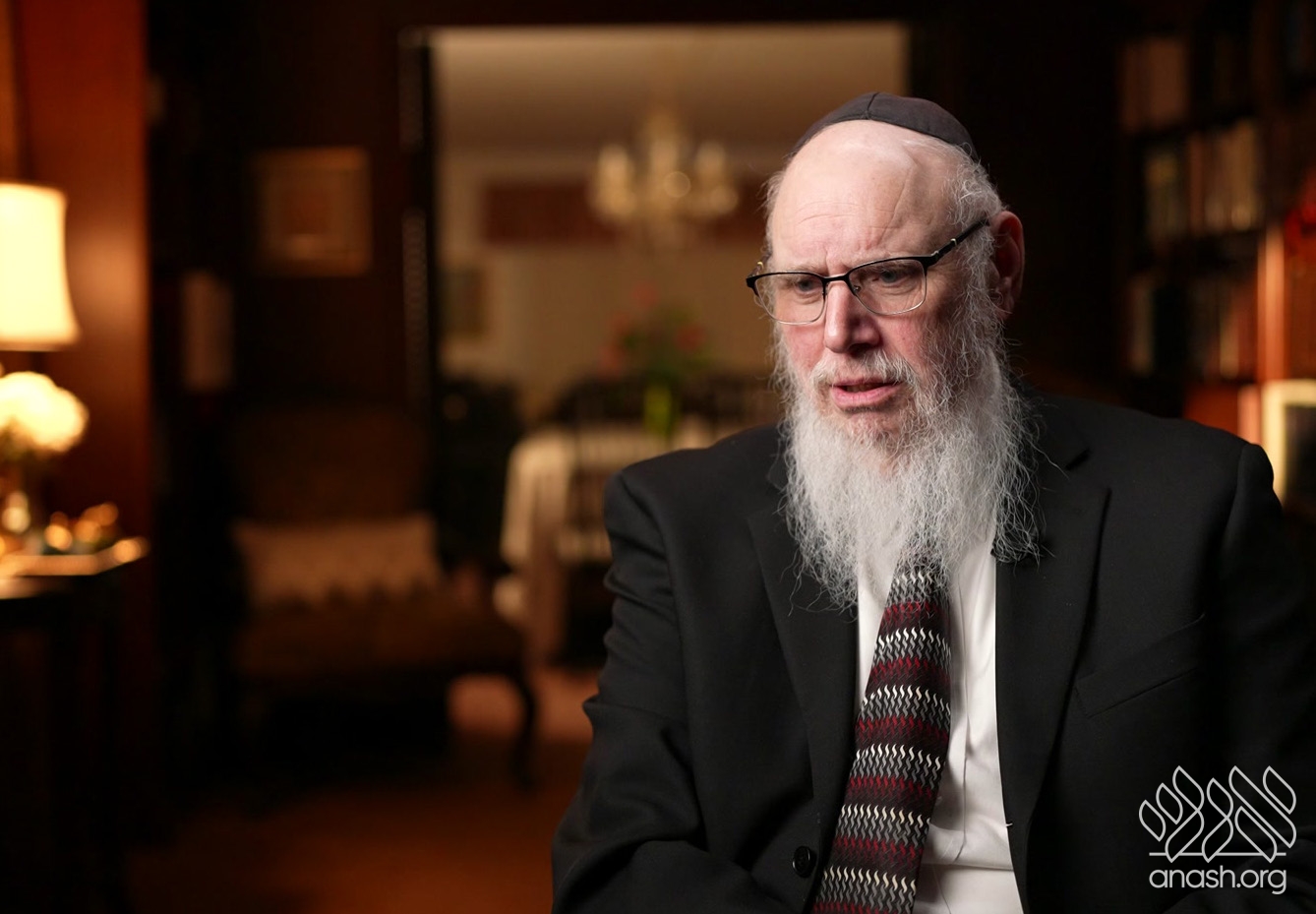
Rabbi Avrohom Wineberg has served as the administrator and lecturer for adult Torah education at the Bais Chabad Torah Center of West Bloomfield, Michigan, since 2000. He was interviewed in March 2025.
In the early 1980s, the Rebbe stopped receiving individuals for private audiences, but when I was studying in yeshivah, in the ‘60s, students were able to have a private audience with the Rebbe every year, in honor of their birthdays.
The Rebbe related to each person in a different way, and for many students, these meetings could be a very powerful experience.
In my class, there was a student, an extremely serious and studious young man, who brought a note into his audience with the Rebbe, in which he detailed all of his perceived personal shortcomings and character flaws.
After receiving it, the Rebbe read the note, and then looked up and smiled. “So much lashon hara (badmouthing) about yourself!” he exclaimed.
A few years later, there was another student, a fellow from a prestigious family, who had come from Israel to learn in the yeshivah in 770 — but he was wasting much of his time instead of focusing on Torah study.
When he had his private audience, the Rebbe began to chastise him loudly: “Is this why you came here from the Holy Land?” he demanded, his tone audibly upset. “If you don’t want to learn Torah, pack your bags and go home! Why are you wasting your time?” It was very rare for the Rebbe to speak this way, but apparently, it was what this young man needed to hear.
In 1968, I had an audience of my own after the festive month of Tishrei. In the note I prepared for the Rebbe, I wrote about something that was bothering me very much. I had been learning about the chasidic perspective on Divine Providence, or hashgacha pratis, which maintains that G-d watches and guides every single aspect of the world. As the Baal Shem Tov — the founder of the chasidic movement — put it, every stalk of grain or blade of grass fluttering in every gust of wind is being orchestrated by G-d’s master plan. But I was struggling with this concept. I understood and was capable of articulating the idea, but I didn’t quite connect with it. So after I discussed the subject with my good friend and study partner, Nachmon Shapiro, we agreed that I should ask the Rebbe about it.
“There are certain aspects of hashgacha pratis that I haven’t internalized,” I wrote in my note.
In response, the Rebbe delivered a five-minute lecture on the subject.
The answer contained a lot of profound material so, not wanting to forget a single word, as soon as I walked out of the Rebbe’s room, I went right over to Nachmon, who was waiting for me in the foyer.
We walked out of 770, and sat down on a bench on Eastern Parkway, where I repeated everything the Rebbe had told me. Nachmon then typed it all up, word for word, and the next day I submitted this transcript to the Rebbe’s secretariat, with the request that the Rebbe review what we had written up, seeing as it was on an important subject. Shortly after, the secretaries showed me that the Rebbe had given back the typewritten transcript with his own handwritten corrections.
The first thing the Rebbe had said was that I should discuss the matter further with scholars of chasidic thought, and he referred me to a letter of his on hashgacha pratis that had been recently published in an Israeli periodical. That letter, however, only dealt with some of the more “academic” aspects of the subject, so the Rebbe went on to address my question in a more straightforward way.
Since I found the topic difficult to internalize intellectually, the Rebbe replied that, on the contrary, “It is difficult to understand how someone cannot believe in hashgacha pratis, while still believing that G-d created the entire world and everything in it — as we have just learned, ‘In the beginning, G-d created [heaven and earth].’” These opening words of the Torah, had just been read in shul the previous week.
“We believe that He created the wind, and that He created the straw,” continued the Rebbe, “so it makes sense that afterwards He would still be thinking about and interested in everything that is going on with that particular stalk or gust of wind. Why would He suddenly lose interest in them?” he asked rhetorically. Even an ordinary person who creates or puts energy into something, presumably continues to care about that thing.
To be sure, the Rebbe went on, “When we are speaking of a limited mortal, who can only think about a limited number of things, then if he has five hundred things on his mind, he chooses one hundred of the most important concerns, focuses on them and then he has no choice but to ignore the rest.” (Apparently, the Rebbe considered it normal for a person to have so many things on their mind!)
“But when we are speaking of the One Above,” he reasoned, “Who is unlimited, Who created so many millions of things, and is certainly capable of thinking about them all, the contrary is true: By logic, why would He suddenly stop thinking about those things? Why would He abandon any of them?”
“Now, if a person has any doubt as to whether G-d created everything, it would be possible to say that He doesn’t concern Himself with everything. But once you do believe that He created everything, it doesn’t require faith beyond that; [G-d’s interest in every individual creation] is something you can understand.
“On the contrary,” the Rebbe concluded, “it’s difficult to understand how a person can think otherwise.”
 COMMENTS


I would love to understand the Rebbe’s point more clearly. If God created the wind and the straw, then presumably He also created the systems that produce them—not for their own sake, but as part of a larger ecosystem. Why would that imply that He is concerned with each individual gust of wind or stalk of straw? Wouldn’t it make more sense to say that He cares about the system as a whole, rather than each of its components?
The same question applies to human beings. Even if God created the species and endowed it with the ability to reproduce across generations, why does that necessarily mean He is involved with each individual person? Wouldn’t His concern be with the species as a whole? That, after all, is essentially the position of many Rishonim, as the Rebbe himself notes.
So how does the Rebbe’s argument clarify—or challenge—that view?
It seems from your question that you conflate the attention that the Creator pays due to the act of creation with the interest the Creator has in His creations.
When one creates, it is natural to care about what happens to the creation, every possibility and every result within that creation is interesting to the Creator. Hashem has infinite capacity for attention and interest, so why wouldn’t He be following the progress of every detail in creation, ensuring that it continues to follow His intent in creating it?
I hope this helps
I don’t think that was the Rebbe’s intention. It seems like a significant leap and assumption that isn’t intuitive at all. If Hashem created the world for a purpose, then it’s reasonable to deduce that He cares about creation insofar as it serves that purpose. But to assume that Hashem cares about every detail of creation even when it doesn’t relate to its purpose, “just because,” is attributing very human-like qualities to Hashem. That kind of emotional projection has no clear basis in logic.
First of all it is important to note the Hashem’s name according to halacha should be abbreviated as G-d. Second, among chassidim we simply write “Hashem”, that’s our shprach.
Regarding the question here, the simple answer is: the whole ecosystem was and is created by Hashem. All the steps that bring the final result are continuously created by Him. So it is obvious that he has an interest in every part of it because לא ברא הקב”ה דבר אחד לבטלה
I’m not sure what your argument clarifies. Sure, a single gust of wind or stalk of grain is significant as it pertains to the whole, and that’s why G-d continues to create all of it. But if the system would function equally well whether the wind blows to the right or the left, at one speed or another, then why does G-d’s constant creation of it indicate that He is concerned with what is insignificant from the point of view of the ecosystem?
Also, your clarification seems to be advancing a different argument than the Rebbe’s. I would love to better understand the Rebbe’s.
Even among the minority halachic views that consider writing “God” problematic, it is only out of concern that these materials are likely to be thrown away once one is done with them—a concern not relevant to this format. I do appreciate your point regarding the accepted shprach among Chassidim.
Without going into the merits of your point, it isn’t the argument or explanation the Rebbe was giving, and I was seeking more clarity on the Rebbe’s argument.
whether or not it’s a minority halachic view, it’s something the Rebbe is careful about himself, and told others to be careful with it as well. so how “mainstream” the halachic views are dont make much of a difference anymore.
also, it definitely is possible that people print out the articles, and the issue comes straight back into the spotlight