




ט׳ מרחשון ה׳תשפ״ו | October 31, 2025
Is Your Blood More Red Than Theirs?
As thousands march to protest the draft, we ought to ask a harder question: Do we actually believe what we’re fighting for? Until a bochur’s Gemara burns with the same fire as a soldier’s rifle, we can’t expect the world—or ourselves—to believe that we’re truly on the front lines.
By Rabbi Shmuel I. Silverstien
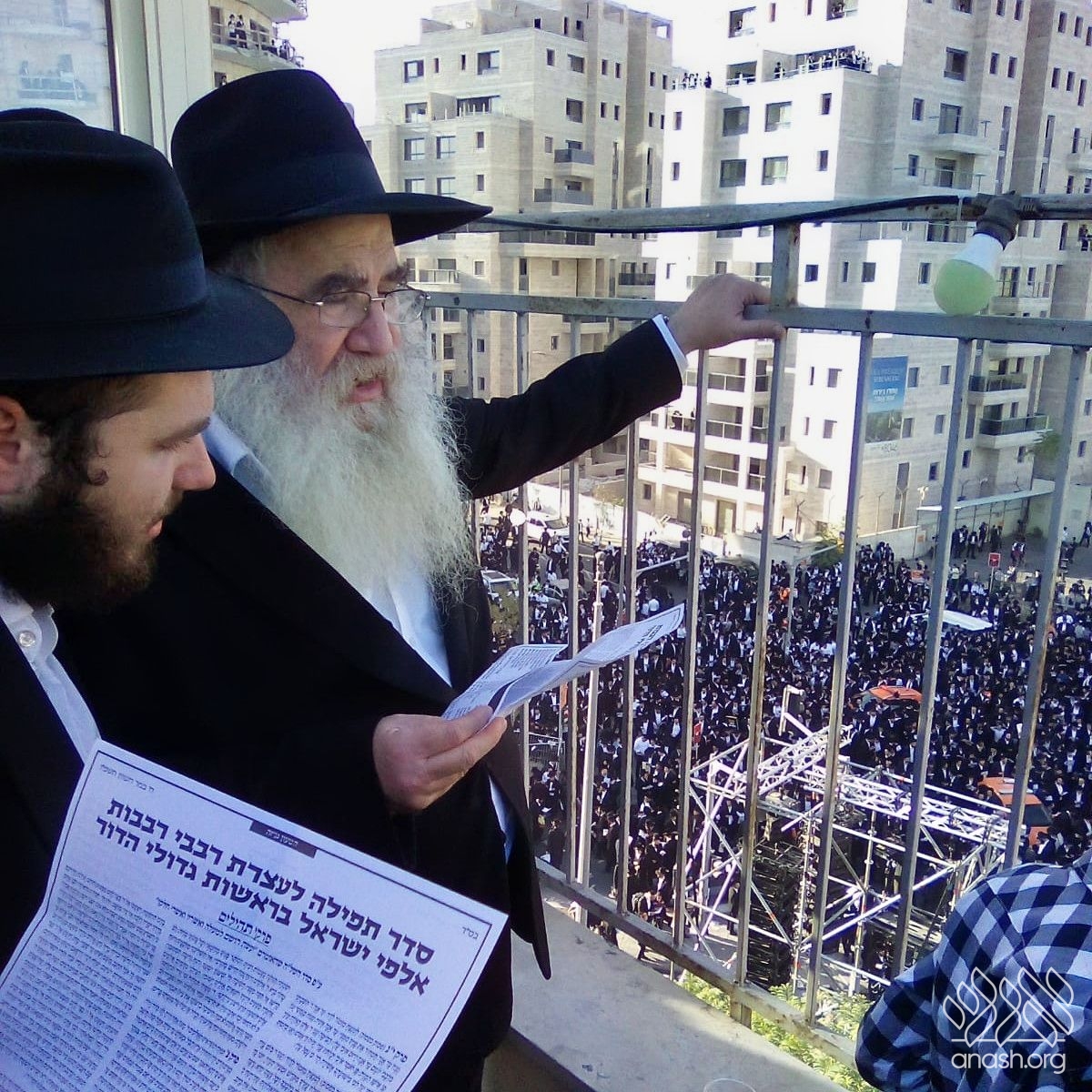
On Thursday, a massive million-man march was held in Yerushalayim in response to the government’s proposed draft law and the recent arrests of yeshivah bochurim who have not enlisted in the army.
There has been much talk in recent days about Chabad’s participation in this rally, and more broadly, about whether – and to what extent – we should be involved in the charedi world’s battle with the government of the State of Israel and the IDF over conscripting yeshivah bochurim.
Personally, I would opine that this is a very sensitive and nuanced issue with potentially grave consequences depending on what we do and how we do it. We must approach it carefully, and ultimately it is up to the rabbonim to determine exactly how we should be involved and to what degree.
However, what I believe is of far greater importance is not how much we protest to prevent the IDF from drafting bochurim learning Torah, but whether we actually believe in what we are preaching and protesting for. Too often, we have the right words, the correct slogans, and the moral arguments – yet we fail to internalize them and truly identify with them.
Like Moshe told the Yidden, “Ha’acheichem yeitze’u lamilchama ve’atem teishvu poh? Will your brothers go to war, and you will sit here?” This is a very real question. For many, it comes from a deep place of pain – that while they and their brethren are being sent to the front, risking their lives to protect our people, there are others who stay behind in air-conditioned rooms and claim it’s because of the Torah they learn.
If we don’t fully believe in what we are doing and the value it has, then perhaps those critics have a point. Why are we staying behind while our brothers go to war? Is our blood more red than theirs? That is an unanswered question for many.
“The soldier on the front line – everyone pats him on the back, he’s awarded a medal of distinction, his name is published in the newspapers, he’s elevated to a higher rank, and he and his children and grandchildren are showered with honor. But the one who sits and learns – no one knows what he does. His accomplishments are not visible, and people call him a coward.
“Then, when he comes home, his wife asks him, ‘Did you know that our neighbor came home from war with an entire tank, and you came home with an old Gemara printed 150 years ago? How can you compare a tank to an old Gemara? Is this all you did for the war effort?’ And he doesn’t know what to respond…”
These words are from a Vov Tishrei farbrengen 5728 (1967), where the Rebbe spoke at length and eloquently explained the role of those studying Torah – how Dovid HaMelech and Yoav ben Tzruyah were bound as one entity. While Dovid sat and learned Torah, Yoav fought the wars. Without Dovid’s Torah study, Yoav would not have been victorious in battle. Just as it is crucial for someone to stand guard and fight on the borders of Eretz Yisrael, it is equally vital that there be a “Dovid who sits and learns Torah.” Without Dovid’s Torah, Yoav cannot win his battles.
The question, however, is not whether we can explain this to the government, the IDF, the media, or those calling us cowards – it is doubtful they will understand. The real question is whether we have an answer at home when our family asks us about “Our neighbor who came home from war with an entire tank, and we came home with an old Gemara printed 150 years ago.” Or when our close friends ask us, “How can you compare a tank to an old Gemara?” Or when we sit alone and ask ourselves, “Is this all I did for the war effort?” Do we have what to respond?
If we cannot give a confident, heartfelt answer to ourselves, our friends, and our family, then our public protests ring hollow.
The Rebbe gives the example of the army itself: If a commander were to tell his soldiers, “You go to the front while I stay back in the headquarters, safe and comfortable, and plan from afar,” people may shout at the inequality. But if the commander actually abandoned his post and rushed to the front, he would not be helping – he would be ruining the war effort. Everyone must remain in the role assigned to them for victory to come.
Similarly, when someone is placed in a yeshiva to sit and learn Torah day and night, the role is essential. If that bochur closes his Gemara and runs off to prove he is a “fighter” and deserves a medal, he not only fails to contribute to victory, he causes actual harm. He leaves his post empty and opens the front line to the enemy, r”l.
Hundreds of thousands can protest – and perhaps rightfully so – about the government’s wrongful intervention in trying to take yeshivah bochurim away from their learning. But are we fully confident in why we are staying behind? Or better yet, are we really “staying behind” at all? Only one who looks superficially, who sees only with physical eyes and not deeper, can think that winning a war happens only through those who stand and shoot – and that we are the deserters, the ones staying behind.
If we truly believe – in our hearts, in our homes – that learning Torah is vital, life-giving, and part of the defense of Klal Yisroel, then we are not staying behind at all. We are right there on the front lines, doing the most important thing. When a Jew sits and learns, this is what gives life to the soldier on the battlefield. This is what wins the war.
Most importantly: If we truly believed it, our Torah learning would look different. We would be fiercely devoted to utilizing our time and energy to studying Torah and engaging Yidden to put on tefillin to protect our nation. Of course, the solution must be to increase, not decrease ch”v, the Torah protection.
And perhaps when we fully believe it, those who challenge us will understand it as well.
 COMMENTS


Hi,
In life we need to be able to handle parodoxes. There’s no question that those who belong learning and not in the army, need to be doing just that and they are making a bigger difference than anyone else. It’s also true, and actually also because of the first truth itself, that it needs to be taken so much more seriously and honestly.
Meaning, those in אהלו של תורה should not leave and those in אהלו של תורה need to be taking it so much more seriously.
There are literally אין ספור examples for this. From the simplest one of being Frum and comparing to a not Frum Yid or being Lubavtich to comparing to someone who isn’t. Stay Frum! Stay Lubavitch! At the same time, that itself requires you to be doing so much more than what you’re already doing.
Same with being healthy and not חס ושלום in a coma. Stay healthy! At the same time, that itself requires you to be doing so much more than what you’re already doing.
In light of the present danger to our people, it is incumbent upon every member of Klal Yisrael to participate in the communal effort to defend life and Torah institutions. While not everyone is suited for combat duty, there exist many halachically valid and essential roles — medical service, emergency response, supply and logistics, homeland security support, and related functions — through which one may fulfill the mitzvah of pikuach nefesh.
To deliberately separate the nation into defenders and bystanders, particularly when yeshivos and families are threatened, constitutes a serious Chillul Hashem and contradicts the Torah’s obligation to preserve life. Community leaders should therefore encourage practical compromises that enable broad participation while respecting the needs of those who learn in kollel or yeshiva.
We ask every family to identify how they can help — in body, skill, or means — and to coordinate with trusted communal bodies so that all contributions are effective, dignified, and consistent with Torah values.
1) In response to Mr Dovid K, Torah learning IS part of our defense, as the Rebbe spoke of many times.
2) In response to the article, I don’t know why you have to frame it that way, eg. Assuming that somebody does not have the proper conviction. This is not a new debate, the Rebbe spoke about it numerously, and lot’s has been written on the topic already. In terms of what our community believes, Dan lkaf zchus. The message about appreciating Torah study could be communicated in a more positive light.
If the problem was that there wasn’t enough fighters, that’s understandable. Everyone knows that’s not the issue.
First of all, the war itself is so unnecessarily dragged out, it could have been easily won in less than a month if the army made proper military decisions without trying to please the world.
Secondly, the essential roles you mentioned are not essential when it comes to Torah. Sitting and learning with “an old Gemara printed 150 years ago”, like the Rebbe spoke about, is the essential role. The other roles you spoke about are necessary but there are many who can fill those roles and those come secondary. It’s obvious that Hashem watches Eretz Yisrael (the six day war and literally every day is a miracle there) and doing what He wants keeps yidden safe. The actual fighting is secondary.
Lastly, the writer has a very valid point which is the main idea. We need to take our role as “fighters” through doing our spiritual part much more seriously. Your comment sidesteps that point. I would even add what the writer touched on at the end. We need to be flooding the streets with mivtzoim and strengthen yiddishkeit a million times more within our own circles. If a Jew wants to contribute, the war on the spiritual front is essential. We need to realize it before shouting it out to the rest of the world
How can anyone claim there are “enough fighters” when reservists with wives and children have been called back five times? You go on to blame what you consider poor war strategy—that the conflict dragged on too long. But the ordinary reservist isn’t making those decisions. So why is he the one being punished?
Two wrongs don’t make a right. Even if your critique of the war’s management is valid, that wouldn’t in any way justify forcing the burden onto the rest of Israeli society alone.
People struggle to understand chabads view of the army, because they don’t know to situation, it is pretty simple:
Chabad is no different than most of the torah world, there is a theoretical approach, and a practical approach:
Theoretical: those who learn dont serve, those who dont learn serve.
Practical: even those who dont learn should not go to the army because they are actively trying to shmad frum yidden.
There. Thats it. It is so simple
I completely dont understand why the author thinks chabad would have a different approach than the entire torah world, that is a bit absurd, because we have the same shulchan aruch as them
Chabad Bochurim arrested upon return from kvutza in spite of the fact that there had been an understanding of the Chabad learning seder system — kvutza year, AND many Lubavitchers are in the front lines in gashmius (in IDF these days) and ruchnius— learning and doing mivtzoyim and helping IDF in gashmius and ruchnius. Hareidim are used to drafting being political and dafka. And the arrests are just another example. At the same time, yes. Those of us who are not risking our physical lives do need to step up our ruchnius that is so much a part of all of us winning the war.
Lets just be clear that just because the soldiers seem to be putting all their effort and might into fighting its not necessarily less than what some bochurim may be investing. Speak to soldiers personally and you may find out that the daily life and grind of war even under constant threats RL in Gaza itself soldiers are human too. This obviously isn’t ignoring the plain and simple fact that these soldiers are risking their lives every second which cant be compared to. Its the premise that they are more “fiercely devoted to utilizing … time and energy” that might need some fact checking. In any case the point you have made is clear and thank you for bringing this Sicha to everyone’s attention.
I believe so strongly that there should have been (should be) a division of the army called the yeshiva students, with uniform and ranks etc based on Torah study diligence and other areas of recognition. Just like and army. Maybe like an adult version of Tzivos Hashem.
This would allow the Yeshivah students to really feel how they play a roll and motivate them to fulfill “Most importantly: If we truly believed it, our Torah learning would look different. We would be fiercely devoted to utilizing our time and energy to studying Torah and engaging Yidden to put on tefillin to protect our nation.”