




י״א כסלו ה׳תשפ״ו | November 30, 2025
Is It 200 Years Since the Mitteler Rebbe’s Geulah?
This year, some calendars and announcements are marking Yud Kislev as a major milestone – the 200th year since the Mitteler Rebbe’s geulah. But isn’t it generally assumed that he was released in 5587, the year before his passing in 5588? If so, wouldn’t the actual 200th anniversary only be next year?
This year, some calendars and announcements are marking Yud Kislev as a major milestone – the 200th year since the Mitteler Rebbe’s geulah. But isn’t it generally assumed that he was released in 5587, the year before his passing in 5588? If so, wouldn’t the actual 200th anniversary only be next year?
Getting to the bottom of this , requires going back into forgotten archives, missing files, and a question that the Rebbeim themselves discussed over the years.
The story of the Mitteler Rebbe’s imprisonment and release on Yud Kislev was always somewhat unclear, including the exact year of the geulah.
The kuntres Bad Kodesh is a long letter the Mitteler Rebbe wrote to General-Governor Nikolay Chavansky, the ruler of the Vitebsk province, after his arrest. In it, he requests that a proper judgment be held so that “straight justice be seen… more than from any minister or judge… to remove from me all false accusations.”
For a period of time, this letter was mistakenly attributed to the Alter Rebbe’s imprisonment, but the Rebbe, in his introduction to the kuntres, rejects that attribution and explains how the mistake happened.
The kuntres was edited and printed by the Rebbe in 5707 (1947), with many he’aros added, as well as the introduction.
In the introduction to kuntres Bad Kodesh (p. 9), it is recorded: “With thanks to Hashem, he was released in peace, with great honor and glory, on Sunday, Parshas Vayeitzei, the 10th of Kislev, in the year 5587 (1826).”
But a footnote there notes:
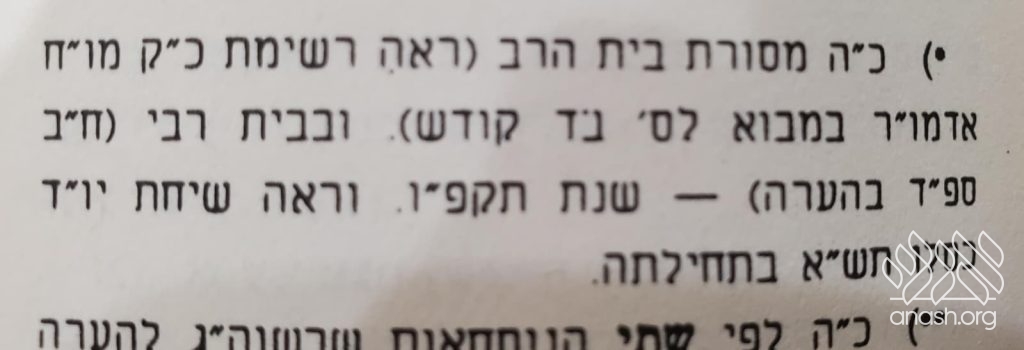
“However, in Beis Rebbi it is written that the arrest and the liberation took place in 5586. Yet, there is a tradition from Beis HaRav, that all these events happened in 5587. (And for this reason, the celebration of Yud Kislev was not firmly established, because in the year after – in which the celebration would have been held for the first time – the Mitteler Rebbe passed away on the 9th of Kislev.)”
Beis Rebbi is the primary, comprehensive biography of the first Chabad Rabbeim, written by Reb Chaim Meir Hillman after 13 years of careful research and verification. While some note occasional inaccuracies – mainly in the sections about the Maggid and earlier, where the author relied on second- or third-hand reports – the general consensus is that Beis Rebbi is highly reliable and is quoted widely, especially in the Frierdiker Rebbe’s sichos.
As the Rebbe told Reb Yisroel Jacobson: “About the Baal Shem Tov and his disciples, others have written better, but when it comes to the Alter Rebbe he is remarkably superior.” The Rebbe also said, in the name of the Frierdiker Rebbe, that “his stories are accurate” (Toras Menachem 5732 vol. 68 pg. 329) and further remarked about the sefer: “it is evident from the way he writes how precise and deliberate he is with everything” (Toras Menachem 5742 vol. 2 pg. 1058).
Despite all this, the Rebbe writes in his Kislev diary of 5693 (printed in Reshimos booklet 69, p. 11):
“There is doubt as to whether the liberation was in 5586 or 5587.”
And in Sefer HaSichos of the Frierdiker Rebbe, 5701 (p. 50):
“Regarding the Yom Tov of Yud Kislev, there are differing views regarding the year in which it occurred. In Beis Rebbi it states that it was in 5586. Others hold that the Yom Tov only began to be observed after the Rebbe’s passing. And there is another view that the beginning of the accusations was in 5586, and the matter dragged into 5587, and the Yom Tov began in 5588.”
In most places, the Rebbe seems to take the position that the geulah happened in 5587 (for example, Vayeitzei 5752, where the Rebbe also notes the kevius of the year matching 5587, and explains why the first year the geulah wasn’t celebrated – due to the Mitteler Rebbe’s histalkus). Most notably, in the Hayom Yom of Yud Kislev, the Rebbe writes clearly: The Mitteler Rebbe was released to freedom – 5587 – from his imprisonment in the city of Vitebsk.”
Still, the Rebbe generally references both Bad Kodesh and Beis Rebbi when discussing the geulah.
In Kislev 5742, Rabbi Shalom Ber Levine, chief librarian of the Library of Agudas Chassidei Chabad, asked the Rebbe about several contradictions regarding the date of Yud Kislev. The Rebbe replied:
“Check it (in the sefer Itim LeBina?) when Yud Kislev fell in 5587 (and there is a bit of a doubt perhaps the geulah in) 5586.”
Over the course of several years, Rabbi Berel Levine and others invested tremendous effort searching through government archives to locate the Mitteler Rebbe’s case file. Finally, in Nissan 5754, 120 pages were discovered from the archives of General-Governor Chavansky.
From these documents – which Rabbi Levine has since translated and published – it appears there were three stages in the release and exoneration of the Mitteler Rebbe, matching the third opinion quoted earlier in Sefer HaSichos 5701. Based on Rabbi Levine’s research:
1. First stage – Kislev 5586
- At the end of the summer of 5585, Simcha Kisin submitted three slanders against the Rebbe.
- On Chol HaMoed Sukkos 5586, the Mitteler Rebbe was taken for interrogation in Vitebsk, the seat of Governor Nikolay Chavansky.
- Interrogations continued through Mar-Cheshvan.
- On 6 Kislev, the Rebbe submitted a petition to Governor Tovanski requesting release.
- On 10 Kislev 5586, he was released home.
2. Second stage – Kislev 5587
- On 19 Kislev 5586, Governor Khovanski transferred the case to the Mohilev provincial government for proper judicial review.
- The case went to the District Peace Court of Babinovitch.
- Investigations were carried out in Lubavitch and in the towns of Kapust, Orsha, Shklov, and Mohilev.
- After collecting all testimony, the Peace Court sent its ruling to the Superior Court of the Mohilev province.
- On 11 Kislev 5587, the Superior Court acquitted the Rebbe of all charges.
3. Third stage – Kislev 5588
- The provincial prosecutor confirmed the acquittal.
- The ruling was sent to Governor Khovanski, who appealed the decision to the Senate in Petersburg.
- On 21 Kislev 5588, the Senate upheld the acquittal – but this was already several days after the Mitteler Rebbe’s histalkus on 9 Kislev 5588.
Despite all the surviving documents, it is important to note once more that the Rebbe generally spoke of the geulah as having occurred in 5587.
Whatever the case may be, this year Yud Kislev either marks 200 years since the chag ha’geulah of the Mitteler Rebbe, or the beginning of the 200th year (haschalas shnas ha’mosayim) of the geulah – both extremly compelling reasons to celebrate and to strengthen our learning and spreading of Chassidus.
 COMMENTS


It seems quite clear that the Rebbe takes the position that it was in 5587 – as the Rebbe writes clearly in Hayom Yom – however the Rebbe also points out that in Beis Rebbi it says 5586. In the picture attached to this article from Likkutei Sichos vol. 25, you see this as well.
I did not do the calculation, but i was told that the kvius of the year 5586 and 5587 were both the same (like this year), so the fact that the Rebbe notes the kvius in the sicha of 5752 is not necessarily proof.
I always remember hearing that it was never celebrated properly because on the first anniversary was after 9 kislev already.
Unlike 19 kislev we saw how the Alter Rebbe celebrated it.
פדה בשלום תשמ”ו מלוקט ח”ה קונטרס י כסלו תנש”א
In the maamar in says 5587
Footnote says tradition in family if Rabbeim
Footnote in Bad Kodesh says this is the accepted opinion
Now we know from the documents the source of the confusion, that there was a miracle both years.
this sounds very similar to the menorah discussion, where some people will say that “now that archeology shows round means it was round”… the word of our Rabbeim trumps any russian record/archive
the file says 11 kislev 5587, so it doesnt exactly accord with our mesora which is very clear about it being yud kislev.
There is nothing at all conclusive about the menorah. It’s just vague discoveries. These are the original documents of the Mitteler Rebbe’s arrest and release.
In addition, the Rebbe repeatedly left room for both years. Given the final discovery, we now understand why, since they are both true (even if not exactly how we originally thought).
who cares about vague discoveries, even if u found the clearest of evidence, it would make nno diffrence because the Rebbe said the Menorah was straight. Over here, there is room (perhaps) to rely on the documents only because the Rebbe himself leaves room for doubt on multiple occasions and even instructed Berel Levine to look into it.
theyre definitely wrong about the chol hamoed sukkos part, why should we trust the rest of the info?
How do we know that they are definitely wrong about the chol hamoed sukkos part?
בחוהמ”ס נודע אשר הלשינו את אדמו”ר האמצעי. ביום א’ פרשת נח כח תשרי נסע בלוית פקידים מליובאוויטש, בצהרים בא לדאבראמיסל, אמר שם דא”ח מים רבים גו’, יום ב’ נסע משם עד ליאזנא, אמר שם דא”ח רשפי’ רשפי גו’, יום ג’ משם לוויטעפסק
unless the documents mean that on chol hamoed the halshana was accepted, but thats not what the article implies