



י״ב כסלו ה׳תשפ״ו | December 1, 2025
If We Only Spoke the Rebbe’s Language
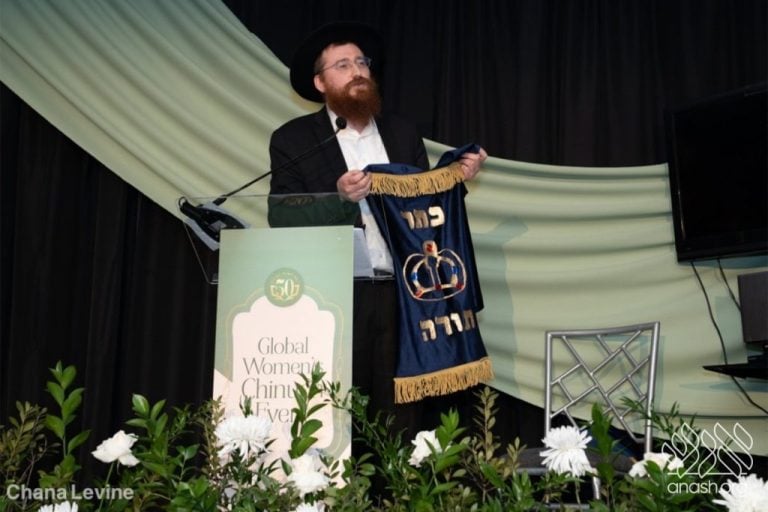
It’s not every day that a respected mashpia brings Purim costumes for his speech at a major chinuch gathering. But at the Global Women’s Chinuch Event in Crown Heights, Rabbi Hertzel Pewzner did exactly that. “The Rebbe is talking a different language – a language educators can learn and begin speaking to children”.

It’s not every day that a respected mashpia brings Purim costumes for his speech at a major chinuch gathering. But at the Global Women’s Chinuch Event in Crown Heights, Rabbi Hertzel Pewzner did exactly that.
Hosted by the Merkos Chinuch Office, the event brought hundreds of mechanchos and women in chinuch, with over 2,000 more joining via livestream, for a powerful and uplifting evening with musical presentations – marking fifty years since Shnas HaChinuch, and since the Rebbe launched the 12 Pesukim.
Rabbi Pewzner, mashpia in the Morristown Yeshiva and author of several books on Chassidus, opened with a simple show-and-tell: his children’s Sefer Torah costumes. It set the tone for his message.
Though he teaches 19-20-year-old bochurim and had spent years immersed in Chassidus, he admitted he had “no clue, no insight into a treasure right before our eyes” – the Rebbe’s sichos addressed to children.
While preparing a small booklet on the 12 Pesukim for a supporter of Sichos in English, he assumed it would be a straightforward project: “forty pages, maybe two sichos.” Instead, he discovered something astonishing. The Rebbe spoke 135 times directly to children, with over 1,200 pages of Torah written specifically for them.
“The Rebbe is talking a different language,” he said – a language educators can learn and begin speaking to children.
He shared a personal moment that drove the point home. His three-year-old came in crying after a five-year-old neighbor took his screwdriver. Instead of demanding it back, Rabbi Pewzner tried speaking the Rebbe’s language:
“Is there a mitzvah you can do with that screwdriver?”
“To give it back,” the boy replied.
“How do you think Hashem would feel if you gave it back?”
“Happy.”
“And how would you feel knowing you made Hashem happy?”
Before he even finished the question, the screwdriver was already out of the boy’s pocket and returned to his relieved three-year-old.
“I realized I was onto something,” he said. “This works in ways I never imagined.”
He shared more examples of how children internalize this approach. His four-year-old ran to wash negel vasser before grabbing a toy because, as the child explained, “I threw the yetzer hara back into the fire.” A message from the Rebbe’s explanation of Shema.
Returning to the Purim costumes, he explained why his children dress up as a Sefer Torah year after year: “They learn Torah. They love Torah. They are Torah.”
Because they hear the Rebbe’s language daily, “they want to dress up like a Sefer Torah, even when other children are choosing astronauts and superheroes.”
He closed with a message to every mechaneches and parent present:
“We can change the face of chinuch. We can give children the language the Rebbe spoke to them and they will start applying it in places we never imagined.”
With this approach, he said, children will be the ones to “recognize Hashem in the final moments of galus,” because “kids know how to do that – if we speak their language.”
VIDEO:

 COMMENTS


Yes — I recall hearing those sichos live and marveling at what the Rebbe was doing! I used the Rebbe’s “language” whenever possible while raising my children, and continue to now with grandchildren B”H. Another fascinating group of sichos is what the Rebbe spoke to the Tiferes Zekeinim Levi Yitzchok: the Rebbe addresses the people with a unique kind of respect reserved for one’s peers… because in age, the people are Rebbe’s peers…
This method teaches the child to be more Frum. What about teaching him to tune into the other child’s feelings? Perhaps it’s important to also say to the 5-year-old, “ look at his face. does he look happy or sad? Do you think there’s something you can do to make him look happier?“. This will teach the child not only to score more “Frum points” but to actually tune into someone else’s feelings, which is the real reason why he stole the screwdriver in the first place. He simply didn’t pay attention to the way it would make the other child feel. Hashem doesn’t only want us to refrain from stealing because it’s against his will; he actually wants us to not desire to steal because we understand it’s painful for the other person. לא תגזל is a mitzvah meant to be performed with understanding and feeling. Not just with Kabalas Ol.
It’s a pity the rebbe didn’t see your comment before he said the sicha
I hope that was just sarcasm
There’s a posuk for that too. It’s called Ve’ahavta L’reiacha Kamocha.
I see the value in using alternate methods, like Yismach, in cases where a child is deliberately unwilling to admit that they would be unhappy if something they had was taken from them.
With of course the Rebbes approach,
I think it’s very important for educators to also include the approach of the Rebbe to educate from a place of love to the child.
Encouraging that a kid share his toy, when maybe the child doesn’t yet feel a sense of self, is actually against Torah and what the Rebbe stands for. A Mechanech (like it says in Klolai Hachinuch Vehadracha, and in the Rebbes Torah) needs to understand the mehus of the child and educate accordingly.
If a child feels a sense of self, and feels like he has, then he can be encouraged to give (like the Rebbe explains according to the 12 Pesukim etc)
But this Chinuch needs to be done on a foundation of love, security and first with the child feeling a sense of belonging and that they have something that is theirs. After that they can give.
Many parents and educators are dangerously leaving out this fundamental Yesod (which is 1000% a yesod the Rebbe taught is imperative when it comes to Chinuch) and just super encouraging their child to share etc
I think this is important to understand.
Also, in regard to the idea of Yetzer Hora, I think there is an unspoken attitude of the Rebbe that by empowering children they will come to understand how to battle the Yetzer Hora, and make those choices. But to play on a child – this Yetzer Hora Yetzer Tov narrative , I personally don’t think this is how the Rebbe wanted it to look like. You don’t want this idea becoming a source of resentment for a child.
Meaning this is a concept that we teach to children, but at the same time for a parent to play into that, I personally don’t think is healthy and what the Rebbe had in mind.
So we empower children to listen to the Yetzer Tov, but empower not to guilt trip.
The concept is 1000% the correct concept but how a parent or mechanech should implement these concepts in my opinion must be done in an empowering way rather than spiritual black mail.
This correct approach of the Rebbe in regard to the attitude of how a child needs to be educated needs to be implemented properly not Chas vesholom in an unhealthy way, otherwise this becomes a source of tremendous hurt in the child, which the child will ultimately come to resent and reject (understandably) growing older
Also, for a child, psychologically , if you keep emphasizing that they have negativity in them, they’ll follow the negative.
So it’s really important that of course we teach Nefesh Hoelokis, nefesh Habehamis, Yetzer Tov Yetzer hora, and the child will use these concepts to win a battle in a situation when they’re challenged, but I think it’s super important that when you’re in education you educate your child to do the right thing.
When they have a battle, know that you need to fight the Yetzer Hora. But that’s a war statergy, not the Yesoid of every day living for a child’s education. Meaning as parents we should be inculcating the right values to our children, so that they will be educated to behave as moral, upright and chassidish people. And along with that the concept that when they are challenged don’t give in to Yetzer Hora.
But to not give them a strong Yesoid of education of what the right thing is, and only bring up this concept of ‘listen to your Yetzer Tov, I don’t think is right.
So the example this mashpia gave in his article about his child and Negel vasser, has to be explained in context.
Was this child taught about not touching things before Negel vasser. Does he have a positive Yesoid of wanting to do the right thing and feeling in general good about life and Yiddishkeit.
If yes, and the child still had a strong urge to do something before Negel vasser then I would maybe bring in that concept.
But in my opinion, there should be an education to do the right thing. The more we make our children feel loved and good, the more they will be super happy to do the right thing.
I think knowing and being taught these concepts, Yetzer hora Yetzer Tov, the child on their own will be encouraged to make the correct choices,
But I think parents got to be careful that in a situation where you kid is challenged, to play into their personal Yetzer hora Yetzer Tov is emotional and spiritual manipulation.
You can either discipline, and tell them what the right thing to do it, but I would be very careful saying things like ‘do you want to make Hashem happy?’
If a child is not emotionally up to that, you’ve used Hashem to manipulate them. It couldnt get worse than that.
So absolutely of course to teach them this Derech, empower them with these concepts but be careful how you bring it in when disciplining and educating a child in a given situation
It’s very bad when mashpiim don’t explain this part, and encourage less gifted parents to start implementing the Rebbes Torah in a toxic manner to their kids
Unless someone can explain that I’m wrong and that the Rebbe had something else in mind, I actually this I’m correct in saying the above
Feedback would be appriciated, perhaps the mashpia can clarify
visit berel.me/rallies to see a list of every sicha from the Rebbe to children!