Genius, Tragedy, and Mystery: The Tshashniker Iluy Revisited
In one of the first installments of From the Margins of Chabad History, we patched together the fascinating and tragic tale of the mysterious Tshashniker iluy. Now, ahead of his 127th yartzeit, we return to his story with new information that answers some questions and raises others.
In one of the first installments of From the Margins of Chabad History, we patched together the fascinating and tragic tale of the mysterious Tshashniker iluy. Now, ahead of his 127th yartzeit, we return to his story with new information that answers some questions and raises others.
To provide readers with the full background, we will first reproduce the original article with minor edits, and with the later addendum incorporated in its place in the story. The new information appears in Part 6.
*
Part 1: Father and Son
R. Leizer (or Lozer) der Krumer is something of a mythical figure in Chabad history. Legend relates that he was a yungerman living in Eretz Yisrael when a chasid of the Alter Rebbe arrived and began teaching Chabad Chasidus. R. Leizer was so captivated by this new Torah that he dropped everything and boarded the next ship to Liozna—without even informing his wife and family. Somewhere along the way, he fell and broke his foot, earning him the lifelong nickname “der krumer,” the limper.
When the Alter Rebbe learned what his new chasid had done, he instructed him to either return home to his wife or send her a get. Unable to leave the Alter Rebbe, R. Leizer sent the get.
R. Shlomo Chaim Kesselman would often relate the legend of R. Leizer der Krumer in great detail, deriving multiple lessons from it.
Beyond this shocking tale, little is known about this chasidishe radical. Some sources maintain that he later married the daughter of R. Binyomin Kletzker, while others name his new father-in-law as R. Chatzkel Droyer. Snippets of later stories suggest that he lived in Nevel at some point.
The noted Chabad historian R. Yehoshua Mondshine proposed that R. Leizer der Krumer should be identified as “R. Elazar Hachiger of Tshashnik,” listed in Beis Rebbe as a great chasid of the Alter Rebbe and later of Harav Aharon of Strashele. This identification is based on the nickname—hachiger being the Hebrew equivalent of krumer. However, others have challenged this theory, noting that Beis Rebbe provides none of the biographical details associated with the well-known story of R. Leizer der Krumer.
Thus, the enigmatic figure of R. Leizer der Krumer remains shrouded in mystery.
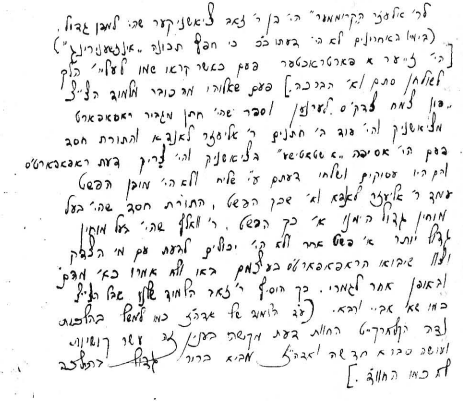
The story as recorded by R. Avraham Weingarten.
This article reveals, for the first time, the equally mysterious story of R. Leizer’s son. His tragic life story eerily reflects the character of his extremist father—though it led him in an entirely different direction.
The first information about the existence of R. Leizer’s son is found in R. Avraham Weingarten’s unpublished notebook, which contains stories he heard from his mashpia, R. Shmuel Levitin, and other chasidim in 770 during the early years of Lubavitch in America. At a farbrengen in 770 for 19 Kislev, 5709, R. Shmuel Levitin related the following story, published here for the first time:
R. Elazar der Krumer had a son named R. Zev Tshashniker, who was a great lamdan. In his later years, his mind became unsettled, as he was drawn to engineering.
He was always deeply engrossed in thought. Once, when he was called up for an aliyah, he absentmindedly walked over to a random table instead of the bimah and recited the brachah there.
He was once asked what he thought of the Tzemach Tzedek’s style of learning. He responded with a story:
“I was a son-in-law in the wealthy Rapaport family in Tshashnik. At the time, there were two other prominent sons-in-law in town—R. Eliezer Landa and the Toras Chesed. Once, an important town meeting took place in Tshashnik. The Rapaports’ input was needed, but they were unavailable. A messenger was sent to bring their opinion, but the message he brought back was unclear.
“R. Eliezer Landa stood up and gave his interpretation of the message. The Toras Chesed, who was an even greater genius, gave a different explanation. And R. Volf, who was an even greater genius than both of them, offered yet another approach. Since they couldn’t determine who was correct, they decided to summon the Rapaports themselves.
“When the Rapoports arrived and explained their position, it turned out that their opinion did not accord with any of the previously offered explanations. Their approach was completely different.
“So too,” R. Ze’ev concluded, “is our form of learning. But the Tzemach Tzedek—his learning is like that of Abayei and Rava.”
“This is similar to the derech halimud style of the Alter Rebbe. Take, for example, Hilchos Nidah. The Alter Rebbe provides clarity. The Chavas Daas raises ten difficulties on a particular matter and develops an entirely new svara. But the Alter Rebbe gives a profound halachic analysis, differing from the approach of the Chavas Daas.”
First, some background information about this story. “R. Eliezer Landa” must refer to R. Yekusiel Zalman Landa. Born in Vilna in 5583 (1823), as a child, he was taken as a son-in-law by R. Berel Rapoport, a prominent gvir from Tshashnik (now Chashniki, Belarus), who had close ties to Chernobyl and Chabad. R. Yekusiel Zalman went on to serve as a chasidishe rov in Vitebsk and Petersburg, and passed away in 5655 (1895).
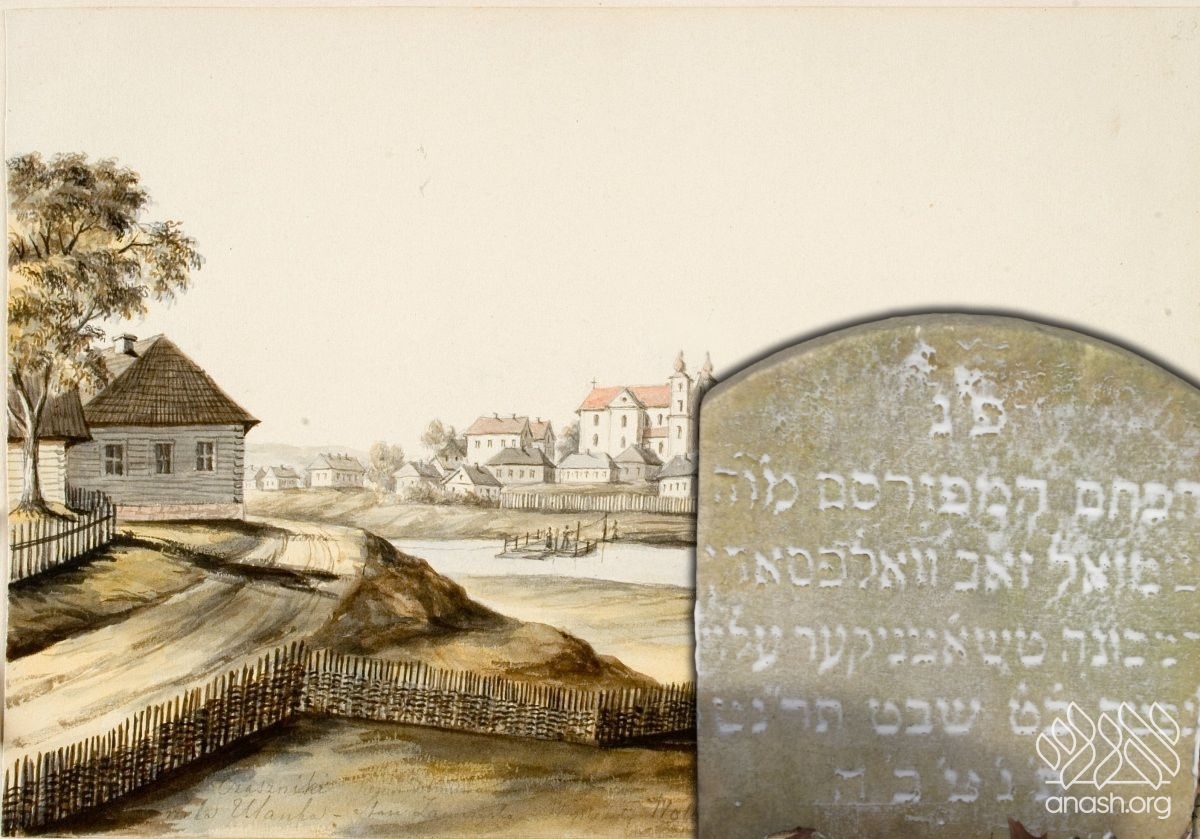
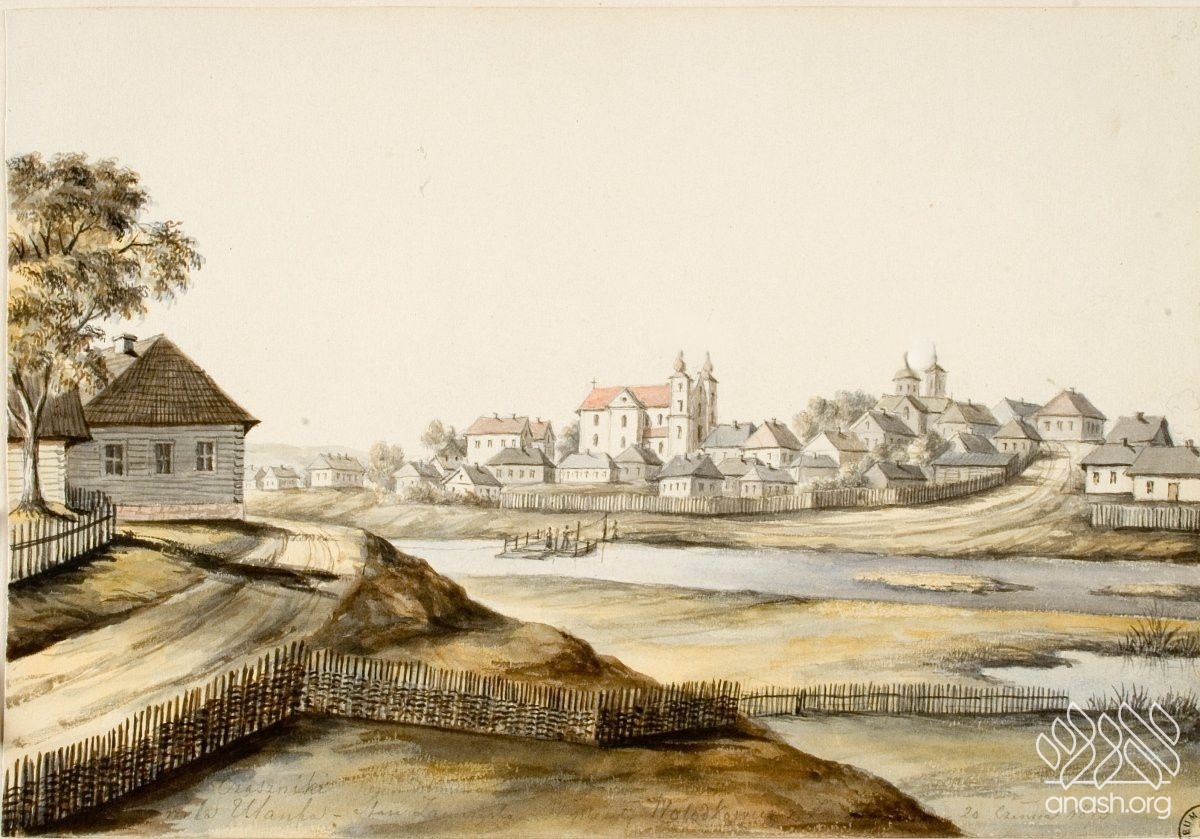
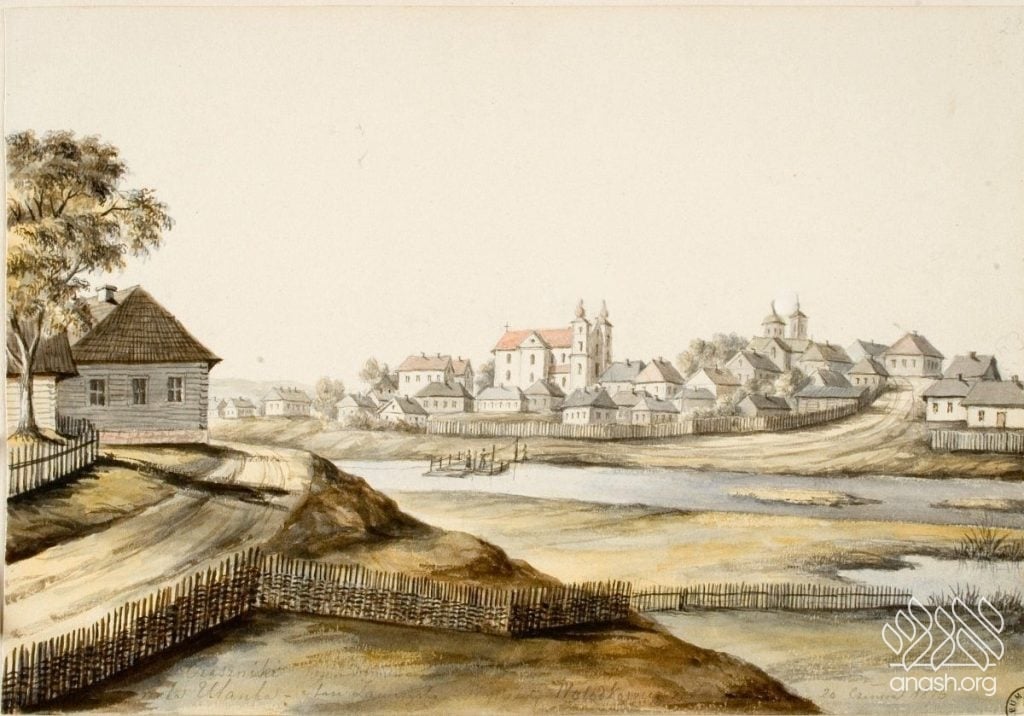
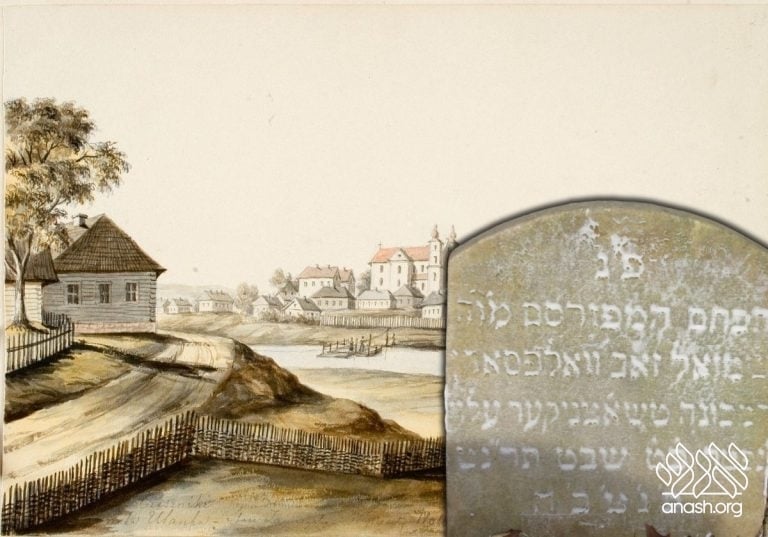
Tshashnik, 5636 (1876). Painting by Polish-Lithuanian artist Napoleon Orda.
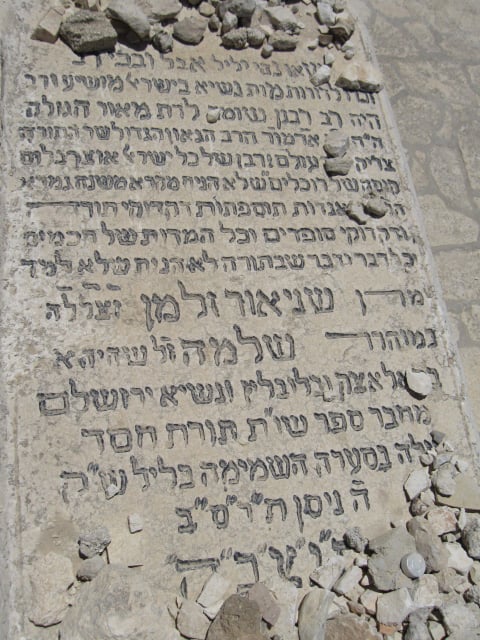
The Toras Chesed is, of course, R. Shneur Zalman Fradkin. Born in Liadi in 5590 (1830), he was known as the “Liadier iluy” and became the son-in-law of another prominent Tshashnik gvir, by the name Glinternik. He later served as a rov in Polotzk, Lublin, and Yerushalayim, where he passed away in 5662 (1902).
R. Shmuel Levitin’s story places these three young chasidishe geniuses—R. Yekusiel Zalman, the Toras Chesed, and R. Zev Volf—together in Tshashnik, likely during the latter half of the 5600s (1840s). We learn from the story that R. Leizer der Krumer’s son, R. Zev Volf, was also a son-in-law of the Rapoport family—either of R. Berel or another close relative. He is described as being considered a greater genius than the Toras Chesed—extremely high praise indeed.
*
Part 2: “He Will Anyway Lose…”
An intriguing detail mentioned at the beginning of the story about R. Zev Volf stands out: “In his later years, his mind was unsettled, as he was drawn to engineering.” This clue leads us to another account—a story related by R. Chaim Shaul Brook and recorded by R. Chananya Yosef Aizenbach (Keser Malchus, p. 85):
The Tzemach Tzedek once called his attendant, R. Chaim Ber, and said to him, “Come, let’s see what the chachmei Yisrael are doing at this hour.” It was 3 a.m., well after midnight.
First, they went to the home of [the Tzemach Tzedek’s son,] Harav Yisrael Noach. Peering through the window, they saw him standing by his table, studying nigleh by the light of a small candle.
The matzeivah of the Toras Chesed on Har Hazeisim.
Next, they visited the home of R. Shneur Zalman Liadier, who would later become renowned as the author of Toras Chesed of Lublin. There, they witnessed the same sight.
But when they approached the window of the Tshashniker iluy, they saw a strange scene: instead of sitting and learning, as he always did, he was standing by the wall, drawing various circles and lines. It turned out he had begun studying geometry.
The Tzemach Tzedek remarked: “He will anyway lose…”
The iluy himself later recounted that Napoleon had left half a million rubles in a certain bank in Moscow, to be awarded to whoever could solve an unresolved problem in geometry. When he heard about this, he began studying the subject and indeed succeeded in solving the problem.
When he traveled to Moscow to claim the reward, he met an acquaintance who was also knowledgeable in this field. He confided in him the solution to the problem. The acquaintance hurried ahead and claimed the prize money first.
Told by my brother, R. Shalom Leib, who heard it from R. Chaim Shaul Brook.
The unnamed “Tshashniker iluy” in this story is clearly our R. Zev Volf of Tshashnik. Here too, we read about his interest in engineering-geometry (geometry provides the fundamental principles and tools that engineers use to design and construct structures and systems), and here too, he is juxtaposed with his colleague, the Toras Chesed.
This second story has a detail that is mistaken—all three Napoleons were, in fact, enemies of Russia, so it makes no sense for any of them to be administering a prize in Russia. Moscow also seems to be an anachronistic location for a national competition, as the capital of Russia during this period was S. Petersburg. Nevertheless, the core background of the story aligns with what we already know about R. Zev Volf.
*
Part 3: A Firsthand Account
R. Zev Volf’s travels to the Russian capital in pursuit of engineering are corroborated by another source. Until now, we have only encountered R. Volf in accounts that are third-hand at best, but our next source comes from someone who knew him personally.
First, some background. R. Eliyahu Klatzkin was born in 5612 (1852) in Ushpol (now Uzpaliai, Lithuania), where his father, R. Naftali, served as the rov. R. Naftali was a chasid of the Tzemach Tzedek and brought young Eliyahu with him to Lubavitch. He had six sons, most of whom became rabbonim and chasidim—with the notable exception of R. Eliyahu, who drifted away from Chabad.
Harav Naftali Klatzkin (5583–5654), the rov of Ushpol and Shimberg
R. Eliyahu was also an iluy, and around the time of his bar mitzvah, he was married into a wealthy family in Shklov. He went on to serve as the rov of Lublin and, in his final years, as the rov of the Eidah Chareidis in Yerushalayim. His personal archive is housed in the National Library of Israel, and several articles have been published based on his preserved correspondence.
The following account from R. Eliyahu was posted on an online forum. It describes the period of 5633–5635 (1873–1875), when R. Eliyahu lived in Petersburg with his then-wife and her family. During his time in the Russian capital, the young gaon dabbled in various sciences, acquiring broad general knowledge in addition to his Torah scholarship. While R. Eliyahu always maintained Torah study as his primary pursuit, he describes an acquaintance he met there who did not:
While I was in Petersburg, I met the engineer R. Shmuel Volf P. Wolfson, a man distinguished by his profound intellect and wisdom. He had once been known as the iluy of Tshashnik, and we had been together back when I was in Tshashnik. He had excelled in talent and depth of analysis, surpassing even the great gaon R. Zalman of Liadi and Tshashnik—who, in his later years, served as the rov of Lublin and authored Toras Chesed. In analytical ability, R. Shmuel Volf surpassed even him.
However, when I met him in Petersburg and attempted to engage him in discussions of chidushei Torah, he was no longer capable of such study, because he had completely immersed his mind and intellectual abilities in mathematics. He himself lamented that he no longer had the same capacity for deep Torah learning and had abandoned its study, but he said that he could not restrain his mind from pursuing engineering and mechanics.
Nevertheless, the Tzemach Tzedek tried to send him a message that if he would return to focusing on Torah study, he would instruct his followers to give him a rabbinic position in a prominent and prestigious city. The Tzemach Tzedek was deeply pained that such a mighty force had been wasted.
In the end, he did not achieve material success even from his wisdom, for he was a man detached from society, distanced from all worldly matters, and absorbed solely in intellectual pursuits.
Harav Eliyahu Klatzkin
Now we have a full name for R. Zev Volf: Shmuel Volf Wolfson. His travels to Petersburg during the lifetime of the Tzemach Tzedek are corroborated, and we see that a few years after the Tzemach Tzedek’s histalkus, he was still spending time in the Russian capital, involved in engineering. Once again, we hear that R. Volf was considered an even greater genius than the Toras Chesed—this time from another genius who knew them both personally.
R. Klatzkin’s account indicates that R. Zev Volf remained a frum Yid as before. What changed was not his religious observance, but his learning. His earlier complete devotion to Torah study had been replaced by an equally all-encompassing immersion in advanced mathematics and engineering. He lamented his inability to return to serious Torah learning, yet he was completely consumed by his attraction to mathematics.
Like his father before him, R. Volf appears to have been a was a one-track mind, capable of only one commitment in life. In the son’s case, sadly, engineering took over Torah study.
*
Part 4: Scientific Achievements
Another source provides further information about R. Volf’s exploits in Petersburg. Reuven Moiseiyevich Kulisher (1828–1896) was a Jewish medical scientist and a prominent Russian maskil. He wrote a book in Russian about his efforts to promote secular education among Russian Jews, titled Hopes and Expectations of the Progressive Element of Russian Jews Over 50 Years (1838–1888). This book includes a passage (pp. 37–38) describing his acquaintance with an eccentric mathematical and engineering genius—our very own Mr. Wolfson.
Following is a translation from the Russian, generously generated by ChatGPT:
Here, it is appropriate to add a few words about those autodidacts who, through their own efforts, without instructors and even without relevant educational guides, reached an understanding of advanced mathematics, in which they could have become driving forces of science under somewhat favorable circumstances. However, this enviable fate befell only those who managed to attach themselves to some chair of mathematical sciences at a foreign university.
Those who remained in Russia either completely disappeared from the field of science, like the one who, in the 1870s in Petersburg, worked on the creation of the Shandorin lamps (Mr. Wolfson), or they withered away in extreme poverty before their discoveries could be fully appreciated. . . .
Pafnuty Chebyshev (1821–1894), considered the founding father of Russian mathematics
The aforementioned Mr. Wolfson drew attention to his research in the first half of the 1850s on integrating elliptic functions. According to a review heard by the author of this essay from the academician Chebyshev, to whose scrutiny these works were subjected, Wolfson indeed possessed tremendous mathematical abilities.
Therefore, it is highly likely that he would have achieved some success if he had accepted the proposal of the aforementioned scholar to become a private correspondent of the mathematics department of the Academy of Sciences, which, along with a small material reward, would have allowed him to benefit from the guidance and advice of such an outstanding mathematician as Chebyshev. But this good intention of the honorable scholar, unfortunately, did not come to fruition.
Wolfson found significant support from a student of the Academy of Arts, L. Bachman, who, though living on a meager income, still devoted much time and effort to organizing Wolfson’s scattered mathematical notes.
Through this same student of the Academy of Arts, Wolfson got acquainted with the author of this essay, to whom he once appeared late at night, half-frozen, as he had no right to live in the capital and was expelled by the police to the city limits, from where, as night fell, he would make his way to my apartment.
At my request, writer N. V. Kukolnik appealed to the then head of the office of the Petersburg governor-general, later director of the police department, Mr. Zhdanov, and immediately a permit for temporary residence in Petersburg was issued to Wolfson, which was later renewed as necessary.
In 1856, the honorary members of the Jewish community, due to the favorable disposition of Mr. Zhdanov towards Wolfson, expressed their willingness to provide him with full financial support. However, Wolfson used this support for a very short time and then had to return to his impoverished family.
This account gives a general description of R. Volf’s activities in Petersburg in the 1850s, and also mentions his presence in the city in the 1870s, working on the “Shandorin lamps,” a system of kerosene street lamps developed by the Hungarian-American entrepreneur Laszlo Chandor.
Patent records from the period reveal that R. Volf was a highly accomplished engineer. Documents from 1858–1859 record that Mr. Samuel Wolfson of Tshashnik was working on a patent for a wagon with a suspension system. He was granted an extension of the deadline to complete his work, but it appears he failed to do so, as no record of the patent can be found.
In the 1880s, R. Volf’s scientific work was focused on the invention of a new railroad steam engine. While he worked on this project, R. Volf received financial assistance from the “Provisional Committee for the Formation of the Society of Crafts and Agricultural Work Among the Jews in Russia,” a committee run by Russian Jewish maskilim in Petersburg.
Over the course of 1883–1884, “Mechanic Samuel Wolfson” appealed to the committee nine times for financial support, and all of his requests were approved. Here is the report of one such request, translated from Russian by ChatGPT:
Reported: Mechanic Samuel Wolfson in St. Petersburg, expressing his gratitude to the Committee for the assistance provided to him, thanks to which he was able to test his newly invented steam engine on a small scale, asks for the Committee’s assistance in implementing his invention in practice.
Determined: To issue mechanic Wolfson 50 rubles over the next three months.
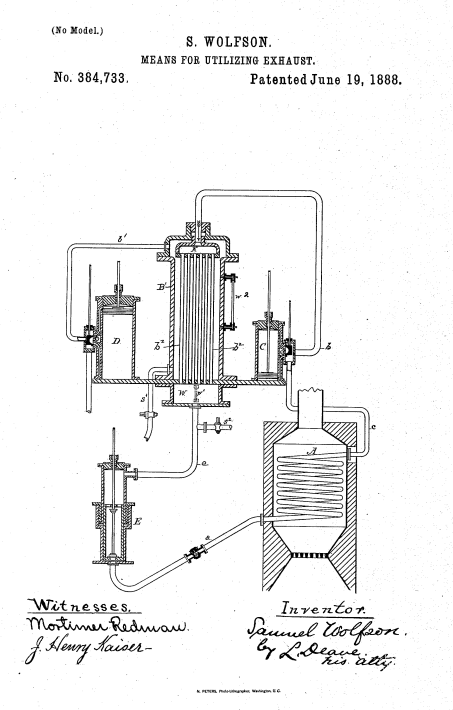
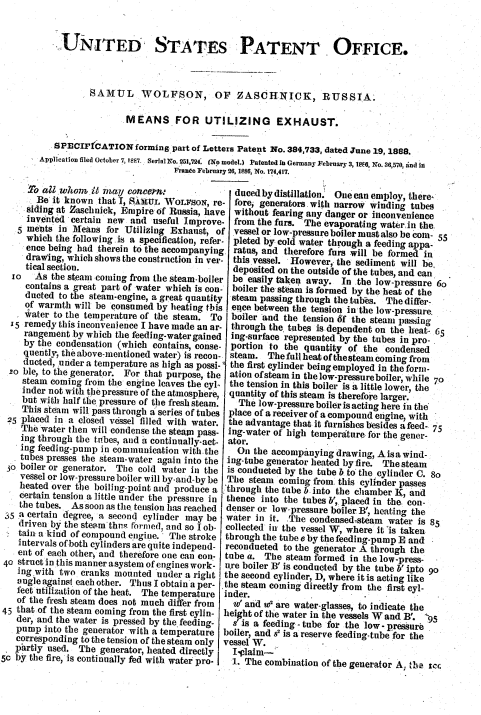
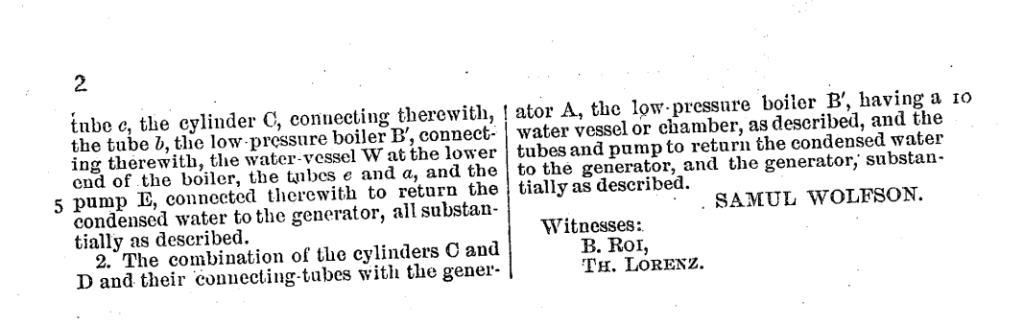
An 1898 filing by “Samul Wolfson of Zaschnick, Russia” for a U.S. patent for “means for utilizing exhaust,” including a drawing and a letter of explanation in English
Over the course of the years 1887–1891, patent records show a flurry of activity on the part of R. Volf, filing eight separate patents for various elements of steam engines, wind turbines, and more. Some of the patents were also filed in the UK, France, and the U.S., and some have been quoted in subsequent scientific research in these fields.
The fact that these filings record R. Volf as living in Tshashnik throughout these decades indicates that he lived a traditional Jewish life in the shtetl with his family, while visiting Petersburg periodically to advance his scientific work.
(Thanks to Peretz [ben R. Dovid Aba] Mochkin and an anonymous reader for their help in piecing together the documentary trail of R. Volf’s engineering inventions.)
*
Part 5: The Sorry End
Our next documentation of R. Volf Tshashniker is his final record—his kever. A matzeivah in the “Congregation Lubowitz Weinzein” plot (an atrocious spelling of Lubavitch VeNiezhin) in Bayside Cemetery, Queens, testifies that “the well-known scholar, R. Shmuel Zev Wolfson, known as Tshashniker Iluy” was buried there in Shevat, 5659 (1899).
R. Volf’s death certificate in the New York City archives states that he was born in 1814 and was 85 years old at the time of his passing. It records his date of death as February 7, 1899, and states that he was buried two days later. This means that the date of passing inscribed on his matzeivah is in fact the date of burial, and his actual yahrtzeit is 27 Shevat, not 29 Shevat.
The matzeivah and death certificate enable us to deduce some information about R. Volf’s sorry circumstances at the time of his death.
The death certificate includes a note that reads “Montefiore Home,” indicating that he was a resident of the Montefiore Home for Chronic Invalids at the time of his death. Located in Manhattan, this Jewish-operated sanatorium provided medical care, food, and shelter to people suffering from chronic, incurable illnesses.
A close examination of his matzeivah reveals the absence of a standard piece of matzeivah information: his father’s name. This indicates that when R. Volf was buried, no one present knew his father’s name. All they knew about Shmuel Zev Wolfson was that he was a “chacham mefursam” (although they didn’t know how to spell it properly in Hebrew) and that he had been “the Tshashniker iluy.”
Thus, the life of this tragic figure came to an end—old, chronically ill, and alone, with no family to give him his proper final respects.
*
Part 6: The Stolen Icebreaker
Our original article about the Tshashniker iluy concluded with unanswered questions: How did R. Volf end up in America? What did he do there?
Now, a new discovery sheds some light on the mystery of the Tshashniker iluy. On 12 Adar 5664 (February 28, 1904), an article appeared in the New York-based Yiddish Di Yiddishe Velt newspaper about the Russo-Japanese War. Just a few weeks earlier, on February 9, Japan had launched a surprise attack on the Russian Pacific Fleet at Port Arthur in the Yellow Sea, beginning the 19-month-long Russo-Japanese War.
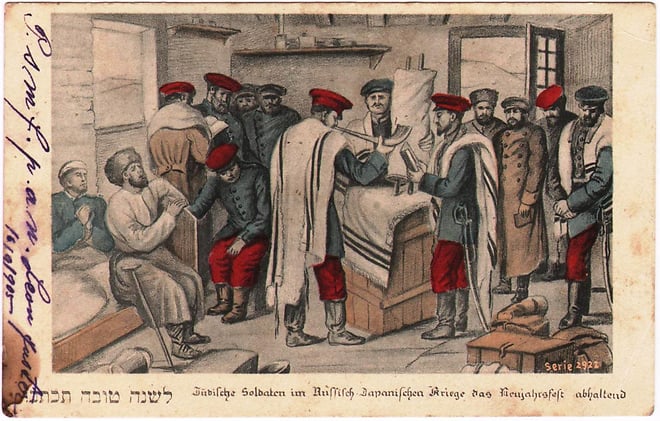
A Russian postcard from 1905 depicting “Jewish Soldiers in the Russo-Japanese War Preparing for the New Year”
The writer, who signs with the pen name “Ben Refael,” states that Jews around the world sympathize with Japan over the tyrannical Russian regime and rejoice in the defeats the Russian army is currently suffering. But at the same time, he continues, Jews are deeply concerned about the tens of thousands of Jewish soldiers compelled to serve in the Russian army, and this worry dampens their joy over the Russian military defeats.
But the Russian losses in the naval battle of Port Arthur can be celebrated wholeheartedly, Ben Refael writes, because there are no Jews serving in the Russian navy. He then continues to relate the story of an additional historical grudge Jews have with the Russian Navy and the commander of the Russian Pacific Fleet, Vice Admiral Stepan Makarov, in particular:
Aside from the fact that Jews are not trusted to serve in the Russian Navy, we, as Jews, have a very serious complaint against the Russian fleet and their new commander, Admiral Makarov, a complaint the world has not yet heard.
The complaint is as follows: decades ago, the authorities in Petersburg sought ways to reach Kronstadt in the middle of winter when the port there freezes over. A Jewish man, Skliansky, a frum person and a passionate Lubavitcher chasid, invented a machine to break through the ice of the frozen Russian ports. However, this Jewish inventor was careless enough to trust Makarov, then a low-ranking officer, with the secret of his invention.
Vice Admiral Stepan Osipovich Makarov (1849-1904)
Makarov presented Skliansky’s invention as his own, quickly rising in rank. Eventually, he worked his way up to become an admiral and the commander of Kronstadt, the powerful Russian fortress protecting Petersburg from foreign attack.
For naught, the impoverished Skliansky wrote to the Russian Minister of the Navy, telling him that he was the true inventor of the icebreaker, as his invention was named. For naught, he asked for his rights over the icebreaker to be recognized, offering to show them how to use it properly. But no one wanted to listen to the Jewish inventor, as Makarov’s influence within the Russian Navy had grown strong and powerful, and Skliansky’s letters were discarded.
Frustrated, Skliansky fled Russia for America. He settled in New York, where he lived in great poverty. When the Chevra Sfard Anshei Lubavitch learned about his hardship and poverty, they supported him with a steady pension. When this genius inventor grew old and sick, he was admitted to the Montefiore Home, where he passed away a few years ago. Skliansky was the only Jew whose work had been utilized by the Russian fleet, and they treated him so poorly.
The Yermak, the world’s first polar icebreaker, launched in 1898
While Ben Refael refers to the protagonist as “Sklinasky,” in light of what we now know about R. Volf Tshashniker, it is clear that this story is about him. There could hardly have been more than one Lubavitcher inventor from Russia who spent his final years in New York and died at the Montefiore Home.
This account also confirms our earlier assumption that R. Volf was always frum and considered a fervent chasid, even though his intellectual energies were devoted to the secular fields of mathematics and engineering. The story about him having the credit for an invention stolen from him matches the general outline of the story we cited above about the Tzemach Tzedek’s prophetic prediction, “he will anyway lose…”
Ben Refael doesn’t tell us the source for his account, and it isn’t clear if he knew R. Volf personally or only by hearsay. The fact that he recorded his name differently lends support to the latter option, although it is also possible that R. Volf used the legal name “Skliansky” in America. At any rate, the degree to which his information checks out with our established knowledge of R. Volf indicates that the story he tells is likely accurate, at least in general terms.
The historic Russian port city and naval fortress of Kronstadt is located in the Gulf of Finland, west of S. Petersburg. Kronstadt was surrounded by a complex network of fortifications, including the Alexander I fortress, pictured above.
We will now examine the historical background of Ben Refael’s account. Vice Admiral Stepan Osipovich Makarov was highly decorated for his service in the Russo-Turkish War of 1877–78. But he was best known as a naval inventor and researcher, publishing over fifty papers on oceanography and naval tactics.
In the mid-1890s, Makarov focused on designing an icebreaker ship capable of breaking through the polar ice of the Arctic Ocean. In 1898, the Yermak ship built under his supervision was completed, becoming the world’s first polar icebreaker. He also worked on the icebreaking steamship SS Baikal, built between 1896 and 1899. Ben Refael seems to have dated this work a little too early when he wrote it began “decades ago” when Makarov was a junior officer.
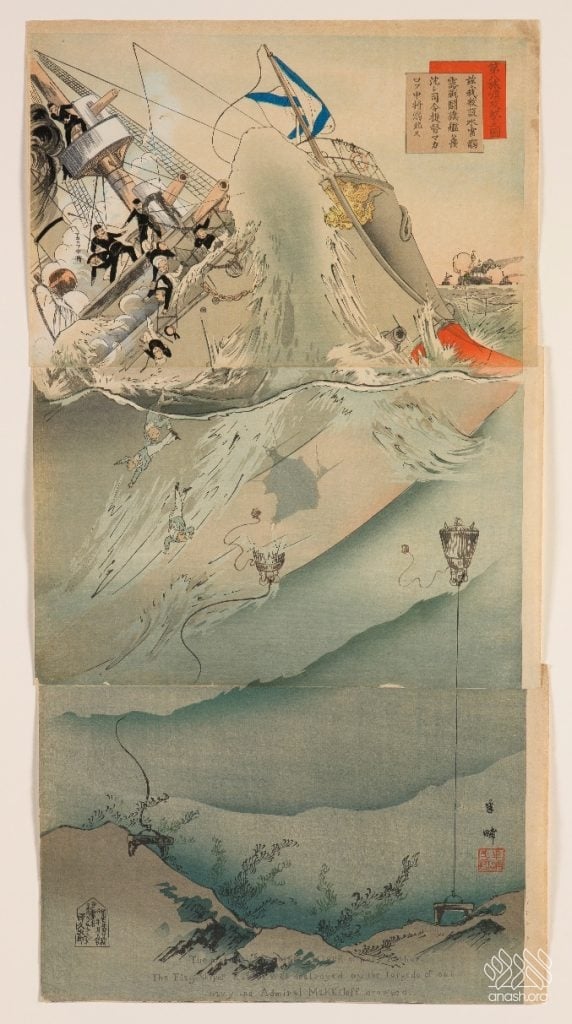
A Japanese depiction of the sinking of Petropavlovsk. The caption reads: “The Eighth Attack on Port Arthur: The Flagship of Russia Struck our Buoyant Mine and Sank Instantly, and Vice Admiral Makarov Drowned.”
In 1900, Makarov was appointed military governor of Kronstadt. Considered the Russian navy’s most competent admiral, he was sent to command the Russian Navy’s battle at Port Arthur after the Japanese surprise attack on February 9, 1904. On April 13—just weeks after Ben Refael’s article was published—Makarov met his death on the Petropavlovsk battleship after hitting a Japanese mine.
After Makarov’s death, several Jewish newspapers around the world picked up Ben Refael’s article and reported happily that the thieving Makarov had met his deserved end.
The Di Yiddishe Velt article fills in some important gaps in R. Volf’s story and sheds light on his final years in New York. But it raises as many questions as it answers: Where is the name Skliansky from? Why exactly did the disappointment of the theft of his invention cause R. Volf to move to America, leaving behind his family in Tshashnik?
It seems that this enigmatic iluy is destined to be shrouded in mystery, and the more we know, the less we understand.
(Thanks to Mendel Nemanov for his assistance in the preparation of this article.)
To view all installments of From the Margins of Chabad History, click here.
For additional exclusive content, follow the column on X: x.com/ChabadMargins
Bibliography:
R. Leizer der Krumer: Ramach Oysiyos, 131; Reshimas Sipurim MiOtvotzk, 34; Reshimos Devarim, p. 237; Yisrael Noach Hagadol, p. 278; Hamashpia Reb Shlomo Chaim, pp. 375-377, p. 729; Reb Mendel, p. 302; Teshurah Langsam 5776, p. 38; Teshurah Marinovsky 5777, p. 209; Kerem Chabad 4:1, p. 13; Beis Rebbe (5774 edition) p. 223). R. Yekusiel Zalman Landa: Vitebsk, pp. 185-187). R. Eliyahu Klatzkin: Heichal Habaal Shem Tov, vol. 34, pp. 152-166; Yeshurun, vol. 15, pp. 745-797.
COMMENTS
We appreciate your feedback. If you have any additional information to contribute to this article, it will be added below.
מאמרים מאלפים! מי הכותב? ועדיין הפרוץ מרובה על העומד, הן בנוגע אליו, ועוד יותר בנוגע אביו. אבל כנראה זה מה שיש. ואלפי תודות על הנ”ל. שלום וויינבערג (ולהעיר מה שהובא בספרי סיפורי חב”ד שחמיו (בזוו”ש) אמר, מען דארף זיין א רוצח געבן א טאכטער לאיש כזה, אבער וואס טוט מען ניט אויף עם באקומען פאר אן איידעם
Genius, Tragedy, and Mystery: The Tshashniker Iluy Revisited
In one of the first installments of From the Margins of Chabad History, we patched together the fascinating and tragic tale of the mysterious Tshashniker iluy. Now, ahead of his 127th yartzeit, we return to his story with new information that answers some questions and raises others.
By Anash
In one of the first installments of From the Margins of Chabad History, we patched together the fascinating and tragic tale of the mysterious Tshashniker iluy. Now, ahead of his 127th yartzeit, we return to his story with new information that answers some questions and raises others.
To provide readers with the full background, we will first reproduce the original article with minor edits, and with the later addendum incorporated in its place in the story. The new information appears in Part 6.
*
Part 1: Father and Son
R. Leizer (or Lozer) der Krumer is something of a mythical figure in Chabad history. Legend relates that he was a yungerman living in Eretz Yisrael when a chasid of the Alter Rebbe arrived and began teaching Chabad Chasidus. R. Leizer was so captivated by this new Torah that he dropped everything and boarded the next ship to Liozna—without even informing his wife and family. Somewhere along the way, he fell and broke his foot, earning him the lifelong nickname “der krumer,” the limper.
When the Alter Rebbe learned what his new chasid had done, he instructed him to either return home to his wife or send her a get. Unable to leave the Alter Rebbe, R. Leizer sent the get.
R. Shlomo Chaim Kesselman would often relate the legend of R. Leizer der Krumer in great detail, deriving multiple lessons from it.
Beyond this shocking tale, little is known about this chasidishe radical. Some sources maintain that he later married the daughter of R. Binyomin Kletzker, while others name his new father-in-law as R. Chatzkel Droyer. Snippets of later stories suggest that he lived in Nevel at some point.
The noted Chabad historian R. Yehoshua Mondshine proposed that R. Leizer der Krumer should be identified as “R. Elazar Hachiger of Tshashnik,” listed in Beis Rebbe as a great chasid of the Alter Rebbe and later of Harav Aharon of Strashele. This identification is based on the nickname—hachiger being the Hebrew equivalent of krumer. However, others have challenged this theory, noting that Beis Rebbe provides none of the biographical details associated with the well-known story of R. Leizer der Krumer.
Thus, the enigmatic figure of R. Leizer der Krumer remains shrouded in mystery.
The story as recorded by R. Avraham Weingarten.
This article reveals, for the first time, the equally mysterious story of R. Leizer’s son. His tragic life story eerily reflects the character of his extremist father—though it led him in an entirely different direction.
The first information about the existence of R. Leizer’s son is found in R. Avraham Weingarten’s unpublished notebook, which contains stories he heard from his mashpia, R. Shmuel Levitin, and other chasidim in 770 during the early years of Lubavitch in America. At a farbrengen in 770 for 19 Kislev, 5709, R. Shmuel Levitin related the following story, published here for the first time:
R. Elazar der Krumer had a son named R. Zev Tshashniker, who was a great lamdan. In his later years, his mind became unsettled, as he was drawn to engineering.
He was always deeply engrossed in thought. Once, when he was called up for an aliyah, he absentmindedly walked over to a random table instead of the bimah and recited the brachah there.
He was once asked what he thought of the Tzemach Tzedek’s style of learning. He responded with a story:
“I was a son-in-law in the wealthy Rapaport family in Tshashnik. At the time, there were two other prominent sons-in-law in town—R. Eliezer Landa and the Toras Chesed. Once, an important town meeting took place in Tshashnik. The Rapaports’ input was needed, but they were unavailable. A messenger was sent to bring their opinion, but the message he brought back was unclear.
“R. Eliezer Landa stood up and gave his interpretation of the message. The Toras Chesed, who was an even greater genius, gave a different explanation. And R. Volf, who was an even greater genius than both of them, offered yet another approach. Since they couldn’t determine who was correct, they decided to summon the Rapaports themselves.
“When the Rapoports arrived and explained their position, it turned out that their opinion did not accord with any of the previously offered explanations. Their approach was completely different.
“So too,” R. Ze’ev concluded, “is our form of learning. But the Tzemach Tzedek—his learning is like that of Abayei and Rava.”
“This is similar to the derech halimud style of the Alter Rebbe. Take, for example, Hilchos Nidah. The Alter Rebbe provides clarity. The Chavas Daas raises ten difficulties on a particular matter and develops an entirely new svara. But the Alter Rebbe gives a profound halachic analysis, differing from the approach of the Chavas Daas.”
First, some background information about this story. “R. Eliezer Landa” must refer to R. Yekusiel Zalman Landa. Born in Vilna in 5583 (1823), as a child, he was taken as a son-in-law by R. Berel Rapoport, a prominent gvir from Tshashnik (now Chashniki, Belarus), who had close ties to Chernobyl and Chabad. R. Yekusiel Zalman went on to serve as a chasidishe rov in Vitebsk and Petersburg, and passed away in 5655 (1895).
Tshashnik, 5636 (1876). Painting by Polish-Lithuanian artist Napoleon Orda.
The Toras Chesed is, of course, R. Shneur Zalman Fradkin. Born in Liadi in 5590 (1830), he was known as the “Liadier iluy” and became the son-in-law of another prominent Tshashnik gvir, by the name Glinternik. He later served as a rov in Polotzk, Lublin, and Yerushalayim, where he passed away in 5662 (1902).
R. Shmuel Levitin’s story places these three young chasidishe geniuses—R. Yekusiel Zalman, the Toras Chesed, and R. Zev Volf—together in Tshashnik, likely during the latter half of the 5600s (1840s). We learn from the story that R. Leizer der Krumer’s son, R. Zev Volf, was also a son-in-law of the Rapoport family—either of R. Berel or another close relative. He is described as being considered a greater genius than the Toras Chesed—extremely high praise indeed.
*
Part 2: “He Will Anyway Lose…”
An intriguing detail mentioned at the beginning of the story about R. Zev Volf stands out: “In his later years, his mind was unsettled, as he was drawn to engineering.” This clue leads us to another account—a story related by R. Chaim Shaul Brook and recorded by R. Chananya Yosef Aizenbach (Keser Malchus, p. 85):
The Tzemach Tzedek once called his attendant, R. Chaim Ber, and said to him, “Come, let’s see what the chachmei Yisrael are doing at this hour.” It was 3 a.m., well after midnight.
First, they went to the home of [the Tzemach Tzedek’s son,] Harav Yisrael Noach. Peering through the window, they saw him standing by his table, studying nigleh by the light of a small candle.
The matzeivah of the Toras Chesed on Har Hazeisim.
Next, they visited the home of R. Shneur Zalman Liadier, who would later become renowned as the author of Toras Chesed of Lublin. There, they witnessed the same sight.
But when they approached the window of the Tshashniker iluy, they saw a strange scene: instead of sitting and learning, as he always did, he was standing by the wall, drawing various circles and lines. It turned out he had begun studying geometry.
The Tzemach Tzedek remarked: “He will anyway lose…”
The iluy himself later recounted that Napoleon had left half a million rubles in a certain bank in Moscow, to be awarded to whoever could solve an unresolved problem in geometry. When he heard about this, he began studying the subject and indeed succeeded in solving the problem.
When he traveled to Moscow to claim the reward, he met an acquaintance who was also knowledgeable in this field. He confided in him the solution to the problem. The acquaintance hurried ahead and claimed the prize money first.
Told by my brother, R. Shalom Leib, who heard it from R. Chaim Shaul Brook.
The unnamed “Tshashniker iluy” in this story is clearly our R. Zev Volf of Tshashnik. Here too, we read about his interest in engineering-geometry (geometry provides the fundamental principles and tools that engineers use to design and construct structures and systems), and here too, he is juxtaposed with his colleague, the Toras Chesed.
This second story has a detail that is mistaken—all three Napoleons were, in fact, enemies of Russia, so it makes no sense for any of them to be administering a prize in Russia. Moscow also seems to be an anachronistic location for a national competition, as the capital of Russia during this period was S. Petersburg. Nevertheless, the core background of the story aligns with what we already know about R. Zev Volf.
*
Part 3: A Firsthand Account
R. Zev Volf’s travels to the Russian capital in pursuit of engineering are corroborated by another source. Until now, we have only encountered R. Volf in accounts that are third-hand at best, but our next source comes from someone who knew him personally.
First, some background. R. Eliyahu Klatzkin was born in 5612 (1852) in Ushpol (now Uzpaliai, Lithuania), where his father, R. Naftali, served as the rov. R. Naftali was a chasid of the Tzemach Tzedek and brought young Eliyahu with him to Lubavitch. He had six sons, most of whom became rabbonim and chasidim—with the notable exception of R. Eliyahu, who drifted away from Chabad.
Harav Naftali Klatzkin (5583–5654), the rov of Ushpol and Shimberg
R. Eliyahu was also an iluy, and around the time of his bar mitzvah, he was married into a wealthy family in Shklov. He went on to serve as the rov of Lublin and, in his final years, as the rov of the Eidah Chareidis in Yerushalayim. His personal archive is housed in the National Library of Israel, and several articles have been published based on his preserved correspondence.
The following account from R. Eliyahu was posted on an online forum. It describes the period of 5633–5635 (1873–1875), when R. Eliyahu lived in Petersburg with his then-wife and her family. During his time in the Russian capital, the young gaon dabbled in various sciences, acquiring broad general knowledge in addition to his Torah scholarship. While R. Eliyahu always maintained Torah study as his primary pursuit, he describes an acquaintance he met there who did not:
While I was in Petersburg, I met the engineer R. Shmuel Volf P. Wolfson, a man distinguished by his profound intellect and wisdom. He had once been known as the iluy of Tshashnik, and we had been together back when I was in Tshashnik. He had excelled in talent and depth of analysis, surpassing even the great gaon R. Zalman of Liadi and Tshashnik—who, in his later years, served as the rov of Lublin and authored Toras Chesed. In analytical ability, R. Shmuel Volf surpassed even him.
However, when I met him in Petersburg and attempted to engage him in discussions of chidushei Torah, he was no longer capable of such study, because he had completely immersed his mind and intellectual abilities in mathematics. He himself lamented that he no longer had the same capacity for deep Torah learning and had abandoned its study, but he said that he could not restrain his mind from pursuing engineering and mechanics.
Nevertheless, the Tzemach Tzedek tried to send him a message that if he would return to focusing on Torah study, he would instruct his followers to give him a rabbinic position in a prominent and prestigious city. The Tzemach Tzedek was deeply pained that such a mighty force had been wasted.
In the end, he did not achieve material success even from his wisdom, for he was a man detached from society, distanced from all worldly matters, and absorbed solely in intellectual pursuits.
Harav Eliyahu Klatzkin
Now we have a full name for R. Zev Volf: Shmuel Volf Wolfson. His travels to Petersburg during the lifetime of the Tzemach Tzedek are corroborated, and we see that a few years after the Tzemach Tzedek’s histalkus, he was still spending time in the Russian capital, involved in engineering. Once again, we hear that R. Volf was considered an even greater genius than the Toras Chesed—this time from another genius who knew them both personally.
R. Klatzkin’s account indicates that R. Zev Volf remained a frum Yid as before. What changed was not his religious observance, but his learning. His earlier complete devotion to Torah study had been replaced by an equally all-encompassing immersion in advanced mathematics and engineering. He lamented his inability to return to serious Torah learning, yet he was completely consumed by his attraction to mathematics.
Like his father before him, R. Volf appears to have been a was a one-track mind, capable of only one commitment in life. In the son’s case, sadly, engineering took over Torah study.
*
Part 4: Scientific Achievements
Another source provides further information about R. Volf’s exploits in Petersburg. Reuven Moiseiyevich Kulisher (1828–1896) was a Jewish medical scientist and a prominent Russian maskil. He wrote a book in Russian about his efforts to promote secular education among Russian Jews, titled Hopes and Expectations of the Progressive Element of Russian Jews Over 50 Years (1838–1888). This book includes a passage (pp. 37–38) describing his acquaintance with an eccentric mathematical and engineering genius—our very own Mr. Wolfson.
Following is a translation from the Russian, generously generated by ChatGPT:
Here, it is appropriate to add a few words about those autodidacts who, through their own efforts, without instructors and even without relevant educational guides, reached an understanding of advanced mathematics, in which they could have become driving forces of science under somewhat favorable circumstances. However, this enviable fate befell only those who managed to attach themselves to some chair of mathematical sciences at a foreign university.
Those who remained in Russia either completely disappeared from the field of science, like the one who, in the 1870s in Petersburg, worked on the creation of the Shandorin lamps (Mr. Wolfson), or they withered away in extreme poverty before their discoveries could be fully appreciated. . . .
Pafnuty Chebyshev (1821–1894), considered the founding father of Russian mathematics
The aforementioned Mr. Wolfson drew attention to his research in the first half of the 1850s on integrating elliptic functions. According to a review heard by the author of this essay from the academician Chebyshev, to whose scrutiny these works were subjected, Wolfson indeed possessed tremendous mathematical abilities.
Therefore, it is highly likely that he would have achieved some success if he had accepted the proposal of the aforementioned scholar to become a private correspondent of the mathematics department of the Academy of Sciences, which, along with a small material reward, would have allowed him to benefit from the guidance and advice of such an outstanding mathematician as Chebyshev. But this good intention of the honorable scholar, unfortunately, did not come to fruition.
Wolfson found significant support from a student of the Academy of Arts, L. Bachman, who, though living on a meager income, still devoted much time and effort to organizing Wolfson’s scattered mathematical notes.
Through this same student of the Academy of Arts, Wolfson got acquainted with the author of this essay, to whom he once appeared late at night, half-frozen, as he had no right to live in the capital and was expelled by the police to the city limits, from where, as night fell, he would make his way to my apartment.
At my request, writer N. V. Kukolnik appealed to the then head of the office of the Petersburg governor-general, later director of the police department, Mr. Zhdanov, and immediately a permit for temporary residence in Petersburg was issued to Wolfson, which was later renewed as necessary.
In 1856, the honorary members of the Jewish community, due to the favorable disposition of Mr. Zhdanov towards Wolfson, expressed their willingness to provide him with full financial support. However, Wolfson used this support for a very short time and then had to return to his impoverished family.
This account gives a general description of R. Volf’s activities in Petersburg in the 1850s, and also mentions his presence in the city in the 1870s, working on the “Shandorin lamps,” a system of kerosene street lamps developed by the Hungarian-American entrepreneur Laszlo Chandor.
Patent records from the period reveal that R. Volf was a highly accomplished engineer. Documents from 1858–1859 record that Mr. Samuel Wolfson of Tshashnik was working on a patent for a wagon with a suspension system. He was granted an extension of the deadline to complete his work, but it appears he failed to do so, as no record of the patent can be found.
In the 1880s, R. Volf’s scientific work was focused on the invention of a new railroad steam engine. While he worked on this project, R. Volf received financial assistance from the “Provisional Committee for the Formation of the Society of Crafts and Agricultural Work Among the Jews in Russia,” a committee run by Russian Jewish maskilim in Petersburg.
Over the course of 1883–1884, “Mechanic Samuel Wolfson” appealed to the committee nine times for financial support, and all of his requests were approved. Here is the report of one such request, translated from Russian by ChatGPT:
Reported: Mechanic Samuel Wolfson in St. Petersburg, expressing his gratitude to the Committee for the assistance provided to him, thanks to which he was able to test his newly invented steam engine on a small scale, asks for the Committee’s assistance in implementing his invention in practice.
Determined: To issue mechanic Wolfson 50 rubles over the next three months.
An 1898 filing by “Samul Wolfson of Zaschnick, Russia” for a U.S. patent for “means for utilizing exhaust,” including a drawing and a letter of explanation in English
Over the course of the years 1887–1891, patent records show a flurry of activity on the part of R. Volf, filing eight separate patents for various elements of steam engines, wind turbines, and more. Some of the patents were also filed in the UK, France, and the U.S., and some have been quoted in subsequent scientific research in these fields.
The fact that these filings record R. Volf as living in Tshashnik throughout these decades indicates that he lived a traditional Jewish life in the shtetl with his family, while visiting Petersburg periodically to advance his scientific work.
(Thanks to Peretz [ben R. Dovid Aba] Mochkin and an anonymous reader for their help in piecing together the documentary trail of R. Volf’s engineering inventions.)
*
Part 5: The Sorry End
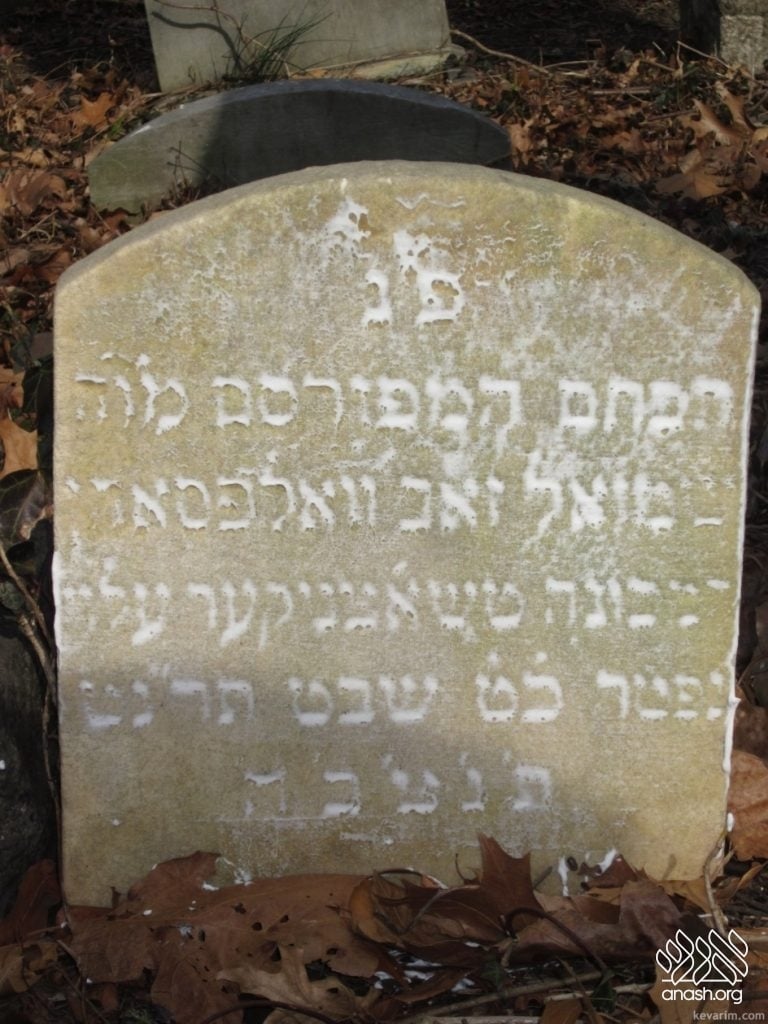
Our next documentation of R. Volf Tshashniker is his final record—his kever. A matzeivah in the “Congregation Lubowitz Weinzein” plot (an atrocious spelling of Lubavitch VeNiezhin) in Bayside Cemetery, Queens, testifies that “the well-known scholar, R. Shmuel Zev Wolfson, known as Tshashniker Iluy” was buried there in Shevat, 5659 (1899).
R. Volf’s death certificate in the New York City archives states that he was born in 1814 and was 85 years old at the time of his passing. It records his date of death as February 7, 1899, and states that he was buried two days later. This means that the date of passing inscribed on his matzeivah is in fact the date of burial, and his actual yahrtzeit is 27 Shevat, not 29 Shevat.
The matzeivah and death certificate enable us to deduce some information about R. Volf’s sorry circumstances at the time of his death.
The death certificate includes a note that reads “Montefiore Home,” indicating that he was a resident of the Montefiore Home for Chronic Invalids at the time of his death. Located in Manhattan, this Jewish-operated sanatorium provided medical care, food, and shelter to people suffering from chronic, incurable illnesses.
A close examination of his matzeivah reveals the absence of a standard piece of matzeivah information: his father’s name. This indicates that when R. Volf was buried, no one present knew his father’s name. All they knew about Shmuel Zev Wolfson was that he was a “chacham mefursam” (although they didn’t know how to spell it properly in Hebrew) and that he had been “the Tshashniker iluy.”
Thus, the life of this tragic figure came to an end—old, chronically ill, and alone, with no family to give him his proper final respects.
*
Part 6: The Stolen Icebreaker
Our original article about the Tshashniker iluy concluded with unanswered questions: How did R. Volf end up in America? What did he do there?
Now, a new discovery sheds some light on the mystery of the Tshashniker iluy. On 12 Adar 5664 (February 28, 1904), an article appeared in the New York-based Yiddish Di Yiddishe Velt newspaper about the Russo-Japanese War. Just a few weeks earlier, on February 9, Japan had launched a surprise attack on the Russian Pacific Fleet at Port Arthur in the Yellow Sea, beginning the 19-month-long Russo-Japanese War.
A Russian postcard from 1905 depicting “Jewish Soldiers in the Russo-Japanese War Preparing for the New Year”
The writer, who signs with the pen name “Ben Refael,” states that Jews around the world sympathize with Japan over the tyrannical Russian regime and rejoice in the defeats the Russian army is currently suffering. But at the same time, he continues, Jews are deeply concerned about the tens of thousands of Jewish soldiers compelled to serve in the Russian army, and this worry dampens their joy over the Russian military defeats.
But the Russian losses in the naval battle of Port Arthur can be celebrated wholeheartedly, Ben Refael writes, because there are no Jews serving in the Russian navy. He then continues to relate the story of an additional historical grudge Jews have with the Russian Navy and the commander of the Russian Pacific Fleet, Vice Admiral Stepan Makarov, in particular:
Aside from the fact that Jews are not trusted to serve in the Russian Navy, we, as Jews, have a very serious complaint against the Russian fleet and their new commander, Admiral Makarov, a complaint the world has not yet heard.
The complaint is as follows: decades ago, the authorities in Petersburg sought ways to reach Kronstadt in the middle of winter when the port there freezes over. A Jewish man, Skliansky, a frum person and a passionate Lubavitcher chasid, invented a machine to break through the ice of the frozen Russian ports. However, this Jewish inventor was careless enough to trust Makarov, then a low-ranking officer, with the secret of his invention.
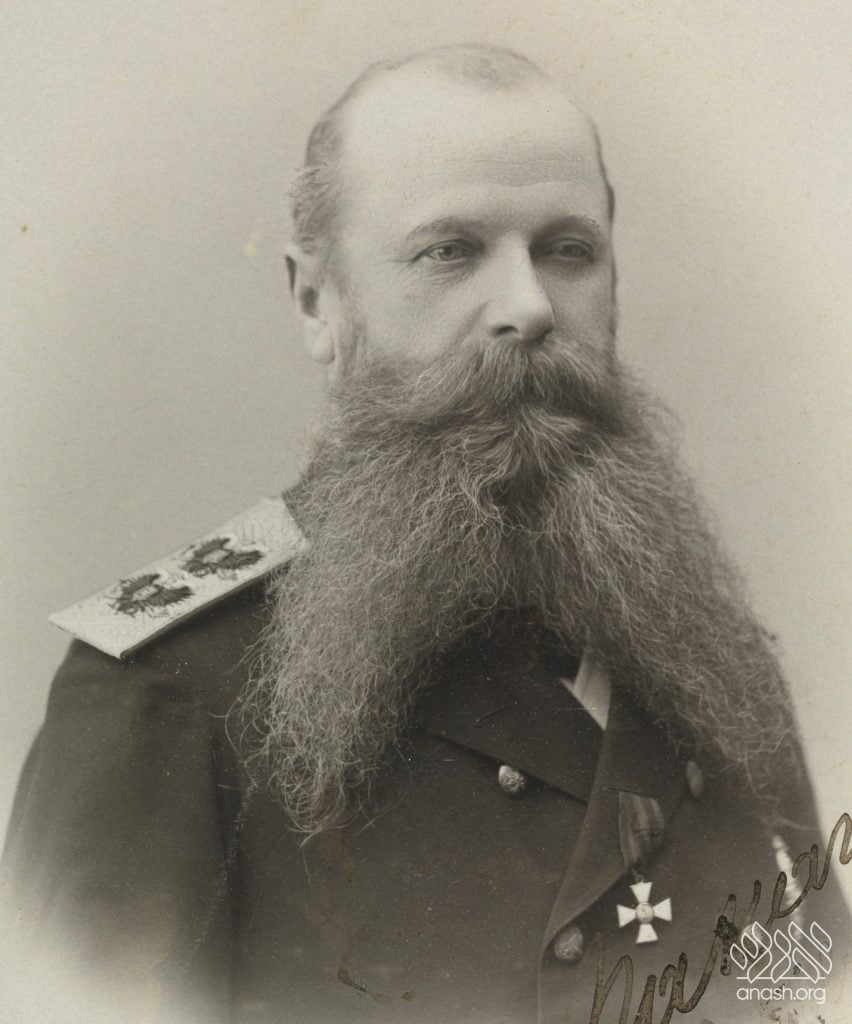
Vice Admiral Stepan Osipovich Makarov (1849-1904)
Makarov presented Skliansky’s invention as his own, quickly rising in rank. Eventually, he worked his way up to become an admiral and the commander of Kronstadt, the powerful Russian fortress protecting Petersburg from foreign attack.
For naught, the impoverished Skliansky wrote to the Russian Minister of the Navy, telling him that he was the true inventor of the icebreaker, as his invention was named. For naught, he asked for his rights over the icebreaker to be recognized, offering to show them how to use it properly. But no one wanted to listen to the Jewish inventor, as Makarov’s influence within the Russian Navy had grown strong and powerful, and Skliansky’s letters were discarded.
Frustrated, Skliansky fled Russia for America. He settled in New York, where he lived in great poverty. When the Chevra Sfard Anshei Lubavitch learned about his hardship and poverty, they supported him with a steady pension. When this genius inventor grew old and sick, he was admitted to the Montefiore Home, where he passed away a few years ago. Skliansky was the only Jew whose work had been utilized by the Russian fleet, and they treated him so poorly.
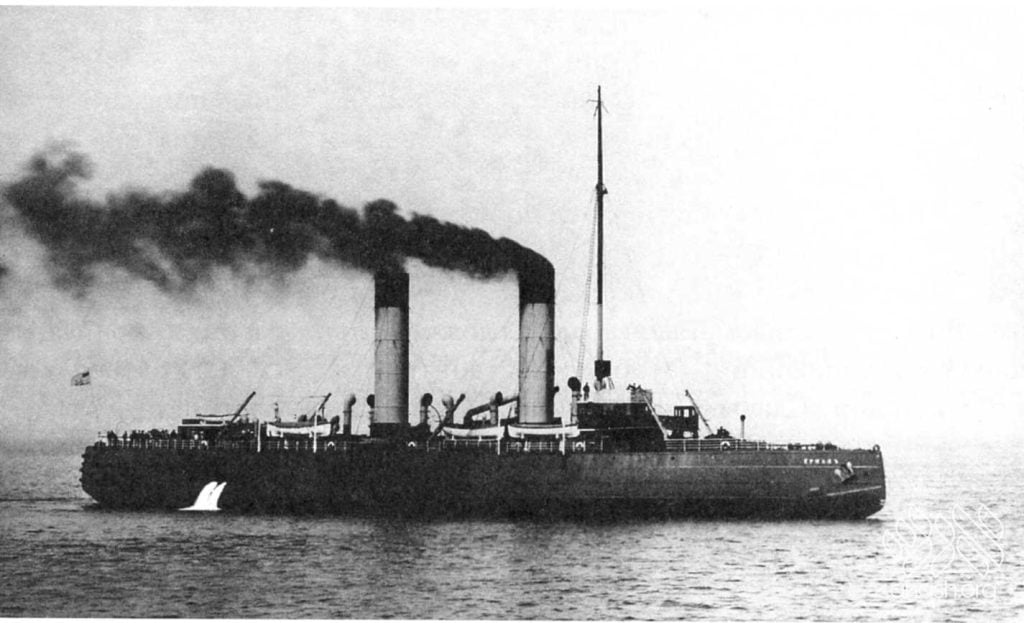
The Yermak, the world’s first polar icebreaker, launched in 1898
While Ben Refael refers to the protagonist as “Sklinasky,” in light of what we now know about R. Volf Tshashniker, it is clear that this story is about him. There could hardly have been more than one Lubavitcher inventor from Russia who spent his final years in New York and died at the Montefiore Home.
This account also confirms our earlier assumption that R. Volf was always frum and considered a fervent chasid, even though his intellectual energies were devoted to the secular fields of mathematics and engineering. The story about him having the credit for an invention stolen from him matches the general outline of the story we cited above about the Tzemach Tzedek’s prophetic prediction, “he will anyway lose…”
Ben Refael doesn’t tell us the source for his account, and it isn’t clear if he knew R. Volf personally or only by hearsay. The fact that he recorded his name differently lends support to the latter option, although it is also possible that R. Volf used the legal name “Skliansky” in America. At any rate, the degree to which his information checks out with our established knowledge of R. Volf indicates that the story he tells is likely accurate, at least in general terms.
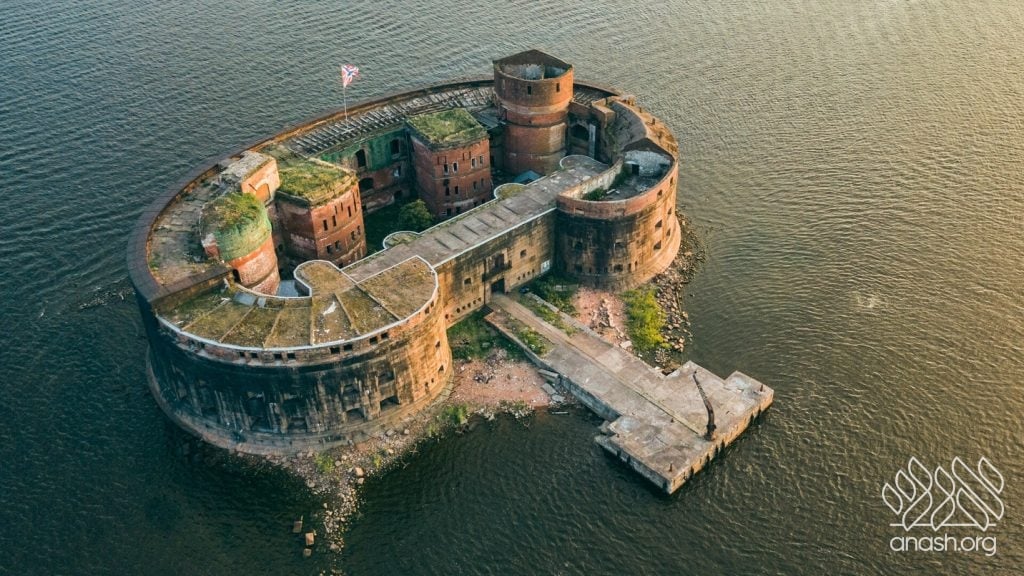
The historic Russian port city and naval fortress of Kronstadt is located in the Gulf of Finland, west of S. Petersburg. Kronstadt was surrounded by a complex network of fortifications, including the Alexander I fortress, pictured above.
We will now examine the historical background of Ben Refael’s account. Vice Admiral Stepan Osipovich Makarov was highly decorated for his service in the Russo-Turkish War of 1877–78. But he was best known as a naval inventor and researcher, publishing over fifty papers on oceanography and naval tactics.
In the mid-1890s, Makarov focused on designing an icebreaker ship capable of breaking through the polar ice of the Arctic Ocean. In 1898, the Yermak ship built under his supervision was completed, becoming the world’s first polar icebreaker. He also worked on the icebreaking steamship SS Baikal, built between 1896 and 1899. Ben Refael seems to have dated this work a little too early when he wrote it began “decades ago” when Makarov was a junior officer.
A Japanese depiction of the sinking of Petropavlovsk. The caption reads: “The Eighth Attack on Port Arthur: The Flagship of Russia Struck our Buoyant Mine and Sank Instantly, and Vice Admiral Makarov Drowned.”
In 1900, Makarov was appointed military governor of Kronstadt. Considered the Russian navy’s most competent admiral, he was sent to command the Russian Navy’s battle at Port Arthur after the Japanese surprise attack on February 9, 1904. On April 13—just weeks after Ben Refael’s article was published—Makarov met his death on the Petropavlovsk battleship after hitting a Japanese mine.
After Makarov’s death, several Jewish newspapers around the world picked up Ben Refael’s article and reported happily that the thieving Makarov had met his deserved end.
The Di Yiddishe Velt article fills in some important gaps in R. Volf’s story and sheds light on his final years in New York. But it raises as many questions as it answers: Where is the name Skliansky from? Why exactly did the disappointment of the theft of his invention cause R. Volf to move to America, leaving behind his family in Tshashnik?
It seems that this enigmatic iluy is destined to be shrouded in mystery, and the more we know, the less we understand.
(Thanks to Mendel Nemanov for his assistance in the preparation of this article.)
To view all installments of From the Margins of Chabad History, click here.
For additional exclusive content, follow the column on X: x.com/ChabadMargins
Bibliography:
R. Leizer der Krumer: Ramach Oysiyos, 131; Reshimas Sipurim MiOtvotzk, 34; Reshimos Devarim, p. 237; Yisrael Noach Hagadol, p. 278; Hamashpia Reb Shlomo Chaim, pp. 375-377, p. 729; Reb Mendel, p. 302; Teshurah Langsam 5776, p. 38; Teshurah Marinovsky 5777, p. 209; Kerem Chabad 4:1, p. 13; Beis Rebbe (5774 edition) p. 223). R. Yekusiel Zalman Landa: Vitebsk, pp. 185-187). R. Eliyahu Klatzkin: Heichal Habaal Shem Tov, vol. 34, pp. 152-166; Yeshurun, vol. 15, pp. 745-797.










 COMMENTS


Great research!
מאמרים מאלפים! מי הכותב? ועדיין הפרוץ מרובה על העומד, הן בנוגע אליו, ועוד יותר בנוגע אביו. אבל כנראה זה מה שיש. ואלפי תודות על הנ”ל. שלום וויינבערג (ולהעיר מה שהובא בספרי סיפורי חב”ד שחמיו (בזוו”ש) אמר, מען דארף זיין א רוצח געבן א טאכטער לאיש כזה, אבער וואס טוט מען ניט אויף עם באקומען פאר אן איידעם
The name is written in the byline: Shmuel Super. A first rate Chabad historian and a rising star in the world of Chabad history.