




י׳ אדר ה׳תשפ״ו | February 27, 2026
Flatbush Rov Exposes ‘Brooklyn Eruv’ Scandal
After months of research and conversations, Rabbi Daniel Osher Kleinman, a rov in Flatbush, revealed how, beyond the many halachic questions, the “Brooklyn Eruv” is physically faulty and how organizers kept changing the story.

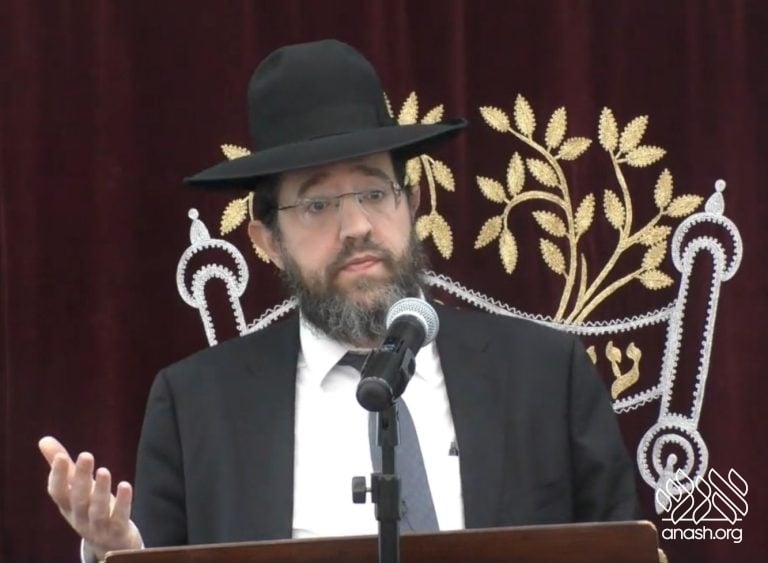
In a recent shiur, Rabbi Daniel Osher Kleinman, Rov of K’hal Nachlas Dovid in Brooklyn and author of many seforim, revealed how, beyond the many halachic questions, the “Brooklyn Eruv” is faulty and fraudulent.
Many leading poskim, including Rav Moshe Feinstein, as well as R’ Zalman Shimon Dworkin and other Lubavitch rabbonim, held that an eruv in Brooklyn could not possibly be established since the area is a reshus harabbim d’oraisa. Yet, Rabbi Kleinman acknowledged, there were rabbonim who held it was possible. Regardless, the “Brooklyn Eruv” is problematic according to all.
Unlike other places, where the eruv is checked weekly under competent rabbinic supervision, he said, Brooklyn has no consistent oversight by rabbonim. Rabbi Kleinman recounted firsthand investigations showing that many sections of the Brooklyn eruv were discovered to be broken and fundamentally flawed.
The “Brooklyn Eruv” relies in many places on silicone caulk to form tzuras hapesach, often connecting to a kaneh al gabeihem with an imaginary gud asik, but in numerous locations, ledges, protrusions, or other obstacles block the proper connection entirely.
Other sections depend on natural features, such as beaches that slope gradually into the water, which do not meet halachic requirements for depth, or on permanent infrastructure whose stability cannot be guaranteed.
Wires spanning poles across streets sometimes leave sidewalks completely uncovered. Rabbi Kleinman documented “around forty-five different places which were questionable at best and pasul l’halacha at worst,” demonstrating that large portions of the eruv fail to meet the standards necessary for reliable Shabbos observance.
When one of the rabbonim associated with the “Brooklyn Eruv” was presented with photographic evidence, the rov admitted, “I told them for this reason that I can’t be involved anymore.” Yet, for some reason, his position was not made known.
Rabbi Kleinman stressed that halacha requires chezkas kashrus – a reliable continuity that people can trust – but in Brooklyn, “the goalposts keep moving,” and even those tasked with oversight often don’t know the true borders of the eruv.
“Something that the story keeps changing … you wouldn’t invest with such a person. And that’s the bottom line with the eruv,” he said, while calling out those sending weekly emails declaring the eruv kosher despite its fundamentally flawed infrastructure, amounting to misrepresentation or outright fraud.
LISTEN
 COMMENTS


I suspected it all along. How could it be that it’s kosher every week and it’s never down?
The Rebbe was adamantly against an Eruv in Brooklyn, and so was R’ Moshe Feinstein. End of story. We didn’t need Rabbi Kleinman to tell us this, but it’s good someone is finally saying the truth out loud instead of bowing to political correctness. The people pushing for an Eruv in CH and Flatbush just want convenience.
They are מחטיא את הרבים
Thank you Anash.org for putting out this important information out. Other’s have not only not protested the Eruv, but have promoted it!!
It is worth quoting Rav Moshe’s own framing directly. In O.C. 4:87 he wrote explicitly that he had not wished to involve himself in the Flatbush eruv matter at all, since the relevant seforim were available for anyone to consult. He was compelled to write only after being informed that people were publicly claiming he supported the eruv., an his teshuva was a correction of that misrepresentation.
the rebbe allowed the kfar chabad eruv. i don’t see the differences
If you can’t see the difference between an eruv in a village in Israel with no connection to a reshus harabim
and Brooklyn or Crown Heights, then you obviously lack the fundamental knowledge of what an eruv needs.
So because YOU don’t see the difference, therefore it doesn’t exist?! The Rebbe is the only דעה, I really don’t understand any other perspective.
The Rebbe was concerned about this and wrote this response:
“My view is well known, that in this generation, if a person or organization that people respect makes an Eruv, and he knows that in the end it will become public knowledge – it is a terrible stumbling block.
“It is impossible that it won’t happen on at least one Shabbos that the Eruv will become invalid. Once people become accustomed to carrying outdoors on Shabbos, no kind of proclamation or announcement that the Eruv has been invalidated and it is forbidden to carry will help to cause them to stop carrying.”
And in another response the Rebbe wrote:
“Oftentimes the eruv breaks, and we see clearly that an announcement about this (a) nowadays only reaches a minority of the community, and (b) few of those will abstain from carrying because of this, after having gotten used to carrying for many Shabbosos.”
For Lubavitcher chassidim, this doesn’t come as a shock. The Rebbe reiterated many times the unreliability of an eruv and the concern of changes that would invalidate the eruv, causing people to transgress Shabbos unknowingly, or even after they are told.
A number of years ago, there were individuals who carefully followed the published ‘Crown Heights eiruv’ map and, on multiple occasions, documented sections that were down on Fridays, with sufficient time before Shabbos to address them. Clear photographs were taken, along with specific locations/addresses, and the information was brought to those responsible.
The response at the time was that the reports were inaccurate and that the eiruv had already been checked that week. After several such instances, it was stated that there was an additional outer eiruv. When clarification was requested regarding the precise outer boundaries, that information was not shared. Subsequently, the explanation shifted further: it was asserted that a broader Brooklyn-wide eiruv encompassed the area in question, and therefore the originally published boundary was no longer determinative. As a result, the previously documented breaches were described as irrelevant.
This occurred over a number of different weeks. Several times, after Shabbos, it was observed that the breaches had not been repaired. In at least one instance, what was documented appeared to be an improperly constructed section of the eiruv, and this as well was not corrected. Local rabbanim who were understood to unofficially be standing behind the eiruv were notified. No public notice was issued advising the community not to rely on it for that Shabbos. In some cases, the issues were reportedly still not repaired the following week.
I am not writing this to attack anyone. I am sharing this because transparency and clarity in something as sensitive as an eiruv are essential. When published maps are relied upon by some people, and documented concerns are dismissed or reframed without clear explanation, it understandably creates confusion and concern.
והאמת והשלום אהבו
There is a video going around, in which a rebuttal is supposedly put forth by those behind the Brooklyn Eruv.
Without getting into the substance of the claims raised in the response, it should be noted that beyond the fact that the points were sometimes presented in a confused or unfocused manner, and at times statements were attributed to Rabbi Kleiman that were not said by him in this video (apparently they were said elsewhere), they also did not address all of Rabbi Kleiman’s points. Some were deliberately omitted, or mentioned only in passing in order to dismiss them as nonsense, while other matters (for instance regarding their separate dispute with another individual) were introduced and an attempt was made to link the issues together.
For example, Rabbi Kleiman argues that there are several substantive problems (aside from the principle of “pi tikra” or the sidewalk question), yet they dismiss this offhandedly by saying that it is all nonsense and the like, or that he does not know what he is talking about (and similarly regarding the claim about the problematic use of using the beach as a Mechitza, which they call foolishness), without directly addressing the substance of the argument.
By the way, there have been times when people noticed problems with an eruv in location xx or yyy and tried contacting the person in charge, but didn’t get anywhere.
A similar situation is happening here: there are issues with the eruv, and no one is really addressing them.
It’s essentially the same kind of situation.
One thing to note is that in their response, the backers of the Brooklyn eruv claim that another well known proponent of problematic eruvin is the real person behind Rabbi Kleiman’s claims and is indeed playing games here.
He also asserts that this other eruv proponent has no real understanding of the halachos of eruvin. This may be the one time we should consider taking him at his word.
Something to note: Rabbi Kleiman in his video claims that one of the rabbis who signed the certification for the Brooklyn eruv later retracted his support. The backers of the Brooklyn Eruv deny this, though they assert that there is a kernel of truth to the claim (which they say was distorted by Rabbi Kleiman), and they offer their own version of how events unfolded.
What is particularly striking is that while discussing the matter and their conversation with that unnamed rabbi, they speak about him in a far from complimentary manner. Although at times they attempt to be somewhat more restrained in how he speaks about him (certainly more so than in their remarks about Rabbi Kleiman) there is a noticeable tone of condescension, as if the rabbi lacks sufficient understanding of the subject and they understand it better than he does.
If they indeed understand the matter better than the rabbi, why do they need him at all? Is the validity of the eruv dependent upon someone whom they themselves do not seem to hold in particularly high regard?
Those who have tried to respond to Rabbi Kleiman’s points have come across as being rather ridiculous. They say: if you have a problem, of course we will take you into consideration, but only on condition that you support the eruv in general and help others feel comfortable using and carrying within this eruv. Apparently, they are not aware of how illogical and even manipulative this sounds. It also reveals how everything is conducted as a kind of maneuvering game in order to achieve a desired outcome.
They also made a strange claim: that if someone truly believes there is a defect in a certain part of the eruv, he should personally finance the correction. According to this reasoning, someone who does not even want the eruv must either pay for its repair (or, as previously stated, support the eruv project in general), otherwise he has no right to raise the issue. This is certainly unreasonable.
The backers of the Brooklyn Eruv claim that there is no difference between the level of supervision of the Borough Park eruv and that of the Brooklyn eruv.
However there are those who have spoken to one of rabbis who are deeply involved in the Brooklyn eruv, and they have described at length the entire supervision process regarding the Boro Park eruv. It is not practically possible to implement an identical process for the Brooklyn eruv, which is far larger in scope.
If so, then either that rabbi was not precise in his description of the process, or these backers are not being precise when they claim that they replicate exactly the same process for the Brooklyn eruv as well.
Anssh.org is using this person (Rabbi) from Flatbush speach to prove and perswade everyone that the Brooklyn Eiruv is not reliable.
We all already know it’s not reliable because so said our own Beis Din of C.H.
But why quote Someone’s Speach or oppinion, someone from Flatbush’s, oppinion, unless, his oppinion, himself, is considered reliable?
And if this person from Flatbush days, that he knows of which Rabbi had retracted his name from the “Brooklyn Eiruv” and YET, the Raabi from Flatbush is withholding THE name, of who has retracted, then how reliable or responsible is anyone who knows the name of a Rabbi who retracted yet fails to reveal his name?
ממה נפשך
?