




כ״ו אלול ה׳תשפ״ה | September 18, 2025
Confirmed: The Rebbe’s Letter on the Manhattan Eruv
A letter from the Rebbe to Manhattan rabbonim regarding the construction of an eruv, thought by some to exist only as an unpublished draft, has now been confirmed to have been sent, confirming the Rebbe’s position on building a city eruv.
A letter from the Rebbe to Manhattan rabbonim regarding the construction of an eruv, thought by some to exist only as an unpublished draft, has now been confirmed to have been sent, confirming the Rebbe’s position on building a city eruv.
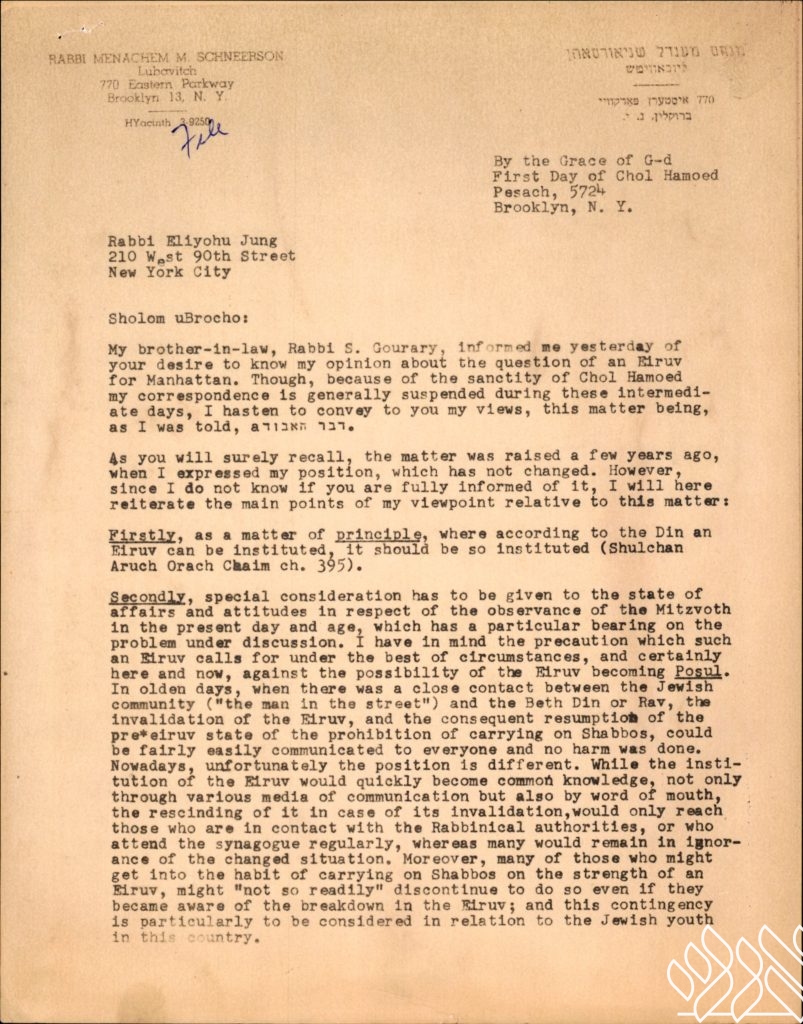
As reported previously by Anash.org, in 5724 (1964), a group of New York rabbonim asked to meet with the Rebbe regarding building an eruv in Manhattan. The Rebbe instead penned a letter to them, dated the first day of Chol HaMoed Pesach, in English, spelling out his position regarding building an eruv in New York.
The letter, which was released by Rabbi Shalom Ber Schapiro of NMP (Nissan Mindel Publications) from the archives of his father-in-law, Rabbi Nissan Mindel, secretary of the Rebbe, was previously thought to have been just a draft and never sent. (Another similar letter of the Rebbe addressed to a different person is printed in The Letter & the Spirit, Volume 3, pages 413–414.)
However, recently, the letter, addressed to Rabbi Eliyahu (Leo) Jung, has been published from the archives of Rabbi Dr. Norman Lamm. Rabbi Lamm was the assistant rabbi to Rabbi Jung at the Jewish Center in Manhattan at the time this letter was sent, and both Rabbi Jung and Rabbi Lamm were active in launching the Manhattan eruv.
This English letter, written on the Rebbe’s stationery, is special in that it is long and detailed, much more so than other letters from the Rebbe about eruv or the handwritten responses written later.
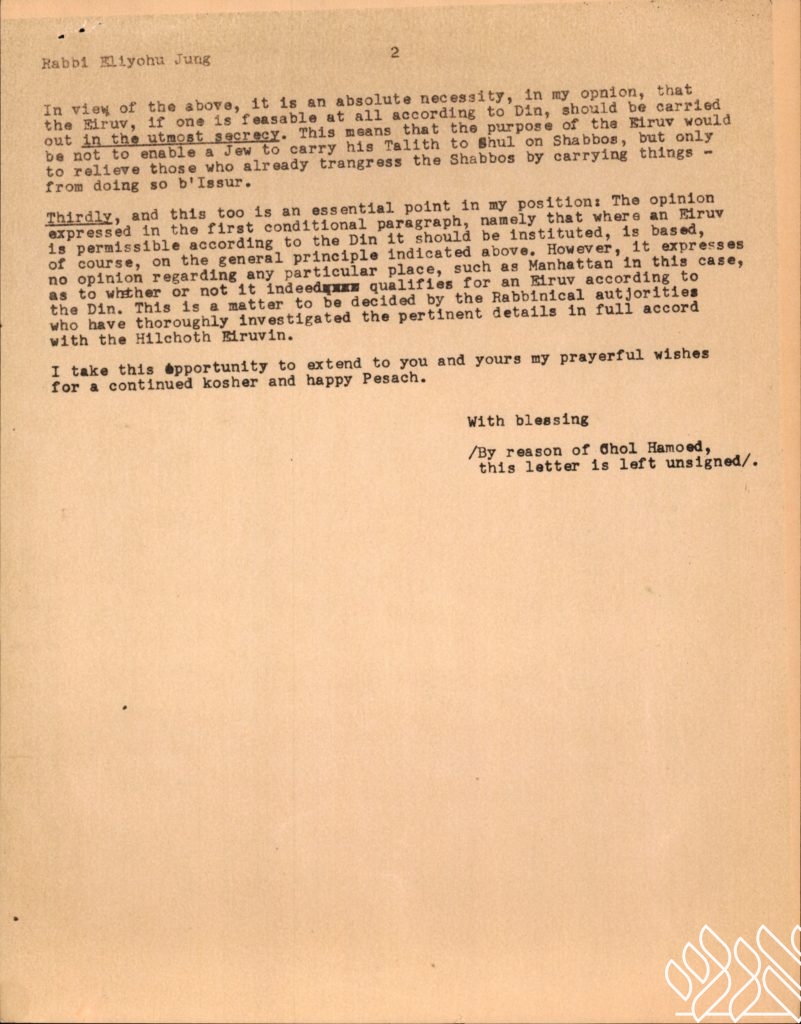
In this letter, the Rebbe clarifies his position on not building an eruv to allow people to carry, and it should only be built – in places where an eruv may be built according to halacha – in complete secrecy for the sake of saving unknowing individuals from chilul Shabbos. “If one is feasible at all according to Din,” the Rebbe writes, “[it] should be carried out in the utmost secrecy.”
In the final letter, the Rebbe made some edits, as the Rebbe commonly would with both dictated letters and letters the Rebbe personally wrote by hand. In this final version, the Rebbe made several small edits and omitted one of the paragraphs from the previous draft.
It appears that this letter must have gone through several stages from its first draft until its completion, which is of particular note due to the fact that the Rebbe’s response was prepared during Chol HaMoed Pesach of 5724. As the Rebbe writes:
“Because of the sanctity of Chol HaMoed, my correspondence is generally suspended during these intermediate days. I hasten to convey to you my views, this matter being, as I was told, a דבר האבוד [a potentially lost matter].”
This highlights how urgent it was to the Rebbe that they be familiar with his stance on this matter.
Special thanks to Chabad historian Rabbi Nochum Zajac for sharing the letter, and to the Lamm Legacy for allowing us to republish the letter.
The full text of the sent letter:
Sholom uBrocho:
My brother-in-law, Rabbi S. Gourary, informed me yesterday of your desire to know my opinion about the question of an Eiruv for Manhattan. Though, because of the sanctity of Chol Hamoed my correspondence is generally suspended during these intermediate days, I hasten to convey to you my views, this matter being, as I was told, a דבר האבוד.
As you will surely recall, the matter was raised a few years ago, when I expressed my position, which has not changed. However, since I do not know if you are fully informed of it, I will here reiterate the main points of my viewpoint relative to this matter:
Firstly, as a matter of principle, where according to the Din an Eiruv can be instituted, it should be so instituted (Shulchan Aruch Orach Chaim ch. 395).
Secondly, special consideration has to be given to the state of affairs and attitudes in respect of the observance of the Mitzvoth in the present day and age, which has a particular bearing on the problem under discussion. I have in mind the precaution which such an Eiruv calls for under the best of circumstances, and certainly here and now, against the possibility of the Eiruv becoming Posul. In olden days, when there was a close contact between the Jewish community (“the man in the street”) and the Beth Din or Rav, the invalidation of the Eiruv, and the consequent resumption of the pre-eiruv state of the prohibition of carrying on Shabbos, could be fairly easily communicated to everyone and no harm was done. Nowadays, unfortunately the position is different. While the institution of the Eiruv would quickly become common knowledge, not only through various media of communication but also by word of mouth, the rescinding of it in case of its invalidation, would only reach those who are in contact with the Rabbinical authorities, or who attend the synagogue regularly, whereas many would remain in ignorance of the changed situation. Moreover, many of those who might get into the habit of carrying on Shabbos on the strength of an Eiruv, might “not so readily” discontinue to do so even if they became aware of the breakdown in the Eiruv and this contingency is particularly to be considered in relation to the Jewish youth in this country.
In view of the above, it is an absolute necessity, in my opnion, that the Eiruv, if one is feasible at all according to Din, should be carried out in the utmost secrecy. This means that the purpose of the Eiruv would be not to enable a Jew to carry his Talith to Shul on Shabbos, but only to relieve those who already trangress the Shabbos by carrying things – from doing so b’Issur.
Thirdly, and this too is an essential point in my position: The opinion expressed in the first conditional paragraph, namely that where an Eiruv is permissible according to the Din it should be instituted, is based, of course, on the general principle indicated above. However, it expresses no opinion regarding any particular place, such as Manhattan in this case, as to whether or not it indeed qualifies for an Eiruv according to the Din. This is a matter to be decided by the Rabbinical autjorities who have thoroughly investigated the pertinent details in full accord with the Hilchoth Eiruvin.
I take this opportunity to extend to you and yours my prayerful wishes for a continued kosher and happy Pesach.
With blessing
/By reason of Chol Hamoed, this letter is left unsigned/
 COMMENTS


How is it possible to make a Eruv that will remain a secret?
B”H.
It is a good question, but that is what the Rebbe writes. In other words, if one can indeed not enact an Eruv which would remain secret from the masses, then it just should not be done.
However, in truth, in the case of the Manhattan Eruv, it indeed was not that hard. The Eruv was relying on preexisting structures, and they by and large did not need to erect new structures.
As a matter of fact, while there had been for a number of years extended discussions with regards to the permissibility of the Manhattan eruv in the rabbinical journals, in the end of the day, for whatever reason the existance of the Eruv was kept secret from the masses (even if various shuls had to raise money for the salaries of the Mashgichim). In one minutes, it seems like this very policy had been enacted on the advice of the Rebbe. It was only a few years later that they officially made the existence of this Eruv public.
What seems to be missing in this conversation, is context…
When addressing any halachic issue, its never a wise idea to put it up as a national referendum…
When an issue in kashrus arises, do we all start taking shu”tim and halacha sefers and begin to debate the issue.. no!
Because everyone understands that when it comes to psak halacha, its up to a posek.
Now,
When we have an issue like the eruv,
Where you have communities that their rabonim agree with it,
People start toying aroumd…
Perhaps if i follow the ruling of a different communities rov, so im ok…
But anyone who knows basic halacha, knows that this holds no water.
There is a concept in halacha called “b’asra drav, halacha k’rav, ubeasra dishmuel, halacha kishmuel”
Which means, that by a certain machlokes between the two great amoraim, rav and shmuel, each one had the say over his city.
And if you lived for example in the town of shmuel, but traveld to the city of rav, you would have to go according to rav.
And if you continued doing like shmuel, you wrre breaking halacha.
So that is where the concept of a mra d’asra comes in,
The word mara in aramaic is master, and asra means place.
And so mara d’asra translates as the baal habayis of that place.
So if you are in a town where everyone accepted upon themselves a rov as their mara d’asra, when you are in that town you cannot do things publicly, that are in contradiction to his opinion.
So now,
The whole question about the eruv in shchunas hamelech, crown heights, all the pilpulim are irrelevant
Apparently the person who made the so called eruv that we don’t use in CH is someone who doesn’t have a beard and isn’t even an actual rov and he claims that a Lubavitcher rov in France supports him because he once brought up in a theoretical discussion on the topic of eruvim the concept of an eruv in CH.
אנו אין לנו אלא דברי בן עמרם
whats the point of posting a article and then saying it should be done secretly? im confused…