




ג׳ אלול ה׳תשפ״ה | August 26, 2025
Chabad Journalist with a Microphone and a Mission
In a time when the influence of media is stronger than ever – shaping opinions and spreading messages far and wide – and as our nation continues to face war while witnessing open miracles, here is a powerful and timely conversation with popular Chabad journalist R’ Mendy Rizel.
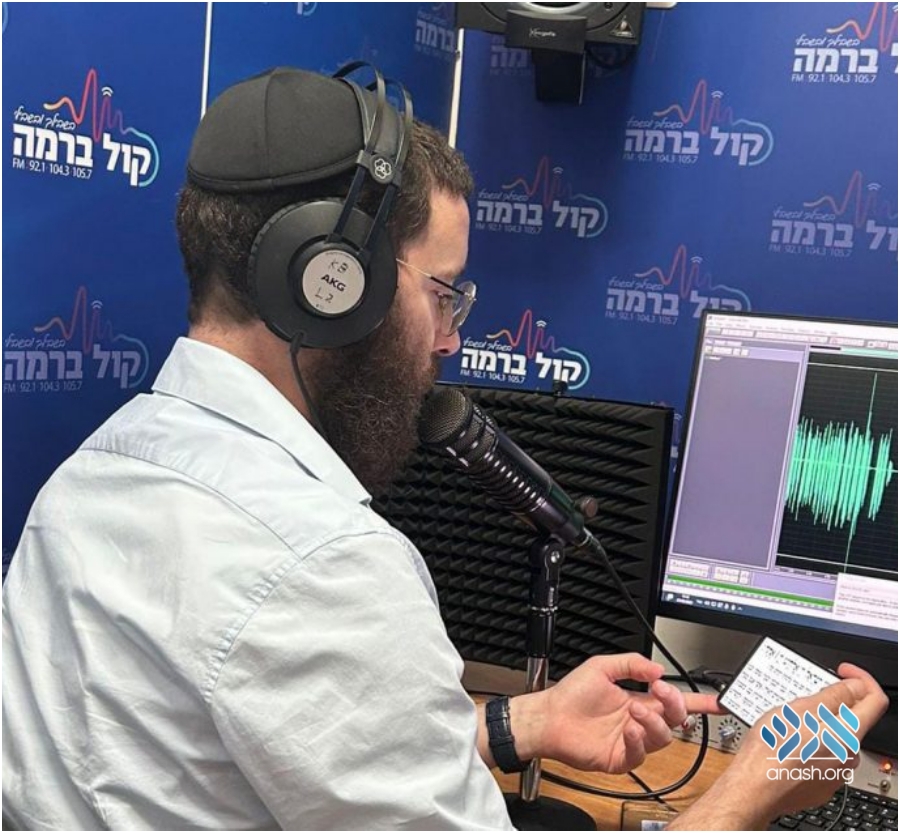
In a time when the influence of media is stronger than ever – shaping opinions and spreading messages far and wide – and as our nation continues to face war while witnessing open miracles, here is a powerful and timely conversation with popular Chabad journalist R’ Mendy Rizel.
By Anash.org staff
Today more than ever, the media’s power to shape minds and communicate powerful messages is undeniable. Amid the ongoing war that has gripped Eretz Yisroel since early last year and the many miracles we continue to witness, this timely conversation with prominent Chabad journalist R’ Mendy Rizel offers a unique perspective on the responsibility and impact of Jewish communication today.
How did you get into journalism?
It was hashgacha pratis. I’ve always loved writing, and even as a child, I wrote and edited the newsletter published by the cheder in Lod where I studied.
During Operation Cast Lead in Gaza, a newsletter was being published, and they asked my father-in-law, Rabbi Moshe Ze’ev Pizem, the Rebbe’s shliach in Sderot, to write a few words about the war. He wasn’t available, so I offered to write in his place. The editor of the magazine, R’ Menachem Cohen – today the editor of Kfar Chabad Magazine, whom I thank for bringing me into the media world – really liked what I wrote. He said it was the first time he didn’t need to make any edits to a contributor’s column. That’s how I began writing a regular column for the magazine.
At a certain point, I gathered the courage to approach my friend, veteran author Rabbi Zalman Ruderman, who at the time was the editor of Shevi’i, a magazine supplement of the HaMevaser newspaper. I asked him to give me a chance, and he agreed. He started assigning me occasional pieces, and before long, I became a full-time journalist for the paper.
After about three years, just before Lag B’Omer, I attended a police press conference focused on preparations for Lag B’Omer within the Chareidi community. There, I met the then-head of the news department at Kol Barama Radio, Nitzan Keidar. I approached him and offered myself for a position, and baruch Hashem, I’ve been working there ever since – for 13 years now.
In parallel, I also hosted a popular current affairs program on Radio Darom 101.5 for five years, until COVID led to the cancellation of the station’s news division. In recent years, I’ve also been appearing regularly as a panelist on Channel 14, which is known as the “Heritage Channel.”
The Rebbe, as is well known, held in high regard the efforts of those who find themselves working in the media. For me too, beyond being a source of income, I see it as a holy shlichus.
How does shlichus express itself in your work?
My role involves covering military affairs, and often I have to report difficult news – soldiers killed in action, etc. About a year ago, I came across a letter the Rebbe wrote to Rabbi Yosef Weinberg, who famously gave Tanya classes on the radio. In the letter, the Rebbe wrote that one must instill faith and hope in the hearts of listeners – not the opposite. Since then, I’ve made it a point to end every weekly program with an uplifting song and a message of hope and trust in Hashem, despite the difficult reality in Eretz Yisrael.
I also make a real effort to emphasize in my reporting on successful IDF operations – for example, Operation “Rising Lion” against Iran’s nuclear program – that it’s not “my strength and the might of my hand” (r”l), but rather the kindness of Hashem.
In addition, even when reporting on what we call “dry news,” I try to include the Rebbe’s perspective on shleimus ha’aretz and other topics.
About two years ago, I had the privilege of starting a new tradition: each morning, the radio station’s broadcast opens with my recorded voice reciting “Modeh Ani,” “Shema Yisrael,” and “Sheyiboneh Beis HaMikdosh.” After the passing of journalist Moti Eden, a rare interview he had with the Rebbe over 40 years ago resurfaced. In it, the Rebbe told him that Shema Yisrael should be broadcast on the radio every morning. I felt that the Rebbe’s words were a message to me personally, as someone who works in radio, and especially at the world’s largest Chareidi religious station, which brings Hashem’s word to hundreds of thousands of listeners. I shared this with the CEO, R’ Ariel Deri, who enthusiastically approved the initiative. I asked him for the privilege to record the prayer. The tremendous z’chus rests on his shoulders.
Can you share your perspective on the past two years?
The past two years have been deeply unsettling.
On the morning of Simchas Torah, less than an hour after the sirens and explosions began, I realized something very unusual was happening. Because of my IDF reserve duty, I turned on my phone to contact my commanders (of course, I had already consulted a rov beforehand and acted based on his guidance). That’s how I found out what was going on, and baruch Hashem, I was able to help save several Jewish lives by warning my wife’s family members, including my father-in-law, Rabbi Pizem, and my brothers-in-law.
In those days, I found myself reporting around the clock – reading names of the murdered and describing horrific scenes. It was incredibly difficult. Sometimes after a broadcast, I would completely break down.
Since then, the reporting has continued non-stop. We await the end of this war with a true victory for the Jewish people over our enemies – and may we soon have the merit to announce the coming of Moshiach Tzidkeinu.
How do you convey the Rebbe’s message on shleimus ha’aretz to the general public?
I simply speak about it clearly and directly, stating the Rebbe’s unequivocal position. Just as I often speak about the mitzvah of tefillin – a clear mitzvah with the added benefit of striking fear into our enemies.
It’s more complicated when I appear in the secular media than in religious outlets, but every time I go on air, I sincerely pray to Hashem to put the right words in my mouth.
Any final message for Anash?
The heart of the Jewish people is awake! The public is thirsty for ruchniyus and inspiration. The unprecedented miracles we’ve seen in the conflict with Iran show that we are very close to the Geulah.
I recently saw a letter where the Rebbe writes that Mivtza Tefillin repairs the damage from the Maalot massacre. So dear friends – go out and do mivtzoim! Speak to fellow Jews, encourage them to do mitzvos. Every good deed brings merit to the Jewish people, protection for our soldiers, and the return of all the hostages home.
Credit: Lubavitch publication
 COMMENTS


We appreciate your feedback. If you have any additional information to contribute to this article, it will be added below.