




י״ד אדר ה׳תשפ״ו | March 2, 2026
As Iranian Missiles Fly Overhead, Purim is Brought to Shelters
After Israel declared a state of emergency and banned public gatherings, shluchim worked around the clock. Volunteers moved from shelter to shelter so every Jew could hear the Megillah, and Mishloach Manos will be delivered in a coordinated, nationwide effort.
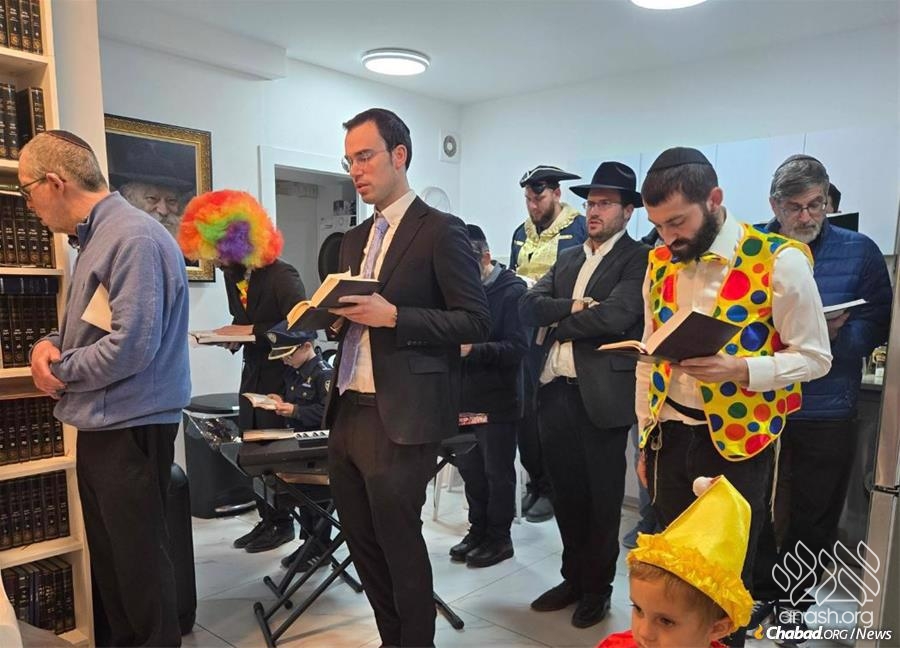
How does a Chabad emissary do Purim when sirens are sounding and public gatherings are banned? That was the question Rabbi Roei and Mushky Uliel and their colleagues across Israel faced within hours of the first Iranian missile strikes on Shabbat morning.
In a typical year, the Uliels fill a rented hall in Jerusalem’s Abu Tor neighborhood for Megillah readings every hour, followed by a festive Purim meal that draws hundreds. What now?
Israel is under a state of emergency after Iranian missiles struck cities across the country in retaliation for a coordinated Israeli–U.S. military operation that devastated Iran’s leadership and military infrastructure. Sirens have sounded around the clock, schools and workplaces have been closed, and the IDF Home Front Command has prohibited public gatherings and educational activities as part of emergency directives meant to protect civilians.
The war started on the Shabbat before Purim, the holiday on which we celebrate the foiling of Haman the Amalekite’s plot to destroy the Jewish people, and when the weekly Torah reading is supplemented with the Zachor (“Remember!”) reading in which we are commanded to remember the evil of Amalek and to eradicate it from the face of the earth.
With large celebrations banned for safety reasons, communities around the country raced to ensure that the observances of the holiday, which begins on Monday evening, are not lost in the chaos.
The solution, worked out in conversations with fellow Chabad-Lubavitch emissaries across Jerusalem, was that if people could not safely gather in central locations, the holiday festivities would be brought to them: to communal bomb shelters, apartment buildings, and safe rooms across the city.
Instead of large gatherings, there would be dozens of smaller Megillah readings spread across communal bomb shelters, apartment buildings, and safe rooms. With Purim already underway in Israel, Megillah reading volunteers are going safely from shelter to shelter to ensure that every Jew who wants to hear the Megillah can do so safely.
Mishloach Manot are being delivered directly to homes where families are limiting their movement. The effort, coordinated across neighborhoods, has become a nationwide mobilization.
“While we typically make large celebrations, this effort of going to where the people are gathered, particularly in a time like this, is potentially even more far-reaching,” says Mushky Uliel. “Now, our personal work is to practice everything we have learned about bitachon – trusting that G‑d and every He plans for us is good. As the Tzemach Tzedek taught us: ‘Think good so it will be good.’”
Neve Shamir is a growing neighborhood with a strong English-speaking community in Beit Shemesh, near the Judean Mountains. Rabbi Danny and Esther Fordham moved to Israel to establish Chabad of Neve Shamir for English Speakers less than a year ago, and are now facing their first war experience in Israel.
Their original plan for Purim night was a large, family-friendly Megillah reading filled with children, crafts, prizes, and mitzvah missions. For the first day after the war broke out, they still hoped some version of it might be possible. But as the security situation became clearer and it was evident that public gatherings would not be allowed, they understood they would have to reorganize entirely.
Within 24 hours, they shifted from planning one large communal event to coordinating multiple small readings in homes and safe spaces throughout the neighborhood.
“Plan A was a big communal event with over a hundred people,” Rabbi Fordham explained. “Plan B is literally going door to door, creating safe mini-readings throughout Neve Shamir in different home shelters, ensuring families can safely fulfill the mitzvah. We’re preparing packages of crafts, megillahs, graggers, and crafts for each home.”
Neve Shamir’s English-speaking community is close-knit, with many young families eager to preserve a sense of normalcy and joy for their children despite the uncertainty. Recreating Purim in smaller, safer settings has become the focus – maintaining the costumes, the noise, and the mitzvot, even without a central gathering.
“Parents are looking for ways to give their children a full Purim experience during uncertain times,” Esther Fordham says. “Thank G‑d, we’re able to recreate that excitement in smaller, safer settings.”
Ultimately, they organized Purim celebrations in ten locations, ensuring hundreds of men, women, and children could celebrate the holiday.
Across the country, from Tel Aviv to Be’er Sheva, Eilat to Kiryat Shemona, that same approach has been adopted: get Purim, and the four mitzvot of the day—hearing the Megillah, exchanging gifts of food, giving charity to the needy, and having a festive meal—everywhere people are sheltering. Thousands of volunteers are already on their routes and schedules, ready to read the Megillah over and over again.
“Megillah every hour on the hour, in shelters across the city—that’s the plan!” says Sara Naiditch, co-director of Chabad on the Coast in Tel Aviv. “We’ll bring all the Purim mitzvot in one place, and make sure everyone can celebrate this special day properly and safely.”
 COMMENTS


We appreciate your feedback. If you have any additional information to contribute to this article, it will be added below.