




כ״ז מרחשון ה׳תשפ״ו | November 17, 2025
When 12-Year-Old Zalmy Brought the Banquet to Tears
Perhaps the most emotional moment of this year’s banquet was when 12-year-old Zalmy Feldman took the stage, walking on his prosthetic feet, after his father, shliach Rabbi Menachem Feldman, shared a moving account of how Zalmy’s life-threatening illness became a source of strength for their family and community.
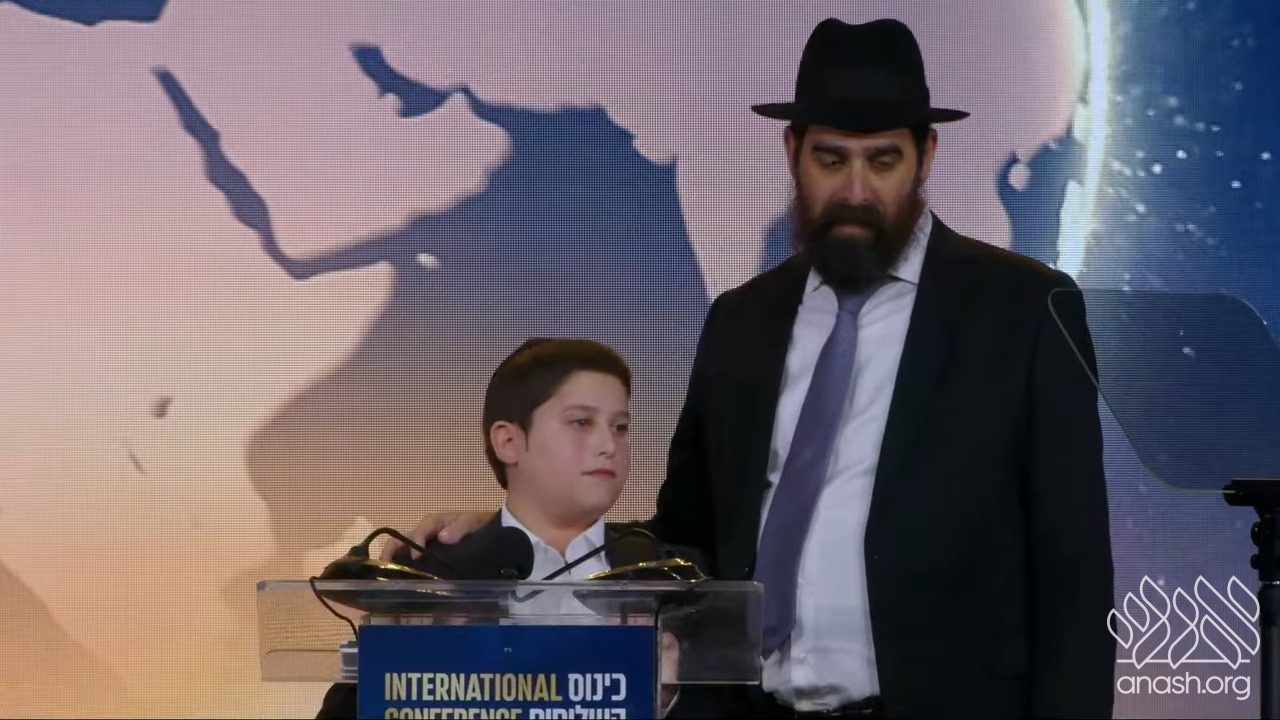
Perhaps the most inspiring and emotional moment of this year’s gala banquet was when 12-year-old Zalmy Feldman took the stage, walking on his prosthetic feet. His father, shliach Rabbi Menachem Feldman of Nes Ziona, Eretz Yisroel, spoke in an extremely moving video at the Kinus Hashluchim Gala Banquet and shared a deeply emotional account of how his son Zalmy’s life-threatening illness became a source of strength for their family and their entire community.
Sixteen years ago, Rabbi Feldman stood as a bochur outside 770 on a Sunday morning of the Kinus Hashluchim, watching as the iconic group photo came together. Waves of shluchim kept arriving. He remembers thinking, “Wow, I am going to be in this picture.”
At that time, he and his family were just beginning their shlichus in Nes Ziona as part of a young shluchim initiative. His focus was on giving shiurim and building a community from the ground up. Years passed. The shlichus took root, the family grew, the community expanded, and the work blossomed.
“It was about the tenth year of our shlichus, and I felt like we were riding the wave,” he recalled. “There was so much to do, the community was growing, the Rebbe was with us.”
One Friday morning, their routine shifted in an instant. With seven children already, the Feldmans were used to the usual childhood fevers and rashes. But when Zalmy woke up covered in a rash, they sensed something unusual. Rabbi Feldman dropped his wife at the clinic and hurried to Savionim School for a Chumash party scheduled for 8:30 in the morning.
As he stepped out of the school, he glanced at his phone and saw over twenty missed calls from his wife.
He called immediately. She said, “Menachem, I am on the way with an intensive care unit to Assaf Harofeh Hospital. Come quickly.”
At the hospital, medical teams were running in from every direction. Trauma teams and specialists converged on the emergency room. The Feldmans stood outside the doors, unaware of what was happening inside. A doctor finally emerged with the diagnosis: Zalmy had been struck by a predatory bacterium, an extremely aggressive infection that placed him in critical danger.
“They could not tell us anything. Whether he would live, whether he would hear, see, or walk. Nothing. We understood only that the situation was very serious,” Rabbi Feldman said.
His mind was spinning. “This is your child. Nothing is more precious. And why is this happening? What does the Eibershter want? How will we live? How will we manage? Will we be able to continue our shlichus? What will our shlichus look like from here?”
He found himself alone in the hospital’s small shul. “I do not remember seeing anyone else. I just remember taking a siddur, and surprisingly, it was the tefila where I felt the presence of the Eibershter more strongly than ever in my life.”
The time for surgery arrived. The parents waited with tefillos and heavy anticipation. Then the doctor came out.
“I remember it like it is happening now. The doctor said, ‘Listen, we did everything. There is no choice. It looks like we will have to amputate his legs.’”
During their time in the hospital, a psychologist approached them, offering support. Rabbi Feldman politely declined. She insisted, asking how he could possibly manage such emotional strain.
“I told her, ‘I have strength. I will get through this.’ She asked, ‘What strength do you have?’ I said, ‘Listen, I am a shliach of the Lubavitcher Rebbe.’”
He continued, “And what is a shliach? Not simply a representative. I am literally the koach of the Rebbe in Nes Ziona. I am there, it is as if he is there. I am certain that this is happening for a precise reason. Even if I do not understand it now, I am sure that everything will be for the good.”
He and his wife made a quiet resolution: “We will take this ordeal, even without knowing how it will end, and we will grow from it. This will become our banner.”
On the first night of Chanuka, nearly two months after the crisis began, they brought Zalmy home. Rabbi Feldman remembers lighting the menorah and thanking the Eibershter.
“We felt a miracle had been done for us. Others might not understand. They asked, ‘What miracle?’ But we, who knew that this child might not have been here, chose to focus on what we have and not on what we do not have.”
He continued with feeling, “There are hands, there are eyes. Out of all 613 parts of a person, why concentrate only on what is missing? There is so much.”
The room erupted in applause.
“Zalmy is not only a child who was not weakened by this. His strength and his inner power are extraordinary. He became someone who inspires others,” Rabbi Feldman said. “No one can complain when they see Zalmy. No one can say, ‘I cannot do it.’ What do you mean you cannot? You can do everything.”
The effect on their shlichus was tremendous, but not in the way people might assume.
“Not only was our shlichus not weakened, it received tremendous strength. Before Zalmy’s story, I could say, ‘I cannot, this is too big, I am not capable.’ Since Zalmy’s story, nothing is too big. The word ‘cannot’ no longer exists. Set a goal, and you will achieve it.”
Rabbi Feldman concluded with a vision for his son’s future. “I believe Zalmy is a shliach. From my perspective, he already is. What the framework will be, I do not know. But in my mind, I see him exactly as I saw myself in that giant picture of all the shluchim – part of the Rebbe’s great army. I certainly see Zalmy standing there, or sitting there, as part of the Rebbe’s army. Because Zalmy is the Rebbe’s child.”
As this moving presentation concluded at the Kinus banquet, Zalmy was welcomed to the stage to a standing ovation, where he confidently walked on his prosthetic feet – living proof of the strength of shlichus, the power of emunah, and the Rebbe’s bracha accompanying his shluchim in the most challenging of times.
His speech that followed, along with his live conversation with shliach Rabbi Liraz Zeira – who had both of his feet amputated just a few weeks ago after stepping on an unexploded grenade in Syria – moved the entire room. Speaking to Zalmy live from his hospital room, the very same hospital where Zalmy had his critical surgery a decade earlier, the two strengthened each other and the thousands of tear-eyed listeners at the gala banquet with courage and conviction that with the koiach of the Rebbe, a shliach is truly invincible.
WATCH

 COMMENTS


Moshiach should come just for Zalmy!