



י״ב טבת ה׳תשפ״ו | January 1, 2026
What’s the Deal with ‘Happy New Year’?
Today, by the Gregorian calendar used by the nations of the world, the year 2026 has begun. Is it true that the Rebbe wished people “Happy New Year”? On the flip side, what did the Rebbe write when N’shei Chabad mentioned the secular New Year?

Today, by the Gregorian calendar used by the nations of the world, the year 2026 has begun.
Although our lives are governed by the Jewish calendar, and we are careful whenever possible to avoid using the secular dating system, this day is nevertheless recognized by most of humanity as the start of a new year.
It is told that the holy tzaddik Reb Levi Yitzchak of Berditchev (and according to some traditions also the Ohev Yisrael of Apt) would extend New Year greetings on this day.
They explained this practice by citing the possuk in Tehillim (87:6), “Hashem shall count when He records the nations.” In other words, Hashem takes note of the times by which the non-Jewish world, which follows a solar calendar, marks the beginning of its year.
The Rebbe himself is reported to have done so on two separate occasions, explicitly referencing this idea.
Rabbi J. J. Hecht relates that during a yechidus that took place on the first day of the secular year, the Rebbe wished his younger brother, R’ Shalom (Sidney) Hecht, a “Happy New Year.” When R’ Shalom reacted with surprise, the Rebbe said that he knew it would surprise him, and explained that Reb Levi Yitzchat of Berditchev did so in line with the possuk.
A similar incident is told with the Rebbe’s secretary, Rabbi Nissan Mindel. On that night, Rabbi Mindel was present in the Rebbe’s room. When midnight arrived, the Rebbe glanced at his watch and wished him, “Happy New Year.” Upon Rabbi Mindel’s expression of surprise, the Rebbe responded simply by quoting the possuk, “Hashem shall count when He records the nations.”
In a yechidus with Mr. Peter Kalms, the Rebbe presented the episode with a slightly different emphasis and as a one time occurence. “Reb Levi Yitzchak of Berditchev,” the Rebbe said, “was constantly searching for opportunities to give a bracha. Once, he did so on the civil New Year. When people questioned how he could do this on a day associated with non-Jews, he replied, ‘When it comes to blessing, every time is appropriate.’” The Rebbe concluded by noting that also now, just a day or two earlier, it had been the New Year of the non-Jews.
There was also a later instance during the distribution of dollars for tzedakah on 3 Teves 5750, the last day of the year 1989, when the Rebbe told someone, in English, “This will give you a happy year.”
Yet, despite the spiritual significance lent to the world’s count, we don’t celebrate the date, and we recognize that it’s not when our New Year begins.
A strong indication of this can be seen from the Rebbe’s own handwriting.
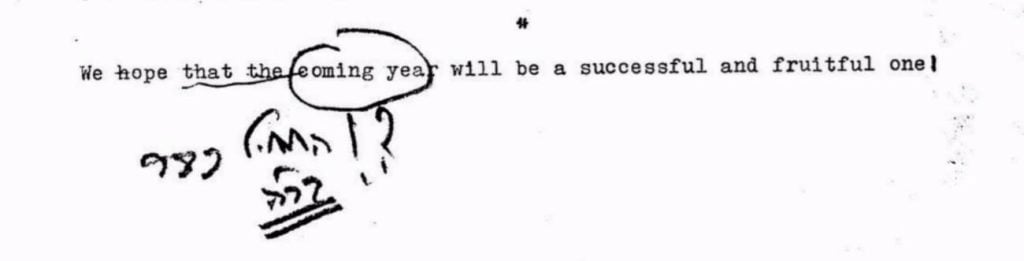
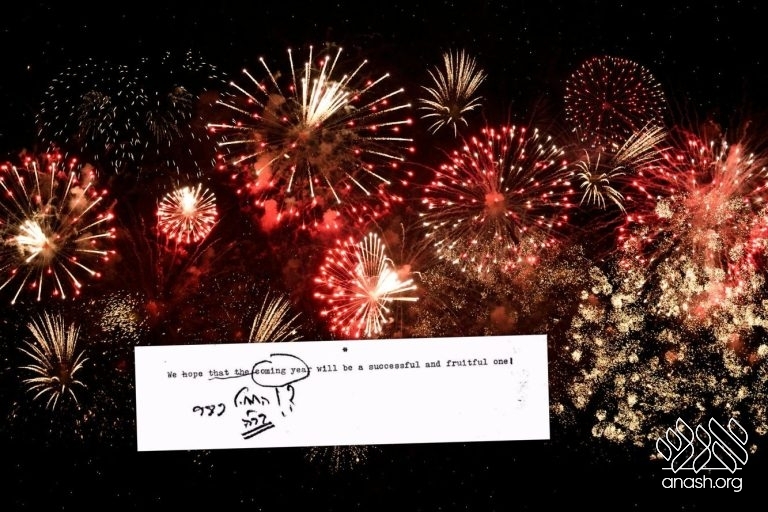
On a document written by the N’shei Chabad of New York, in English, ahead of the secular new year, the authors wrote, “We hope that the coming year will be a successful and fruitful one.” The Rebbe circled the words “the coming year” and added his handwritten comment, “?! It already began on Rosh Hashanah.”
The message: Despite the deeper explanations on the Divine significance in worldly happenings, as Yidden, we must not confuse our values and hold Torah as our only guide to life.
 COMMENTS


We appreciate your feedback. If you have any additional information to contribute to this article, it will be added below.