




י״ט כסלו ה׳תשפ״ו | December 8, 2025
What Is a Farbrengen? – Mashpi’im in Conversation
In a virtual round-table, five mashpi’im — R’ Chaim Shalom Deitsch, R’ Zalman Gopin, R’ Adin Even-Yisrael (Steinsaltz) a”h, R’ Shabtai Slavatitsky, and Rabbi YY Jacobson — come together for a conversation on the role and nature of farbrengens in chassidishe life.
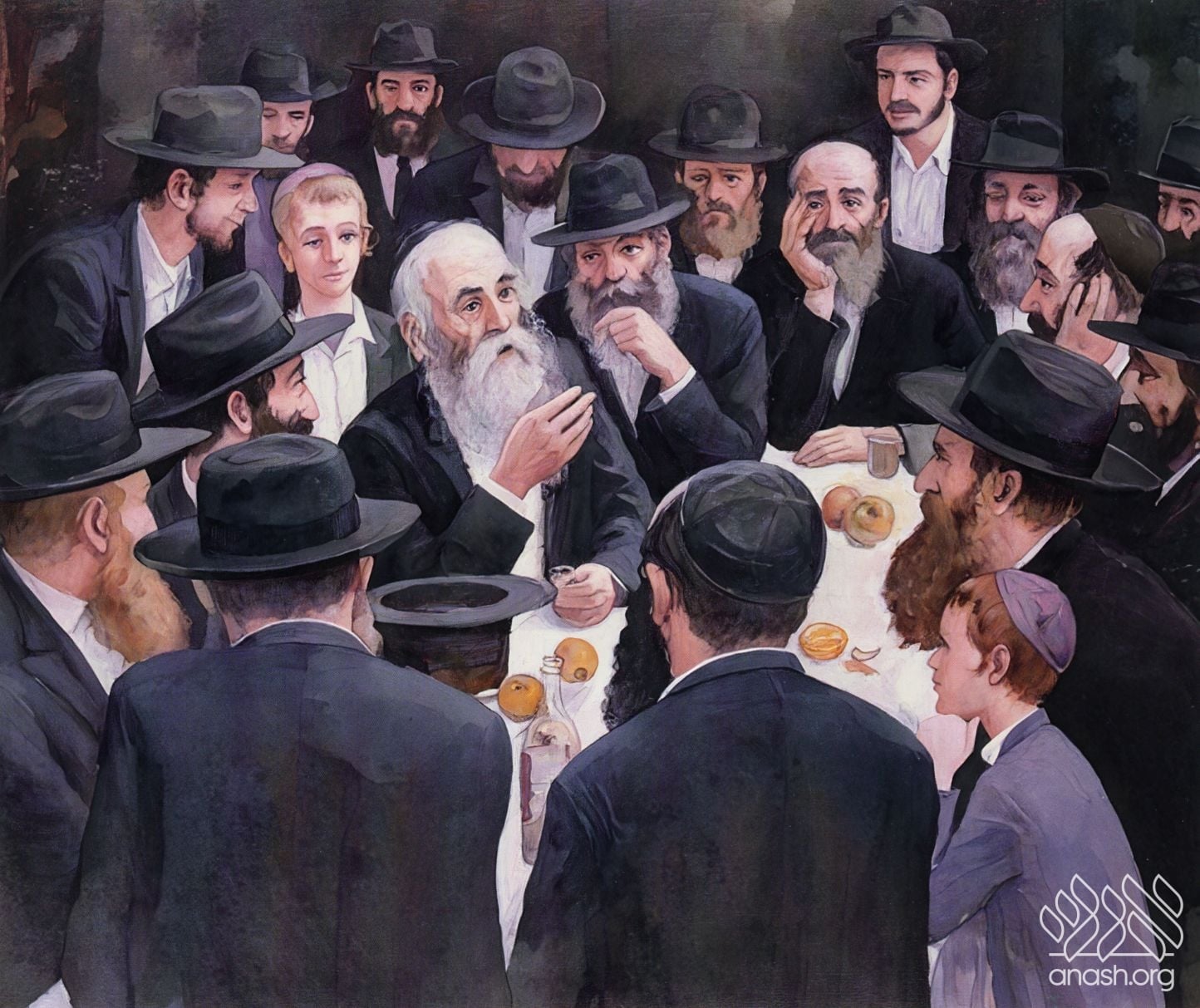
By Menachem Yakubowitz – Ki Karov Magazine
A group of Jews with different personalities sit together around a table with simple refreshments. It feels like they’ve stepped into a different world. A soft, heartfelt niggun rises; from time to time, an elderly Chossid with a noble countenance shares words of hisorerus, and everyone feels he’s putting into words exactly what they themselves wanted to say – and needed to hear.
A farbrengen is a living event. It’s the encounter of neshamos with each other – neshamos that, even while housed in physical bodies, still manage to lift themselves above the body, and in doing so lift the mundane parts of daily life into the palaces of kedusha.
The well-known book series “Farbrengen” from Maayanotecha – whose tenth and final volume just appeared at the Tzama Chassidus fair – gathers a full world of vibrant, real farbrengens from mashpi’im: R’ Chaim Shalom Deitsch, R’ Zalman Gopin, R’ Adin Even-Yisrael (Steinsaltz) a”h, R’ Shabtai Slavatitsky, and Rabbi YY Jacobson.
The originally spoken farbrengens were written and edited for print as necessary for a printed book, yet they remain authentic farbrengens. Through the pages, you still feel the energy, the ideas, and mainly the inner heartbeat pulsing in between the lines.
To celebrate the completion of the series, we compiled selections from the many volumes that paint a clear picture of what a proper Chassidishe farbrengen is. We arranged the material as a round-table discussion on the essence and importance of a farbrengen, until the text itself became a farbrengen. Take a little cup of lechayim, step inside, and warm up.
*
There’s no question that when sincere Jews sit together and sing with the heart, it creates an uplifting spiritual moment. But is that enough to explain why farbrengens are such a central pillar of avodas Hashem in the derech of Chassidus?
R’ Shabtai Slavatitsky: Chassidus distinguishes between koach and chush. Koach is an ability – the koach to think, to understand, to know. But chush means to sense, to feel, to internalize. The senses allow a person direct contact with his surroundings, to truly encounter something and absorb it.
A person can learn Chassidus very well and keep it all in his head, but it still won’t “stick.” He stays the same, and the Chassidus stays the same.
A farbrengen, however, makes the Chassidus stick to the heart.
Some people learned less, but whatever they learned became part of them. It became their personality.
R’ Mendel Futerfas used to say that a farbrengen means a person sits with himself. Even though many people are at the farbrengen, each one needs to pay attention to his own inner state – to ask: What am I taking for myself? Or am I just watching from the side like a cultural event? Throughout the farbrengen, each person must be alert, thinking and contemplating what he can take from here, and how he can strengthen his own avodas Hashem.
If everyone sits at a farbrengen and each one asks: “What change will happen in me tomorrow because of this farbrengen?” — then clearly the farbrengen is not treated as a mere social gathering, but as a central event in avodas Hashem. R’ Mendel used to put on a gartel at farbrengens – something chassidim usually wear only for davening – because he treated the farbrengen with seriousness.
Rabbi Jacobson: From the halachos of kashering keilim we learn an important lesson: even a flavor absorbed into the walls of a vessel can affect the vessel, even if you can’t see it. What matters is what happens inside.
In life, too, we focus too much on the outside. We all know the mishnah “Don’t look at the container but at what’s inside it,” or the more modern version – “don’t judge a book by its cover”. But if we’re honest, we care far more about the external than about the pnimius and too often we sacrifice the internal for the sake of appearance.
A classic example: “What will people think of us or our families?” often outweighs “What does Hashem think of me?” – even though the inner life of the home is infinitely more significant than how others perceive us.
So a farbrengen is kashering keilim – an attempt to peel away the shells and look more deeply into our avodas Hashem in daily life.
A story: In Communist Russia, one couldn’t walk in the street without ID papers. A policeman could stop anyone, and a bitter fate awaited the one caught.
One night, a chassid was rushing home after an underground farbrengen when a policeman appeared and demanded, “Who are you? Where are you going? What do you do with your life?”
The chassid, still uplifted from the farbrengen, replied: “Ah! Those are piercing questions. This is exactly what I have been occupied with these last hours…”
R’ Chaim Shalom Deitsch: The purpose of a farbrengen is to bring what’s written in seforim into daily life. You can learn many important ideas, but the goal is to live them at home, with your family, with your friends and students.
People once “complained” to me that at farbrengens, I speak too much about shalom bayis and chinuch. I admit it. Because that is the goal of a farbrengen. If Chassidus demands bitul hayesh – to subdue your ego, it must translate into how you speak and behave at home. And sometimes that means being among “those who hear their shame and do not answer.”
I knew a professor of social psychology who sat in our kollel after retiring. He was constantly amazed by how often Chassidus offered solutions to psychological problems. Many times he brought his patients to Chassidus shiurim and farbrengens.
Of course, the purpose of farbrengens is not to heal psychological issues – their purpose is to help a Yid serve Hashem. But addressing that point often ends up resolving many struggles that come from the nefesh habehamis taking up too much space.
R’ Zalman Gopin: A real farbrengen is a continuation of learning Chassidus. When people learn Chassidus together, the limud itself demands a farbrengen afterward. If people didn’t learn together, the farbrengen is more artificial — they “need” to farbreng, so they do. But when you learn together, the learning itself pushes toward farbrengen.
Why? How does learning push towards a farbrengen?
R’ Zalman Gopin: Because Chassidus, by its very nature, is Torah that obligates. It’s not understanding for the sake of understanding or knowledge for the sake of knowing. Even the deepest, most intellectual topics in Chassidus aren’t philosophy – they’re expressions of the truth of the matter. Everything Chassidus speaks about – especially in Chabad: seder hishtalshelus, Elokus, the essence of Torah and mitzvos – exists for one purpose: to demand avodah.
All the revelations of G-dliness in the world exist so that there can be avodah. We learn Chassidus to affect real change within ourselves.
One of the people who often came to farbrengens spoke with me a few times and complained that “we,” meaning those who learn Chassidus, are “never satisfied with ourselves.” He was completely right, and I’ll explain why.
A person can learn and still feel perfectly content with where he is. Chassidus doesn’t allow that. Chassidus, by its very nature, demands action.
Every maamar, every sicha, every teaching from the Rebbe – whether spoken or written – leads to a practical directive. There is always a “bottom line,” always something required of us. This isn’t just a style of presentation; the subjects themselves demand a result.
The deepest inyonim – the neshamah of a Yid, Torah and mitzvos, seder hishtalshelus, the sefiros, Elokus, ohr ha’sovev and ohr ha’memaleh – all exist for the avodah of Yidden. Once you truly understand these matters, the ideas themselves press for action.
It may demand things that we don’t always know how to interpret or put into practice, but one thing is absolutely clear: it demands something from us.
In that sense, when we learn an idea in Chassidus, the idea itself demands that we farbreng. A farbrengen doesn’t happen because we enjoy the atmosphere, or because we like the l’chayim or the farbaysen on the table. A farbrengen happens so we can speak with each other and, together, look for a way to translate what we learned into real, practical action.
To illustrate: without Chassidus, the natural assumption is that first I exist, and only afterward there is Torah, mitzvos, and Hashem. Chassidus teaches the exact opposite: first of all there is Elokus. Hashem is the certain and true reality. Only afterward do we ask: our eyes see a world – so is the world real? Is the physical reality we see and experience actually something?
What changes our perspective and flips the question is learning – for example – the discussions in Chabad Chassidus about whether Kesser is Ein Sof or a sefirah. This engrains in us the awareness that Elokus is the true reality, and only afterward do we contemplate questions like whether the world exists, what defines the world, why it was created, and why we were created.
In this way, after learning, a farbrengen naturally follows – not to give “lectures,” but to break the learning into personal, practical pieces and absorb the content of what we learned in a deep, internal way.
That’s why, after learning, there must be a farbrengen – not for speeches, but to break down what was learned into practical “pennies,” something a person can internalize and actually live with.
Can a person simply sit down at a farbrengen without preparation? Or is some preparation essential?
R’ Zalman Gopin: The pasuk says, “וידעת היום והשבת אל לבבך כי ה’ הוא האלוקים…” – “Know today and bring it back into your heart that Hashem is G-d.” Meaning: after the knowledge, you must bring the knowledge into the heart.
In one of his ma’amorim, the Rebbe Rashab raises a question. It would seem that the influence of the intellect on the heart is natural, it’s a cause and effect: a person understands something in his mind, and that understanding automatically produces feelings in the heart.
This is true in all areas, including serving Hashem. If one truly meditates on the greatness of Hashem, that meditation naturally gives rise to a feeling of love for Him. If so, why is a special mitzvah needed – “and you shall take it to heart”? Why isn’t “you shall know today” enough to produce love for Hashem? Why is an extra action – “take it to heart” – required for the idea to reach the heart?
To answer this, the Rebbe Rashab explains how emotions develop from intellect. He says that for emotions to be born from the intellect, something additional is needed between them – another link in the chain – a “hachanah,” a preparation.
What does this “preparation” mean?
“Preparation” means that the person who is meditating doesn’t approach the subject just because he enjoys thinking or likes gaining intellectual insights. Rather, he contemplates Hashem’s greatness with a clear intention: that this contemplation should lead him to love Hashem.
The Rebbe Rashab then lists practical preparations: learning chassidus before davening, feeling bitterness over distance from Hashem, saying Krias Shema al hamitah with a cheshbon hanefesh – all of which prepare the heart.
With proper preparation, the mind naturally gives birth to feeling.
The same is true with a farbrengen.
A farbrengen has its style. People share Torah, hisorerus, stories; they sing niggunim, say l’chaim, sit together with dibuk chaveirim. All that is great and important. But to be ready for a farbrengen means acting beforehand so that when you sit down for the farbrengen, you are already seeking and striving for real results – that it should have an actual, practical effect on you.
A person knows what he needs or what he wants to change. One may need to improve in tefillah, another seeks to succeed in consistent Torah study, and another wants to strengthen his observance of bein adam l’Makom or bein adam l’chaveiro. There are many things to do and improve. But the point is that the farbrengen must accomplish something.
Therefore, one should enter a farbrengen with the awareness that it obligates us. Like the famous bracha the Rebbe would send out before the major farbrengens around the world on Chassidishe dates, that they should be “active farbrengens”. That is, farbrengens that have a continuation – that influence real results and change.
Rabbi Deitsch: It is important to know that in previous generations, farbrengens were for elevated Jews – serious mashpiim, dedicated ovdim. Nothing would emerge from their mouths, however precise or well-phrased, unless they themselves had worked on it and internalized it deeply.
Nafshi yatz’ah bedabro – one could see that the Yid and Chassidus were truly one. Every word he spoke was full of life and deep feeling. He was entirely a ‘shtik chassidus’. And when words like these came from his mouth, everything sounded different. These were the people we would come to hear at a farbrengen. Their words were genuine and sincere. Every word that came from them was alive, spoken with deep feeling. Words like these truly entered the heart.
I remember how the students would plead with Reb Moshe (Meishke) Naparstek, the mashpia at Tomchei Tmimim in Kfar Chabad, to speak and farbreng with them, yet he steadfastly refused. Today, a lecturer or magid shiur is almost automatically invited to farbrengens. But it was never like that. Back then, a farbrengen was simply a reflection of the spiritual state of the one ‘farbrenging’.
R’ Zalman Gopin: Reb Chatshe Feigin once received an instruction from the Frierdiker Rebbe to farbreng with the bochurim. At the time, he was completely occupied with communal work and underground activities, and he complained that he had no time for proper learning or davening. Still, the Rebbe directed him to farbreng.
The bochurim gathered, brought some mashke and a bit of simple food, sat around the table, and R’ Chatshe took his place at the head. He sat there in silence.
Nu, it happens… sometimes a person simply doesn’t have something ready to say and needs time to think and organize his words. The bochurim sat around the table and waited. Half an hour… forty-five minutes… an hour… two hours…
Finally, the bochurim, with all their respect and bittul, said to him: “Reb Chatshe, the Rebbe told you to farbreng!”
He replied, “This is exactly what the Rebbe intended – to show that when one does not learn or daven as he should, he is unable to farbreng.”
Why is it that singing together, hearing words of inspiration, and listening to chassidus must happen specifically at a set table with refreshments and mezonos? Doesn’t this, in some way, seem to contradict the farbrengen’s purpose – to lift the neshoma and step back a bit from the vanities of the world? And why all the mashke, wine, and spirits, which at first glance don’t appear to be the path of frum Jews?
R’ Chaim Shalom Deitsch: This is how we overcome barriers. I once had a talented yungerman from the Litvishe world explain it to me: in the yeshiva world, translating learning into action happens through ‘kabalos’ – accepting obligations. But often, these are dry.
At a farbrengen, Chassidim spoke from the heart. If the words didn’t carry enough genuine emotion, a l’chaim would often precede breaking into a chassidishe nigun. In this way, the heart and action became intertwined – “Nichnas yayin, yotzei sod.”
Even as a bochur in Ponovezh, I would attend the farbrengens of Reb Shlomo Chaim Keselman. I would ask for special permission from the mashgichim to travel, and I was always granted it on the condition that I would not miss a single moment of the sedarim the next day. With Hashem’s help, I succeeded in meeting this condition.
Reb Shlomo Chaim would see me constantly, yet he did not give me any special attention. The turning point in my connection to Chassidus came at the farbrengen of 19 Kislev. I was then a 19-year-old young man and Reb Shlomo Chaim “picked” on me. I will never forget how he quoted: “They give a drink to the animal before shechita; the drink helps to remove the skin easily.”
He explained how, by a farbrengen, the drink strips away the nefesh behamis and opens the door to the nefesh elokis, which then begins to influence the body. After that farbrengen – and only after it – I knew where I was really holding.
When a Chassid takes a small drink of “l’chaim” at a farbrengen and awakens a little, he feels the special value in Torah and mitzvos. This is the essence of the “joy of a mitzvah” – the feeling of “how fortunate we are, how good is our portion.”
They relate in the name of Der Heiliger Ruzhiner that the reason Chassidim take a drink and say “l’chaim” to one another after prayer is that during prayer, the yetzer harah uses all its strength to disrupt a Jew’s davening and confuse his intentions. What did the Chassidim do? They came up with a new idea: after davening, they take a small drink and some food. When the yetzer harah sees that they are eating and drinking, it ceases its opposition.
It only opposes during davening, when a person is engaged in holy matters, but at the time of eating, it sees no reason to resist. On the contrary, it thinks these matters belong to it…
The Chassidim take advantage of this opportunity. They say “l’chaim” to one another and give brachos. And since through Torah they fulfill the obligation of davening in its proper text, these wishes carry great power…
Perhaps this is why the yetzer harah is called “an old and foolish king.” Such a fool – even after being deceived again and again, and even after farbrengens produce essential changes in serving Hashem – still does not grasp the value of a farbrengen. It cannot even imagine that a farbrengen in which “l’chaim” is said and a little food is tasted can affect great and hidden results…
R’ Adin Even-Yisroel: This is why, in Yiddish, a farbrengen is called a farbrengen. The word literally means “to spend time” – to enjoy. In old Yiddish, farbrengen di tsayt simply meant to spend time together.
Many years ago, I arrived at a Lubavitch yeshiva and tried to learn as much as I could. Suddenly, one of the bochurim called out: “Come to a farbrengen.” I replied, “I came here to learn, not to enjoy.” Yiddish is my mother tongue, but it took me some time to understand that in the yeshiva, farbrengen does not mean ordinary enjoyment.
Why do we call it farbrengen – to enjoy? Because the great accuser – the satan, the yetzer hara, the malach hamaves – when he sees people heading to daven, he knows it’s a threat to him, so he starts causing trouble right away. Suddenly, all the stray thoughts that never crossed a person’s mind all day show up right in the middle of davening. Someone is working hard to insert them and ruin the davening- he’s always sticking out a foot to trip you up.
However, when the yetzer hara hears that people are going to “enjoy themselves,” he thinks: I don’t need to interfere. They will take care of ruining themselves. He does not come. And then we have the opportunity to speak about holiness and uplift one another.
Since then, he has read all the newspapers – perhaps he even writes in them – and discovered what a farbrengen truly is. So what do we do? We set up a microphone. He assumes that only nonsense will be spoken, and so he leaves…
Why all the eating and drinking? They asked the Yid HaKadosh of Peshischa: Why do Chassidim gather and eat? Should they not be learning? He answered, citing Mishnah, Gemara, and halacha: it is forbidden to drink wine with non-Jews, because that brings closeness. But there is no issur against learning with them. From this, we learn: learning alone does not create closeness; eating and drinking together does.
It’s true that each person does their own work. In the end, everyone runs on their own. Each person walks alone. ‘Who will ascend the mountain of Hashem?’ – one at a time. Even when people walk together, they’re still each alone. Everyone has their own neshama, their own growth. There’s no such thing as a group rising together. But when people hold one another’s hands, they help pull each other upward and make sure no one falls. That’s how it has to be.
Do I love everyone equally? I don’t. But I have to feel about people the way someone feels about the limbs of his own body. Some limbs are more important to him, some less, but they’re all his. When a person sits and feels that he’s with his brothers, with people close to him, people he wants to be close to – this itself makes something happen.
It doesn’t matter whether anything was said or not, whether songs were sung or not. What matters is the simple fact that I sit, look at the person next to me, above me, behind me, and I want to be together. Because we want to reach out to one another and move in the same direction.”
R’ Shabtai Slavatitsky: About fifty years ago, a group of Chassidim managed to leave Russia. Two of them, Reb Yankel Notik and Reb Mottel Kozliner, were sent by the Rebbe to visit Harav Moshe Feinstein. Reb Moshe saw two Chassidim who had just escaped Communist Russia and asked: “How did you keep Shabbos? How did you educate your children?”
Reb Yankel replied: “Did we have any choice? We had no choice.”
Reb Moshe began to cry.
Why was this so moving? Life in Russia was full of constant danger and uncertainty. Many Jews, under extreme pressure, worked on Shabbos and sent their children to Communist schools.
Sometimes you decide to insist, and sometimes you say there’s nothing to do – it’s pikuach nefesh. There were many good Jews who, in those harsh times, went to work on Shabbos while trying hard to avoid actual melachah, and they sent their children to Communist schools. That was the reality.
It’s true that there were those who stood strong like a lion and didn’t give in. But when Reb Yankel answered, “We had no choice,” Reb Moshe suddenly understood that for him it was simple. Just as a person doesn’t need to think in order to breathe – so his Yiddishkeit worked. It wasn’t an act of heroism; there truly was no alternative. For him, yiddishkeit wasn’t something outside of life, as if you live and eat and sleep and, besides that, you also have yiddishkeit.
Rather, this was life – “for they are our life.” And this is what moved Reb Moshe so deeply that he cried.
Reb Mottel answered slightly differently: “What kept us alive were the farbrengens.”
What does that mean? Reb Motel’s answer was really a continuation of the first. The role of a farbrengen is to take everything we learn and know and bring it inside, until it becomes part of our life – part of our reality.
Reb Mendel Futerfas would say about “vehi she’amda”: the cup of wine – the lechayim – is what stood for us. It sustained us. Not only enemies like Egypt or Greece, but all forces – “not one alone” – the entire world, physicality, and desires stand against us. A farbrengen makes Yiddishkeit part of life itself, and through it, Hashem saves us.
At first glance, if someone wants to inspire himself in avodas Hashem, it seems easier to sit face-to-face and speak privately with a trusted mashpia or a close friend. So what’s the purpose of Jews sitting together in a large group?
R’ Adin Even-Yisroel: Often, what passes between the lines is more important than what is spoken.
When two Yidden join, there are two nefesh Elokis against one nefesh beheimis. The nefesh beheimis stands alone, but the nefesh hoelokis cares for the other as for itself. With a group, imagine how many nefashos Elokiyos are present – enough to overcome and crush the nefesh beheimis.
The first thing that occurs at a farbrengen is simple: people sit together and create warmth and closeness. There is a Chassidishe niggun: “What do they do in Lubavitch? They say lechayim and dance in a circle!” And of course, there is the saying of the Alter Rebbe, attributed to Reb Avrohom Hamalach: “What ten Yidden can accomplish at a farbrengen – even the malach Michael cannot!”
In a shul, one person is learning, another is davening, another is making himself a cup of tea in the corner – and together they form a holy community. It’s like this in every shul, and the same should be true at a farbrengen: a group of different people sitting together. They can either clash with one another or become one. They eat, they drink, sometimes they dance, but above all, they feel together
This unity rises to the highest of places. The highest level of the soul is called Yechida, where all souls are one.
With whom did Hashem consult when creating the world? With the souls of the tzaddikim. At that time, they were not yet righteous – they were bare souls, existing before the giving of the Torah, before Gan Eden and Gehinnom, before the world itself. Hashem asked them whether the world should be created. He consulted the neshomos of the Yidden, who sat together without coverings or layers, and through them, the decision was made whether there would be a world, Gan Eden, and Gehinnom.
At a farbrengen, one sits with his fellow the way they sit in the upper worlds, at their true source, as neshomos sit together.
We shed our false coverings. One is a great lamdan, the other anam ha’aretz – neither seems suited to sit together, yet from the source of the soul, they sit much higher. When people sit together, sip a little mashkeh, and enjoy some refreshments, they reach, in the deepest sense, the very roots of reality.
When two people sit together at a farbrengen and each thinks of the other, “I can tolerate you…,” that is the foundation of Ahavas Yisrael. One asks the other, “What will become of us?” and the reply comes, “Maybe it’s time for teshuvah.”
The essence of a farbrengen is: “Then those who fear Hashem spoke one to another… and Hashem listened and heard.”
R’ Chaim Shalom Deitsch: Torah can be learned alone. Tefillah can be davened alone. But one thing cannot be done alone: a farbrengen. It requires others, for it is through one another that we are enriched.
More than once, I’ve experienced that during a farbrengen, Hashem opens my eyes and the eyes of everyone present. It’s not just once or twice: when people come to me seeking advice on how to strengthen their yiras shomayim, sometimes I answer immediately, and other times I tell them, “Come to the next farbrengen and remind me of your question there.” And truly, that is where the right answer is revealed. In my view, there is no explanation for this other than the power of the collective.
Niggunim
A large portion of a farbrengen is dedicated to singing niggunim together – melodies that stir the heart. These are not merely ordinary musical pieces; they convey the deep inner emotions that a chasid seeks to draw forth in his service of Hashem.
R’ Shabtai Slavatitsky: Just as the purpose of a farbrengen is not to learn new things but to internalize what we already know, so too with niggunim. We sing familiar tunes again and again, with the intent that each time they become part of us.
Reb Shlomo Chaim Keselman would say: “Why do you switch from niggun to niggun? Take one and ‘kvetch’ (squeeze) it to the end. That is a farbrengen.”
R’ Zalman Gopin: The Frierdiker Rebbe divides niggunim into three categories:
(1) Niggunim Mechuvanim – composed by Rebbeim, corresponding to higher matters, such as the Alter Rebbe’s Arba Bavos, paralleling the four worlds.
(2) Niggunim Memula’im – composed by Chassidim – these niggunim are filled with the content of that heartfelt moment. This is because they didn’t go into a studio to record the niggunim. Instead, they created them during davening, while reciting Krias Shema al hamittah, or during a farbrengen. In a particular moment, their hearts would awaken inwardly, and from that awakening, the niggun would be born. When sung in davening, we add our own inner content. When sung at a farbrengen, they absorb the content of that farbrengen. Sometimes a niggun expresses yearning, other times bitterness – influenced by the time, place, and atmosphere. This is what makes a niggun truly “filled.”
(3) Niggunim Shotim – Foolish songs. They can make one dance or jump, and perhaps even stir emotion in the moment – yet they remain empty of true inner content.
There’s a significant advantage to learning niggunim at farbrengens or similar gatherings, rather than from a recording. When you learn a niggun from a professional recording, each time you play it afterward, what does it really bring to mind? Usually, it reminds you of the singer or musician, whether you liked their performance or how much you enjoyed the first time you heard it.
But when you learn a niggun at a Chassidishe farbrengen, every time you play it later, it brings back the farbrengen itself – the discussion, the atmosphere, and your spiritual state at that moment. The niggun is meaningful on its own, of course, but it gains an added layer of personal significance through your own experience – and ultimately that is what truly matters.
 COMMENTS


We appreciate your feedback. If you have any additional information to contribute to this article, it will be added below.