




ב׳ אלול ה׳תשפ״ה | August 25, 2025
War Day 688: Houthi Palace Hit, Trump Predicts War Will End in Weeks
War Summary, Day 688: Trump thinks the war in Gaza could end in 2-3 weeks, IDF inching towards center of Gaza City, troops identify threat and fire at Nasser Hospital, Iran spreading weapons production while entering negotiations with E3, Houthis fire missile with cluster bomb warhead, IDF targets Houthis in Yemen with powerful strikes, and Israel continues to strike active Hezbollah terrorists in Lebanon.
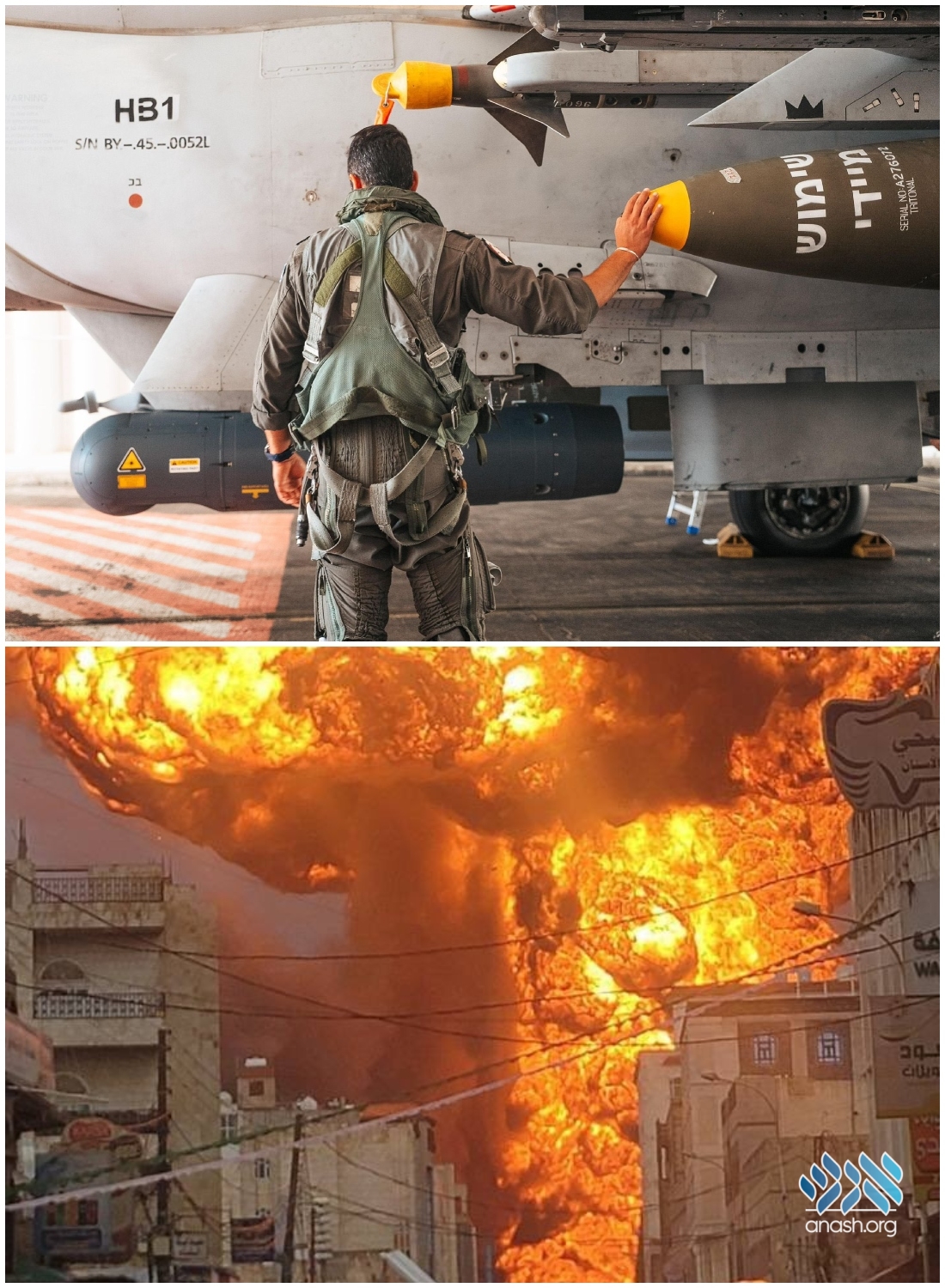
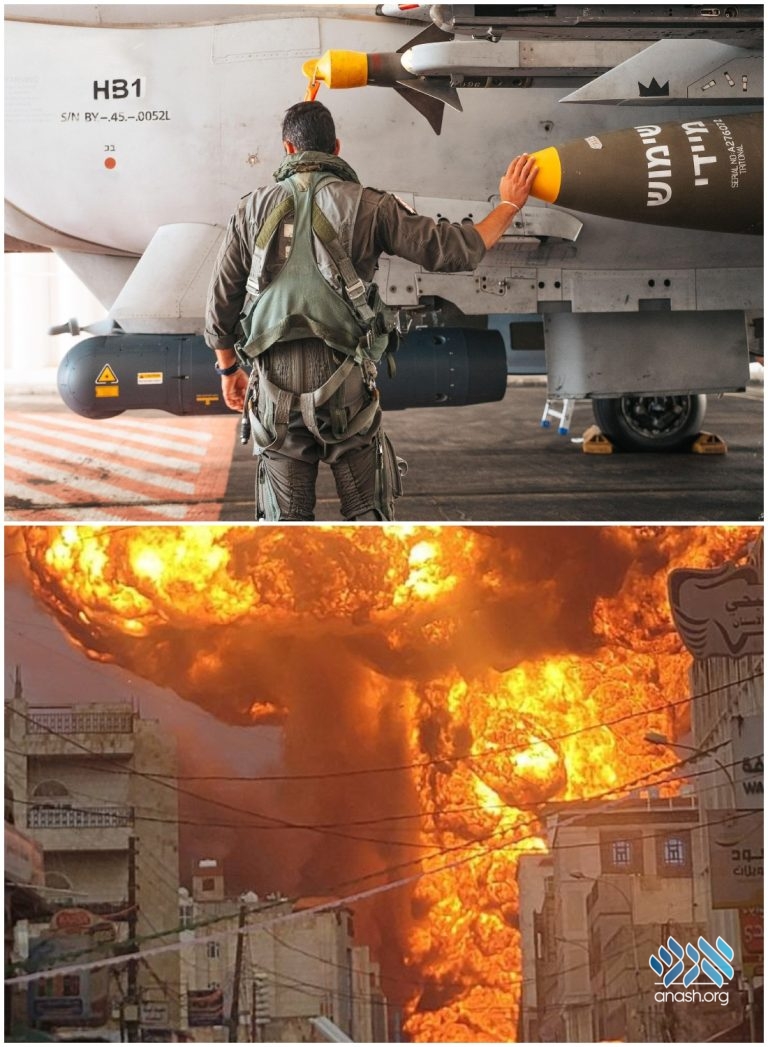
War Summary, Day 688: Trump thinks the war in Gaza could end in 2-3 weeks, IDF inching towards center of Gaza City, troops identify threat and fire at Nasser Hospital, Iran spreading weapons production while entering negotiations with E3, Houthis fire missile with cluster bomb warhead, IDF targets Houthis in Yemen with powerful strikes, and Israel continues to strike active Hezbollah terrorists in Lebanon.
By Mrs. Bruria Efune
50 held captive in Gaza.
28 hostages confirmed murdered held in Gaza.
148 living hostages rescued.
57 hostage bodies rescued.
1,917 Israelis killed.
460 fallen soldiers and police in the battle in Gaza.
88 fallen soldiers in Northern Israel.
18 fallen soldiers and police in Judea & Samaria.
32,372 estimated projectiles fired at Israel.
1 Jewish nation united in prayer, charity, and good deeds.
Top Headlines:
– Qatar is working on yet another partial hostage deal proposal
– Trump thinks the war in Gaza could end in 2-3 weeks
– Hero falls in Southern Gaza
– IDF inching towards center of Gaza City
– Troops identify threat, fire at Nasser Hospital
– Gaza flooded with aid
– IPC distorts rules to declare famine in Gaza
– Once again: photo of terminally ill child used as famine propaganda
– Papers distort facts to present false casualty numbers in Gaza
– Iran spreading weapons production, while entering negotiations with E3
– Houthis fire missile with cluster bomb warhead
– IDF targets Houthis in Yemen with powerful strikes
– Terrorists arrested in Judea & Samaria
– Israel continues to strike active Hezbollah terrorists in Lebanon
– Israel will reduce strikes if Lebanon works to disarm Hezbollah
– Details on talks and challenges between Israel and Syria
Hostages:
Reports are emerging on JPost and other news outlets that Qatar is working on a new hostage deal proposal, based off an “improved Witkoff framework.”
However, it appears that the proposal still only guarantees the release of 10 living hostages—in other words, a partial deal. Prime Minister Netanyahu already said that he would only accept a complete deal, that brings all the hostages home, and ends the war on Israel’s terms—with Hamas gone.
In a press conference today, U.S. President Trump commented on the war in Gaza: “I think in the next two to three weeks you’re gonna have a pretty good conclusive ending… It does have to end, but people can’t forget October 7th.”
It’s unclear if he said this because he thinks a deal will be made within three weeks, or he thinks that the IDF will finish the job that fast. The IDF’s current plan for Gaza does not fit in a three week schedule.
Gaza:
The IDF announced the name of a hero who fell in Gaza on Shabbat:
Lt. Ori Gerlic, 20, from Meitar.
**
Operation Gideon’s Chariots Two does not appear to have properly begun yet, but preparations are underway, with four divisions operating in Gaza:
Division 162 recently returned to Jabaliya, north of Gaza City. The troops are completing work done earlier, by locating and destroying remaining tunnels and terrorists. (This gets very loud, especially at night.)
Division 99 is operating in the Zeitoun area of Gaza City, and is slowly moving into the Sabra neighborhood, which is in the center of the city.
While there are no troops in Central Gaza, the last few days saw a couple of airstrikes in Deir al-Balah, one of which targeted rocket launchers that were primed and aimed at Israel.
Division 36 is still operating in Khan Younis, working on areas which were surrounded but not cleared until now.
On Monday morning, forces of Division 36 identified a threat in the Nasser Hospital, which is near IDF positions in east Khan Younis. Hamas is known to operate from within the Nasser Hospital. The soldiers responded to the threat with targeted artillery fire. Details about the threat have not yet been published.
The Hamas-run Gaza health ministry reported that 20 people were killed, including four journalists. Among the journalists was Al Jazeera photographer Mohammad Salama, known for enthusiastically documenting Hamas’s sickening ceremonies in which the bodies of the Bibas family and Oded Lifshitz were paraded before being returned to Israel. Salama also infiltrated Israel on October 7th, and shared videos from inside Israel, chanting “Allahu akbar!”
The IDF spokesperson office wrote that the incident is being investigated, adding: “The IDF regrets any harm to non-combatants and in no way intentionally targets attacks towards journalists as such, and acts as much as possible to minimize harm to them while maintaining the security of our forces.”
Humanitarian Aid:
In the last week, more than 1,600 trucks carrying humanitarian aid, primarily containing food, entered Gaza.
Close to 2,500 trucks of humanitarian aid were collected and distributed by the UN and other aid organizations from the Gazan side of the Kerem Shalom and Zikim Crossings. The UN is slowly catching up, and collecting the aid which has been piling up. However, most of it is still being hijacked by Hamas and other gangs, who then sell it for a profit.
In addition, an average of 130 pallets of aid are being air dropped daily.
The Gaza Humanitarian Foundation (GHF) continues o distribute around 1.5 million meals each day. The foundation is improving their processes, and now have a system which allows women, children, and the vulnerable to pre-order packages to be picked up, without walking through crowds of men.
**
On Friday, the UN-backed IPC declared a phase 5 famine in Gaza. However, the IDF’s COGAT Division refuted the validity of the report, based on three core flaws:
– The IPC refused to take into account the 10,000 trucks of humanitarian aid delivered to Gaza since May. Instead, the IPC declared the famine based on earlier assessments and predictions that ignored the trucks of aid being delivered.
– The IPC ignored the sharp drop in food prices across Gaza. For example, the price of flour dropped from $29/kg in July, to just $5/kg today.
– In other countries, the IPC declares famine when 30% of the population face malnutrition. But in Gaza they put the bar to just 15%.
**
To go with the IPC’s declaration, newspapers once again published photos of terminally ill children in Gaza, to illustrate famine.
The front page of The Daily Mirror featured 3-year-old Karim Ali Fouad Abu Mu’amar, with claims that his condition was caused by “famine” in Gaza. In fact, Karim suffers from a genetic illness known as Fanconi Syndrome, which led to muscle and urinary tract weakness. This is a hereditary disease that affected other family members as well.
**
Last week, The Guardian and other papers reported that according to the IDF database, 83% of dead in Gaza were civilians. This was outright false, based on a nonsensical interpretation of the data.
The real information is that the IDF named 8,900 of the Hamas terrorists which were eliminated—totaling 17% of the deaths. The other terrorists eliminated were either from other terror groups like the Palestinian Islamic Jihad, or simply weren’t named.
It’s actually astonishing that an army can identify the names of that many dead terrorists, especially since most of them fight in civilian clothing and hide their faces.
In fact, according to Hamas’s own data, over half of the deaths in Gaza since October 7th were combat-aged men. This is even when counting deaths of natural causes.
In Amit Segal’s words: “While combat-aged men in Gaza account for around 29% of the strip’s total population, according to Palestinian data, they’ve made up 53% of Gazan fatalities in this war.”
Iran:
Iran International reports that Iran is set to have nuclear negotiations with the E3 countries (Germany, France, and the UK) on Tuesday. Iran’s agenda is to get the sanctions lifted.
Meanwhile, Iran has made it clear that they have no intention to give up their nuclear ambitions. Iran’s Defense Minister Nasirzadeh publicly stated that “Iran has set up weapons production facilities in multiple countries, but we will not disclose their locations.”
Yemen:
The weekend saw a small escalation in the conflict with the Houthis.
On Friday afternoon, a Houthi-launched UAV (attack drone) was shot down near Israel’s border with Egypt and Gaza. Sirens were activated in several small towns in the area.
Later, on Friday night, the Houthis launched a ballistic missile towards central Israel. Sirens were activated for over a million Israelis.
Initial reports stated that the missile disintegrated midair, and interceptors were launched to break down the large shrapnel. At least one piece of large shrapnel did land in an Israeli city—thankfully no injuries were reported.
After a further investigation, the IDF determined that the Houthis had launched a missile carrying a cluster bomb warhead at Israeli civilians. The warhead broke off into several smaller missiles, indiscriminately targeting civilians.
Iran, who supplies the Houthis with missiles, had used this type of missile against Israel a few times during the 12-day war in June.
**
The IAF responded to the latest Houthi missile with airstrikes targeting Houthi military infrastructure in the Sana’a area of Yemen. The targets included:
– A military complex containing the presidential palace in the Sana’a area. This site served as the command center where the Houthi terror regime managed and coordinated its military operations.
– The Hiza power station, a key facility providing electricity that directly supported the Houthis’ military activity. Its destruction dealt a blow to the regime’s operational infrastructure.
– The Asar power station, another major electricity supplier for Houthi military purposes. Like Hiza, it exemplified how the regime exploited civilian infrastructure to advance its terrorist operations.
Judea & Samaria:
Over the last week, Israeli security forces arrested 90 wanted individuals throughout Judea and Samaria, for their ties to terrorism.
One arrest operation was carried out by the Duvdevan unit, deep inside Jenin. A large-scale operation was carried out in Shechem (Nablus).
During operations, several weapons were confiscated, including two pistols, a Negev type weapon, an M16 type weapon, a hunting weapon, and several improvised explosive devices.
**
Less than 24 hours after the attack against shepherds near Adei Ad in Samaria, Israeli forces located and arrested the terrorist, and confiscated his (failed) pistol.
Lebanon:
There does not seem to be any indication of the IDF limiting strikes in Lebanon.
On Monday, the Air Force struck a Hezbollah terrorist in the Tavin area of southern Lebanon. IDF troops of the 91st Division had identified the terrorist working to rebuild Hezbollah infrastructure in the area, in violation of the ceasefire agreement.
A similar strike on Friday eliminated a busy Hezbollah terrorist in the area of Ayta ash Shab in southern Lebanon. A second strike destroyed a Hezbollah weapons storage facility in the Dir Kifa area in southern Lebanon.
**
U.S. envoy Tom Barrack arrived in Israel and met on Sunday with Prime Minister Netanyahu, Minister for Strategic Affairs Ron Dermer, Foreign Minister Gideon Saar, and Minister of Defense Israel Katz. According to Axios, Barrack’s mission was to request that Israel restrain attacks in Lebanon, and advance talks with both Lebanon and Syria.
The Prime Minister’s Office published a statement welcoming Lebanon’s government decision to disarm Hezbollah by the end of 2025, calling it a key step toward restoring Lebanese sovereignty and stability. The statement expressed readiness to support Lebanon’s efforts and pledged reciprocal steps, including gradually reducing IDF presence in coordination with the US, if Lebanese forces move to disarm Hezbollah.
The statement did not guarantee a reduction in strikes, but put the onus on Lebanon first: “If the Lebanese security forces take steps to disarm Hezbollah, Israel will take reciprocal measures, including a gradual reduction of IDF presence in coordination with the US.”
So far, Hezbollah has expressed that they will never give up their weapons.
Syria:
IDF forces in southern Syria continue working to keep armed terrorists away from Israel’s border. Last week, forces under Division 210 completed several raids, in which they located weapons, and arrested and interrogated terror suspects.
Talks are underway between Israel and Syria—not for a peace agreement, but a “security agreement.”
According to Sky News Arabic, Syria’s al-Sharaa (aka al-Julani) is betting that an agreement will be made soon. However, U.S. envoy Tom Barrack told Axios that while both parties are talking in good faith, they are not close to finalizing an agreement.
The details and challenges of the agreement, according to Sky News Arabic:
– Al-Sharaa wants the agreement to be based on the 1974 post Yom Kippur War ceasefire line, with the IDF withdrawing from areas in south Syria which they entered with the fall of Assad. Israel wants to remain in certain key control areas in the Hermon mountain range.
– Israel doesn’t want any armed forces near the Syria-Israel border, but might agree to allow limited Syrian forces with “light weapons.” Syria wants a more significant presence.
– Israel has an interest in ensuring the safety of the Druze in Syria, but al-Sharaa drew a red line at any “independent entities,” and insists that there should be no weapons beyond the reach of the state.
– Israel wants a humanitarian axis between the Golan Heights and the Druze population in Suwayda. Al-Sharaa opposes this.
Dedicated to the courageous IDF and Israeli citizens for their commitment and endurance for justice and peace. By an anonymous reader.
WATCH:
 COMMENTS


We appreciate your feedback. If you have any additional information to contribute to this article, it will be added below.