




כ״ו ניסן ה׳תשפ״ו | April 12, 2026
Trump Orders Hormuz Blockade After Iran Talks Fail
President Donald Trump announced that the United States Navy will begin blockading maritime traffic tied to Iranian ports after Iran rejected U.S. demands in Islamabad and continued threatening one of the world’s most vital shipping lanes.
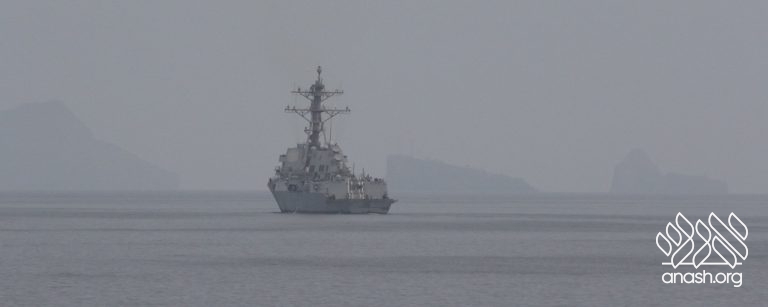
 Photo: CENTCOM
President Donald Trump announced Sunday morning that the United States Navy will begin blockading maritime traffic tied to Iran after negotiations with the regime collapsed in Islamabad, Pakistan, dramatically escalating pressure on Tehran even as the current two-week ceasefire remains in place.
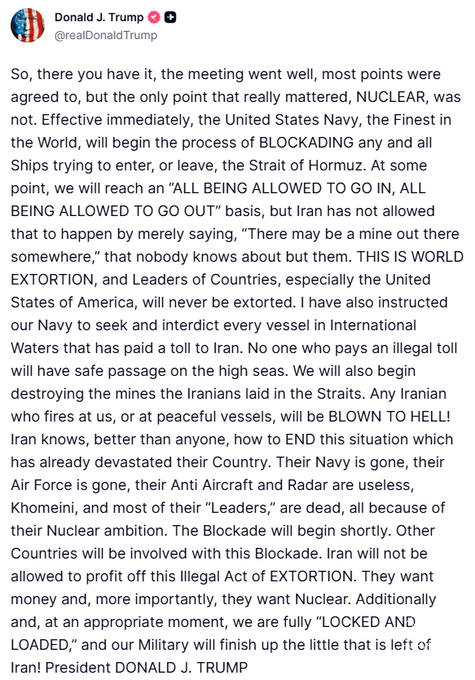
Posting on Truth Social, Trump declared, “Effective immediately, the United States Navy, the Finest in the World, will begin the process of BLOCKADING any and all Ships trying to enter, or leave, the Strait of Hormuz.” He described the move as an “all or none” policy, making clear there would be no passage until Iran complies.
The announcement came after direct talks in Islamabad, Pakistan, failed to produce any agreement. What had been presented as a major diplomatic effort instead ended after roughly 21 hours without a breakthrough, with Iran refusing to abandon the central issue at the heart of the standoff. Trump later summed that up as the “only point that really mattered, nuclear.”
The significance of the showdown is enormous. Roughly one-fifth of the world’s oil supply passes through the Strait of Hormuz, along with about one-fifth of global LNG trade, making it one of the most critical shipping chokepoints in the world. Any serious disruption there can ripple through global energy markets within hours.
Trump cast the decision as a direct response to what he called “WORLD EXTORTION,” accusing Iran of threatening the global economy by suggesting there are mines in the waterway while demanding illegal payments for so-called safe passage.
He said Iran “will never be allowed to extort the world,” and insisted there must be free passage through the strait with “no illegal tolls” and no payments to Tehran for ships to move safely through international waters.
Under the new policy, Trump said the Navy will “seek and interdict every vessel in International Waters that has paid a toll to Iran.” He added a blunt warning to shippers and operators participating in that arrangement, writing, “No one who pays an illegal toll will have safe passage.”
Trump also said American forces will work to locate and destroy all mines laid by Iran in the strait, expanding what had already begun as military preparations in the area. He warned that any Iranian force that opens fire on U.S. or peaceful commercial vessels will be blown up.
In a follow-up statement, U.S. Central Command said its forces will begin implementing the blockade at 10 a.m. Eastern Time on Monday, April 13. CENTCOM said the action will apply to “all maritime traffic entering and exiting Iranian ports,” including ports on the Arabian Gulf and Gulf of Oman.
At the same time, CENTCOM clarified that its forces “will not impede freedom of navigation” for vessels transiting the Strait of Hormuz to and from non-Iranian ports. In practice, that means the pressure is being aimed directly at Iran’s maritime access while still allowing other shipping traffic to continue moving through the area.
The move comes in the middle of the current two-week ceasefire, under which America halted its attacks on Iran and forced Israel to stop its direct strikes as well. For many living in Eretz Yisrael, or who are learning in yeshivos and seminaries there, the pause has brought real relief, with airports reopening, bombardments paused, and families no longer running to bomb shelters day and night.
At the same time, many remain deeply uneasy with any arrangement that leaves the Iranian regime standing and its terror apparatus intact. The concern remains that Tehran will use the pause to regroup, rearm, and continue threatening Israel and the region.
Trump has suggested the ceasefire could continue longer if Iran changes course, but with the Islamabad talks already collapsed and the naval blockade now set to begin, what comes next is far from clear.
 COMMENTS


We appreciate your feedback. If you have any additional information to contribute to this article, it will be added below.