



ה׳ שבט ה׳תשפ״ו | January 22, 2026
The Vermont-Born Rov Who is Creating a Global Halacha Revolution
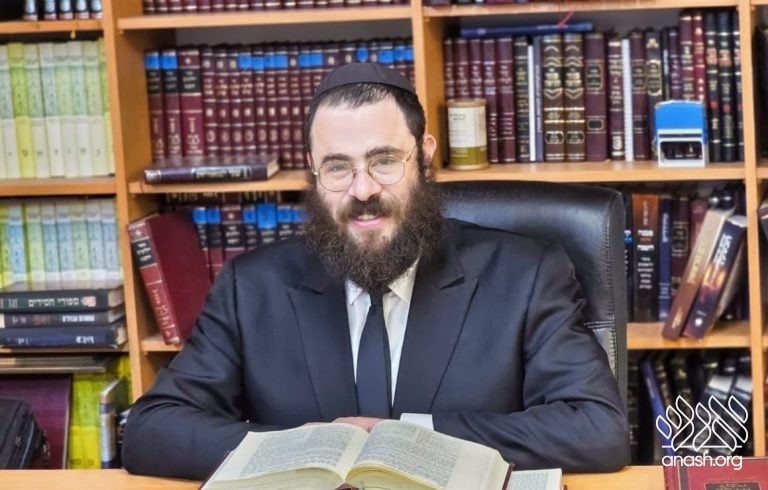
Rabbi Chaim Hillel Raskin is well known to English readers for his weekly halacha column and his leadership of Kolel L’Rabbonei Chabad. But in his hometown of Petach Tikvah, Rabbi Raskin has created nothing short of a Torah revolution – and a model for Chabad communities everywhere.

By Mendy Kortes – Kfar Chabad Magazine
A faded black-and-white photograph, taken decades ago – nearly a century – shows the veteran Tzemach Tzedek shul in Petach Tikva during its early years. The image shows a modest, single-story rectangular building, with thick stone walls and a sloped tiled roof. At the front, there is a small wooden annex with a tiny window, attached to the main building like an added room.
There is something quietly simple about this nostalgic scene. It carries a strong, authentic flavor of the past. The area around the shul looks undeveloped: bare earth, traces of mud, and stones.
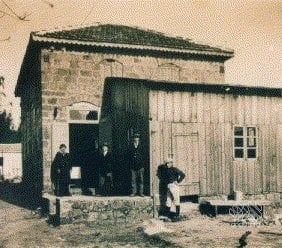
The shul was founded around 114 years ago, in 5672 (1912). It is one of the oldest shuls in Eretz Yisroel that is still in use. The man who built the shul, whose name is still displayed on its façade, was the Chabad benefactor Rabbi Gershon Antigon. He came to Eretz Yisroel in the late 5660s and settled in Petach Tikva near the local market. He bought land in the active colony, and not far from his home, he established a shul named after the Tzemach Tzedek.
“Those who sow in tears will reap in joy.” The small building photographed at its founding has grown considerably over the years. Today, alongside the main shul, there is a women’s section, a large second hall, a children’s room, and a bomb shelter.
But the exterior is mostly just scenery. The real life happens inside. Every day, the shul is bustling with people: dozens of Anash, bochurim, baalei teshuvah, and mekuravim, all bent over seforim, immersed in deep study.
The story of the Chabad community in the heart of Petach Tikva today, nearly 120 years after its beginnings in the early decades of the previous century, is a unique, rich, and compelling one. Among those who have shaped it with particular skill is the community’s rabbi and mara d’asra, Rabbi Chaim Hillel Raskin.
Rabbi Raskin arrived in the city just seven years ago. Today, several hundred Chabad families live throughout Petach Tikva, scattered across different neighborhoods, with about half concentrated in the city center.
“Currently, there are around ten Chabad minyanim across Petach Tikva,” Rabbi Raskin presents the basic numbers, “some in Chabad houses and similar locations. So, whereas in the past most of the community would come specifically to daven in the Chabad shul, today there are other places to daven.”
But the central hub of life is the Tzemach Tzedek shul, which has served the community since its earliest days. The Chabad community in Petach Tikva is one of the oldest Chabad communities in Eretz Yisroel. Among those who davened in the shul were the well-known chassid Reb Avraham Pariz, and his father-in-law, Reb Gershon Ber Feigin, who is also buried in the city. Incredibly, the shul has operated continuously since its founding until today.
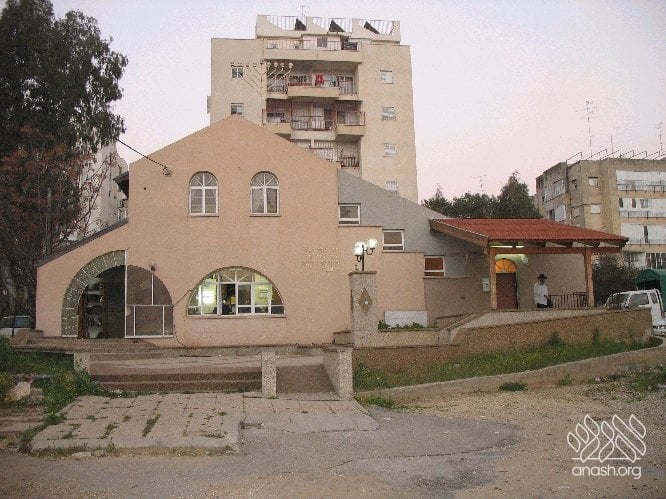
“In later years,” Rabbi Raskin relates, “Harav Dovid Chanzin, one of the prominent Chabad rabbonim, led the community. Over the years, the shul was also expanded. The gabbai, Reb Tzvi Lipsker, one of the pillars of the community, worked among other things to enlarge the building. And in the last few years, the gabboim expanded the shul further.”
Harav Chanzin passed away in 5763 (2003). In the years following his passing, a certain leadership gap emerged in the longstanding community. Around the same time, in 5762 (2002), the gabbai Reb Tzvi Lipsker passed away. His son, Reb Naftali Lipsker, was appointed as his successor, guiding the continued development of the shul.
In recent years, the community has experienced significant growth, with young Anash families moving to the city. At the same time, additional volunteers joined to support the community’s growth, including the shul gabbai, Reb Efi Segal.
All of this led to the search for a dynamic rabbinical figure to continue the momentum of the community. Such a figure was found in Kfar Chabad Beis. On Motzei Shabbat Selichos of 5778, elections were held among the community members, and at their conclusion, Rabbi Raskin was chosen for the position.
He is in his early forties. He speaks with passion and warmth, is relatable, and his presence exudes genuine Torah stature. Today, he leads significant learning projects in Petach Tikva and around the world, some of which we will elaborate upon. He is determined to instill and deepen a love of Torah and active engagement in Torah study in those around him.
Rabbi Raskin grew up on shlichus. He is the eldest son of the shluchim in Burlington, the largest city in Vermont, USA, Rabbi Yitzchak and Mrs. Zisa Raskin.
“In my childhood, there was no Jewish school in our shlichus area,” Rabbi Raskin told Kfar Chabad this week. “My siblings and I studied independently with our parents and with bochurim and yungeleit who came to assist on shlichus from time to time. Periodically, we would travel to Crown Heights for several days, about a week, and during that time, I would attend Oholei Torah for short learning sessions. My parents made sure my level of learning was always on par with my peers studying at Oholei Torah.”
“When I was ten, toward the end of fifth grade, I began traveling regularly to New York to attend cheder as a full student in Oholei Torah. This followed the guidance that my father had received from the Rebbe when he was a young boy. My father grew up in Casablanca, Morocco, as the eldest son of the shluchim Rabbi Leibel and Reizel Raskin.
“As a child, around age nine or ten, he already wanted to travel to study in Brunoy, France, but his mother wanted him to stay home a little longer. The question was brought to the Rebbe, and the answer my father received was ‘eim habanim semeicha,’ the mother of the children is to be happy. So he remained in Morocco a while longer.”
“Following his path, I also ‘left home’ only around age eleven. In sixth grade, I studied at the Cheder in Montreal. I would travel home once a week for Shabbos and spend the rest of the week in Montreal. After completing elementary school, I continued in the mesivta of Detroit, then zal in Detroit, and later in Oholei Torah.”
After finishing his studies at Oholei Torah and after a year of shlichus in Chicago, Rabbi Raskin began semicha. He received semicha in Morristown and later traveled on shlichus to Maayanot in Yerushalyim. During those years, he also began taking the challenging Rabbanut exams at Heichal Shlomo.
In 5766 (2006), he got married to Chana, the daughter of Rabbi Moshe Chefer, director of Beis Rivka in Kfar Chabad, and settled in Kfar Chabad Beis. Over the years, he served as a moreh tzedek in the local shul. At the same time, he devoted all his time to rabbanos and dayanus at the kollel “Or Yaakov v’or Zroa” in Rechovot, under the leadership of Harav Meir Aharon. For nearly fifteen years, he was among the kollel’s dedicated students.
He is a devoted student of Rabbi Aharon. “Those who set me on my feet in Torah were, first and foremost, my father, who always had a ‘koch’ in learning and instilled it in me and my siblings; my grandfather, the philanthropist Reb Shmuel Aizik Popack, who, although a businessman, I saw up close dedicating himself with enthusiasm to learning every free moment, maintaining five or six regular chavrusas. Thanks to him, I was able to devote time to learning after marriage. I also learned a lot from the maggidei shiur in the yeshivas I attended, each according to his own stature and subject, and of course, last and dearest, Harav Aharon.”
“Harav Aharon believed in his students and constantly pushed us forward. He had vision. He encouraged me to study for neighborhood-level rabbanut, then city rabbanut, and then dayanus, never to settle for what I had already learned. He didn’t just convince me and support me along the way; he also ensured that his students would become poskim themselves, with all that entails.”
“I’ll share an example: Approaching Pesach in my first year as a rov in Petach Tikva, I called Harav Aharon and asked to transfer all the community members’ mechiras chometz documents to him to perform the sale himself, a common practice among rabbonim joining together for chametz sale.
“Although I knew how to sell chametz on my own, and in earlier years I had assisted in chametz sales with rabbonim I had worked with, I still wanted to join an existing sale. Harav Aharon immediately said: ‘You are the rov in Petach Tikva – sit, review the halachos again, and perform the sale yourself.’ He pushed us to stand on our own strong feet without fear or hesitation. This expressed itself in many examples.”
“Anyone who spoke with Harav Aharon saw someone fluent in Shas and poskim, with broad shoulders. Until his passing, he was often my first call for various halachic matters. I consulted him frequently. Today, after opening the kollel here, I realize even more how much I learned from him.
“Many times I stop and think: What would he have done in this situation? And I plan my steps accordingly. I can see how significant, deep, and fundamental the lessons he instilled in us truly were.”
Rabbi Raskin says he came to Petach Tikva with a clear mission, a goal.
“I always felt that shlichus is not just going to a remote, spiritually barren place, such as where I grew up, but also – and especially – even within Anash, within our own community. Today, Chabad consists of many styles and backgrounds. There is much to do and many areas to advance within Chabad itself.”
“When I arrived in Petach Tikva in 5779, I began working to strengthen and expand the community’s Torah life. I had a clear vision of what was needed.
“Once, I heard from Rabbi Tzvi Grunblatt, the head shliach to Argentina, that when he set out on shlichus, Rabbi Chadakov told him to draw and map out how he wanted his shlichus to look, like an engineer preparing a blueprint of a building. Then, during the shlichus, build the plan floor by floor, brick by brick, until the building envisioned at the outset is actually constructed.”
The young rabbi of the Petach Tikva community rolled up his sleeves and got to work. The first step was a dramatic expansion of shiurim.
“From the very beginning, I knew there had to be a focus on the Torah element and to infuse meaningful, substantial content into the community. Torah study elevates a person, no matter their situation.
“We began opening new shiurim – first on Friday nights, then every Monday – and gradually, shiur by shiur, until today there are one or two shiurim every day in the shul. Some shiurim I teach myself, others are taught by knowledgeable community members. In addition, there are shiurim for women.”
The next stage was children and youth activities. Mrs. Raskin opened large and successful groups for elementary and high school girls. For boys, Rabbi Raskin founded a Yeshivas Erev several days a week. In the summer, he established a summer yeshiva for bochurim.
Alongside his various rabbinical responsibilities, Rabbi Raskin oversees the management of all these programs. He ensures that each activity has the appropriate leadership, seeing it as an integral part of his shlichus.
But the crowning achievement was yet to come.
Nearly two years ago, the moment arrived to build in practice the main “floor” envisioned in his initial plan: a kollel for yungeleit.
“It was a long-standing dream,” Rabbi Raskin says, “but it took time to fulfill, both because of the high cost of the project and because I personally needed to complete my dayanus studies first. Only after finishing those studies did I devote myself to establishing the kollel.”
Today, nearly twenty yungeleit learn in the kollel. They come from Petach Tikva but also from cities across the region.
“I try to emulate the path Harav Aharon led and instilled, encouraging the yungerlait to take exams at Heichal Shlomo and study halacha in depth. Even a yungerman who studies in the kollel for only one or two years can focus on a specific halachic area and be tested on it.”
Rabbi Raskin serves as the head of the kollel and personally delivers shiurim to the yungerlait.
“There are shiurim, there are tests. The kollel is active every day, and the yungerlait learn until five in the afternoon. The city’s rabbi, Rabbi Micha Halevi, also greatly appreciates the kollel and recently came to give a shiur himself.”
According to Rabbi Raskin, anyone who wishes to join is welcome. Among those learning are also fresh baalei teshuvah. The guiding principle is the yungerman’s desire to dedicate himself to learning.
“When someone wants to join the kollel, I ask why he wants to join. If the answer is ‘because it’s what we do after marriage’ – that’s not a good answer. Our kollel is characterized by members who genuinely want to learn, invest themselves, and be tested and advance. I believe the atmosphere in the kollel is excellent, and its reputation has spread far.”
As is customary, the yungeleit receive monthly stipends.
“In the first year of the kollel, my friend Oz Avrahami, a city resident who, through his work in the shul over the years, became an integral part of the community and now manages the kollel and the yeshiva, and I had to travel tirelessly to secure funding – from here and there. As we neared 5786, I seriously wondered how we could continue sustaining the kollel.”
On 12 Sivan of last year, the community lost Mrs. Dina Rina Chanzin, the daughter-in-law of Reb David Chanzin, the community’s unforgettable rabbi. Her husband, Reb Yaakov Moshe Chanzin, who passed away suddenly at age 53, had learned in kollel in Kfar Chabad all his years until his passing.
Following Mrs. Chanzin’s passing, their son, R’ Mendy Chanzin, a successful businessman from Mexico and a native of Petach Tikva who grew up in the shul, took on the responsibility of maintaining the kollel. Since then, the kollel has been dedicated in her memory and named “Rani v’Smichi bas Tzion” (her name was Rina Dina bas Reb Tzion). The kollel operates in a room in the shul called “Yankel’s Shul,” built by Rabbi Mendy Chanzin in honor and memory of his father.
Reb Mendy Chanzin, together with other dedicated supporters, regularly sustain the huge project in Petach Tikva. The “Project” – because the kollel is only one part of the larger Torah mosaic in Petach Tikva.
In recent months, Rabbi Raskin established a yeshiva framework in the shul for older bochurim.
“We opened a yeshiva called ‘Ba’avur David Avdecha,’ in memory of Reb Dovid Chanzin. It was his dream that a yeshiva operate in the shul, and now, more than twenty years after his passing, the dream is being realized.”
The yeshiva, also supported by R’ Mendy Chanzin, is a full yeshiva framework, including dormitories and three meals a day. The bochurim have the opportunity for both advanced semicha learning, and they receive material support. There is a kitchen providing meals daily for both the kollel and yeshiva bochurim. A mashgiach and mashpia guide the bochurim throughout the day in nigleh and chassidus.
Both the kollel for yungeleit and the yeshiva for bochurim operate within the historic Tzemach Tzedek shul.
“Although these are two separate frameworks, they intersect: sometimes a bochur starts in the yeshiva and later, after marriage, moves to the kollel. There is also some overlap in study content.”
The yeshiva for older bochurim also includes a shlichus component. They are assigned to various activities in the community – for example, running children’s programs. The bochurim also spend Shabbosim with community families, bringing chassidic chayus into homes. But above all, the focus in the yeshiva is on high-level, in-depth study.
The shul houses a very rich library, existing for decades. Reb Yosef Yitzchak Chanzin, son of Reb Dovid Chanzin, raises funds for it and ensures its development. Recently, with the establishment of the kollel, the library expanded significantly, with a wide and diverse range of learning materials.
Rabbi Raskin refers to a sicha of the Rebbe on Shabbos Parshas Eikev, 25 Menachem Av. 5733.
“The Rebbe expressed that in Lubavitch, there was no kollel, and it was a concept the Rebbe himself innovated. The Rebbe said it was his ‘personal desire’ that yungeleit after marriage sit and immerse themselves in pure Torah knowledge. He said that sometimes people visit other communities, enter batei midrashim, and see yungerlait learning with passion, and he wanted that to exist in Lubavitch as well.”
“I strive to implement this, ensuring that the learning in the kollel and the yeshiva is full of chayus, with discussion and debate among its members. We place great emphasis on learning the Alter Rebbe’s Shulchan Aruch with the Kuntres Acharon, directing study so that the yungeleit and bochurim have great passion for learning.”
In recent years, alongside his work with the Petach Tikva community, Rabbi Raskin has served as a dayan on the Beis Din Rabbonei Chabad in Eretz Yisrael. In addition, he serves as head of the Kollel L’Rabbonei Chabad under Merkos L’Inyonei Chinuch, designed for shluchim in the US and around the world, which really deserves its own conversation. But in short, the kollel is intended for shluchim who serve as rabbonim, functioning as a kind of advanced training program for rabbonim, with a focus on halachic topics relevant to shluchim.
“This year, the kollel is studying the halachos of mikvaos,” Rabbi Raskin shares. “The study is in-depth, following the Tur, Shulchan Aruch, and Beis Yosef in order. The format is that at the beginning of each week, there is an opening Zoom shiur covering the material. During the week, the shluchim study the halachos together – usually in chavrusos that we help arrange for them.
“At the end of the week, there is an analytical shiur, with a variety of magidei shiur – sometimes expert rabbis who come specifically for this. I give a halacha l’ma’aseh shiur alongside Rabbi Tuvia Kasimov, a moreh tzedek in Crown Heights. Like any kollel, there are tests and certificates as customary.”
Rabbi Raskin concludes with some personal inspiration:
“We are now in the preparation days leading up to Yud Shevat. There is a sicha of the Rebbe in chelek 16 of Likutei Sichos where the Rebbe mentions two points from the Frierdiker Rebbe, both connected to learning halacha: opening batei midrash for rabbonim and educating Yiddishe children. The Rebbe directs us to implement this practically – to study and dedicate ourselves to halacha l’ma’aseh.
“When my father had his bar mitzvah, he spent the summer in Morocco learning with mekuravim. He planned to travel to the Rebbe, and before setting out, his father told him to prepare a duch for the Rebbe, detailing his activities. My father did so, listing the shiurim he gave to mekuravim and his learning with them. Shortly after submitting the letter, the secretary, Rabbi Binyamin Klein, called for him.
When my father arrived, Rabbi Klein told him: ‘The Rebbe saw your report on your activities with the mekuravim and asked: What did you learn for yourself?’
“This shows that there is certainly value in working with the ‘chutza,’ but no less important is the Rebbe’s question for us Chassidim: How are we progressing ourselves? Each person in their place. When the Rebbe expresses his desire that yungeleit immerse themselves in Torah, he means it literally – that every chossid dedicate himself to learning as much Torah as possible.
“There is great merit in studying halacha, as it is known that ‘devar Hashem zu halacha.’ It has also been shown that today, people often search for purpose, and studying halacha connects people and gives them the drive to continue learning. In any case, everyone can learn what their heart desires – pick up a sefer from the library; there are so many, and one can dive deeply into Torah study.
“I recently heard from one of the members of the shluchim kollel that his participation completely changed his life. He is a yungerman who also works as a melamed in a cheder. He told me that suddenly, his children at home see their father dedicating structured time to learning for himself. His students also recognize that their teacher has his own shiurim for personal advancement in learning. It impacts his home and his students – beyond imagination.
“Now, on the eve of Yud Shevat, it is the opportunity for everyone to make a good hachlata to add more and more Torah learning, in accordance with the Rebbe’s desire.”
*
Personal Memories
As a young child, under ten years old, Rabbi Raskin experienced many moments with the Rebbe that left a lasting mark on his memory.
“Because my parents’ shlichus was only a few hours’ drive from New York – about six hours by car – it happened that from time to time I would travel to the Rebbe,” he recalls. “For example, I would go with my father for Shabbat Bereshis, then to the Kinus HaShluchim, and again for Yud Shevat and Chof Beis Shevat, and so on.
“The memories etched in me are mostly from the early 5750’s. I remember in particular a simple moment that repeated itself while waiting in line for the dollar, through the eyes of a small child: You stand there in line for a long time, among many people waiting for their turn with the Rebbe. The line moves forward, and finally, you ascend the steps into the lobby of 770. And then, at the moment you cross the corridor where the Rebbe stands, a silence of awe forms in the background. There’s electricity in the air.
“There was one time when my uncle, Rabbi Tzvi Hirsch Raskin, now in Montreal, told me that after receiving the dollar, one should say ‘thank you’ to the Rebbe. His words stayed with me. I believe it was in 5752. When it was my turn, I received the dollar directly from the Rebbe and immediately said, ‘A dank, Rebbe.’ A broad smile spread across the Rebbe’s face. Later, my uncle, standing nearby and curious, asked me why the Rebbe smiled at me when I passed. I told him: It’s thanks to you.”
Rabbi Raskin also shares personal memories of his grandfather, the shliach to Casablanca, Rabbi Yehuda Leib Raskin.
“In his later years, I traveled to him twice, as a bochur, for Pesach in Casablanca – once with another cousin and once alone – and during that time, I had many hours of quality time with him. He shared many stories. It seemed that my grandfather had a desire to tell us as much as possible.
“One story he told was from his youth. He had been in Eretz Yisrael, having arrived from Europe shortly after the state was established, after successfully escaping the Soviet Union with his family using forged Polish documents. He wanted to leave Eretz Yisrael to travel to the Rebbe, but couldn’t, as he needed an exit permit. He sent a personal letter to Ben-Gurion, recounting his story and explaining that he was a bochur from Russia, newly arrived in Eretz Yisrael, and longed to travel to his Rebbe in New York.
“My grandfather told me that in response, he was summoned to meet with Nechemia Argov, one of Ben-Gurion’s close associates and his military secretary at the time. At the beginning of the meeting, my grandfather asked if Argov could speak Yiddish, and Argov agreed. Argov presented him with a question on behalf of Ben-Gurion: How is it possible that a young man raised under Communist Russia would feel such passion and yearning to see his Rebbe? Ben-Gurion wanted to understand how such a thing could exist.
“My grandfather answered Argov that in Lubavitch, the Rebbe is like a father and the Chassidim are like brothers, and the love between the Chassidim gives them the strength to survive all of Communism.”
Reprinted from Kfar Chabad Magazine with permission.
 COMMENTS


Thanks for posting!
Great article! Thanks for translating and sharing.
I understand that Rabbi Laibel Raskin was his grandfather (not great grandfather)
Knowing Rav Raskin personally, I think the writer failed to bring out what a rare unique talmid chochom he is. Years of hasmadah and chazarah, coupled with sitting at the feet of numerous gedolei haposkim have developed him into the dayan and posek he is!
Kudos to anash.org for highlighting an example of new rabbinic leadership in Chabad.