



י׳ שבט ה׳תשפ״ו | January 28, 2026
The Story of Basi Legani Through the Years
The highlight of the Yud Shevat farbrengen each year was undoubtedly the Ma’amor “Bossi Legani.” It was with this inaugural ma’amor that the Rebbe formally accepted the Nesius of Chabad and outlined the framework for the mission of our generation. The following is an in-depth overview of the Rebbe’s Bossi Legani ma’amorim throughout the years.
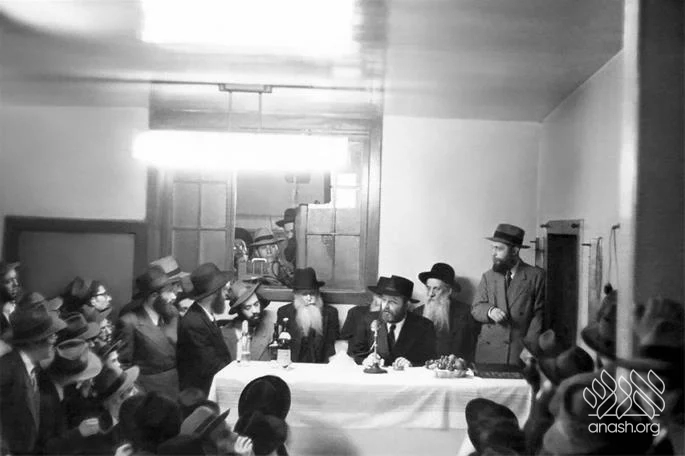
The highlight of the Yud Shevat Farbrengen each year was undoubtedly the Ma’amor Bossi Legani. Beginning with the year 5711, it was with this Ma’amor that the Rebbe finally accepted the Nesius of Chabad in a formal manner, and this inaugural Ma’amor, he laid the framework for the mission of our generation, Dor Hashv’i.
Each year, the Rebbe would expound upon another section of the Ma’amor while quoting from the Torah of each of the preceding Rabbeim.
The following is an overview of the Rebbe’s Bossi Legani Ma’amorim throughout the years.
*
Towards the end of the Frierdiker Rebbe’s Nesius, due to his poor health condition, he was no longer able to say Ma’amorim. In place of this, at the approach of each Yom Tov and special day, he would give out a Ma’amor which he had recited in previous years. He would add onto them a “Dibbur Hamaschi” and summaries. These ‘new’ Ma’amorim were given out to be printed and publicized.
In addition to this, he requested from the Rebbe, who was in charge of putting together and publishing these Kovtzim, to add a “Pesach Dovor” (introductory paragraph), footnotes and sources, and a few other additions to the main body of the Ma’amor as well as to the Koivetz.
These Kuntreisim were distributed throughout Lubavitch communities, with one condition: they should be learnt on their intended date. On the international map, many Rabbonim and Mashpi’im received them in the mail, again with the condition that they learn and teach it.
Upon the Frierdiker Rebbe’s will, the Rebbe would also pen a letter, which was sent along with the booklet.
REBBETZIN RIVKAH’S YAHRTZEIT
In continuation of this practice, a “Hemshech” (a series of Ma’amorim) was being prepared in honor of 10 Shevat 5710, the Yortzeit of the Frierdiker Rebbe’s grandmother, Rebbetzin Rivkah, wife of the Rebbe Maharash. For this kovetz, the Frierdiker Rebbe chose a Hemshech of four Ma’amorim which he had said 27 years earlier on Yud Shvat 5683. The Hemshech is divided into four parts, each one containing five Perokim. The first part, as mentioned, was prepared for Yud Shevat with an introduction and summaries added to it. The “Dibbur Hamaschil” it was given is from a Possuk in Shir Hashirim; “Basi L’gani”.
The second part was dated for 13 Shevat in honor of Rebbetzin Shterna Sarah’s Yahrtzeit, the Frierdiker Rebbe’s mother.
Following its opening Ma’amor, it also received an introduction and summaries as well as another Possuk from Shir Hashirim for its Dibbur Hamaschi; “Hayosheves B’ganim”. The third part was scheduled to be published for Purim, and the fourth in honor of 2 Nissan, the day of the Rebbe Rashab’s Histalkus. The second two, however, still needed work done on them.
The first two parts were printed in one Kuntres; Kuntres 74. On Friday, 9 Shevat, it arrived back from the printer. A few of the more attentive Bochurim took note of a strange phenomenon that appeared in the newly written Pesach Dovor: in the Frierdiker Rebbe’s title – Shlita, the Yud was missing. Just a day later, this small ‘mistake’ would take on a whole new meaning…
The Frierdiker Rebbe wanted the first Ma’amor, Basi L’gani, to be learned on that Shabbos in public.
The Rebbe was the one who brought it into the Frierdiker Rebbe’s room. In a special Reshimah which is printed before the Ma’amor, the Rebbe describes what transpired:
“The Ma’amor (the Kuntres) came back from the printer on Friday, 9 Shevat. When I brought the Kuntres to the Frierdiker Rebbe, I found him in his room — the one in which he davened and held Yechidus — sitting down with his Siddur (Torah Ohr. Brooklyn 5701) opened to page 45, at the end of “Hodu” right before “Posach Eliyohu”. I placed the Kuntres on the table, and he nodded his head, showing his approval and great satisfaction.
The next day, Yud Shvat, Shabbos Parshas Bo, at eight o’clock in the morning, he was Nistalek. And from then on, many Chassidim and Anash accepted upon themselves to learn this Ma’amor on Yud Shevat, his Yom Ha’hilula. It has already been established with its name; Basi L’gani 5710…”
THE LIVING MAAMOR
After the Histalkus on Yud Shvat, it became apparent that the Ma’amor Basi L’gani had been given out in connection with the Histalkus of the Frierdiker Rebbe. At farbrengens and in letters, the Rebbe labeled this Ma’amor as “The Ma’amor of the day of Histalkus”, or “The Ma’amor that the Rebbe prepared for the Histalkus.”
Throughout the year following the Histalkus, the Rebbe carried a copy of the Ma’amor in his Siddur and would be seen looking inside it. During Farbrengens and letters written in that year, it was common for there to be mention of ideas explained and brought down in that Ma’amor.
As the first Yortzeit approached, the Rebbe strongly encouraged the Chassidim to learn the Ma’amor. Emphasizing that in addition to simply studying it, one should learn it by heart, thereby engraving the words in one’s mind.
In a letter written for Rosh Chodesh Shevat of that year, the Rebbe addressed Anash, the Tmimim, and all those close to Chassidim and Chassidus around the world, arousing them to learn the Ma’amor Basi L’gani on the night and day of the Yortzeit.
In another letter, which is commonly known as the famous Yud Shvat letter, the Rebbe writes in detail all the Minhogim that the Chassidim should do in honor of the Histalkus and included in there is an exact schedule of how and when the Ma’amor should be said on Yud Shevat.
Many years later, at the Farbrengen of Shabbos Parshas Bo 5748, the Rebbe added to this and encouraged the Chassidim to learn the Ma’amor on the Shabbos before Yud Shevat as well.
Throughout the years, the Rebbe stressed time and time again the need to fulfill the Minhogim of the Yom Hahilula and even instructed the Kfar Chabad magazine to publish the letter.
The Rebbe once exclaimed, “The Baal Hahilula gave out the Ma’amor so that it should be learnt on the day he was Nistalek and in the years to come.”
A YEAR OF APPREHENSION – YUD SHVAT 5711
As the true extent of the shock and tragedy of Yud Shevat became a reality, the Chassidim turned to the Rebbe for leadership. The months that followed were ones of tension and apprehension for Chabad Lubavitch. The Chassidim begged and cajoled the Rebbe to officially accept the post of Rebbe, yet he continuously and consistently humbly refused.
Finally, after much nervousness and tension, the Rebbe agreed to accept the Nesius. This was to be done in the form of a Ma’amor.
Exactly one year from the Histalkus of his predecessor, on Wednesday night Motzei Yud Shevat 5711 at the Farbrengen in 770, the Rebbe officially took upon himself the role of leadership for the Cha- bad Lubavitch organization. About one hour into the Farbrengen, Reb Avraham Nemtzov (he was Reb Nissen Mindel’s father- in-law) stood up and proclaimed, “The assembled crowd requests from the Rebbe that he say a Maamor Chassidus”.
As the clock struck ten forty, the Chassidim held their breaths as the Rebbe looked inside the Kuntres of Basi L’gani and said, “In the Ma’amor that the Rebbe gave out for his “Yom Histalkus,” the Rebbe begins with ‘Basi L’gani’”. Continuing to look inside the Kuntres, the Rebbe began to speak using the traditional tune of a Ma’amor, “Basi L’gani Achosi Kallah…”
The Rebbe continued exactly where the Frierdiker Rebbe had left off. In the same way that the Frierdiker Rebbe took over from his father, the Rebbe Rashab, with the Ma’amor called “Reishis Goyim Amoleik,” the last Ma’amor of the Rebbe Rashab.
OUR MISSION STATEMENT
The Ma’amor was said in three segments, in each, the Rebbe made mention of all seven Rebbeim. At the beginning of the first part, the Rebbe was looking into the Kuntres open in front of him. After finishing the explanation about Ikkar Shechina, the Rebbe raised his eyes and stared straight ahead of him for the duration of the opening segment. Upon its conclusion (Ois Gimmel), the Rebbe instructed them to sing the Beinoni Niggun and a Niggun of the Rebbe Rashab.
The Rebbe then recited the second part of the Ma’amor, which explains the idea of “Dirah B’tachtonim” (Ois Hey), followed by a Niggun of the Rebbe Maharash and of the Tzemach Tzedek.
The Rebbe then said the third and final part, which explains the idea of a “Shtus Dikedusha”. During this segment, the Rebbe told a story about each one of the Rebbeims’ extraordinary Messirus Nefesh for Ahavas Yisroel. The Rebbe concluded the Ma’amor choked with emotion and tears as he spoke of the Frierdiker Rebbe and our mission to conclude all he has done and bring Moshiach.
On the Shabbos immediately after Yud Shvat, Parshas B’shalach, the Rebbe said the Ma’amor “Hayosheves B’ganim”, which explained the Frierdiker Rebbe’s Ma’amor with that Dibbur Hamaschil. In this Ma’amor, the Rebbe mentioned each one of the Rebbeim by name, and in addition, he made mention of the Baal Shem Tov and the Maggid, something which was not done on Yud Shevat itself (see later for the reason).
A BUSY NIGHT
The night before the historic Yud Shvat Farbrengen at which the Rebbe said his famous “Basi L’gani”, found the office of Mazkirus in 770 completely empty aside from Reb Moshe Groner, who was sitting in his usual place.
Suddenly, the silence in the office was broken by the shrill ringing of the phone. Although Reb Moshe spent many hours in the room, he did not work for Mazkirus and therefore did not attempt to answer the call. However, this time, after the caller persistently tried to get through, he made an exception and lifted the handset. To his utter shock, he heard the Rebbe’s voice on the line. The Rebbe asked him if there was anyone else in the office, to which he replied that there wasn’t. The Rebbe then asked him if he could come over to his house, which was then on the corner of New York Ave. and President St., and he obviously replied that he could come, and quickly ran over.
When Reb Moshe arrived, the Rebbe said to him, “There is a man in the hospital whom I want to visit, but I don’t know the number of the doctor responsible for him. Can you please try and get hold of him, and when you do, let me know?”
While Reb Moshe went about this task, the Rebbe returned to his study. After a while, Reb Moshe informed the Rebbe that the doctor had been reached. The Rebbe came out into the corridor where the phone was. Out of courtesy and respect, Reb Moshe stepped into the study, not wanting to hear the conversation.
The scene that met his eyes was truly unbelievable, as he himself describes:
“The desk was scattered with Seforim. In the middle, the Kuntres of Basi L’gani 5710 lay open on top of a notebook with different notes and comments in the Rebbe’s own holy handwriting, dated 5708. Scattered around this were Seforim from all the Rebbeim opened up to different places. Sitting next to this were Seforim of the Baal Shem Tov and the Maggid closed.”
When the Rebbe concluded his phone conversation, he told Reb Moshe that he was going to visit the man in the hospital. He asked Reb Moshe to please find certain Kabbalah Seforim (that are mentioned in the Ma’amor) and leave them on the table, while he went out.
The Rebbe wanted the doctor to leave his house in the middle of the night, long after his hours were over, and go and visit a patient in the hospital. The doctor only agreed once the Rebbe said he would go along with him.
How incredible!
At such a crucial and valuable time, the day on which the Rebbe was to officially become Rebbe while he was preparing the Ma’amor with which he was going to do it, he stopped and went himself to care for a sick Yid in the hospital. This story falls right in place with the stories of Ahavas Yisroel, the Rebbe was to relate the very next night!
PRESTIGIOUS GUESTS
Perhaps one of the most striking and unique features of the Basi L’gani Ma’amorim is the consistent mention of a Torah from each one of the Rebbeim, and when being quoted, it was done by name. The Baal Shem Tov and the Maggid were also mentioned every single year, along with one of their teachings, aside from 5711 when they were cited on the Shabbos after.
From the year 5735 and on, the Rebbe would also occasionally mention a teaching from his father and again quote it with a name.
The year 5733 marked four hundred years from the Arizal’s Histalkus. From that year on, the Rebbe also mentioned a teaching from him. There were a few exceptions to this; in years 5741, 5743, 5745, and 5748, the Arizal was not mentioned.
From the year when the Rebbe launched the daily Rambam campaign (Acharon Shel Pesach 5744) the Rebbe included a Torah from the Rambam in the Basi L’gani Ma’amorim.
On Shabbos Parshas Bshalach 13 Shvat 5711, the Rebbe explained why he had mentioned all the Rabbeim in the Ma’amor earlier that week. This also serves as the explanation for the continuation of this practice in the years to come.
“The concept of mentioning someone by name is similar to the known idea that when one is truly bothered by one’s lack or inability to understand a point from Divrei Chazal, he mentions their name and his soul yearns for them. It is clear that there is something of substance to this practice, and it is of the ability to accomplish…”
At the same Farbrengen, the Rebbe also explained why he had not made mention of the Besht and the Maggid on Yud Shevat.
“At the Chassunah (referring to his own), the Frierdiker Rebbe said that there are Neshomos of forbearers that come from on high to join in chassunos. Generally, for most of Klal Yisroel, up to three generations back come. There are those people to whom even further generations come. The Frierdiker Rebbe then enumerated all the Rabbeim until, and including, the Alter Rebbe.
“Since at that time the Frierdiker Rebbe did not mention any further (past the Alter Rebbe), therefore, during the Ma’amor on Yud Shevat, I did not mention past the Alter Rebbe. I was afraid to mix, and for what purpose should I mix in, if the Rebbe did not mention them at all.
But, being that this matter bothers me, today on 13 Shevat, which is a continuation of Yud Shevat – as one can clearly see from the fact that the Ma’amor ‘Hayosheves B’ganim’ is a Hemshech of ‘Basi L’gani’ – I mentioned all the way till the Besht.”
In recent years, a number of handwritten notes by the Rebbe were found, upon which he wrote down the source of what was to be said from each one of the Rabbeim.
THE CYCLES
The first “Basi L’gani,” which the Rebbe said (in 5711), primarily explains the first Perek of the Freidiker Rebbe’s Ma’amor, as the Rebbe himself wrote when editing the Ma’amor for print.
Similarly, in 5712, the Rebbe based the Ma’amor on the second Perek and wrote as such when the Ma’amor was printed. From then on, every year the Ma’amor of Yud Shevat would begin with the Dibur Hamaschil of Basi L’gani and focus on the subsequent Perek of the Freidiker Rebbe’s Ma’amor until in 5730, the Rebbe explained the 20th and final chapter for the first time.
On Yud Shevat 5731, the crowd of Chassidim came to the Farbrengen in suspense as to what the Rebbe would focus on in the Basi L’gani of that year. To everyone’s surprise, the Rebbe simply went back to the beginning and explained the first Perek again.
In 5745 the Rebbe explained the significance of learning the Ma’amor for a second time; “After learning the twenty Perokim throughout twenty years, we have reached a level of understanding that is expressed in the statement in the Gemara ‘At the age of twenty an orphan can sell the estate of his father’; we can then learn the Ma’amor again to reach a double level of understanding.
In 5748, after the passing of the Rebbetzin, the Rebbe stopped farbrenging in the middle of the week, and rarely said Ma’amorim in general, and therefore did not finish the second cycle of new Ma’amorim, the Rebbe began to edit and print the Ma’amorim said for that year’s Perek in the first cycle.
In 5750, the Rebbe was Magiah “Basi L’gani – 5731” to begin the third cycle, which finished in 5770.
Throughout the past few years, the offices of “Vaad Hanochos BeLaHak” have been putting out a Kovetz in preparation for Yud Shevat. Included inside is the Perek of that year from the Frierdiker Rebbe’s Ma’amor and all the Ma’amorim of the Rebbe that correspond to it.
BASI L’GANI – THE MAKEUP
The first few Perokim of each Ma’amor contain a summary of the Perokim of the Ma’amor up until the Perek of that year.
In the Sichos following the Ma’amor, the Rebbe would occasionally expand further on the topics spoken about in the Ma’amor.
Many deep and fundamental topics in Chassidus are explained in the Ma’amorim of Basi L’gani. In the years 5734, 5735, 5738, 5739, 5742 and 5746, the Rebbe also incorporated an explanation of a Possuk from his Kapitel in Tehillim of that year.
Although most years the Ma’amor was said in the traditional tune of a Ma’amor, beginning from 5746, they were said in the tune of a Sicha (Ke’ein Sicha).
MORE THAN ONE
In many instances, the Rebbe would say not just one, but several Ma’amorim explaining the Frierdiker Rebbe’s Ma’amor. For example, when Yud Shevat was on Shabbos (such as it was in 5710), the Rebbe would say the Ma’amor on Shabbos and again with some changes and additions on Motzei Shabbos.
In the early years, when Yud Shevat was on Friday, the Rebbe would say the Ma’amor on Friday night after Kabolas Shabbos (something that was a very rare occurrence) and then continue on Motzei Shabbos by the main Farbrengen. (In the years 5721 and 5724, the Rebbe said the Ma’amor three times, on Friday night, on Shabbos day, and on Motzei Shabbos; although the Shabbos Ma’amor had a different Dibur Hamaschil).
In some years when Yud Shevat was on Wednesday, such as 5711, in addition to the Farbrengen on Yud Shevat, the Rebbe would farbreng on Shabbos, Yud Gimmel Shevat, and say a Ma’amor titled “Hayosheves B’ganim” in continuation of Basi L’gani of that year.
In 5738 and 5739, there was a third Ma’amor in the Hemshech by the Farbrengen of Tu B’Shevat. In 5736 and 5748, the Rebbe said a Ma’amor Basi Legani on the Shabbos before Yud Shevat.
THE REBBE’S SHAAR BLAT
The Ma’amor Basi L’gani was the very first Torah of the Rebbe to be printed with his own “Shar Blatt” bearing the title “כ”ק אדמו”ר שליט”א מליובאוויטש”. The story of how this came about is told in Yemei Bereshis:
On Yud Aleph Nissan, 5711, before the Rebbe went to the Ohel, the Rebbe sent a message through one of the bochurim saying, “Anyone who is willing to give themselves over completely, without asking any questions, should sign their name and their mother’s name on a note. They need not fear that they will be demanded to ‘Climb to the heavens,’ but those that sign should know that they will be required to listen to what they are told.”
The Rebbe added that they should know that this is not a joking matter. When given the list of Bochurim who signed, the Rebbe again said, “This is a serious thing”.
At the Ohel, those watching witnessed the Rebbe read the Ma’amor Basi L’gani 5711. When the Rebbe returned from the Ohel, he gave the edited version of the Ma’amor to be copied. At first, the Rebbe insisted that it only be copied informally, but when shown the Shaar Blatt, the Rebbe agreed that it be printed, and said it should be ready for Yud Gimmul Nissan.
The Rebbe was also Magiah the Ma’amor of 5712, 5719, 5728, 5729, (the second Ma’amor of ) 5730, (the second Ma’amor of ) 5731, 5732, 5737, (the second Ma’amor of ) 5738, 5740, and 5748.
TWO VOLUMES OF LIGHT
Almost all the Basi L’gani Ma’amorim (with the exception of the ones we don’t have at this time) were transcribed by those who were present.
These transcriptions were not checked and revised by the Rebbe, except for a number of comments he would occasionally make on some of the written Ma’amorim, as was the case in 5736.
The first cycle of Ma’amorim (5710-5730) was printed in their own Sefer entitled “Sefer Hama’amorim Basi L’gani Chelek Aleph”, released in honor of 11 Nissan 5737. At the beginning of the Sefer, the Hemshech of the Frierdiker Rebbe is printed in its entirety.
It is important to keep in mind that this whole idea was a complete novelty. The Rebbe at that time, did not allow anything that had not been checked and edited to go to print, complete with his Shaar Blatt and the “Kehos” logo. However, this Sefer, in which a large portion of it was unedited Ma’amorim, went to print with the Shaar Blatt, logo, and all.
The second cycle (5731-5748) of Ma’amorim was printed in its own Sefer entitled “Sefer Hama’amorim Basi L’gani Chelek Beis”. This volume was released in honor of Yud Shvat, 5751.
These seforim were reprinted in recent years. Certain things were added to enhance them, for example, the insertion of Sichos and Ma’amorim, which explain the ideas brought in the Ma’amor.
Let us conclude with the fervent wish that this year we merit to hear a new Ma’amor Basi L’gani from the Rebbe and we will end off with the words that the Rebbe used in his very first Ma’amor:
ונזכה זעהן זיך מיט׳ן רבי׳ן דאָ למטה אין אַ גוף ולמטה מעשרה טפחים, והוא יגאלנו!
 COMMENTS


“Hemshech of four Ma’amorim which he had said 27 years earlier on Yud Shvat 5683” – should be: TWO Maamorim on Shabbos Bo Yud Shvat, and the following Shabbos Bshalach, split into 4 in 5710