




י״ב ניסן ה׳תשפ״ו | March 29, 2026
The Rebbe’s Role in Building the Department of Education
Education and Sharing Day is a good moment to return to an essay that argued that the Rebbe’s vision is exactly what America is missing.

By Rabbi Motti Seligson
In May, a magazine, ARC: Religion, Politics, Et Cetera, published an article that traced the Rebbe’s pivotal role in creating the U.S. Department of Education, and argued that his vision for American schooling is more urgently needed today than ever.
The piece, written by educator and Brooklyn resident Tamara Mann Tweel, traces the unlikely partnership between the Rebbe and President Jimmy Carter in the late 1970s. It appeared at a moment when the department they helped build was facing an existential threat — and that threat hasn’t gone away.
The partnership that built a department
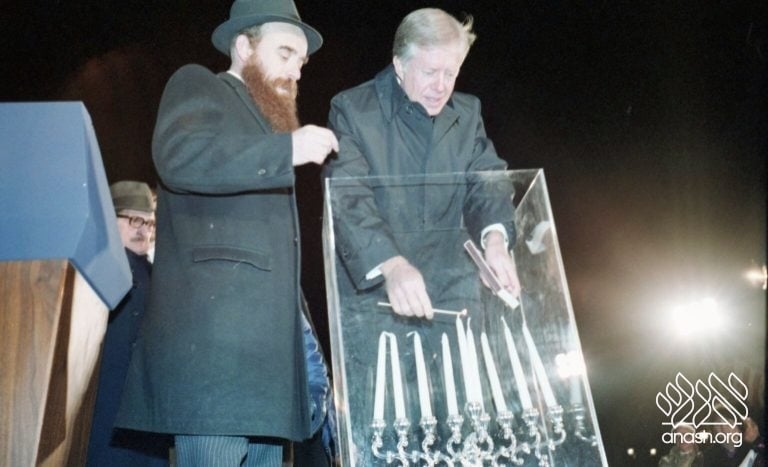
Tweel recounts how the Rebbe, writing from 770 Eastern Parkway, threw his full support behind Carter’s push to establish a cabinet-level Department of Education, which Carter signed into law on October 17, 1979. The Rebbe’s backing was not merely symbolic. He wrote directly to Carter, corresponded with Reagan after him, and deployed emissaries in Washington to make the case. As then-Secretary of Education Richard Riley acknowledged in 1997: “His voice, so respected and beloved, helped make it happen, so I owe my job to him.”
But the essay is at pains to show that the Rebbe’s interest was never political. His support for the DOE flowed from a deeply-held philosophy: that education without moral purpose is dangerous. Having witnessed firsthand how Germany — among the most scientifically and philosophically advanced nations in the world — produced the Holocaust, the Rebbe wrote that education “must have a soul.” Children, he argued, “are not computers to be fed a mass of informational data, without regard for their human needs for higher goals and ideals in life.”
It was in that spirit that Congress, on Carter’s prompting, established Education Day in 1978 — to be observed annually on 11 Nissan, the Rebbe’s Hebrew birthday. Every president since has continued the tradition, making it one of the longest-running annual presidential proclamations honoring a single individual.
Still timely
Tweel published her essay in May 2025, shortly after an executive order instructed Education Secretary Linda McMahon to take all steps necessary to facilitate the DOE’s closure. The department’s staffing and future remain uncertain, making her argument no less relevant now than when it first appeared.
She also challenges readers to reckon honestly with what the Rebbe actually wanted. The DOE’s stated mission — focused on global competitiveness and individual achievement — captures only part of his vision, she argues. What the Rebbe called for was something harder to legislate: an education system oriented toward character, ethics, and a sense of responsibility to something greater than oneself.
“The educational system must pay more attention, indeed the main attention, to the building of character,” the Rebbe said at the first Education Day address in 1978, pointedly referencing what had happened in a country that “ranked among the foremost in science, technology, philosophy” — meaning Germany.
The birthday that became a national day
Tweel closes her essay with a proposal: that whatever form the Department of Education ultimately takes, it should launch a national conversation about what education is actually for — inviting families, schools, and communities to ask the questions the Rebbe spent his life posing. “Americans can come closer through shared questions rather than through shared answers,” she writes.
On this 11 Nissan, as communities around the world mark the Rebbe’s birthday with farbrengens, learning, and acts of goodness and kindness, it’s a question worth sitting with.
The full essay can be read at arcmag.org.
 COMMENTS


We appreciate your feedback. If you have any additional information to contribute to this article, it will be added below.