




ה׳ כסלו ה׳תשפ״ו | November 24, 2025
The Rebbe’s Holy Image Isn’t Meant as Artwork
Article by Rabbi Yisroel Shmotkin: There are those who show hiskashrus by using the Rebbe’s picture as a profile photo. His image appears on posters, ads, fundraisers, pushkas, signs, and bentchers – becoming a “graphic element” added to flyers and invitations. The intention is pure, but we ought to pause for a moment and reconsider.

By Rabbi Yisroel Shmotkin – Milwaukee, Wisconsin
We’re witnessing something extraordinary: a deep, genuine hiskashrus to the Rebbe, especially among younger chassidim who never saw him with their own eyes. In some ways, their bond is even stronger than that of those who did – those who stood at farbrengens, went into yechidus, and experienced the Rebbe’s presence directly.
This connection shows itself in many ways: steady, serious learning of the Rebbe’s Torah; caring about his inyanim, directives, and mivtzoim; identifying with his vision; and dedicating oneself to his shlichus – even in far-off places and difficult circumstances.
One of the expressions of this love is the way people relate to the Rebbe’s picture. His image hangs in homes, Chabad Houses, and institutions everywhere.
But today, when we have access to so many photos – spanning every year, every event, every moment -and when technology has made them available to anyone in an instant, we must be careful to preserve the preciousness and the sense of holiness that a picture of the Rebbe deserves.
In the Shabbos Parshas Vayeitzei farbrengen of 5748 (1987), the Rebbe explained Rashi’s comment on the possuk “And Yaakov left Be’er Sheva and went to Charan.” Rashi says: “This tells us that the departure of a tzaddik from a place makes an impression: As long as the tzaddik is in the city, he is its hod, its ziv, and its hadar; when he leaves, its hod is gone, its ziv is gone, its hadar is gone.”
The Rebbe explains: Hadar means honor; ziv means light; and hod means a light that awakens awe.
We must remember that the ziv – the hiskashrus, the learning, the watching of videos and looking at pictures, etc. – must be done with hod – with reverence and awe of holiness. Then we can also have hadar, honor.
There are those who express their hiskashrus by using the Rebbe’s picture as their personal profile photo. The Rebbe’s picture appears on posters and advertising, fundraising materials and campaigns; it is printed on pushkas and signs, shul conduct sheets and bentchers. The picture becomes a “graphic element” automatically added to every ad and invitation.
The intention is pure and sincere. Still, we need to pause for a moment, step back from the constant flow and everyday use of the many images now so easily available, and ask ourselves:
What is a picture of the Rebbe? How should it be treated? Is this the right way to use it? Is this what the Rebbe would want?
Is it really appropriate for someone’s personal profile photo to be a picture of the Rebbe – especially when it appears on a device that, in practice, isn’t kept away from places that are far from holy? Doing so is an affront to kedushah.
Is it possible to publish the Rebbe’s picture on invitations, flyers, or bentchers that end up scattered on tables where there may be crumbs of food and drink stains? Personally, I would not even place a Sefer Tanya on top of a picture of the Rebbe.
The same applies to book covers. Why use the Rebbe’s picture on the cover of a sefer? It is simply not respectful. Whether it’s a sefer of the Rebbe’s Torah – anyone familiar with the Torah world knows it is not customary to print a picture on a serious Torah or scholarly sefer – or whether it’s a biographical book about a chossid, where the Rebbe’s picture is used for the cover of a book about someone else.
Even more painful is when the front cover has a full “profile” picture of the chossid, while on the back cover, in a corner, there is a picture of the Rebbe giving him a dollar…
It’s important to stop and recognize that: A picture of the Rebbe is holy. You do not use holiness for every purpose, and certainly not for personal needs.
The Frierdiker Rebbe relates (Hatomim, vol. 8, p. 11) that when a portrait of the holy face of the Alter Rebbe came into the hands of the Tzemach Tzedek, he would lock himself in his room every single weekday, close all the doors so that even his servants could not enter, place the picture on the table, put on Shabbos clothes and hat, gird himself with a gartel, and look at it for a long time.
I will never forget when the Rebbe’s picture arrived in Eretz Yisroel in 5716 (1956). We were all deeply moved and gazed at it with full concentration. A few white hairs were visible in the Rebbe’s beard. This detail touched everyone’s heart. People looked at the picture and related to it with awe and holiness.
The way we treated that picture mattered. It was holy, special, precious.
Looking at the Rebbe’s picture is one of the ways of hiskashrus, as the Rebbe pointed out and encouraged in several letters and sichos regarding the picture of his father-in-law, the Frierdiker Rebbe.
Reflecting on the Rebbe’s picture creates a bond with him. It gives chayus to fulfill our mission, to walk in the ways of Torah and mitzvos, and to push aside all obstacles and hindrances.
A picture of the Rebbe is something holy and alive. Using it must be done with the highest degree of preciousness and respect.
In a reply to a woman who wrote to the Rebbe about struggles and failures, the Rebbe wrote:
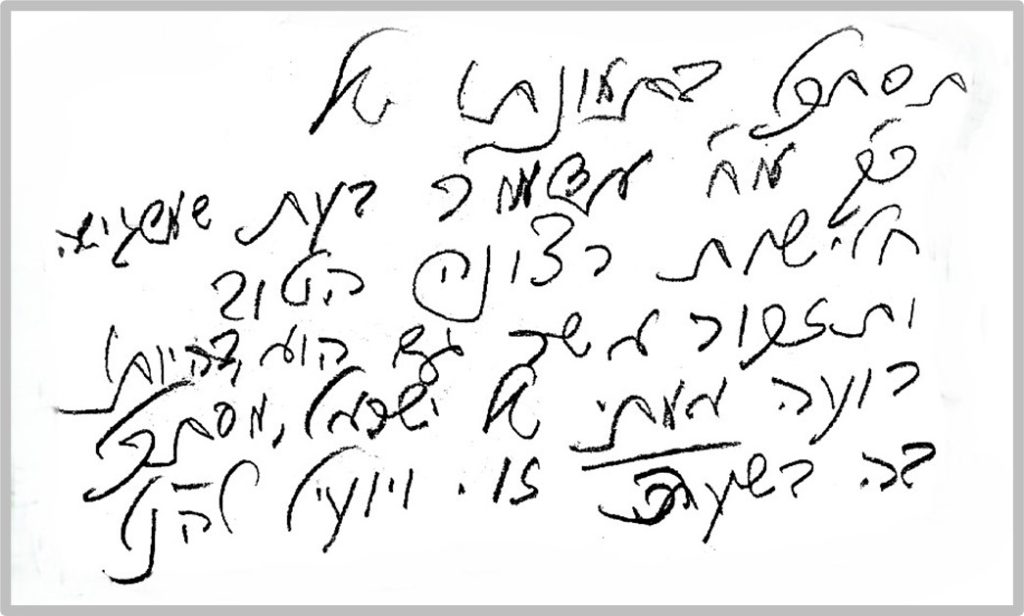
“Let her look at the picture of my father-in-law, the Rebbe, at a time when she feels her good will weakening, and remember that he too, being a true shepherd of Israel, is looking at her at that very moment. This will help her with the above-mentioned.”
When “the good will” is weakening and there is a pull toward a fall, one should look at the Rebbe’s picture and remember that not only are we looking at the Rebbe’s picture. At that very time, the Rebbe is looking as well. The thought that he is looking helps a person overcome their struggles and challenges.
There are many well-known and publicized stories of fires, chas veshalom, where an entire room was burned, yet the Rebbe’s picture remained intact. During the terrible terror attack at the Chabad House in Mumbai, the terrorists roamed throughout the building, raging and destroying whatever they could. The Rebbe’s picture remained on the wall, untouched.
This means the Rebbe was there with them, looking at them, sharing their pain – “In all their distress, He is distressed.” The murderers’ hands couldn’t touch the picture.
Just recently, an Iranian missile struck an apartment in Nes Tziyonah. The house was damaged, the windows shattered, but the Rebbe’s picture on the wall – printed on glass – remained in place, whole.
There is a known story (and I recently heard it directly from the person involved) about a Yid who wrote to the Rebbe about a personal problem. The Rebbe did not answer. He wrote again, and again. When he still did not receive an answer about the painful matter, he grew very upset and, Rachmana litzlan, struck the Rebbe’s picture that hung in his home.
Later, when he came by the Rebbe for kos shel brocha, the Rebbe poured him wine, then asked him about that personal matter he had written about. After the man began to move away, the Rebbe called him back and said: “Your blow still hurts me…”
This all shows that the picture is something holy, precious, and meaningful to every chossid. It is a central tool of hiskashrus – but only when we treat it in the right way.
In Parshas Emor, when the Torah forbids eating terumah in a state of tumah, it says: “They shall keep My holy things… and they shall not desecrate My holy Name.” At first glance, what is the connection? How does eating terumah in tumah desecrate Hashem’s holy Name?
The answer is simple: Using something holy in a way that does not belong to you, a lack of sensitivity and reverence for the holiness of terumah, that is a chillul Hashem. Eating terumah in tumah is worse than eating chazzer, because it shows a lack of sensitivity to holiness. It is a desecration of kedushah.
The Rebbe himself once said that he is afraid to touch the Baal Shem Tov’s siddur.
“The idea itself is out of the question”
In addition to basic logic and a chossid’s own sensitivity – which, when one pauses for a moment and looks past the habits that have become so common, immediately recognizes that the Rebbe’s picture must be treated with awe, used for reflection and hiskashrus, and not dropped into every ad or design -the Rebbe himself also addressed this matter clearly.
In Igros Kodesh (vol. 18, p. 226) the Rebbe writes, regarding a proposal to print a postage stamp with the Alter Rebbe’s picture:
“Concerning what you wrote about a stamp with the picture etc., in my opinion, the idea itself is out of the question, because stamps get passed around, in the end they are handled in all kinds of ways, and in addition, there is the necessary act of stamping on the stamp and on the picture.”
In a letter from Rabbi Chadakov to R. Yitzchok Gansburg a”h in Eretz Yisroel, dated Tuesday, 3 Adar I 5727 (1967), he writes:
“It is not proper to put pictures of gedolei Yisroel on a toy and the like.”
Someone incorporated a picture of the Frierdiker Rebbe into a certificate of honor, on the same page as pictures of two women who had assisted the institution. The Rebbe responded in an extremely sharp and frightening way:
“If he wants to give a certificate of distinction to Mrs. Plonis and Mrs. Plonis, is it truly in his authority to give this certificate specifically by printing their pictures together with the picture of my father-in-law, the Rebbe?”
And the Rebbe adds an alarming expression:
“I have already seen many disturbing things, but I must admit that this is among the ‘first in rank’ of them.”
Practically, the Rebbe instructs him:
“Surely he will at once remove this page from existence. Since I cannot bear the responsibility for a practice where, for the sake of ‘publicity,’ they don’t withhold even when it comes to such things.”
And the Rebbe continues:
“He should remove my name from all stationery, booklets, etc.”
The Rebbe goes on:
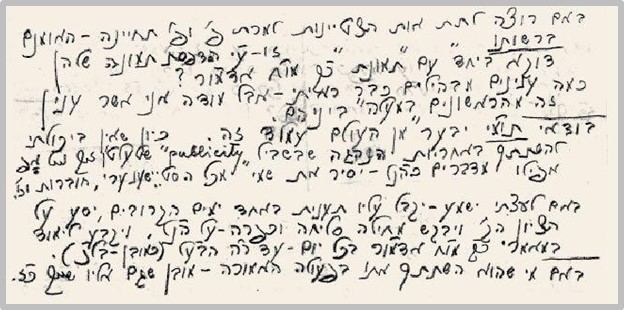
“If he will listen to my advice, he will accept upon himself a fast on one of the coming days, travel to the holy Ohel and ask for mechilah, selichah and kapparah for this, and establish a daily study in the maamarim of my father-in-law, the Rebbe, until the coming Rosh Hashanah (obviously without a neder).”
“If anyone else participated with him in this act, all of the above applies to him as well.”
Means or end?
The question that must guide us is simple: For what purpose is the Rebbe’s picture being used?
Is the picture itself the goal – solely to honor the Rebbe – or is it being used as a tool to advance some other purpose, whether personal or communal?
A picture of the Rebbe hanging on a wall at home is an end. It awakens awe, emotion, and hiskashrus. A pushka, however, has a different goal. When a picture of the Rebbe is printed on it, the picture becomes, chas veshalom, “an addition,” a means. That is a real desecration of holiness. It is forbidden to exploit the Rebbe’s holy picture for any other usage. The Rebbe’s picture is meant only for the Rebbe’s honor.
Incidentally, even in the home, using the Rebbe’s picture must be with awe and respect. I remember when my son returned from a chassidishe summer camp in his childhood. He came home with a whole pile of Rebbe pictures which had been given out to the children as prizes (this practice is, to me, very questionable). When I walked into his room, I saw that the wall was full of pictures. I told him to take them all down and leave only one picture. The picture is holy and precious, not a colorful collection of cheap items (and indeed, this left a deep impression on him about the respect due to the Rebbe’s picture).
Even using the holy picture in an ad for something connected with the Rebbe – for example, a flyer about an organized trip to the Ohel, a learning campaign, or a chassidishe farbrengen – is not appropriate. Why is the Rebbe’s picture there? Does adding the picture really bring more participants or more travelers? And even if it did, can we desecrate holiness and use the picture as a tool for another goal, even a holy one?
Graphic designers are usually focused on creative expression and making things look good, not on the Rebbe’s honor. For them, the endless supply of Rebbe photos is a perfect graphic addition for posters, signs, and ads.
Everything we’ve said applies even when the picture is used in a respectful way. All the more so regarding edited images, cut-outs, graphic manipulations, and backgrounds used in all kinds of publicity. Putting the Rebbe’s picture inside a logo, as a faded background with text over it – this is literally a desecration of holiness!
Some go even further, chasing the coveted “pirsum rishon.” For the sake of their own honor and excitement, they publish various pictures of the Rebbe whose appearance was not intended for respect and holiness: for example, photos of the Rebbe learning privately in his room, taken secretly, where he is without a hat, not in the manner in which he appeared in public; or pictures from the painful period when the Rebbe’s health was not strong, and other such things.
Is this what the Rebbe wants? Is the publication of such photos meant to increase honor, reverence and deep hiskashrus?
It is known that when Rabbi Krinsky, the Rebbe’s secretary, asked which photo should be used for public announcements, the Rebbe instructed that it should be a picture where he is smiling.
I heard of a Boyaner chossid whose Rebbe instructed him that under the chuppah, when he pictures his Rebbe’s face in his mind, he should picture him in the nicest way he ever remembers seeing him.
All of this does not only apply to pictures.
Unfortunately, in recent years, it has become common to “use” and “exploit” the Rebbe’s name for all kinds of purposes.
Ads shout about “the Rebbe’s magbis” with a designed picture of the Rebbe used to raise funds. Slogans like: “The Rebbe promises: five hundred times your donation.” People promise, in the Rebbe’s name, financial success to every donor.
(By the way, I have a simple suggestion that would spare the organizers all the trouble of a campaign: If they truly believe that “the Rebbe promised” that whoever gives will merit to have his money multiplied 500 times, let them donate $2,000, and they’ll quickly receive a million dollars for their cause…)
We are dealing with fundraising for holy and lofty goals, for important, pure mosdos. The organizers are devoted chassidim. Yet through lack of attention – usually on the part of graphic designers and campaign consultants – something very serious happens. No cause, however noble, justifies “using” the Rebbe and his holy name as a means for more successful fundraising.
At the end of a letter from Rabbi Chadakov to Rabbi Azriel Zelig Slonim a”h, director of Chabad mosdos in Yerushalayim, he writes:
“P.S. To our great surprise, a donation form from ‘Shikkun Chabad Yerushalayim’ came into our hands, with a picture of the Rebbe shlit”a on it. We have never yet seen such a practice in any Chabad institution, and it is astonishing that this was done without asking, etc. Especially since someone who sees this can easily think that the Rebbe shlit”a is the one ‘requesting’ the donation, etc., and that is enough said.”
We can see how far this can go from the following directive:
In 5744 (1984), a notice appeared in Kfar Chabad magazine announcing that people could dedicate a printing of Tanya in various locations for the price of $770. The editor, Rabbi Aharon Dov Halperin, received a phone call from the head of the secretariat, Rabbi Chadakov, who said that the Rebbe asked under whose authority the ad was placed in the magazine and on what basis.
Before he could answer, he heard the Rebbe’s voice asking Rabbi Chadakov to ask:
“What will those who ‘are seeking an excuse’ say when they see that the number ‘770’ is being used to make money?”
The Rebbe added that he would delay his trip to the Ohel and wait until Reb Aharon Dov would find out who had placed the notice, call that person, and ask on what basis he did it, and check if it was still possible to hold back distribution of the magazine, at least in New York.
Reb Aharon Dov hurried to do what was needed, succeeded in stopping the magazine’s distribution in New York, and called back to report to Rabbi Chadakov. Again, he heard the Rebbe’s voice on the line, thanking him and saying that it gave the Rebbe nachas ruach that he acted so quickly.
We see from this how problematic it is to use the number 770 – and how much more so the Rebbe’s name, picture, and holy words – as tools for another purpose, even to raise money for a holy cause, a campaign of the Rebbe.
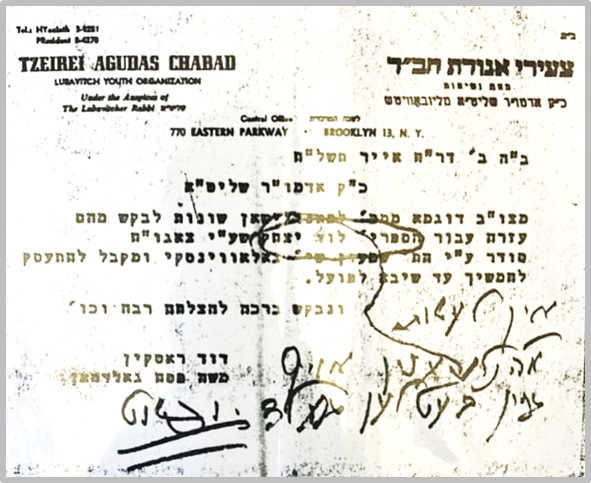
In 5738 (1978), the “Levi Yitzchok Library” run by Tzach in New York wanted to raise funds for its upkeep. They drafted an appeal letter to donors. When the letter was brought to the Rebbe for editing, he circled the words “Levi Yitzchok Library” and wrote:
“One must not turn this [=the Levi Yitzchok Library bearing my father’s name] into a project for which to beg for money. And this is self-understood.”
Holy handwriting
The same applies to using facsimiles of the Rebbe’s handwriting on invitations, and certainly when the cover of a wedding teshurah prints the family name, or the names of the chassan and kallah, in a font made from the Rebbe’s handwritten script, or similar uses (publicizing a bracha, or a shidduch announcement, with a copy of a bracha in the Rebbe’s handwriting printed next to it).
The Rebbe’s handwriting is holy. It is an end, not a means. It cannot be turned into a design element or a “cute touch” under any circumstances.
Similarly, in every matter connected to the Rebbe, where people use things freely and thoughtlessly, without considering the honor and preciousness due.
To sum up:
A. The Rebbe’s picture is a living entity – holy, more precious than anything. It is meant to honor the Rebbe and to help a person contemplate and connect. It is not something “cheap” to be used freely and stuck into every ad, sign, booklet, and bentcher.
B. Beyond what common sense itself dictates, the Rebbe explicitly ruled that a holy image must not be used for other purposes.
C. The test that should guide us in any given case is this: Is the Rebbe’s picture itself the goal, and is its appearance solely for his honor? Or, chas veshalom, is it being used as a means to another end – a pushka, a logo, an ad?
D. The same is true for the Rebbe’s name, his handwriting, and even the number “770.” They may serve only as an end in themselves, not as a tool for success in some other goal, such as fundraising (even for the Rebbe’s own mosdos).
E. Beyond the fact that the picture is meant for its own sake and not for other aims, and must be treated with awe rather than used wholesale as raw material in a designer’s hands, there is an added lack of respect when the picture is put on pushkas, bentchers, profile photos and the like that get tossed and passed around in all kinds of places.
It is obvious that the Rebbe is dear to every single chossid. All of us want to preserve a sense of holiness and preciousness, that nothing associated with the Rebbe – and certainly not his picture – should ever become “not precious enough.”
The only goal here is to awaken attention to an issue that, in the rush of routine and due to how widespread these habits have become, we sometimes simply do not think about deeply enough.
May it be Hashem’s will that we soon merit the true and complete Geulah, and the fulfillment of the possuk “Your Teacher will no longer be hidden, and your eyes shall behold your Teacher,” with the coming of Moshiach Tzidkeinu, speedily in our days.
Translated from Kfar Chabad Magazine with permission
 COMMENTS



Several years ago I was involved in printing a calendar for the Crown Heights community. Some people asked why didn’t I put a picture of the Rebbe there, to which I replied that the Rebbe never gave me permission to do so, and I believe it would be disrespectful.
I also recall reading in one of the diaries (I think it was 5741 or 5744) that some organization prepared a pushka (or other item) with a picture of the Rebbe. When it was sent to the Rebbe the response was that even an Eved Ivri isn’t placed atop a pedestal in the marketplace.
When I prepared wedding invitations for my daughter’s wedding, I sent a PDF to the printer. When he called me to say the invitations are ready, I was shocked to see that he printed an image of the Rebbe’s handwriting on the back of the invitation. When I asked how that got there, since it wasn’t in the PDF, the printer told me “everyone puts it there”, to which I replied “well I don’t! People throw the invitations out in the garbage, I don’t want an image of the Rebbe’s holy handwriting going to the garbage on my account “. The printer had to reprint the invitations without the image of the Rebbe’s handwriting.
Kfi Ydiosi,(as heard from the son of the Baal Hamaase) that Maane (about Afilu Eved Ivri…) was in response to preparing Tapes of the Rebbe’s Farbrengens and selling them by stands in train stations (a common practise at that time).
Not to mention the “new method” of warping the Rebbe’s image in a whole new horrifying way.
Generating one image of the Rebbe with AI destroys worlds, in an unimaginable way. The “tool” and “artist” you use spits out what would be a pure and holy face to R”L INCORPARATE ALIENATED FACIAL FEATURES ones that are DISGUSTING and beyond disrespectful.
This is because AI doesn’t treat the image as a Rebbe, rather treats it R”L like the image lehavdil elef havdolos of an older GOY with a beard, and thats the fact because ITS TRAINED OFF OF BILLIONS of images of goyim!
Hashem have pity, and woe is to the one who produces and spreads such images — such ignorance and kofui tova. When I encounter such images I quickly look away, shuttering in pain.
This has been bothering me for years. Bh someone finally spoke up. Ty, beautifully written
Yes i agree with some contents of this article, and yes the rebbes pictures should not be found on the floor but at the same time i feel this reminds me of a story of when chassidus just started to spread and a man found chassidus on the floor and he came to yell at the alter rebbe look at this it’s so accessible that this whole precious hidden part of Torah the most secretive parts are being torn and trappled on the floor and made similar arguments to the one your making here. The rebbe replied with a famous mashal of the king with a sick son and he’ll have to grind his most precious stone but maybe a small amount will enter his sons lips and save his life and the rebbe connected this and said that’s chassidus. And I would think the same would apply to the rebbe picture yes it’s holy and sacred but being that it’s so accessible today must be for a purpose and for a reason and if thsi rebbe picture can even wake up one Jew I am sure it is worth it. So yes people should take care of a rebbe picture but at the same time the rebbe picture can accomplish so much!
1. That story is quite clearly addressing the Chshash that through CORRECT usages of the Melech’s crown (printing Chassidus) it may lead to a possible Bizayon, which this is considered worthwhile, L’achar Hamaase, due to the absolute necessity. NOT, Milchatchila using Holy items in a disparaging circumstance, with the excuse that it may, possibly, lead to good.
2. This is the about the Crown of the king, not the king Himself, Ublashon Hatanya “אוחז בראשו של מלך ומורידו למטה וטומן “פניו …שאין לך עלבון גדול מזה
True, but who gets to make that call. We have clear directions from the Rebbe on this matter, so that trumps this beautiful gezaira shava.
At the first siyum harambam (11 nissan 5742?) The Rebbe spoke about making a stamp with a picture of the Rambam.
The Rebbe discussed the Pros and cons (many of which appear in this article in one way or another)
The conclusion was, that for “the possibility” that someone will see it and be reminded (or told) of the The Rambams message of the Seven Noahide Laws,/Moshiach it is worth it!
It’s possible that by saying this, the rebbe ruled it upon himself as well (as the Rebbe taught us many times)
In other words perhaps:
The Rebbe’s picture can be this generations’ “inner gem stone of the kings crown “, that gets crushed, mixed and spilled and even wasted,… just so that one drop should get in.
And revive the Prince
And bring Moshiach now!
The difference between the stamp of the Rambam which the Rebbe seemingly supported and the stamp of the Alter Rebbe and Rebbetzin Chana which the Rebbe was Sholel was brought up in קובץ הערות וביאורים בתורת כ”ק אדמו”ר גליון רמא and answers were brought up and discussed in the next 2 Gilyonos, and according to most explanations there your proof/comparison is not exactly true.
Here are the links:
Gilyon 241: https://drive.google.com/file/d/1rl9hixRqxFoo4ENxH2maD84TtmKjXRBs/view
Gilyon 242: https://drive.google.com/file/u/1/d/1xCx3nZm4mYDeg2ccXzCffTlJj33PufIT/view?usp=drive_open
Gilyon 243: https://drive.google.com/file/d/10VoQLZkwDl34syY50C2q8dsV8ZAZYGN6/view
@editors, the cover picture for this article is going against everything stated inside… its using a picture of the Rebbe as a means to an end, the end being to describe how wrong it is, but two wrongs dont make a right…
This is an excellent article and so true.
Unfortunately, Anash.org has failed to notice that they are guilty of the exact offense the author is decrying–using the Rebbe’s holy picture to prove a point and gain clicks with the image attached in the beginning of the article.
Deeply painful and Sad!
finding a scrap of chassidus on the floor has absolutely no connection to a bochur actively plastering the Rebbe’s holy picture or handwrting and the like wherever he wants in an effort to promote whatever it is
also no connection to it being able to affect and accomplish so much in a yid, a yid can see the Rebbe’s picture on the wall or printed otherwise in a respectable manner
plastering the Rebbe on questionable cards and disseminating them throughout NYC is definitely mechalel his Holy name
yes! yes! yes!
What about the proliferation of bumper stickers with the Rebbe’s picture plastered everywhere?
All the stickers with the Rebbe’s picture all over Eretz Yisroel and New York that get ruined in the rain and get ripped and fall of the back of traffic lights and street lamps?
In my opinion this is a lot worse then some of the other stuff but it’s not even mentioned.
The issue is not that they get ripped down, but that they are affixed in the first place
Plastered on every surface imaginable… terrible
Thank you for this article and making us aware of the need for holiness concerning the Rebbe’s photograph, etc.
Yaakov Avinu did not realize he was lying in a holy place. So too many, l’havdil, are ‘sleeping’ and may not realize the holiness of the Rebbe’s photo but still we all want the tzadik to ‘rest’ on us and we should all unite as one and see each other with a good eye.
May Hashem wake us all up with the geula shlaima and unite us with all of the Rebbeim mamosh.
I 100 percent agree with this article, and just to add a point, I was once walking on shabbos in ch and it was pouring rain. during that time there were advertisements all over the ch lightposts and trees about a certain farbrengen or gathering (I dont remember exactly what) and one of the posters for the advertisement was a full page of a sicha. first of all the fact that a page of a sicha of the rebbe was all over the trees in ch in itself is problematic. as i was walking i noticed to my horor that one of the sicha flyers had fallen onto the floor in the rain and was lying in the wet mud and garbage and as it was shabbos there was nothing i was able to do. WHERE IS THE ACHRAYUS! when you put up a sicha or a picture of the rebbe on a lightpost, tree, or a building what will be when it inevitably falls down. I hope that this article will raise awarness on this issue.
well said! 10 points!
Has anyone asked whether a picture of the Rebbe should be considered shaimos?
In my opinion, the Rebbe’s holy face should not appear on material that will be discarded.; and that includes brochures, calendars, newsletters, etc. People might argue that if the picture is small, it might not make a difference. But the point of the article and this letter is to stress that it does make a difference. A word to the wise should be sufficient.
A picture is not shaimos. Shaimos is a halacha that has a clear definition and pictures are not one of them.
If one has a picture of the Rebbe that needs to be discarded, one can wrap it in a bag and put in the trash, like other tashmishei kedusha or divrei torah that are not shaimos.
Not every house has a shaimos disposal service. Around Chof Av the newsletters and flyers from a particular webside stack up quickly and takes up precious space in everyones closets since we cant get rid of it.
Its not just the picture of a Tzadik – the same is true for any tzelem elokim. People have no respect and wash our porches with face flyers. Have some respect.
is there a mkor that a picture of a tzadik has kdusha i dont think you wil hear l such a thing in any community you probaly hear the opposite
and the rebbe letting his picture being printing in the NY times which by many is read in the bathroom and then thrown out?
in 770 they have a 7.70 and $770 donation on the screen maybe they need to remove it as well under the Rebbe directives?
I get where the writer is coming from, but it feels like he made up his mind before actually looking at both sides. I don’t really agree with the tone he takes here — it has this whole “I know better than you” energy, which just comes off as condescending.
It could’ve been more like: inspire (don’t talk down…).
If the goal is to honor the Rebbe, then lift people up.
That may just be your sensitivity and projection. Some things need to be said, and the listerner needs to work on themselves to listen. And there’s nothing condescending about it. It may not be to your taste or style, but there’s no need to judge the person saying it. It doesn’t have to be either you or either he are bad.
B”H
In the spirit of Ahavas Yisroel, I would like to remind the great Rabbi of this article. How The Alter Rebbe once saved the Magid with the story of the dying prince. Grinding up the crown jewel most of it falling on the floor. In the hopes of saving the prince.
Another story of how a misnagid who told the Alter Rebbe he uses Reb Zushe’s sefer to keep his desk straight.
The Alter Rebbe smiled and told him he know Reb Zushe to be someone who himself would lay down under the desk to help the desk.
Moshiach Now!
Ok I wanted to post this for a whole, hopefully my kids teachers will read this.
What am I supposed to do with the many crafts coming home from school with pictures of rabbeim on it? Often in very poor quality. Can we teach children about yud tes kislev without their crowns bearing a picture of the Alter Rebbe?
And the weekly dvar torah printouts being dropped by my door with a picture of the Rebbe, that I never signed up to get, dont read it and dont know what to do with it…
I remind myself of the story of the yid who r’l strayed and just before his avodah zara ceremony he saw a picture of the rebbe on a newspaper which brought him back. So thats why I get a newsletter with a picture of the rebbe in my mailbox every week.
And the girls production brochures that get all stepped on…
Thank you for this important article. Many of the anecdotes and Horaos are new to me. It’s easy to assume something is ok because it’s being done by so many, so thank you for the reminder. How can one just post around the Rebbe’s picture without His permission?!
Many are pointing to the Mashal of the Alter Rebbe and the prince. Brining the Rebbe to Yidden is what He wants – it’s not a means to an end.
Showing the picture of the Rebbe to thousands of teens in Times Square will enhance their connection to him and to Yiddishkeit and so that’s what the Rebbe wants. It’s similar to the Rebbe Maharash going into the casino to find that one Yid.
On the other hand, you can’t take this to justify using the Rebbe’s image on promotional/fundraising material or art. That’s clearly using it as a means to an end.
This has bothered me since I moved to Eretz Yisroel years ago, and I’m glad to find out that the feelings of disgust and embarrassment are valid! The Rebbe’s picture is plastered all over the country! Just yesterday I saw a poster/billboard plastered over a picture of the Rebbe (visible where the new poster had come loose). How utterly disrespectful! Honestly, I try not to look, as difficult as that is…
Can you please write a notepad about people visiting the rebbe’s house and room? Who gives one permission to walk into the rebbe’s house? It became a museum? You were invited? Since when does one walk into the rebbe’s room? After yud shvat, was the FR’s apartment and room lpen for public visits?
The Rebbe wrote to Rabbi Levine that he should open the Frierdiker Rebbe’s apartment for people to daven and say Tehillim there.
למיטב זכרוני, הרשד”ב שי’ לוין כתב מקום תפילה, וכ”ק אדמו”ר הוסיף בכתי”ק “וקריאת פ”נ”.
Are the above stories of our Rebbeim not a Makor themselves? Besides for that, I think an average Poilisher Chossid would not feel okay about one of his Rebbeim’s (at least one from a previous generation וד”ל) picture being on the floor.
There is a big difference between saying that a tzurah of a tzadik has kdusha and has segulos, to saying that a piece of paper has to be put in shaimos. The tzurah of a tzadik is of a tzadik that his tzurah became holy through mitzvahs, and his tzurah, if it’s mekushar to him, it’s kodosh. A picture is a reminder of his tzurah and you could be mtzayer it. But to give kedusha to paper that’s nifrad from him might be a big problem. Look in Kuzari that the cheit ha’egel was because they gave kedusha without the Torah. It says in poskim that if not the possuk calls a shul a mikdash me’at, it would be forbidden to call it like that.
Of course, a picture represents the person, so if somebody throws something etc., he means what it represents, and that’s why Poilishe will be noheig kuvod etc. And of course, it’s big bizyonos what the narisishe, well-meaning youngsters are doing to the Rebbe, but that is because it represents. But to give a dovor nifrad kdusha could be a big mistake. The Torah is not knew, and I never heard that the etzem picture has kdusha. Adraba, a lot of gedolim would not let their picture.