



ח׳ שבט ה׳תשפ״ו | January 25, 2026
The Phone Call That Changed a Family Forever
For the man that Yiddishkeit meant nothing more than candles and crackers, a single phone call from Rabbi Sholom Ber Lipskar changed everything, as he patiently and persistently guided him toward Torah and mitzvos. For the shluchim at the Shabbos table right before Yud Shevat, the story was a beam of light from the Rebbe.

Rabbi Moishy Raskin – Kampala, Uganda
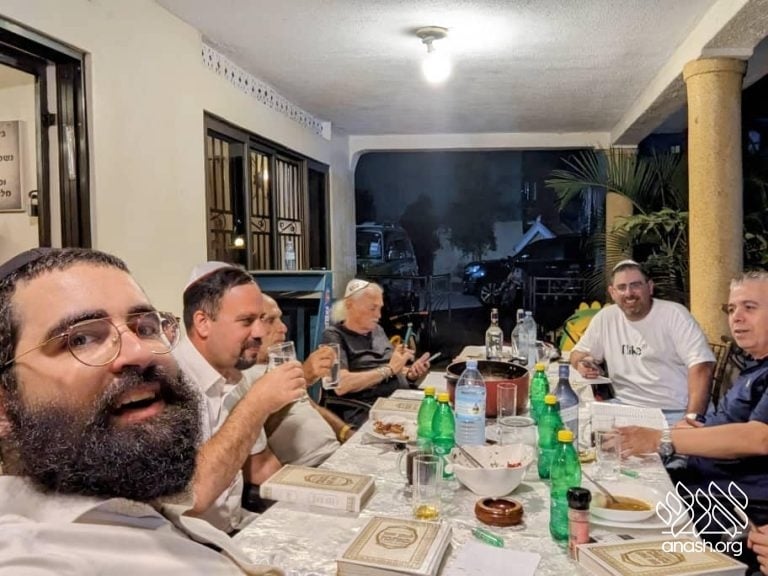
This past Shabbos, we hosted a couple. The husband is an American that served in the Israeli army; the wife is originally from Puerto Rico. Today they live in the United States and had come to Uganda for a short work assignment.
At the Shabbos day meal we held a farbrengen as a preparation for Yud Shevat. I asked everyone around the table to look at the Rebbe’s picture and share what the Rebbe means to them, and what message they take from the Rebbe into their personal lives.
It was a special experience to hear each person at the table, Jews who do not define themselves as Chabad Chassidim, describe their personal connection to the Rebbe, and how for each one the Rebbe is a figure who deeply impacts their life, day to day in 2026.
But nothing prepared me for the story that followed.
The American guest casually began telling us about his father, whose name was Jen. He grew up in America, in some suburb in North Carolina, in a place with no Jewish community and, as far as he knew, no other Jews at all.
He explained that for his father, yiddishkeit meant “crackers and candles.”
Crackers, because he remembered that on Pesach you eat something that looks like a cracker (matzah).
Candles, because his grandmother used to light candles every Friday.
That was yiddishkeit to him: crackers and candles. Beyond knowing that they were Jewish, it had no real presence in his daily life. It was something shallow and not meaningful.
Until one day, Jen gets a phone call.
“Hello, Mr. Jen?”
“Yes,” he answers.
“Are you Jewish?”
Jen had no idea where this was coming from. How does this person know he’s Jewish? Who had been following him? What does the guy want from him?
Still, for some reason, he went along and answered, “Yes.”
The man on the line introduced himself as Rabbi Sholom Ber Lipskar AH, the well-known shliach in Bal Harbour, Florida. He began asking him questions: Do you have matzos for Pesach? Do you have a mezuzah in your home? Jewish books? What do you know about yiddishkeit?
Already at the start of the conversation, Jen wasn’t very interested. He said to Rabbi Lipskar:
“Rabbi Lipskar, I still don’t understand what you’re trying to sell me, but yiddishkeit to me is crackers and candles. It sounds like something very shallow, not deep.”
Jen had explored different religions and belief systems and felt that they had a certain depth. Yiddishkeit, as far as he knew, did not.
Rabbi Lipskar answered him:
“Listen, over the years Jews have been accused of many things, but one thing we were never accused of is being stupid.”
That sentence touched him.
Jen said to himself that Rabbi Lipskar was right and if that’s the case, let’s hear what yiddishkeit actually has to offer – what depth the “crackers and candles” might hold.
From then on, every week, one phone call after another, Rabbi Lipskar strengthened him and his family in Yiddishkeit. He later sent him tefillin and taught him, over the phone, how to put them on.
In one of the conversations, Rabbi Lipskar asked:
“Jen, what’s your Jewish name?”
Jen laughed. Aside from his bar mitzvah, his Jewish name had never been used. He was just Jen. Still, he answered:
“Yosef.”
From that point on, in every phone call, Rabbi Lipskar called him Yosef.
One time Rabbi Lipskar said:
“Yosef, what do you say, maybe you’ll start keeping Shabbos?”
Yosef laughed.
“Shabbos? That’s my favorite day of the week. I go out, have fun, travel with friends. That’s already too much for me.”
But his wife got very excited:
“Great! A family day. That way you’ll stay home and we’ll all be together. What do we need? To bake bread? We’ll bake bread.”
And that’s how, in the middle of nowhere, in a place with no Jews, no yiddishkeit and no shul, there’s one Jew, and one shliach of the Rebbe who calls him every week, doesn’t give up, and teaches him what it means to be a Jew.
The result: Baruch Hashem, Yosef has a family with six children, all of whom went on to build families of their own, and on one level or another are connected to yiddishkeit, Torah and mitzvos.
An entire family that could have been completely disconnected from yiddishkeit and tradition turned around 180 degrees and began living a life of Torah and mitzvos.
To conclude, he shared that once he attended an event, and suddenly someone pointed and said, “That’s Rabbi Lipskar.”
He was stunned. After all, they had never met, despite the deep connection and years of phone calls.
He approached him and said:
“Rabbi Lipskar, shalom. This is Jen. Do you recognize me?”
Rabbi Lipskar answered:
“No. You’re not Jen. You’re Yosef.”
We felt that on the Shabbos before Yud Shevat, the Rebbe was sending us a beam of light. The Rebbe was showing us how effort for one single Jew, even at the edge of the world, with persistence and dedication, can bring about a 180-degree transformation in an entire family.
L’chaim u’livracha.
 COMMENTS


What a fabulous story about an extraordinary Chassid.
This story needs a follow up. Why/how was Rabbi Lipskar calling a random Jew from North Carolina?