




י״ג כסלו ה׳תשפ״ו | December 2, 2025
The Half-Century-Old Chinuch Article Still Relevant Today
50 years ago, an article marking Shnas HaChinuch was edited by the Rebbe and published. Brimming with storytelling, humor, and insights, the article is filled with vivid examples of the fashions, styles, and quirks of the era. Though trends have changed, its timeless messages remain as relevant and powerful today as they were then.

Fifty years ago, the Rebbe declared the year 5736 as Shnas HaChinuch, a year dedicated to the education of children – eventually leading to the launch of a revolutionary global initiative, Mivtza Chinuch, and the proclamation of the famous “Twelve Pessukim.” Marking that occasion, Anash.org is pleased to present an original article published in Di Yiddishe Heim, titled Shnas HaChinuch: Are You a Living Example?
Di Yiddishe Heim was a Yiddish and English periodical newsletter published by N’shei Ubnos Chabad, catering to Jewish women and girls. It circulated for nearly five decades and enjoyed unique attention from the Rebbe, who reviewed and even edited much of its content.
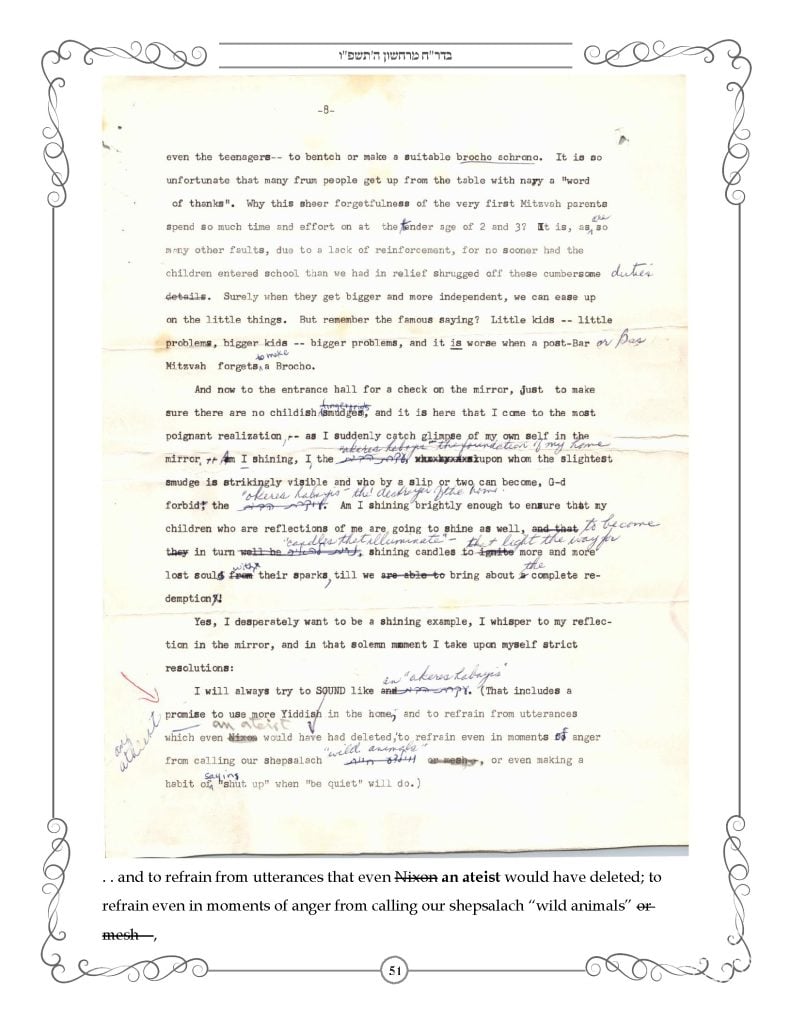
This article was no exception. The Rebbe thoroughly reviewed it, adding several edits. For example, right at the beginning, the author wrote: “As I hear the Rebbe speak and stress over and over again the importance of chinuch, I consider the great responsibility weighing upon us parents who can affect the child’s character to the good or otherwise…” The Rebbe added in pencil after “otherwise”: “G-d forbid.”
Another notable example occurs toward the end of the article, when discussing Jewish mothers’ resolutions to speak better in the home: “and to refrain from utterances which even Nixon would have had deleted.” The Rebbe crossed out “Nixon” (the former U.S. president who had resigned two years earlier) and replaced it with “an ateist.”
In the following line, concerning not calling her children “wild animals” or “mesh” (a reference to meshuga), the Rebbe crossed out the words “or mesh” entirely.
The article is a compelling column, brimming with storytelling, humor, and profound insights – filled with vivid examples of the fashions, styles, and quirks of the time. Though trends have changed and styles have shifted over the decades, the timeless messages remain as sharp and relevant today as they were fifty years ago.
*
Shnas Hachinuch: Are You a Living Example?
Leah Bas Rivkah
This year has been proclaimed by the Lubavitcher Rebbe Shlita as a Year of Chinuch—Education in Accordance With the Torah. As I hear the Rebbe speak and stress over and over again the importance Chinuch plays from the very moment of a child’s birth, I consider the great responsibility weighing upon us parents who can affect the child’s character, to the good or otherwise, G-d forbid, permanently.
I say to myself, I’m a person who grew up in a Torah environment. Same goes for my children. But no, I prod myself mentally. If I really look into it, isn’t there so much that is missing in my generation’s concept of Chinuch nowadays, so much room for improvement in unnoticed little actions which have subtly and imperceptibly edged into our daily life from our secular environment. How many concessions to American society have unwittingly and unobtrusively seeped into our lives despite our battle cry that “America is not different!?”
STAGE I
A HOUSEHOLD TOUR
Mentally I begin an inspection. Let’s start at the very beginning—the nursery. Oh, sure, here we have it, those cute nursery pin-ups. Cute, sure, but what message for a tiny Yiddishe soul? The crib, haven of that same Yiddishe Neshama—decorated with teddy bears and characters from Mother Gooses fables. Where is there some sign of encouragement for that neshama so that its soul could have some inkling that it has indeed landed in a Jewish home? Shouldn’t I take the trouble to paste on some Torah symbols on the walls as faithfully as I remember buying and pasting on mobile with tiny clowns, hippopotamuses and other trefa animals?
I smile quietly but secretly I always regretted that instead of teddy bears, I drew Hebrew letters. So I resolve to work. I tell myself. And thus begins my work as Chapter I in my Chinuch—let the eyes feast on the Alef-Bais, pictures from chumoshim, siddurim, etc.
My mind’s eye wanders on to the next shelf in the second bedroom — the “older” children’s. Aha—Mother Goose rhymes among the Chumoshim and such gems. Do I not sit down with their little heads each bedtime? But I wanted to give them a well-rounded education so that they know how “other walks of life” work. Those bright little heads proudly recited a nursery rhyme for me—after all, I’m not a fanatic who completely isolates herself from all other cultures. So what’s wrong with shepping a little nachas? — But have you forgotten, Mother dear, of the Torah it is said “Turn it, and turn it, for everything is in it” — the Torah encompasses everything. Why look to barren sources to entertain our kids, with so many rich and dramatic stories and memory exercises and enriching Torah. What should an impressionable child swallow with each spoonful at mealtime; what words should be the last to enter a Jewish child’s head before he drops peacefully off to sleep? The Three Piggies? The Gingerbread Man? or—Moshe and the Burning Bush, Joseph and his Brothers, Abraham Destroys the Idols? These choices and opportunities are endless.
In this Health Food Era nearly all of us have thought about a few ways to enrich our families’ food diets by replacing “junk foods” with healthier substitutes. How many have thought of extending this trend to our mental and spiritual lives as well? Let’s not fill Yiddishe little heads with junk stories and ideas. Torah is a much healthier substitute.
Now I finally turn to myself—the Mother. Have I the proper look of a “Mechanechess”—educator—in the Jewish household? Do I sometimes walk around the house (unwittingly of course) in seemingly direct defiance of the Torah’s laws of modest dress: sleeves rolled up way past the elbow, stocking-less, housedress too short (it’s only a housedress) with too many buttons open (on top and on bottom), my kerchief at the tip of my head, looking more like a head-embellishment than a hair covering. I remonstrate—but it’s only at home, I wouldn’t ever dare step out like that (though how many do!)—or at most only to dash out to the school bus or for a couple of minutes at the fruit-truck… Ah, the breaches get greater already, we become too rapidly accustomed to this attire. You’re a Yiddishe Mama, aren’t you? So look like one. Remember, chinuch begins in the home.
STAGE II
The years pass quickly, and before long, that nursery may well have been transformed into a newly-decorated, completely color-coordinated, up-to-date young adult’s room. And suddenly, the parent of the now-10–17 year old may come to a startling realization: All is not as it should be with my child. Yes, something is lacking: the actions are correct, those of an average religious shomer Torah U’mitzvos, but the values are wrong. But I tried, I really did. What went awry?
There is an indefinable line in one’s life. Though one’s daily actions may well correspond with Torah, where is one’s head? Is your head in your feet (must get yet another pair of shoes for that new outfit), or on your walls and floors (color schemes are really tough decisions), etc? All these matters do not directly clash with the law: but need they take over the very essence of your daily life? Where does one leave off and the other begin? What percent of your mind is engrossed in the mitzvos which by now have become routine daily acts? “And ye shall be holy”—Is it sufficient merely to bodily perform holy acts, or must our entire thinking be permeated with them?
Almost all of us with children can look at our families and freely admit—yes, I could have done a little more, and if you don’t admit that—then you are really in trouble! Because even a Benoni of Tanya (a person on a high spiritual level) is in the constant process of doing Tshuvah—repentance. Despite all the good deeds to our credit, the road to improvement is infinite.
First, we review the case of the very young mother. She imagined she was doing her best when she made sure her little ones said Modeh Ani and washed Negel Vasser first thing each morning; wrote out mounds of mitzvah notes to encourage them to do the mitzvos; prompted them faithfully to make brochos at every meal, and say Shema each night—and felt content that I am doing my best each day. I am giving my children a good foundation in faith, she thinks idealistically. Every afternoon she would, with great sacrifice to her housework, take time off to review the homework with her budding little geniuses, always seeking to instill the priority and holiness of the Torah subjects. At mealtimes, she would expend enormous amounts of energy to enforce decorum at the table, to instill the feeling of refinement even in the material and mundane aspects of the daily life.
But did she really do her best? Well, yes, within the scope of her human fallibility.
Every well-meaning Yiddishe Mama wants the best for her child, a good Yiddishe upbringing included. And to that end, she is willing to make the greatest sacrifice (this side of Akaydas Yitzchok): self-sacrifice, uprooting of one’s own weaknesses and vices, and overcoming of one’s own shortcomings.
So once again, we embark on a mental household tour of our homes to find the wrongs—and then the rights.
We begin again from that once-upon-a-time nursery, now smartly remodeled. Aha, the first culprit—chitzonius—superficial appearances. My friends and I are now into interior decorating; after all, we do need some interests in our spare time, don’t we? (Why is there never time for P.T.A., Neshek, and Bikur Cholim!) After I allowed the Parent and Child “advice” mags to expire, the decorator mags took over. I rationalize: all my friends are doing it for their older daughters, should I be the exception? Should I “deprive” my daughter? And it’s not at all that expensive (when you paper the walls yourself and spend days and weeks on end looking for 20 per cent discounts on the gorgeous furniture). But we are all neglecting something in the upbringing of a Yiddishe home. We are giving her a house, when we should be concentrating on a home. We are teaching her to put the stress on external beauty, not on internal, Torah-base beauty. Which of the 613 precepts states “Thou shalt decorate” to which we are all abiding so unfailingly? It’s no wonder that one of the most popular topics our teachers in school are overhearing nowadays between our girls is — you guessed it — interior decorating!
Permit me to open the closet—and find yet another tell-tale sign—a high-priced pair of boots for a 12-year-old. Even for a 16-year-old—is it justified? (Unless she’s getting ready for shidduchim, in which case extra effort to enhance appearance is permitted according to Jewish law). And observe the row of shoes—colors to match every dress in the wardrobe. The wardrobe—a storage room in itself. Well, my fellow parents—our values have changed. We all remember the days when we actually prided ourselves on our idealism in keeping these expenses to a minimum—even when we could afford to spend more.
Today, we’d be the last to deny our daughters the best in good living. If—and whisper this—we can’t afford it—needless to say, we’ll set aside one day each week to scrummage at sales, and make sure that our daughter wears no less. So again, we cannot show surprise, much less dismay, when the main topic dominating every school recess conversation is where to get gorgeous boots, clothes, haircuts and more. These are all fruits of our own actions. Because Chinuch is the values we live by. It is not relayed by words, but by actions, it is a living example.
When you preen and parade in front of the mirror countless times, or spend endless hours shopping for the latest styles, or devour the magazines for the latest trends, and in general concentrate much more on the subject of fashion than on the concept of modesty, you are undermining the very Chinuch you would like your daughter to be getting. For subtly, wordlessly, the message comes across—if so much time and energy is spent on this it must indeed have first priority.
There are some things which should be taught thoroughly to our youngsters—personal cleanliness, proper grooming, and general neatness. Nowhere is it taught that a chosid or chassidiste should be a shlump. This is a vital point which is surely the duty of the parents to teach and instill in the child. Cleanliness is part of G-dliness. But where does fashion fit in? Especially if it fits too tightly on the forms of our maturing young ladies. Even as the mother who is anxious to buy her daughter grown-up clothes, you must be aware of, and teach her the limits of: (1) price tags; (2) type of clothing—avoid the too trendy or too clingy; and (3) dangers of specifically searching for the latest styles. Just because you’ve read in some fashion column the latest way to tie your neckerchief, headkerchief or sash, doesn’t mean you must immediately rush to carry this out as if it were Toras Moshe. Toras Moshe has quite a different idea about all this, as it clearly states—“And in their statutes you shall not go.”
Our mental tour leads us to the family room. And there in the corner I can spot that offensive little box— which in some homes is hidden under an elegant closet facade or other temporary hideout. This “blank” little screen box has infiltrated too many decent Jewish homes. Is there a need to wax rhetorical about this topic when even non-Jewish sources have lately acknowledged its ill effects? Need we mention that these boxes fill our children with violence, inanities, and secular concepts, and stunt the healthy, normal development of a child? Even when you imagine yourself to be strictly censoring and limiting TV watching-time, something as innocent as commercials are reforming your child’s consciousness, instilling in your kids a desire for those famous TV toys, no end of products and other great buys which do not and should not have any connection with a Jewish child.
You say—you can’t pin the blame for a kid going astray only on TV. But think of the subtle effect of the brainwash theory of commercials. Millions of dollars are spent by companies on them. Why? They get results, that’s why. Constant repetition of one kind of advice eventually makes its mark even on a resisting viewer who knows she’s intelligent enough not to buy a given shampoo merely because the actress on the screen has shiny hair. But it’s been proven to work! Because familiarity and repetition breed acceptance.
This same principle applies as well to the endless romance novels our youngsters are subjected to. Somewhere, sometime, it must leave a mark, a stain, on an impressionable young mind.
This same family room should be the stage for a chevrusa or private shiyur which every Jewish father should have. It is up to the “Ekeres Habayis”—the wife and mother—to encourage such a thing if it is not reality yet.
Rare is the wife who fails with her feminine charms when she is really determined to accomplish something. Many a Baal(as) Tshuva was brought back to the fold by the memories of her father’s intoning the singsong of Gemorrah late at night. The family room could also be a center for other positive, heartwarming activities—hachnosas orchim, (welcoming guests—the needier—the more welcome), helping a lost or troubled soul, and scenes of family togetherness.
The family room leads to the kitchen and what tips do we pick up there? Well, that depends on the type of “Koch” you have. Having a Hollywood kitchen is not a major transgression, in itself, but is your entire “koch” in having that kitchen? If there is lots of good food, and when it comes to cooking preparations for Shabbos and Yom Tov you can proudly vie with the greatest chef, is your whole soul, your whole koch in the food rather than in the symbolic reasons behind these tasty dishes?
You probably teach your children never to say “I hate this food”—but have you thought of the crassness in saying “I love this food”? Certainly you are anxious for your child to finish his plate, but do you want him to forget why a good Jew eats? In other words, even when doing the right thing, we may err by stressing the wrong aspect.
Before we depart from the kitchen, let’s not forget to remind our kids—even the teenagers—to bentch or make a suitable bracha achrona. It is so unfortunate that many frum people get up from the table with nary a word of thanks. Why this sheer forgetfulness of the very first Mitzvah parents spend so much time and effort on at the tender age of 2 and 3? It is, as are so many other faults, due to a lack of reinforcement, for no sooner had the children entered school than we had in relief shrugged off these cumbersome duties.
Surely when they get bigger and more independent, we can ease up on the little things. But remember the famous saying? Little kids—little problems, bigger kids—bigger problems, and it is worse when a post-Bar or Bas Mitzvah forgets to make a brochah.
And now to the entrance hall for a check on the mirror, just to make sure there are no childish smudges, and it is here that I come to the most poignant realization,—as I suddenly catch a glimpse of my own self in the mirror. Am I shining, I, the “akeres habayis”—the foundation of my home upon whom the slightest smudge is strikingly visible and who by a slip or two can become, G-d forbid, the “okeres habayis”—the destroyer of the home.
Am I shining brightly enough to ensure that my children who are reflections of me are going to shine as well, to become in turn “candles that illuminate”—that light the way for more and more lost souls with their sparks, till we bring about the complete redemption!
Yes, I desperately want to be a shining example, I whisper to my reflection in the mirror, and in that solemn moment, I take upon myself strict resolutions.
I will always try to SOUND like an “akeres habayis”. (That includes a promise to use more Yiddish in the home; and to refrain from utterances which even an atheist would have had deleted; to refrain even in moments of anger from calling our shepsalach “wild animals” or even making a habit of saying “shut up” when “be quiet” will do).
I will always try to BEHAVE like a true “akeres habayis”. That includes the three traits identifying an authentic Jewish daughter: (1) Sympathy to others in distress. (2) Bashfulness, the antonym of arrogance, for arrogance negates the very concept of “Chabad”, which stresses Bitul (self-effacement. The ch of Chabad stands for chochmah—wisdom. חכמה is composed of two words: כח מה, meaning What am I?)
Always will I bear in mind the important postulate—the more I think of myself, the less I am worth. (3) Doers of charitable acts—when a collector comes to my door for a donation, I will treat him with respect for enabling me to do a Mitzvah; I will not call him shnorrer behind his back.
I will always try to LOOK like a true “akeres habayis”.
Yes, I will try to be a shining example and I will try to illuminate the world with the pure and shining souls of the children I raise with real hard work and self-sacrifice. Then, when the day of reckoning comes, I and all the rest of the Jewish mothers will be able to stand erect and declare proudly and with conviction: we have tried our very best to fulfill the promise we made at Har Sinai that through our efforts our children will be the perpetuators of our Torah heritage.

 COMMENTS


Bh , Thank you for sharing this article. It was meaningful and really hit the spot!