




כ״ז כסלו ה׳תשפ״ו | December 16, 2025
Rabbi Eli Schlanger Mourned at Emotional Levaya in Sydney
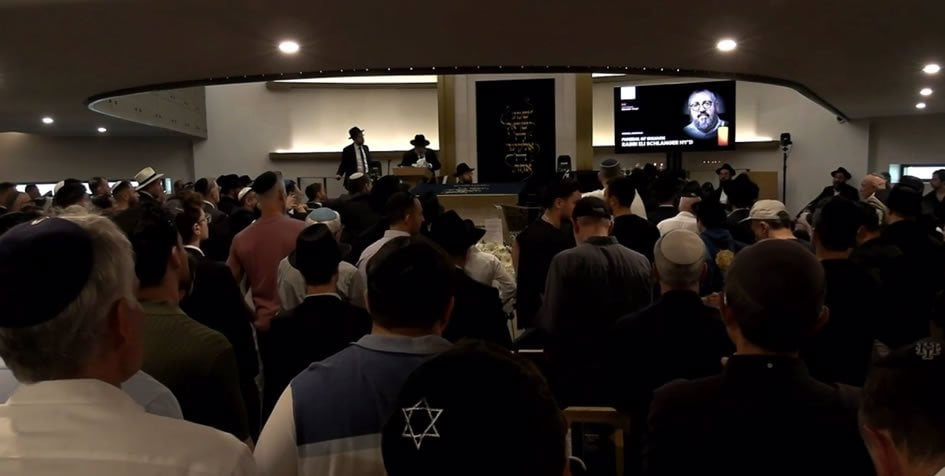
Hundreds packed into Chabad of Bondi on Wednesday morning for the Levaya of Rabbi Eli Schlanger, the 41-year-old Shliach who was murdered Sunday evening while hosting a Chanukah celebration at Bondi Beach.
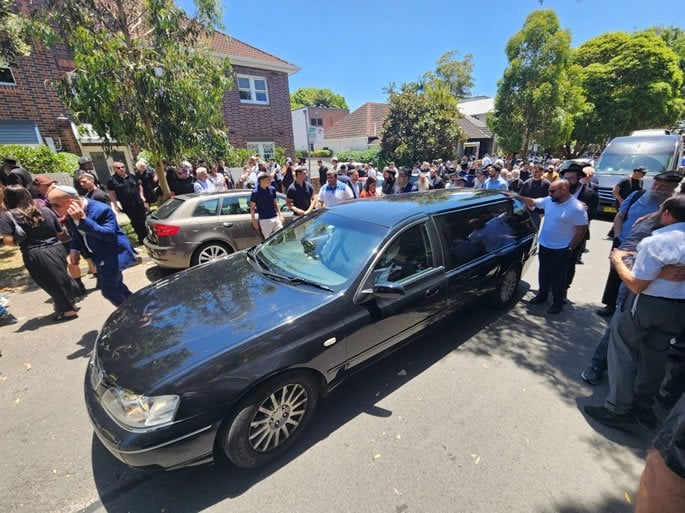
Hundreds packed into Chabad of Bondi on Wednesday morning for the funeral of Rabbi Eli Schlanger, the 41-year-old assistant rabbi who was murdered Sunday evening while hosting a Chanukah celebration at Bondi Beach.
Wellington Street was closed surrounding the synagogue due to heavy security and the expected crowds. The service was livestreamed to thousands of mourners around the world, including Schlanger’s parents in Jerusalem.
“We kept hoping over the last three days that we would wake up and somehow realize that this was all just a terrible dream,” Rabbi Aron Moss, who served as emcee, opened the service. “We can’t dream that anymore. Today we’re here to mourn and honor our beloved Eli, one of the purest and most sincere and compassionate people any of us could have known. The loss is unspeakable.”
Israel’s Minister for Diaspora Affairs Amichai Chikli recited the opening prayers. Rabbi Yossi New, director of Chabad of Georgia, representing Chabad headquarters, recited Psalm 124. Rabbi Shua Solomon said Psalm 20 for the recovery of all the victims.
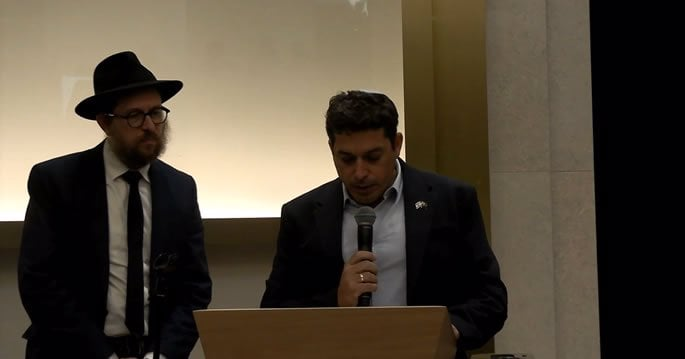
Chief Rabbi of Singapore Rabbi Mordechai Abergel, Rabbi Pinchas Feldman, and Rabbi Moshe Gutnick participated in the prayers. Rabbi Yakov Lieder, Rabbi David Rogut OAM, Rabbi Menachem Dadon, and Rabbi Michoel Chriqui each then led a prayer.
In an emotional moment, Rabbi Yossi Lazaroff of College Station, Texas—whose son Leibel is recovering from gunshot wounds to the abdomen and thigh sustained in the attack—choked on his words as he led a Psalm, before Rabbi Mendel Kastel, Schlanger’s brother-in-law, also led a prayer.
‘Eli, Eli, Why Have You Left Us’
Rabbi Yehoram Ulman, Schlanger’s father-in-law, director of Chabad of Bondi and the senior dayan on the Sydney Beth Din, was called to speak.
Through sobs he staggered up the stairs, unable to stay calm, and took a minute to compose himself when he faced the crowd.
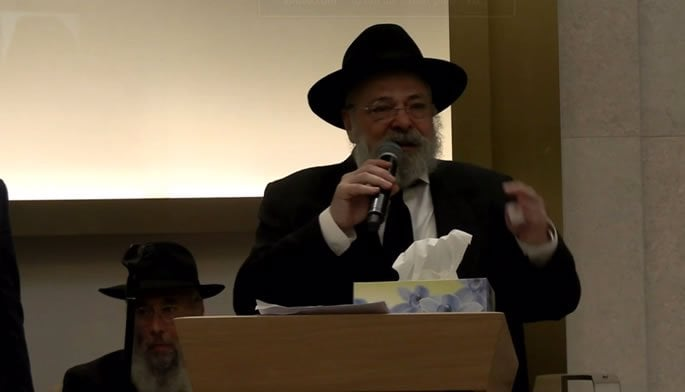
“It’s unthinkable that we talk about you in the past tense,” Ulman said through tears. “And unthinkable to me that we have a crowd in the shul and I can’t turn to you and say ‘Eli, what do you think about this or that?’ We did everything together.”
Ulman noted that the Shulchan Aruch prohibits bringing a coffin into a synagogue, with two exceptions: a great leader among the Jewish people and a kadosh, a holy martyr who gave their life sanctifying God’s name.
“Eli, there’s no question you’re both,” he said before breaking down in sobs.
Then, invoking the words of Psalms, he cried out: Ayli, Ayli (“my G‑d, my G‑d) lama azavtani (why have you left me)?”
He then modified the words slightly and addressed his son-in-law, Eli, Eli, lama azavtanu, “Eli, Eli, why have you left us?”
Sobbing was audible throughout the sanctuary.
Ulman described the profound bond he shared with Schlanger over nearly two decades of working together.
“Eli, from the moment that you married Chayale, you became a son to us as much as she’s our daughter. You became everything to me. My hands, my feet. Your dedication to me knew no limits. I could rely on you for everything. You’re my son, my friend and confidant. To think that your wife, your children, I, will have to go a day without you is impossible.”
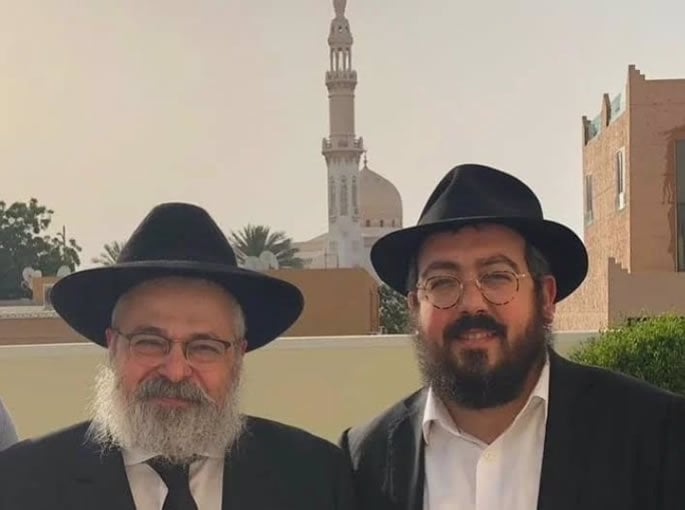
Ulman noted the tragic irony that they were holding the funeral in the new Chabad of Bondi building, a facility Schlanger had dedicated his final year to helping establish.
“It is so fitting we’re here with you today, this mikdash me’at, a place you gave your life to, you gave everything to it, for many many years. And to think only a year after your dream was realized you’ll be here without us seeing you.”
A Life of Service
Ulman described Schlanger as someone who achieved in 41 years what many couldn’t in double that time.
“In the community he was there for everybody. Constantly thinking of new ways of how to help another person,” Ulman said. “So many people since he died came over to me to say he contacted them. He was always thinking: Who have I not spoken to in a while, who I haven’t seen recently.”
Ulman detailed how Schlanger was instrumental in every initiative he pursued—from publishing a book of rabbinic cases to establishing a worldwide organization dealing with questions of Jewish status.
“He never wanted to be in the limelight,” Ulman said. “Everyone fell in love with his personality, what he represented.”
Ulman then recited the names of each person killed in the attack, acknowledging the family of the youngest martyr, Matilda in the crowd, before wishing a complete recovery to Leibel Lazaroff and all others wounded.
Drawing on teachings of the Rebbe about how to respond to tragedy, Ulman said: “I can tell you how Eli would react: he would take any tragedy to make something l’shem shamayim—for the sake of heaven.”
He noted that 1,000 people had put on tefillin at Bondi Beach in Schlanger’s honor the day after the attack, calling it “his response.”
Addressing Schlanger’s widow Chayale and their five children, including their two-month-old baby wounded in the attack, Ulman pledged that the community would be “Eli’s hands, feet and heart to make sure you’ll be looked after.”
He committed to continuing all of Schlanger’s initiatives, including Project Noah and other outreach programs.
“If you want to honor him, give him nachas, do what he asked in the past: Want to put on tefillin? We’ll help you. Shabbos candles? We’ll help you,” Ulman said.
‘We’ll Light All Eight Candles’
Ulman ended with a defiant message about the community’s response to the attack.
“When those animals try to hurt us they want us to be scared. To take off our mezuzahs, and yarmulkes and to ‘never go to Bondi Beach again.’ That’s not the answer. We can never allow them to succeed. Every time they try something we become greater and stronger.”
He announced that this Sunday night, when all eight Chanukah candles would be lit on the final night of the holiday, all Sydney rabbis would gather at Bondi Beach to light the menorah together.
“We’ll light all eight candles and show the world that the Jewish people are unbeatable.”
A video was then played of Schlanger speaking to the community, telling them how to respond to antisemitism by doing more—more mitzvot, more Jewish pride, more public celebration of their identity.
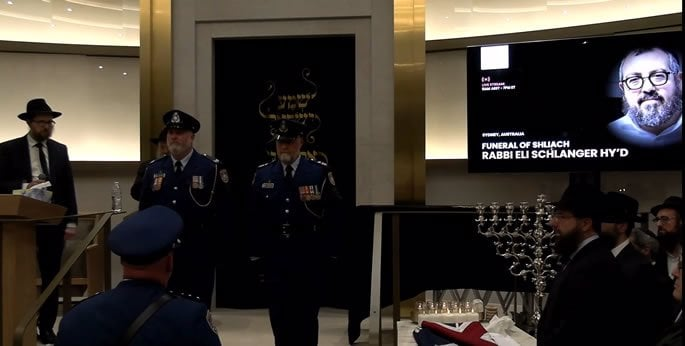
Then a cadre of NSW Department of Correctional Facilities officers made an honor guard and marched before Chazzan Rabbi Yehuda Niazof led an emotional rendition of Keil Malei Rachamim.
Following the service, a procession accompanied Schlanger’s body to Rockwood Cemetery for burial.
 COMMENTS


We appreciate your feedback. If you have any additional information to contribute to this article, it will be added below.