



כ״ד כסלו ה׳תשפ״ו | December 14, 2025
Pop-Art Rabbi’s Menorah to Shine at Site of Boulder Attack
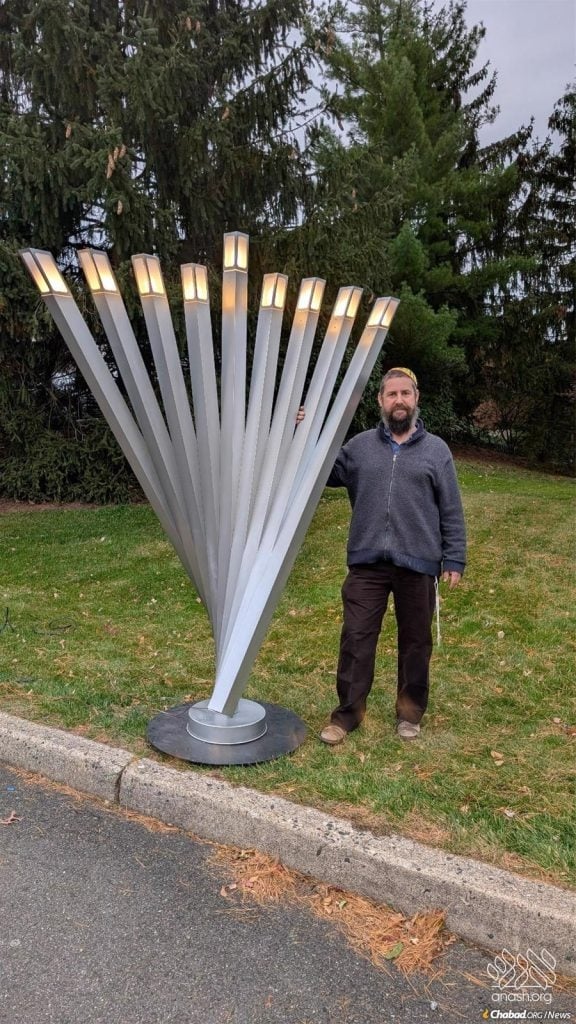
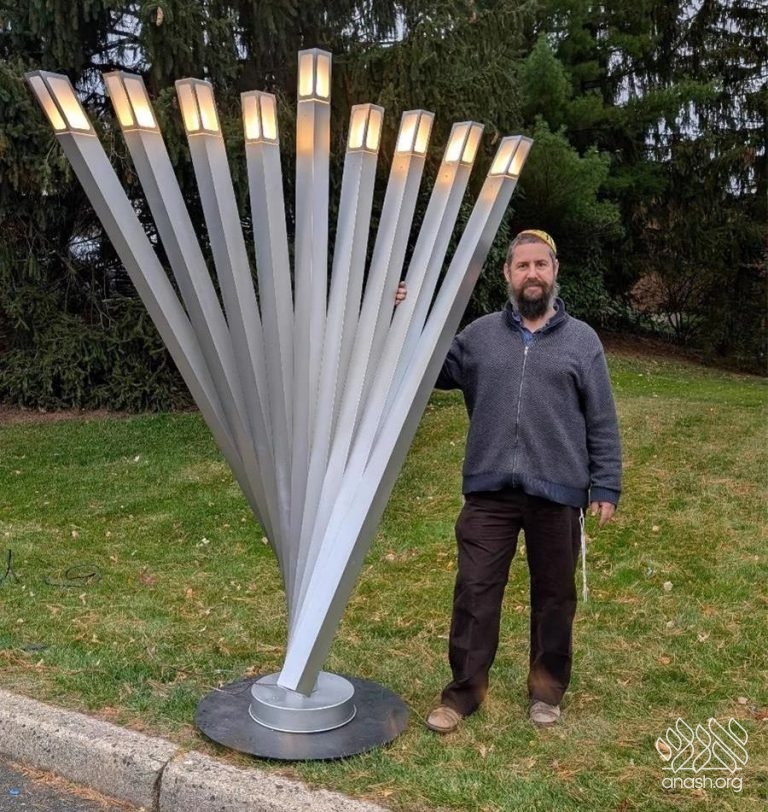
A monumental public art menorah will be unveiled in Boulder, Colo., this Chanukah, lighting up the same site where a deadly antisemitic attack took place earlier this year. The piece represents months of work by Lubavitcher artist Yitzchok Moully.
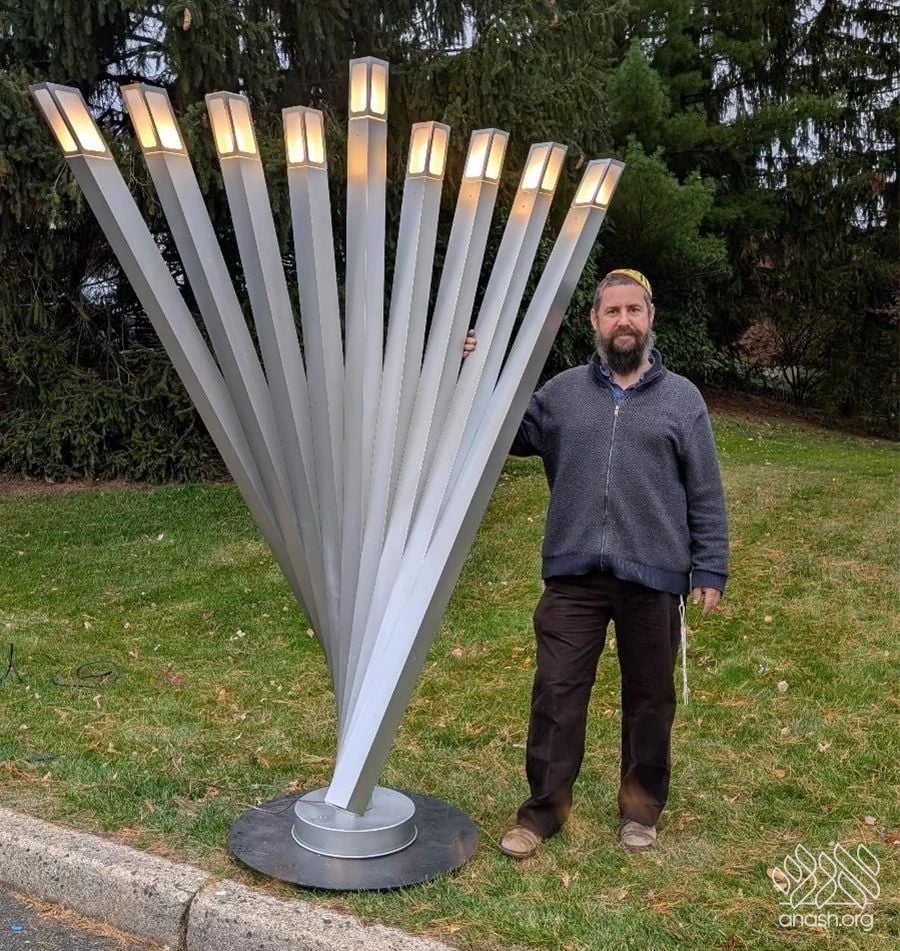
A monumental public art menorah will be unveiled in Boulder, Colo., this Chanukah, lighting up the same site where a deadly antisemitic attack took place earlier this year. The piece represents months of work by the artist Yitzchok Moully, the Boulder community’s conviction that hate and violence will not win the day, and the Chabad-Lubavitch movement’s belief that light can, and does, dispel even the greatest darkness.
“When do we add light?” asks Moully, 47. “What holiday symbolizes this more than any other? Chanukah, of course.”
On June 1, 2025, the eve of the Jewish holiday of Shavuot, Egyptian national Mohamed Sabry Soliman, armed with a “makeshift flamethrower,” hurled a Molotov cocktail into a crowd of Jewish people peacefully rallying in support of the hostages being held by Hamas and other terrorist organizations in Gaza, murdering 82-year-old Karen Diamond, and injuring dozens, including 88-year-old Holocaust survivor Barbara Steinmetz.
“It was a regular eve of Shavuot,” recalls Chany Scheiner, co-director, with her husband Rabbi Pesach Scheiner, of Chabad of Boulder. Shavuot began that night, and she and her husband were preparing their new Chabad center for the holiday. Then her phone started exploding. “I normally get a lot of calls, but here the phone was really just blowing up.”
The first message came from someone who had been at the attack. “Chani, I just want to let you know what happened,” the woman wrote. She had been in Boulder’s Pearl Street Mall attending the “Run For Their Lives” walk, a rally dedicated to remembering the hostages in Gaza, when the attacker, dressed as a landscaper, threw the firebomb at the congregating Jews.
“People were injured. Two had to be airlifted. One person died,” Scheiner says. The location is five minutes from the Scheiner’s new center, seven from their house, and Chani has attended the walk numerous times herself.
“People were in shock, trying to find out if they knew anyone impacted,” she recalls. All the media descended on Boulder. The holiday program the Scheiners hosted that evening drew even more local Jewish community members than expected. “People were really shaken, anxious, and vulnerable.”
In the aftermath, something shifted. “Since the attack there has definitely been an uptick of people coming to shul, people trying to come together more,” Scheiner says. A week later, the Boulder Jewish Festival, at which Chabad had two booths, was entirely dedicated to the victims of the vicious attack and bringing the community together. “We took up positive initiatives to expel the darkness.”
For a place that had always been safe, the attack was incomprehensible. “It was just a shock,” says Scheiner. “We thought something like this could never happen here, and it did.”
Not long after, Rabbi Scheiner connected with Moully, telling the artist that every year Chabad lights a large public menorah at the very same Pearl Street Mall where the attack took place.
“I wanted to work with them to add more light,” Moully recalls. He told the Scheiners he wanted to create a beautiful public art menorah for Boulder. Something bigger. Something permanent.
“It felt like the time to get a really beautiful menorah,” says the rabbi. The site had become a place of vigils and flowers—a reminder of the darkness that had descended upon it.
“I wanted to create a special menorah that would convey a strong message,” adds Moully. “It should be like a hug.”
Every Day Is Chanukah
Within days of the project’s start, a philanthropist from Toronto stepped up and said he would cover the entire cost of a monumental new menorah for Boulder, and in a matter of months it was ready.
Moully hopes to be there for the Scheiners’ big Chanukah event this year, when more than 500 people are expected to gather at Pearl Street Mall to inaugurate the menorah. Survivors of the attack will be there, lighting candles together. “Excitement is building,” says Scheiner. “Dignitaries are coming. It’s very well-attended. It’s a community event that people love to come to. Especially in these times, they feel less alone. There’s a community.”
This isn’t Moully’s first such Chanukah project. In 2018, weeks after the deadly antisemitic shooting at Tree of Life in Pittsburgh, he wanted to create a mural but couldn’t find a wall.
So he turned to the family RV instead, transforming it into an interactive art installation. The 30-foot RV rolled through the streets of New York and New Jersey, impossible to miss. Both sides were covered in black panels bearing the words “Light Over Darkness” in bold letters. At the bottom, just the tip of a menorah emerged from the darkness.
For eight nights of Chanukah, Moully drove this mobile canvas through neighborhoods, inviting passersby to write what they would do to transform darkness into light. Each night, he painted another flame.
Boxes of bright markers in hand, he collected hundreds of commitments to bring more light into the world.
“For me, every day is Chanukah,” says Moully. “I’m always thinking of menorahs.”
From the Outback to Brooklyn
Moully was born in what he calls “the capital of nowhere,” and raised in a collective-living commune in the Australian Outback. With his mother, a spiritual hippie who wasn’t a practicing Jew at that time, he slept in a caravan permanently parked in the wilds of Australia’s interior. The family observed only one Jewish holiday: Yom Kippur. On that day, mother and son would leave the commune, wandering through the unforgiving wilderness until they reached a creek, where she would meditate on G‑d in silence.
“That was the kind of life we had,” recalls Moully.
Everything changed when Moully was four and his grandfather fell seriously ill. For the first time since his circumcision, mother and son left the Outback for a Jewish community. While praying for her father, Moully’s mother spoke with Rabbi Shimon Cowen, a Chabad rabbi in Melbourne. That conversation planted the seed for Moully to attend Jewish day school. On his first day of school, his grandfather passed away.
“It’s as though he was holding on and holding on,” Moully reflects. “He didn’t want to leave until he knew we were spiritually connected.”
There was no going back to the Outback now. Still grieving, Moully’s mother began to plan their future. Where could they find nature, Judaism and an alternative lifestyle? The plan was an Israeli kibbutz. The route was through North America, with a 10-day stopover in a little neighborhood in Brooklyn called Crown Heights.
The stopover lasted four and a half years.
Mother and son arrived for Rosh Hashanah 5745 (1985), staying with strangers. Someone suggested Moully’s mother write to the Rebbe—Rabbi Menachem M. Schneerson, of righteous memory—to ask for a blessing for their journey. The Rebbe’s response: Stay here for the time being and with the help of friends accomplish what you’re here to accomplish.
For a five-year-old raised in the Australian bush, the busy streets of Brooklyn became a new kind of wilderness to explore. Moully says he was a wild kid, racing through the crowds, squeezing through the Rebbe’s synagogue at 770 Eastern Parkway on a Shabbat morning to catch a glimpse of the Rebbe.
On one Shabbat morning, as the Rebbe walked through the sea of congregants towards his place at the front of the synagogue, he noticed the child who had pushed his way to the front. Smiling at the little boy, he said, “Good Shabbos.”
“What did the Rebbe see in that five-year-old running around 770, that he specifically noticed me among the massive crowd?” says Moully.
Those four and a half years were transformative. His mother worked as a preschool teacher while he attended a Chabad yeshivah, where the teacher spoke only Yiddish. There were dollars from the Rebbe’s hand, Sukkot. Simchat Torah celebrations, spending holidays and milestones in the Rebbe’s court. It was a new world, and Moully loved it.
‘Chassidim With Color’
Over the next few years, Moully grew in his studies, eventually graduating from yeshivahs in Melbourne and Morristown, N.J. In 2004, Rabbi Mendy and Malky Herson offered the now-married Moully and his wife, Batsheva, the opportunity to join them in their work at Chabad of Basking Ridge in New Jersey.
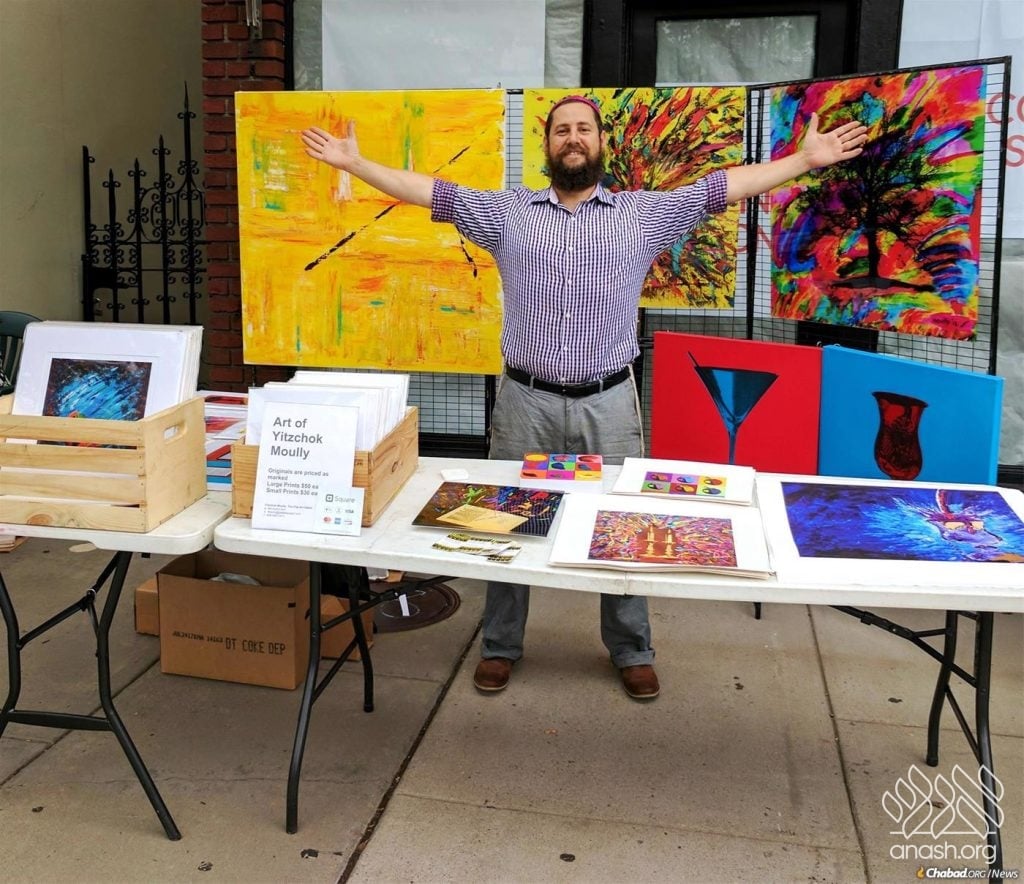
The couple spent years in Basking Ridge, building a family, running programs and serving the local Jewish community, and during that time, Moully began experimenting with photography. As soon as he ventured into abstract art, something clicked. Born and raised by hippies, creativity ran through his veins. A certain wildness that had never left him and was now finding a new outlet. He started spending nights crouched over six-by-six-inch canvases, trying to master silk screen printing—Andy Warhol’s technique of fusing photography and paint. After putting his kids to bed, he’d head to the basement. The process was technical and difficult, and it took him a year to work it out. Commercial silk screen shops turned him away: “Please don’t come back. We don’t have time for you.”
But he kept going.
Things started to take off. A gallery owner in New Hope, Pa./Lambertville, N.J., an area on the Delaware River, was intrigued by Moully’s blend of Chassidic imagery and pop art. He gave him a show, and the local press picked up on it.
The Moullys spent more than a decade in Basking Ridge, before moving to Hillside, N.J., where they both remained active in Jewish education. By now working on his art full-time, Moully spearheaded an all-night show of his work and that of other Chassidic artists in Crown Heights titled “Chassidim With Color.”
“I couldn’t close the doors,” says Moully. “I literally couldn’t close the doors. Two o’clock in the morning, 3 o’clock one morning, I couldn’t lock up. People just wanted to share and connect and talk.”
So was born the “Pop Art Rabbi.”
Illuminating the Street
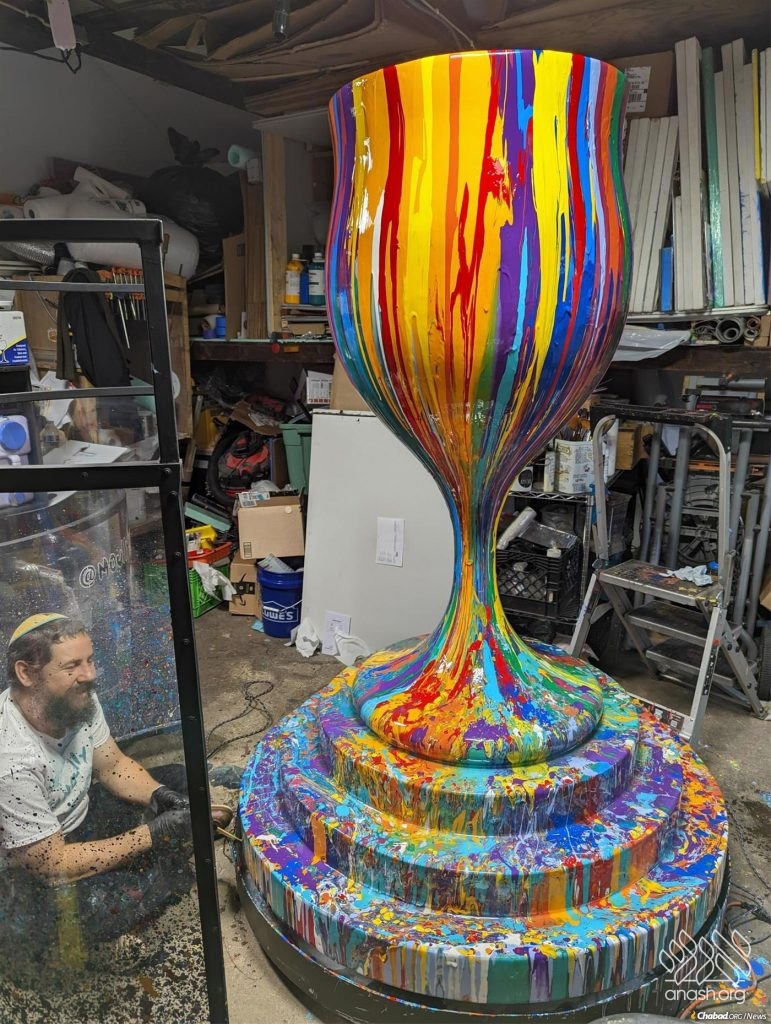
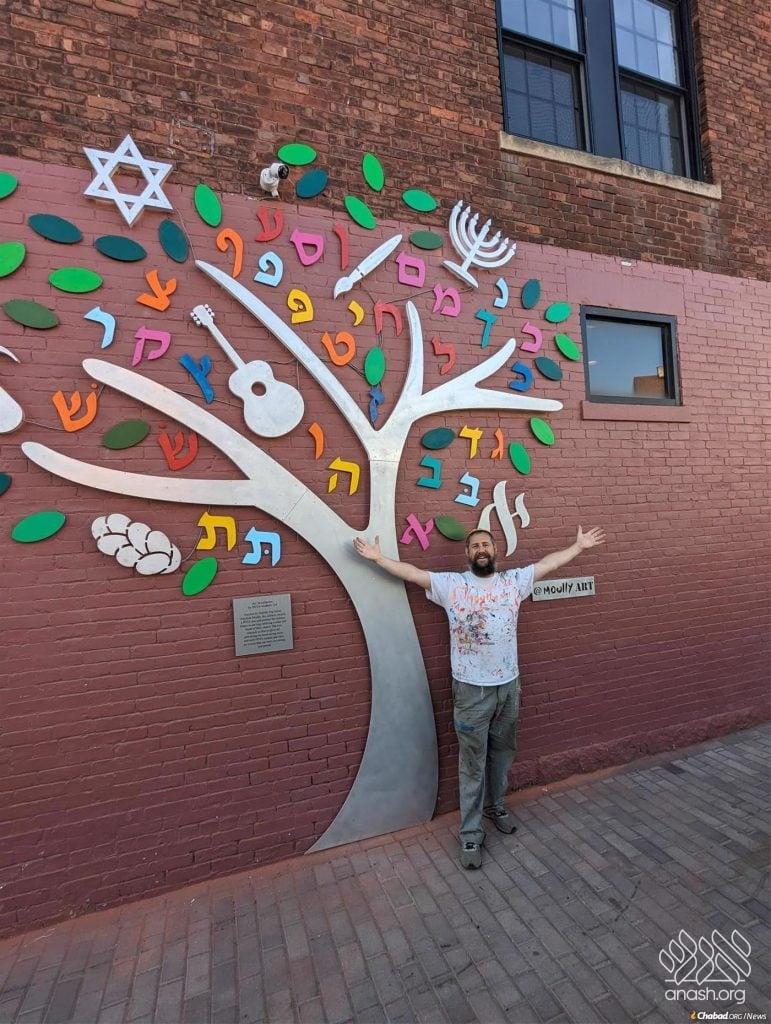
Since those late nights in Basking Ridge, Moully has moved through many phases: photography, silk screen, abstracts, sculptures and interactive installations. But his focus now is squarely on public Jewish art.
“The mission is to bring Jewish art into the public sphere,” he says. “To make public menorahs that illuminate their spaces in more ways than one, that will uplift their surrounding communities.”
“[T]he Chanukah Lights are expressly meant to illuminate the ‘outside,’ symbolically alluding to the duty to bring light also to those who, for one reason or another, still walk in darkness,” the Rebbe wrote in a 1981 public letter addressed to attendees of menorah lightings around the country.
“What is true of the individual is true of a nation, especially this great United States, united under G‑d, and generously blessed by G‑d with material as well as spiritual riches,” he continued. “ … Let us pray that the message of the Chanukah Lights will illuminate the everyday life of everyone personally, and of the society at large, for a brighter life in every respect, both materially and spiritually.”
 COMMENTS


We appreciate your feedback. If you have any additional information to contribute to this article, it will be added below.