



כ׳ אב ה׳תשפ״ה | August 13, 2025
Our Days: Lessons and Takeaways for Chof Av
From Derher’s new book Our Days, this account recalls Harav Levi Yitzchok’s mesirus nefesh for spreading Yiddishkeit, the enduring meaning of Chof Av, and the Rebbe’s directives such as Kollel Tiferes Zekeinim and Beis Chochmas Nashim.
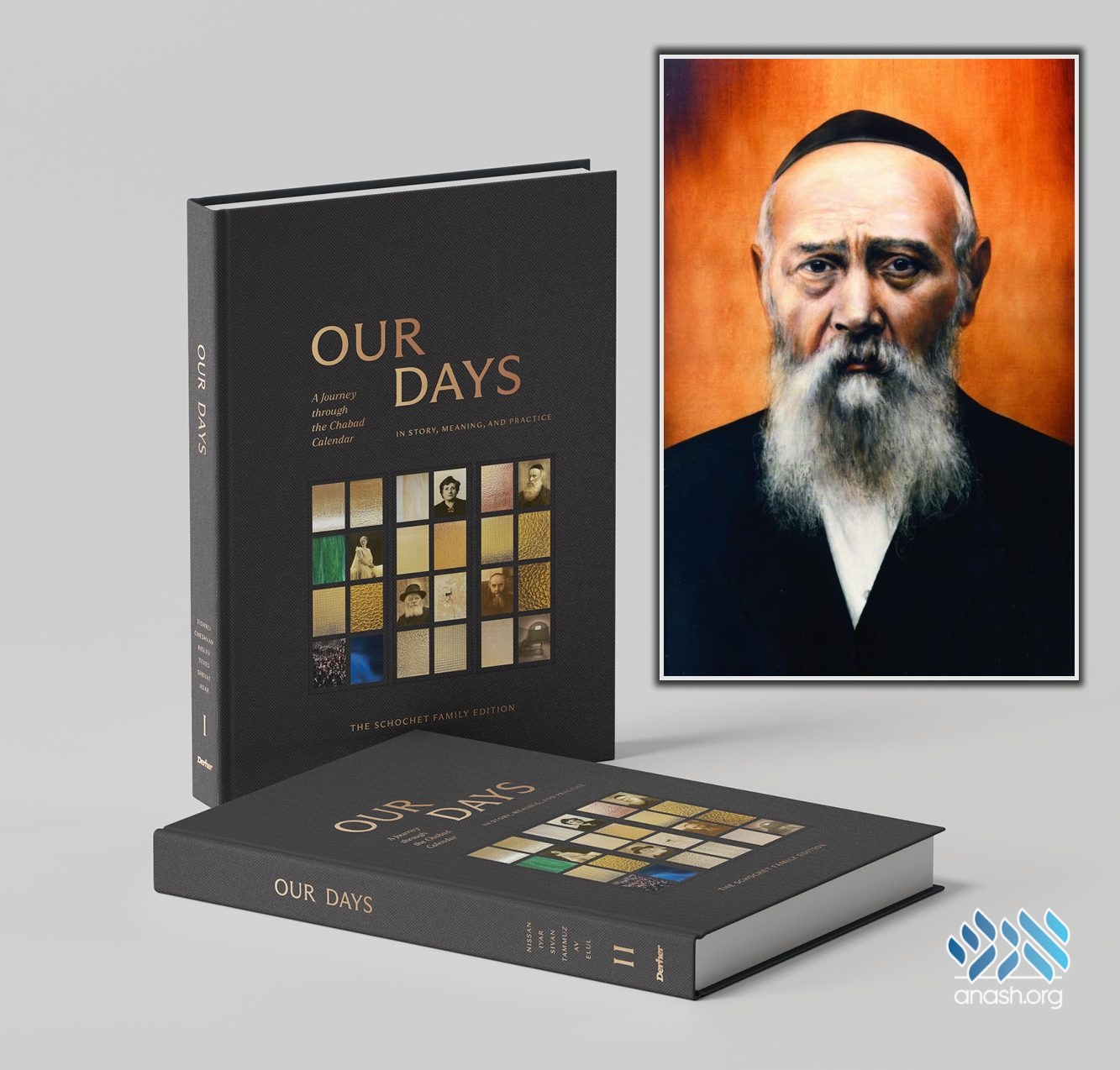
From Derher’s new book Our Days, this account recalls Harav Levi Yitzchok’s mesirus nefesh for spreading Yiddishkeit, the enduring meaning of Chof Av, and the Rebbe’s directives such as Kollel Tiferes Zekeinim and Beis Chochmas Nashim.
An excerpt from Derher’s new book Our Days
Despite All Odds
A yahrtzeit of any tzaddik provides a special opportunity for us to reflect upon and learn from their life. This is particularly true of Harav Levi Yitzchok, whose untimely passing resulted from the suffering he endured for spreading Yiddishkeit to his fellow Jews. This makes his yahrtzeit especially significant for all Yidden, offering a time to take lessons from his avoda.
Foremost among these lessons is the imperative to spread Yiddishkeit to remote locations. It wasn’t Harav Levi Yitzchok’s personal Torah study or observance of mitzvos—within the confines of his home and beis midrash—that provoked government opposition. Rather, it was his unwavering commitment to spreading Yiddishkeit and bringing its light to distant and far-reaching places that led to his sentence. We must follow his example and spread Yiddishkeit to every corner of the globe.
We can also learn from Harav Levi Yitzchok the importance of perseverance in the face of challenges. Despite enduring the harshest circumstances, he remained unwavering in his mission to spread Yiddishkeit and ultimately succeeded. Similarly, we should pursue our sacred work of spreading Torah and mitzvos with determination, undeterred by any obstacles that come our way.
Impact of a Yahrtzeit
Each year, on a yahrtzeit, the neshama experiences an aliya, ascending from one spiritual level to the next. At the same time, the neshama yearns for the merit of elevating the physical world. When we follow in the ways of the baal hayahrtzeit, prompted by the inspiration of studying the Torah he taught, we contribute to the neshama’s aliya and enable it to have an impact on this world.
This applies to anyone who has a connection with the baal hayahrtzeit—by having studied his Torah and been influenced by his teachings.
Forty Days to Rosh Hashanah
The Gemara teaches that forty days before a child is conceived, preparations for their birth begin:
“Forty days before an embryo is formed a Heavenly Voice issues forth and says: The daughter of so-and-so is [destined] to [marry] so-and-so; such and such a house is [destined] to [be inhabited by] so-and-so; such and such a field is [destined] to [be farmed by] so-and-so.”
Some of the most critical elements of a person’s life are determined in this time period.
Since Rosh Hashanah marks the creation of Adam Harishon, the preparation period began forty days earlier, on Chof Av.
This timing holds deep significance, not only for Adam Harishon but also for every Yid. Each year on Rosh Hashanah, the world—and humankind in particular—undergoes a form of renewal and creation. On Rosh Hashanah, each person is inscribed in the Book of Life for the coming year, symbolizing a fresh start and a “re-creation.” In this sense, the date of Chof Av—forty days prior—carries unique significance for everyone.
It is, therefore, an appropriate time to begin preparing for Rosh Hashanah by increasing Torah study and mitzvos, reflecting on the significance of Rosh Hashanah, and enhancing mivtzoim activities. Indeed, some communities of mekubalim begin their preparation for Rosh Hashanah on Chof Av with various practices, including Hataras Nedarim.
Historical Significance of Chof Av
The Gemara in Maseches Taanis mentions the date Chof Av as one of the dates when a korban ha’eitzim was brought in the Beis Hamikdash.
When the Jewish people returned to Eretz Yisroel with Ezra, they faced a shortage of wood for the mizbeiach. In response, several families committed to providing regular wood donations, and this became known as the korban ha’eitzim. One of these families would bring their donation on the 20th of Av.
What stands out about this korban is the remarkable ahavas Yisroel demonstrated by the donors. They were not bringing wood for their own benefit; rather, their donation was intended for the korbanos of their fellow Jews who could not provide their own wood. This act of giving was done anonymously, without knowing who the recipients would be. Furthermore, their generosity extended to all types of Jews, even those who were not in the best standing in their avodas Hashem, many of whom were bringing korbanos to atone for their misdeeds.
Additionally, the family who donated on the 20th of Av displayed a special act of mesirus nefesh: As summer drew to a close, the wood in the forests would become moist and unfit for use until the following summer. This meant the family was donating from their limited supply, knowing they couldn’t replenish it until the next season. Yet they proceeded without hesitation, bringing their precious stockpile to the Beis Hamikdash.
This selfless dedication mirrors the conduct of Harav Levi Yitzchok, who risked not only his spiritual avoda but his very life for the welfare of other Jews.
The lesson for us is clear: we must do everything in our power to spread Yiddishkeit to the furthest corners of the earth and to Jews of all types. We must do so without being deterred by challenges or distractions that may arise along the way.
Special Initiatives
The Rebbe established several special initiatives in connection with his father’s yahrtzeit:
On Chof Av 5724 (1964), marking twenty years since his father’s histalkus, the Rebbe announced an initiative: the creation of a fund to provide teachers with short-term loans. This fund aimed to alleviate their financial burdens, enabling them to focus on their vital role of teaching Torah to young students.
In 5740 (1980), the Rebbe introduced another initiative, this time emphasizing the importance of encouraging the elderly to engage in Torah learning through public shiurim. The Rebbe announced the establishment of a special organization called “Kollel Tiferes Zekeinim” to ensure this endeavor’s success on a broad scale. The Rebbe asked that an official kollel be established in every city and every shul, with set times for public shiurim; and that participants should receive a monthly stipend so that they would be motivated to participate consistently and punctually.
Since these kollels were initiated in connection with Chof Av, the Rebbe said it would be proper to add the name “Levi Yitzchok” to their title.
The Rebbe later further expanded this initiative by announcing the establishment of special shiurim for elderly women under the unifying name “Beis Chochmas Nashim.”
 COMMENTS


We appreciate your feedback. If you have any additional information to contribute to this article, it will be added below.