




י׳ אדר ה׳תשפ״ו | February 26, 2026
Original Admission Card from Frierdiker Rebbe’s Arrival Surfaces
An admission card for the official welcome of the Frierdiker Rebbe at Pier 97 in New York Harbor, tells the story of the miraculous journey from war-torn Europe, the yearning of chassidim to see their Rebbe, and the establishment of Lubavitch in America.
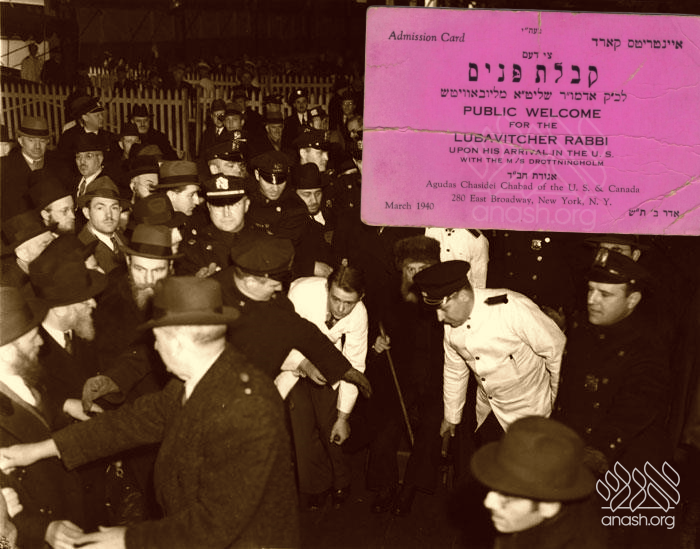
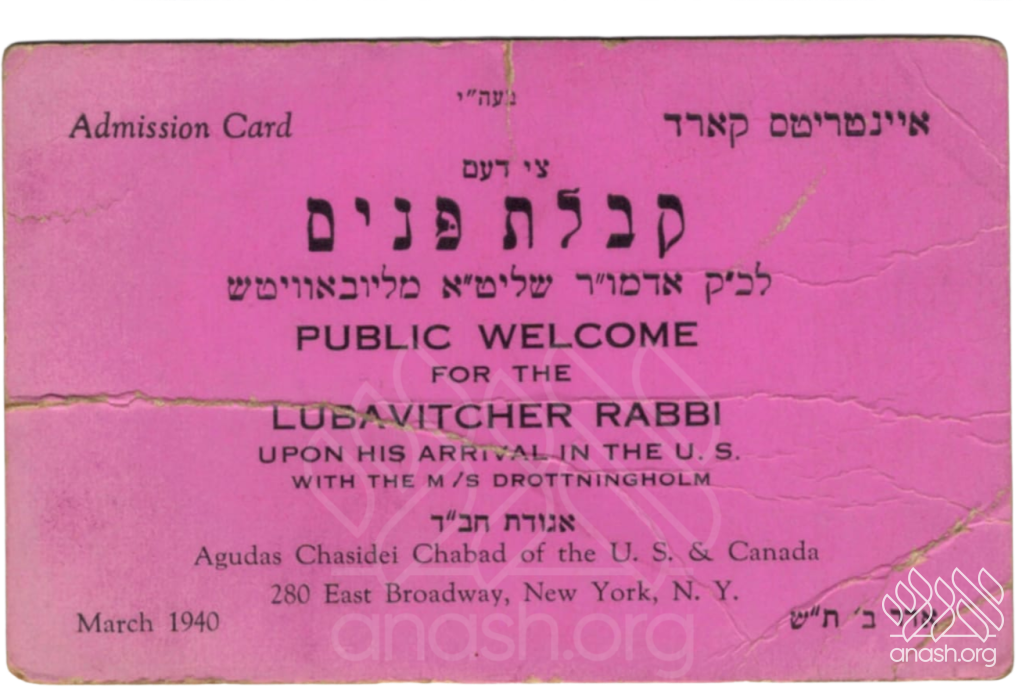
In honor of Tes Adar, 86 years since the Frierdiker Rebbe arrived in the U.S. from Nazi Europe, we share an image of a special admission card allowing special guests to partake in the kabolas ponim welcome ceremony for the Frierdiker Rebbe at the pier on Tes Adar II 5700 (1940).
It was a brisk, windswept Tuesday morning when thousands gathered at Pier 97 in New York Harbor to witness a moment that would become one of the defining turning points in American Jewish history.
After months of uncertainty, the Frierdiker Rebbe was finally able to leave Europe and board the ship to U.S. shores. The Swedish liner Drottningholm carried him across the Atlantic.
The voyage itself reflected the turbulence of the times. German U-boats patrolled the North Atlantic, and the liner was stopped multiple times by warships verifying its neutrality. It became the last commercial ship to cross the Atlantic before wartime restrictions halted civilian travel.
“On Monday, 8 Adar II – after a twelve-day voyage, around four hours past midnight – the shores of Newark came into view,” one of the passengers traveling with the Frierdiker Rebbe described in a diary. “About two hours later, we reached the harbor.”
“Any ship arriving at the Newark harbor after four hours past midnight is not allowed to disembark passengers until the following morning. On Tuesday, 9 Adar II, at nine o’clock in the morning, preparations began to welcome the holy Rebbe, shlita.
“After the official greetings of the port staff, the verification of travel documents began. The officials in charge of disembarking the passengers suggested that the Rebbe, shlita, step down immediately, because if they waited, the process of unloading some 400 people would begin, causing a crush and noise.
“At half past eleven, we left cabin number 13, where we had stayed since 9 a.m., 26 Adar I, until 11:30 a.m., 9 Adar II – a total of thirteen days and two and a half hours.
“The Rebbe, shlita, ascended to the upper deck, giving brief words of thanks to the ship’s captain and assistants for their kind treatment. The harbor and the entire area in front of it were filled to capacity with men and women.”
As the ship approached the harbor, a government launch carrying immigration and customs officials met the ship several miles offshore, along with a delegation of Agudas Chassidei Chabad, including R’ Fishel Kleinfield, the commissioner, Mr. William Harlands, Reb Shmuel Levitin, R’ Yekusiel Kramer, and Reb Yisroel Jacobson, eager to greet the Rebbe and escort him ashore.
The captain respectfully asked whether he preferred to disembark first or last; the Rebbe chose the latter. Before arrival, he also sent word through Chazan Shmuel Kantaroff that those on the pier should recite the bracha of Baruch mechayeh hameisim upon seeing him, acknowledging the miracle of his survival.
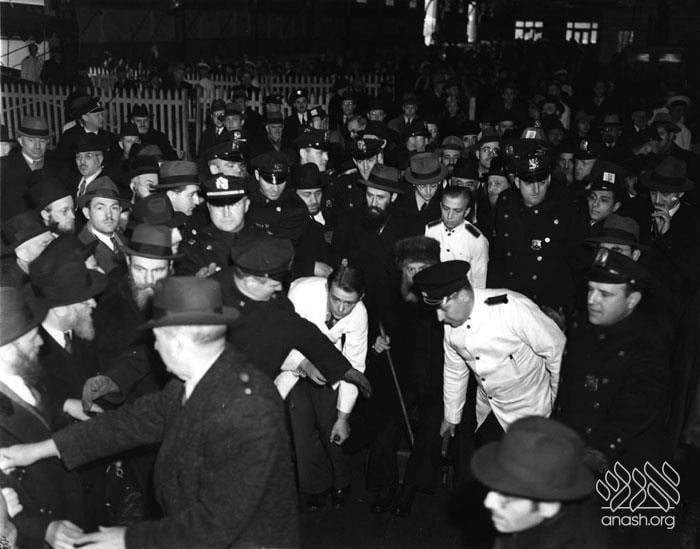
Thousands waited anxiously on the pier. The dock officials had a hard time controlling the crowd. The intense longing to see the Rebbe burned in everyone; they could not stay in one place. The police also had their work cut out for them.
“Suddenly, a commotion – a song breaks out,” a policeman described in an article later printed in the newspaper Der Tog. “The Lubavitcher Chassidim began singing a Lubavitcher niggun, just like in a shtibel. Believe it or not, when we, Jewish policemen, saw that the Rebbe would soon disembark, we, too, began singing.”
The ship Drottningholm came into view. As it neared, passengers could be seen through the windows, and the crowd of thousands gathered on the shore to greet the Rebbe. When he finally appeared, a powerful and emotional “Sholom Aleichem” resounded across the waterfront. Thousands recited the bracha Shehechiyanu, while dozens of cameras clicked.
Even before stepping onto land, the Rebbe told R’ Yisroel Jacobson that the suffering he endured under Nazi rule surpassed his imprisonment in Soviet Russia, yet there was no time to dwell on the past: “We will quickly complete the formalities and begin the work immediately. Our task is Torah and Yiddishkeit overseas.”
The ship reached the shore, and the Rebbe disembarked in his wheelchair, accompanied by police and others, on the special bridge leading to the shore.
“As soon as people saw the chair on the pier,” the police officer continued, “a loud voice rang out: ‘Baruch Mechayei Mesim!’ A shiver ran through everyone. The Rebbe’s face came closer – delicate, startled – like nothing I had ever seen, the face of a man being carried by others, and hearing the blessing Mechayei Metim.
“The singing was led by Chazan Shmuel Kantaroff, one of the best-known and closest Lubavitcher Chassidim. He also fervently sang Shehechiyanu and Bruchim Habaim.”
Special “tickets,” small cards, were issued for a special welcome ceremony on the pier. The tickets were sent in advance to Chabad activists and representatives of Chabad institutions in the U.S., along with a special letter:
“You are invited to obtain tickets for the welcome ceremony for the Lubavitcher Rebbe, shlita, who will, with Hashem’s help, arrive at a good hour on Tuesday, 9 Adar II (March 19), aboard the ship Drottningholm, Pier 97, West 57th Street, New York, around midday.
“This ticket will give you the opportunity to be in a special reserved place at the mentioned pier, which has been designated for the welcome of the Lubavitcher Rebbe, shlita. This letter is sent only to special representatives of organizations and invited individuals.
“Please arrive on time and as early as possible. Check the Jewish newspapers for the latest updates on the ship’s arrival time on Tuesday, or call the office of Agudas Chabad for further information.”
The card read as follows:
Admission Card – איינטריטס קארד
צו דעם קבלת פנים לכ״ק אדמו״ר שליט״א מליובאוויטש
PUBLIC WELCOME FOR THE LUBAVITCHER RABBI
UPON HIS ARRIVAL IN THE U.S.
WITH THE M/S DROTTNINGHOLMאגודת חב״ד
Agudas Chasidei Chabad of the U. S. & Canada
280 East Broadway, New York, N. Y.March 1940 – אדר ב׳ ת״ש
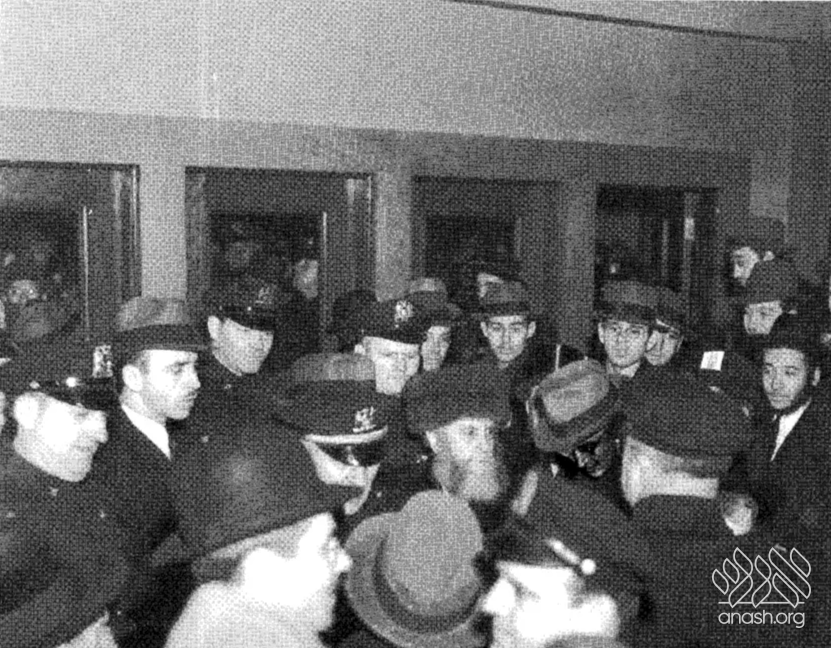
The thousands in the crowd rushed and gathered inside the port hall to be among those present for the welcome ceremony and to see and hear the Rebbe.
The Rebbe was then guided through the port into the hall, in a large predesignated area, with a police officer walking ahead to clear the way.
He was greeted by representatives of Agudas HaAdmorim, Agudas HaRabbanim, the Rabbinical Committee, Degel HaRabbanim, Agudas Yisrael, Mizrachi, Young Agudas Yisrael, Poalei Agudas Yisrael, Young Mizrachi, Young Israel, Yeshiva Rabbi Yitzchak Elchanan, Yeshivas Rabbi Chaim Berlin, Yeshivas Rabbi Yaakov Yosef, Ramaz Margaliot, Torah v’Daas, Toras Emes, Ahavas Torah, Toras Chaim, and others.
Rabbis had come from other cities – they had arrived the previous day – as well as many frum Jews, including men from Boston. Everyone pushed forward and rushed through the port doors into the hall. When the crowd rushed toward the hall, it was a true danger to life; the police could not help.
Although Agudas Chabad had printed tickets for many Chassidim to attend the welcome ceremony on the pier, the ship’s officers did not want to let people board freely.
“You must have tickets from Customs,” they told the crowd, which had by now pushed itself onto the pier.
Indeed, a large crowd with Chabad tickets had to remain off to the side – they could not get close to the ship. The distress of those forced to stay aside was visible as they watched others succeed in getting onto the pier.
Meanwhile, inside the hall, everyone stood on all sides, on fences and benches, to hear the Rebbe’s words. Mr. Kramer introduced the mayor of Lagwardia’s envoy, Mr. Harlands, who conveyed the mayor’s blessings.
The Rebbe then addressed the crowd, which included government officials and representatives from nearly every major Jewish organization. He spoke with deep emotion. While acknowledging their warm welcome, he emphasized that his heart remained with the Jews trapped in Europe and urged American Jewry to awaken to its historic responsibility to act and save lives.
At 12:30, the Rebbe left the hall and went out to the square in front of the harbor, receiving blessings of “Shalom Aleichem” from the thousands of men and women filling the area. The Rebbe then sat in the car while nigunim and Tehilim were sung, and the car slowly moved forward. Around 1 a.m., the Rebbe arrived at the Greystone Hotel.
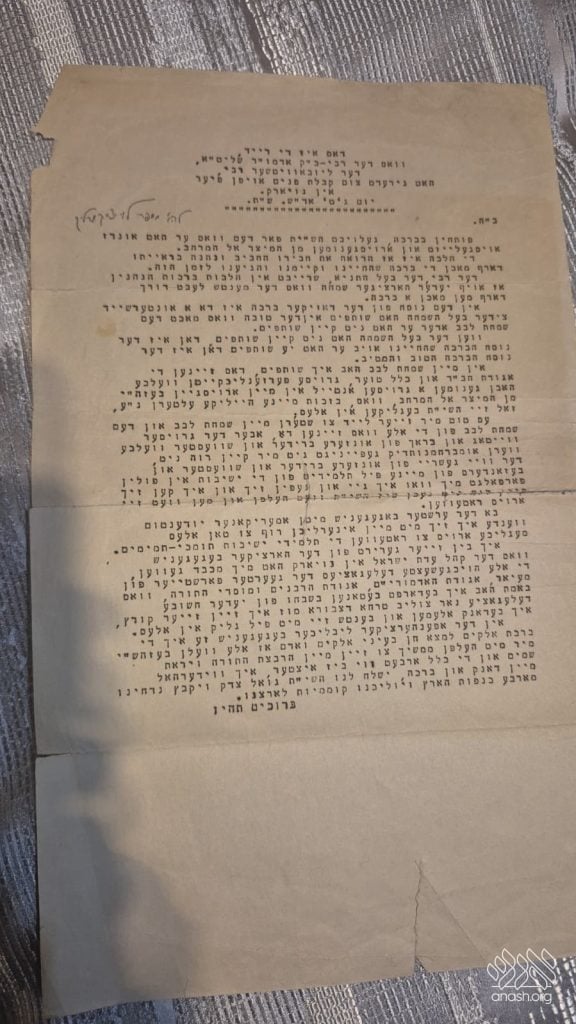
Original hanacha of the Frierdiker Rebbe's sicha then
 COMMENTS


We appreciate your feedback. If you have any additional information to contribute to this article, it will be added below.