




כ״ו ניסן ה׳תשפ״ו | April 13, 2026
Hungary’s Orban Falls After 16 Years, Ending Remarkable Era
Hungarian Prime Minister Viktor Orban conceded defeat on Sunday night, ending 16 years in power. For Hungary’s Jewish community, and for shluchim across the country, the defeat marks the close of a notably favorable era.
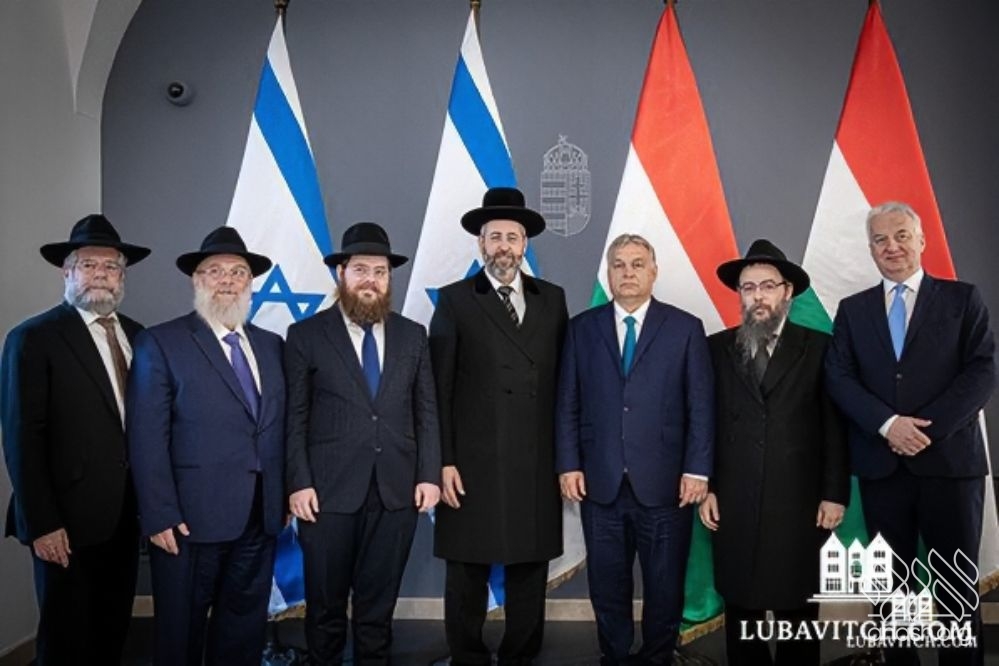
Hungarian Prime Minister Viktor Orban conceded defeat on Sunday night, ending 16 years in power after opposition leader Peter Magyar and his Tisza party swept to a commanding parliamentary victory.
With nearly all ballots counted, Tisza secured 138 seats, enough for a two-thirds majority, while Orban acknowledged the outcome plainly: “The election result is painful for us, but clear.” Officials also reported record turnout of over 77 percent, underscoring how consequential the vote was seen across the country.
For Hungary’s Jewish community, and for shluchim across the country, the defeat marks the close of a notably favorable era. Orban was widely viewed as one of Israel’s strongest allies in Europe, and Prime Minister Bibi Netanyahu publicly praised him in unusually warm terms, saying he had “done remarkable things for Israel and the Jewish people.” Netanyahu added: “You support Israel proudly, unstintingly, you stand with us at the European Union, you stand with us at the United Nations, and you’ve just taken a bold and principled position on the ICC. I thank you, Viktor.”
That relationship was not only diplomatic. Before Netanyahu’s visit to Budapest last year, local shluchim and heads of Hungary’s Jewish communities were unexpectedly among the first to hear that Hungary would withdraw from the ICC in support of Israel, summoned to the Prime Minister’s office before the announcement was made public.
After his meetings with Orban, Netanyahu sat with local shluchim and reviewed concrete matters raised with the Hungarian government, including a fixed annual grant tied to heirless Jewish property, renovation of the Jewish university, renovation of the Jewish hospital in Budapest, and other support for Jewish communal life.
The sense of security felt by many local Jews was widely echoed at the time. One shliach said, “As someone who was born and raised here, I don’t recall a time like this, when Jews received such respect and appreciation, and felt so secure.” Another said the respect shown by Orban toward Netanyahu and the Jewish community sent “a powerful message to the entire Hungarian population.”
The numbers bear that out. In the EU Agency for Fundamental Rights’ 2024 survey, 65 percent of Jewish respondents in Hungary said antisemitism was a significant problem in their lives, still troubling, but notably below the survey average of 84 percent. Just 25 percent said they avoid wearing Jewish symbols out of safety concerns, compared to 48 percent across the survey, making Hungary one of the more livable places in Europe for visible Jewish life.
Magyar is not being cast as hostile to Israel. In a Rosh Hashana message last year, he wrote that “as a Christian, I regard the Jewish religion, which is thousands of years old, with deep respect,” and spoke warmly of Hungary’s Jewish community and its contributions to the country. He has also said he views Israel as a strategic partner with the right to defend itself.
But analysts expect the relationship to look meaningfully different in practice. Unlike Orban, who repeatedly used Hungary’s EU veto to shield Israel in Brussels, Magyar has signaled he wants to repair ties with European institutions and end Hungary’s diplomatic isolation. His government is also expected to reverse Hungary’s withdrawal from the ICC, one of Orban’s most dramatic pro-Israel gestures, as part of a broader reset with the European mainstream.
Upon Magyar’s victory, head of the EMIH (the Unified Hungarian Jewish Congregation), shliach Rabbi Shlomo Kovesh, sent him a letter, on behalf of the Jews of Hungary:
“Allow me to express my heartfelt congratulations to you and to the Tisza Party on your unprecedented victory in the elections. The celebration of Hungarian democracy strengthens, time and again, our shared belief that shaping the destiny of a nation is a responsible and lofty mission.
“According to our tradition, ‘The heart of kings and ministers is in the hand of Hashem’ (Proverbs 21:1). This ancient idea offers both strength and a reminder of humility: it underscores that leading a country is an exceptional privilege, but also a particularly weighty responsibility—especially when it comes to a nation like Hungary, one of the oldest, most experienced, and most historic in Europe.
“As a Hungarian Jew, I see it as a special merit that over the past fifteen years, Hungary has become one of the safest countries in Europe for the Jewish community. As members of one of the oldest and largest Jewish communities in Europe, we look to the future with a sense of confidence, and we hope that this unique security will be preserved and even strengthened. Today, Hungary is one of the few Western countries where the Jewish community can live securely, and where antisemitism is not a daily threat—thanks to the joint efforts of successive Hungarian governments and the Jewish community.”
The letter concludes with hope for maintaining the special relationship between Hungary and Israel, above political considerations.
“We also see special value in Hungary maintaining friendly relations with the world’s only Jewish state, Israel, and that this issue is not subject to internal political dispute. We sincerely congratulate the President and the Tisza Party, and believe that in the coming years, through joint efforts, it will be possible to preserve this security and contribute to the strengthening, prosperity, and development of Hungary in all areas.”
 COMMENTS


We appreciate your feedback. If you have any additional information to contribute to this article, it will be added below.