



י׳ טבת ה׳תשפ״ו | December 29, 2025
How a Menorah Was Lit on a U.S. Naval Base Against All Odds
After the Bondi massacre, Andrea, a young military civilian worker, wanted to take off. B’hashgacha pratis, she met multiple Jewish service members who were denied the right to light menorah. Through incredible persistence and courage, she led a public menorah lighting on base and opened the door to further opportunities.
What is a young, Jewish, Torah-observant woman doing on a military base? I am a civilian employee in the Recreation Department, planning and executing special events and recreational programs. Every morning, as I pass through the front gate, I say the Shema three times, because I know that G‑d sent me here to complete a mission.
The night before Hanukkah, my Chabad rebbetzin asked if I wanted to take some menorah kits to the base to give out to Jewish service members. I declined, because over my 18 months working there, I had barely met any Jewish service members.
Monday morning, the day after the Bondi massacre, I arrived on base at 9 a.m. in severe distress. I told my manager that I had to go home sick, returned to my car, and called my rebbetzin to tell her that I was coming home. She encouraged me not to give up and let the terror get the best of me. I listened to her advice and went back inside the office to tell my manager that I was going to stay at work after all. I then drove to the beach on base to sit on a bench because I needed some time alone to cry. After letting the tears fall for an hour while staring into the lake, it was time to get to work.
I was scheduled to run a Christmas ornament-making activity, and returned to the office to gather the supplies. I was so depressed that I could barely move my arms or legs. Two service members walked by, noticed that I was struggling to transport the boxes into the van, and offered to help me load. I finally made it to the barracks and started setting up the activity.
Just as I greeted all the service members in the lounge with a loud “Merry Christmas,” I heard someone say, “Are you Jewish?” in a Southern accent (clearly, seeing my Star of David necklace). I turned my head and saw a very common Jewish last name on the service member’s jacket. I couldn’t believe it.
From here on, I will refer to the person simply as “Jewish Service Member.”
When I confirmed I was indeed Jewish, she instantly cried and fell into my arms, and we sat down on the couch to talk. She told me that her commanders had forbidden her to hang a mezuzah on her door and told her that the cafeteria would not provide her with kosher food. She had no menorah and her commanders had told her that she could not light because it would be a fire hazard.
I promised to help her, but I would need some time to figure out how.
Jewish Service Member went back to her duty and I went back to helping service members make Christmas ornaments.
Then, I heard the same words again, this time in an Israeli accent: “Are you Jewish?”
I again confirmed that I was, and the woman behind the voice told me her Jewish name. She explained to me that she doesn’t have kosher food and that, as an Israeli, she finds it hard to relate to other service members. She also did not have a menorah and her commanders had likewise told her that she could not light because it would be a fire hazard. On top of that, she attends night school, and therefore does not even have time to light!
With two Jews on base and no menorah lighting scheduled, I rushed back to my Chabad house to “debrief” the situation. My rabbi got Rabbi Estrin from the Aleph Institute on the phone. Rabbi Estrin explained to me that it is the service members’ constitutional right to light a menorah wherever and whenever they wish. But with no rabbi on the base, it is still extremely difficult to receive Jewish accommodations.
My rabbi suggested that I call Jewish Service Member to ask her if she would like to light a menorah tonight. Jewish Service Member answered the phone and said, “Yes I would like to light a menorah! But I’m on duty tonight and am not allowed to leave my barracks.” I told her I would ask her commander to let her leave as my volunteer.
I then suggested that we go somewhere secluded where no one would see us lighting fire.
I did not want to return to base after having just finished my 8-hour workday, but I realized that I was the only way that the mitzvah was going to be completed. My rebbetzin handed me a bag of menorahs and some sufganiyot to bring to Jewish Service Member.
I asked the commander if Jewish Service Member could help me for 20 minutes.
I held my breath.
The commander responded: “Okay.”
Jewish Service Member was waiting outside the office, and I whispered to her, “Jewish Service Member, we are in the clear! Let’s go, come on.”
We drove to a spot along the beach. It was dark, cold, and windy. We got out of the car and she placed the menorah on the snow. Just as she took out the matches and was about to light, a pickup truck drove up and flashed its lights. We were definitely not allowed to be at the beach after curfew!
We quickly jumped back into the car to find another spot. We got out of the car and she struck the match, but the wind was too strong. We got back into my car and drove around, thinking about where else we could light this menorah. The chapel would be locked at this hour of the night and our 20 minutes was almost up. I had to have her back to her barracks in minutes.
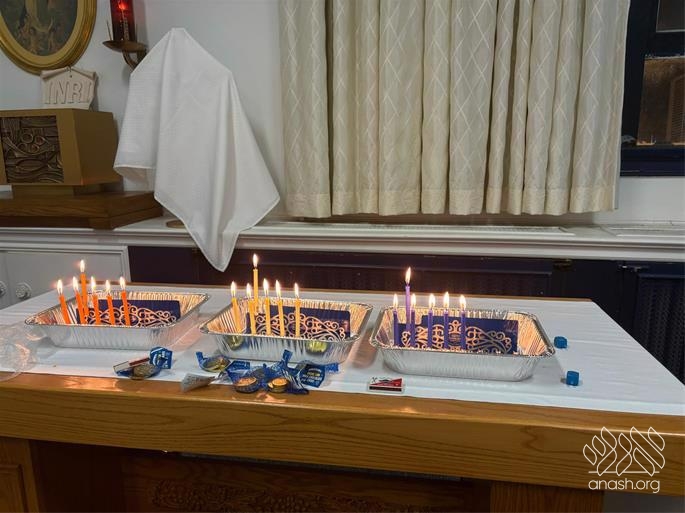
We got back to the parking lot outside of her barracks and she lit the menorah right then and there, inside my car. The mitzvah was complete. I handed her the box of sufganiyot and wished her Happy Hanukkah. She left my car with a big smile.
The next morning, I sent her a text message asking what time she wanted to light that evening. She explained that she had been sent to another barracks to file leave paperwork, and the commander said she would not be able to leave until it was done. I told her to let me know by 1730 if she was going to be released. Service members are typically released for dinner by 1630, so 1730 should give her plenty of time.
I called Rabbi Estrin to ask him what I should do and he directed me to call the base chaplain. I explained the situation to the chaplain and he said we could light inside the chapel and that I had permission to take service members to light the menorah.
It was 1630, and I checked in with Jewish Service Member. She said that it didn’t look like she was going to be done by 1730, so I texted her that I was coming in for the rescue again.
I told the Lieutenant Commander: “Hi, I’m here on behalf of the chaplain and I have permission to take Jewish service members to light the menorah.” The Lieutenant Commander seemed annoyed but reluctantly allowed me to take Jewish Service Member to the chapel.
On the fourth night of Hanukkah, I decided to hold a public menorah lighting for the entire base. I went back to the Lieutenant Commander for permission again, and he explained to me that “liberty” was cancelled (meaning, service members would not be permitted to leave their barracks) that night because “mass exodus” (winter break) was starting the following day. But he reluctantly agreed to make an exception.
I spent an hour running all over the base, announcing over the loudspeakers in all 16 barracks: “Good afternoon, the Recreation Department was proud to provide you with Christmas programs this holiday season. But, if you are a Member of the Tribe, don’t worry, G‑d has not forgotten about you! If you are Jewish, please meet at the chapel at 1715 to light the Hanukkah menorah. It is your constitutional right to light the menorah! Meet at the chapel at 1715. Thank you!”
At 1715, inside the chapel, three Jewish women from places far away—one with a Southern accent, one with an Israeli accent, and one with a Midwestern accent—miraculously found each other to light the menorah together.
I began my speech:
Tonight we gather on the 28th of Kislev, 5786, at a US military base, to light the Hanukkah menorah. We American military Jews are not only warriors for this country, but warriors to complete mitzvot and to express our Yiddishkeit. We are on a battlefield to seek the resources we need, as often the resources are desolate. But tonight the Hanukkah miracle is that we found each other and we are expressing our constitutional right to practice mitzvot.
Just hours ago, President Trump signed an executive order declaring the day before Christmas and the day after Christmas federal holidays.
But G‑d wrote an executive order for the Jewish people to light the Hanukkah menorah wherever they are, no matter the challenges, and so that is what we will do.
Our commanders told us that we couldn’t light Hanukkah candles because it is a fire hazard, but that didn’t stop us. Our commanders also told us that “liberty” was cancelled tonight, but that didn’t stop us. They said that there’s an “exodus” tonight, but it is we, the People of Israel, who know the real Exodus.
We may feel lost in this sea of green, but somehow we Jews always find each other.
As Rabbi Eli Schlanger, who tragically lost his life on Sunday, said: the way to respond to antisemitism is to “be more publicly Jewish.”
I now invite you to light the menorah.
The next day, I updated Rabbi Estrin that we lit the menorah in the chapel the previous night and asked him what the procedure is regarding acquiring kosher food on a military base, as these two Jewish service members were without kosher food.
He replied, asking me if I wanted to be the next Jewish lay leader of the base. The lay leader acts as the Jewish representative in the absence of a Jewish chaplain. I was shocked and honored. I had no idea that such an opportunity with the Aleph Institute was available!
After the Bondi massacre, the light of the Hanukkah candles and Rabbi Schlanger’s message continue to travel into deep and hidden crevasses across the world. Behaving more publicly Jewish is exactly what led to our menorah lighting and thus the breakthrough of Jewish services now becoming available on the base.
 COMMENTS


Why are anash Reading about Xmas ornaments? to quote the Rebbe ע״ז כפשוטה.
Even if the story is true, since this is most likely absolutely forbidden halachically, we should not include these details in the story.
As an aside, I also wonder, if the locations for lighting the menorah are all legitimate according to Halacha. But that is the lesser of the issues.