



י״ז תמוז ה׳תשפ״ה | July 13, 2025
Halacha Guide for 17th of Tammuz and Three Weeks
The following is a Halacha guidebook for 17th of Tammuz and the Three Weeks, compiled by Rabbi Shmuel Lesches, Rov of Young Yeshivah Shul in Melbourne, Australia. The fast of the 17th of Tammuz concludes Sunday at 9:00 PM in New York City.
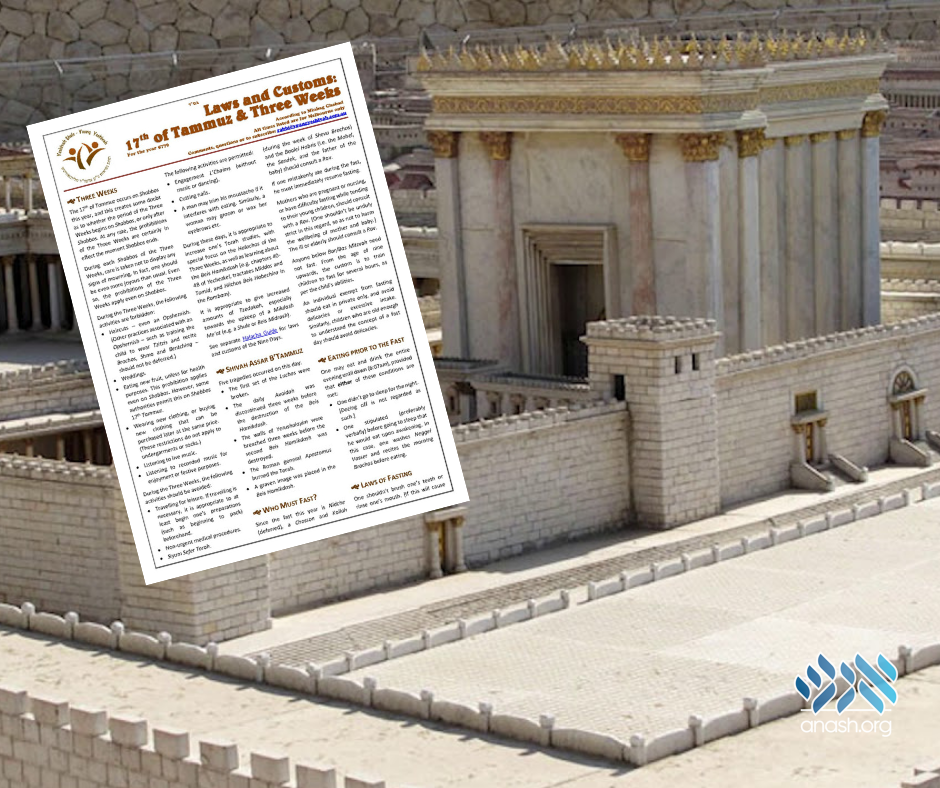
The following is a Halacha guidebook for 17th of Tammuz and the Three Weeks, compiled by Rabbi Shmuel Lesches, Rov of Young Yeshivah Shul in Melbourne, Australia. The fast of the 17th of Tammuz concludes Sunday at 9:00 PM in New York City.
Three Weeks
The laws of the Three Weeks begin as soon as Shabbos concludes.
During the Three Weeks, the following activities are forbidden:
– Haircuts, even an Opshernish. (Other practices associated with an Opshernish – such as training the child to wear Tzitzis and recite Brochos, Shma, and Bentching – should not be deferred.)
– Weddings
– Eating new fruit, unless for health purposes
– Wearing or buying new clothing that could be bought later at the same price (Undergarments and socks are exempt)
– Listening to live music
– Listening to recorded music for enjoyment or festive purposes
During the Three Weeks, the following activities should be avoided:
– Travel for leisure. If travel is necessary, it is appropriate to at least begin preparations (e.g. packing) beforehand
– Non-urgent medical procedures
– Siyum Sefer Torah
The following activities are permitted:
– Engagement L’Chaims (without music or dancing)
– Cutting nails
– A man may trim his moustache if it interferes with eating. A married woman may groom or wax her eyebrows etc.
During these days, it is appropriate to increase one’s Torah studies, particularly the Halachos of the Three Weeks and topics relating to the Beis Hamikdash (e.g. chapters 40–48 of Yechezkel, tractates Middos and Tomid, and Hilchos Beis Habechira in the Rambam)
It is also appropriate to give increased amounts of Tzedakah, especially toward the upkeep of a Mikdash Me’at (e.g. a Shule or Beis Midrash)
On each Shabbos of the Three Weeks, care is taken not to display signs of mourning. In fact, one should be even more joyous than usual. Even so, the prohibitions of the Three Weeks still apply on Shabbos
See separate Halacha Guide for laws and customs of the Nine Days
Shivah Assar B’Tammuz
Five tragedies occurred on this day:
– The first set of Luchos was broken
– The daily Avoidah was discontinued three weeks before the destruction of the Beis Hamikdash
– The walls of Yerushalayim were breached three weeks before the second Beis Hamikdash was destroyed
– The Roman general Apostomus burned a Sefer Torah
– A graven image was placed in the Beis Hamikdash
Who Must Fast?
All must fast, including a Chosson and Kallah during the week of Sheva Brochos, and Baalei Habris (i.e. the Mohel, the Sandek, and the father of the baby)
One who mistakenly ate during the fast must immediately resume fasting
Mothers who are pregnant or nursing, or who have difficulty fasting while tending to their young children, should consult a Rov (One should not be unduly strict so as not to compromise the wellbeing of mother and baby)
One who is ill or elderly should consult a Rav
Children below Bar/Bas Mitzvah are not required to fast. From age nine, the custom is to train children to fast for several hours, according to their ability (One should not be unduly strict)
An individual exempt from fasting should eat privately and avoid meat, delicacies, or excess. Similarly, children old enough to understand the concept of a fast should avoid meat, treats, and indulgences
Eating Prior to the Fast
One may eat and drink the entire evening until dawn (6:10am), provided that one of the following conditions is met:
– One didn’t go to sleep for the night (Dozing off is not considered full sleep)
– One verbally stipulated before sleeping that they intend to eat upon awakening
In this case, wash Neggel Vasser and recite the morning Brochos before eating
Laws of Fasting
– One shouldn’t brush teeth or rinse mouth
(If this causes great aggravation, one may be lenient if: they lean forward to avoid swallowing liquid, use inedible substances such as Listerine, and rinse with less than 86 ml)
– Non-chewable pills may be taken without water for medical needs. Consult a Rav for other medications
– One may shower, bathe, and apply ointments or creams
– If a Bris occurs on a fast day, the Seudah takes place at night, after the fast
– One may handle and prepare food. However, one may not taste it unless preparing for a Seudas Mitzvah that will take place right after the fast, and only if:
– It is expelled without swallowing
– It is the bare minimum required
– The total amount tasted throughout the day is less than 86 ml
Conduct on a Fast Day
– One should study Torah related to the fast
– The Rebbe instructed to learn the passages of Nevi’im associated with the fast of the 17th of Tammuz: Melachim II 25:3–8, Yirmiyahu 39:2–7, and Zecharya 8:18–19
– One should give extra Tzedakah, especially before davening. Ideally, donate the value of the meals forgone
– The goal of fasting is to perform Cheshbon Hanefesh (personal reflection) and do Teshuvah. Time should not be wasted on entertainment or idle activities
– One must be especially cautious to avoid anger
Chazzan’s Aneinu
– During Shacharis, only the Chazzan recites Aneinu.
– One who is not fasting, or suspects they won’t complete the fast, should not serve as Chazzan
If the Chazzan is not fasting or fewer than three congregants are fasting:
– Aneinu is recited within the Shema Koleinu brocho and the brocho concludes regularly: Shomea Tefillah
If the Chazzan forgot Aneinu:
– If remembered before saying Hashem’s name in R’foeinu, recite Aneinu and then repeat the R’foeinu brocho
– If remembered only after finishing R’foeinu, say Aneinu in Shema Koleinu with the double ending: Ha’one B’eis Tzara V’shomea Tefillah
– If remembered only after finishing Shema Koleinu, recite Aneinu as a separate brocho before Sim Shalom
Selichos & Avinu Malkeinu
– Selichos is recited. It is customary to stand throughout. If one is infirm, they may sit, but should try to stand for each Yud-Gimel Midos
– One davening without a Minyan omits Yud-Gimel Midos Harachamim
– The long Avinu Malkeinu is recited in full. (It is not our custom to recite each verse after the Chazzan)
– If Tachnun is omitted due to a Chosson or Baalei Habris, Selichos is still recited, but Avinu Malkeinu is omitted
– One who is not fasting must still recite Selichos and Avinu Malkeinu
Torah Reading
– The passage of Vayechal is read, provided that at least three congregants are fasting
– A non-fasting individual must hear the reading, but should not receive an Aliya unless necessary. If he is the only Kohen or Levi, he may excuse himself. If this would cause discomfort or reduce the Torah’s honor, he may accept
– He may perform Hagbah or Gelilah
– A non-fasting person should not be the Ba’al Koreh unless no one else can
– When the congregation reads verses aloud, the Ba’al Koreh pauses. The Oileh begins with the congregation but concludes with the Ba’al Koreh
Mincha
– Mincha is longer than usual (due to Krias Hatorah and Haftorah) and should end before sunset (5:18pm)
– Krias Hatorah must not begin before Mincha Gedolah (12:51pm). Shmoneh Esrei must also not begin earlier
– After Haftorah, the Chazzan recites Kaddish slowly as the Torah is returned to the Aron Hakodesh
If one forgot Aneinu:
– Recite it in Elokai N’tzor before the second Yih’yu L’ratzon
– If completely forgotten, do not repeat Shmoneh Esrei
– Non-fasting individuals do not recite Aneinu
– The Chazzan recites Aneinu between Goel Yisroel and R’foeinu
– Birchas Kohanim is recited
– The Rebbe reinstated the practice of addressing the congregation after Mincha to inspire Teshuvah
The fast concludes at 9:00 PM in New York City.
Click here for times at all other locations.
 COMMENTS


We appreciate your feedback. If you have any additional information to contribute to this article, it will be added below.