




י״ב ניסן ה׳תשפ״ו | March 30, 2026
Growing Kashrus Controversy Shakes Pesach Food Market
Investigative report: A long-standing kashrus issue has come to the forefront this Pesach, with ads, denials, and widespread questions about a common ingredient used in many processed foods. Many rabbonim warn that numerous products on Pesach shelves may carry a serious chametz concern.

A kashrus fight that’s been brewing for years went fully public this Pesach season, spilling into newspaper ads, formal denials, and a flood of questions reaching rabbonim across the country.
The dispute centers on xanthan gum – a thickener found in hundreds of Pesach products, from salad dressings to gluten-free baked goods to liquid medications – and whether it is actually permissible on Pesach. If the stringent position is correct, a meaningful number of products currently on Pesach shelves with mainstream hashgachos may have a serious chametz concern.
Xanthan gum is a common thickener found in hundreds of food products – salad dressings, sauces, gluten-free baked goods, ice cream, and even liquid medications. It is produced by feeding bacteria a sugar solution, which causes them to secrete the gum. That gum is then separated using alcohol, dried, and ground into a powder.
For most of the year, the kosher concerns are manageable with proper certification. The CRC notes that “the growth media might contain non-kosher nutrients, and for that reason items made via fermentation always require certification.” For Pesach, however, the stakes are significantly higher, and the issue breaks into two distinct layers.
The first is the glucose. As OK Kosher explains, the sugar used to feed the bacteria “can be derived from cane sugar, lactose, corn, or wheat – in Europe, wheat sweeteners are commonly used.” Wheat-derived glucose is chametz, and a meaningful percentage of the global supply involves wheat.
The second problem is the alcohol. Manufacturers recycle their alcohol across multiple production runs, including non-Pesach products. It is purified between uses, but the halachic question is whether that process removes the chametz status the alcohol may have absorbed from prior runs.
“Since this process occurs in facilities that also produce other non-Pesach products”, Rabbi Menachem Meir Weissmandel, Av Beis Din of Monsey Nitra explains, “the alcohol may have absorbed chametz residues.”
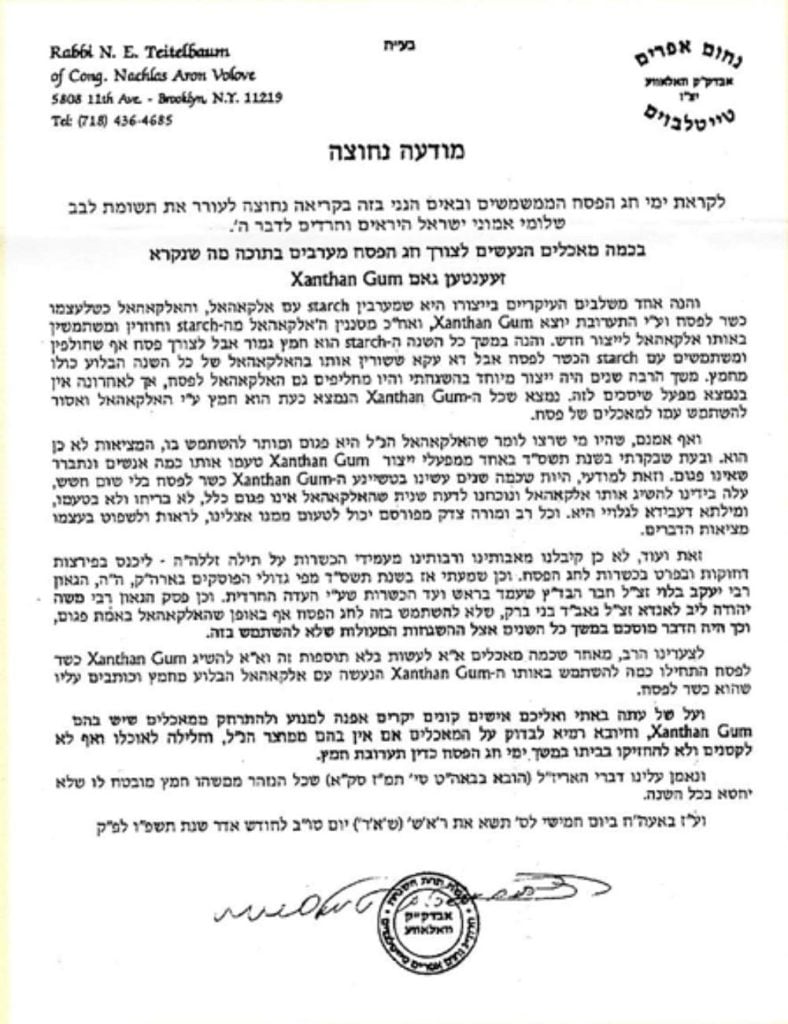
For years, Rabbi Nuchem Efraim Teitelbaum of Vaalov Kashrus in Brooklyn was the authority who certified xanthan gum as kosher for Pesach. Several years ago, he stopped issuing that certification for production-related technical reasons. Yet many hashgachos have continued certifying products that use xanthan gum as an ingredient, despite the fact that the specific kosher-for-Pesach xanthan gum certification they had relied on no longer exists.
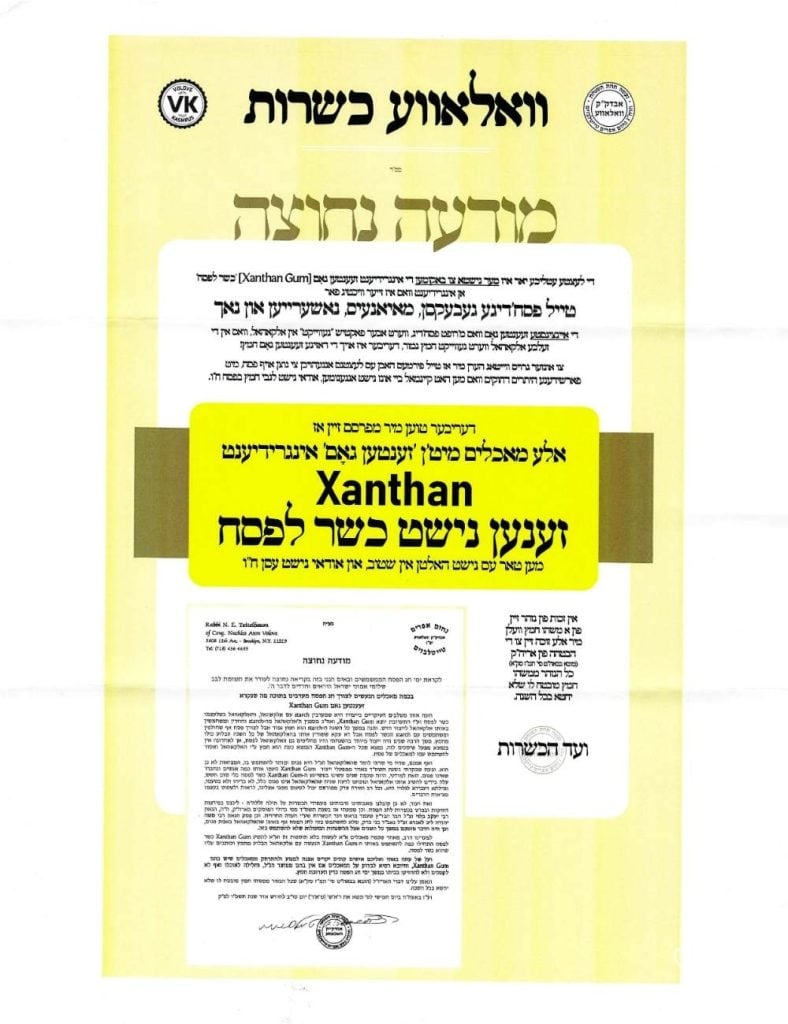
In response, Rabbi Teitelbaum issued a public notice this year declaring that any product containing xanthan gum is not kosher for Pesach. His son, Rabbi Boruch Teitelbaum, followed up with a detailed hour-long interview laying out the full case.
The recycled alcohol, he explained, carries real chametz absorption from prior production runs, and the standard heter of nosen ta’am lifgam – that the alcohol’s taste is sufficiently off-putting (pagum) to nullify the prohibition – does not hold up. The Vaalove Rav reportedly tasted the alcohol himself and concluded that it is not sufficiently pagum to rely on.
“How can one rely, in a matter of chametz on Pesach, on such a thin thread,” his published letter reads, “dependent on the subtle discernment of individuals?”
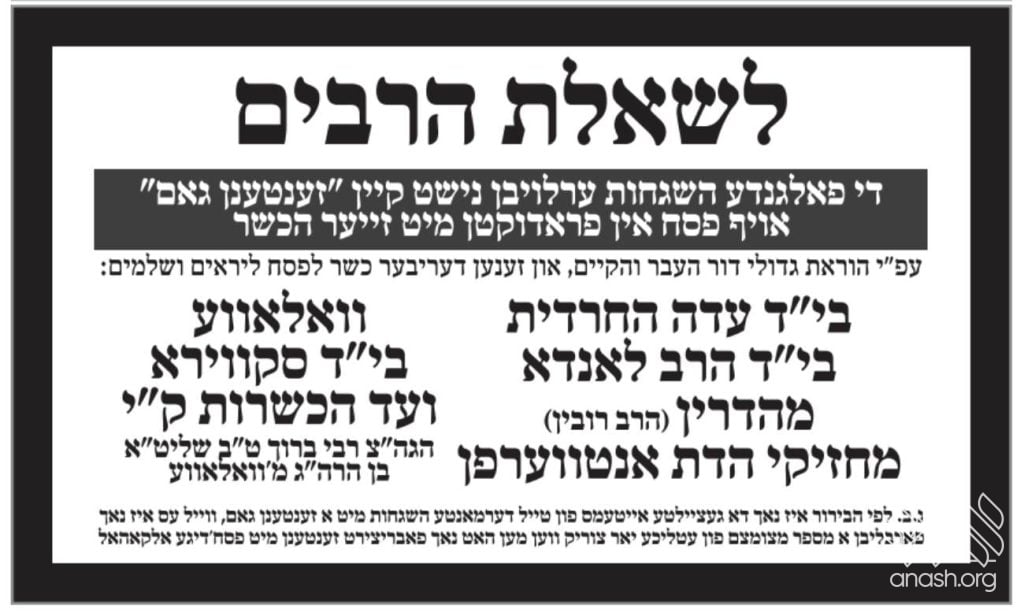
Vaalov published a list of hashgachos that, to their knowledge, do not permit xanthan gum in Pesach products: Eidah Hachareidis, Beis Din of Rav Landa, Beis Din of New Square, Mehadrin under Rav Rubin, Vaad HaKashrus of KJ, and Machzikei HaDas Antwerp.
In response to an inquiry by Anash.org, a source from CHK Kashrus confirmed that the Badatz of Crown Heights does not approve any xanthan gum products for Pesach.
“There are currently two cream cheese products without a hechsher that list xanthan gum on the label,” the source told Anash.org. “However, they do not actually contain xanthan gum. The labels are simply older versions that have not yet been replaced.”
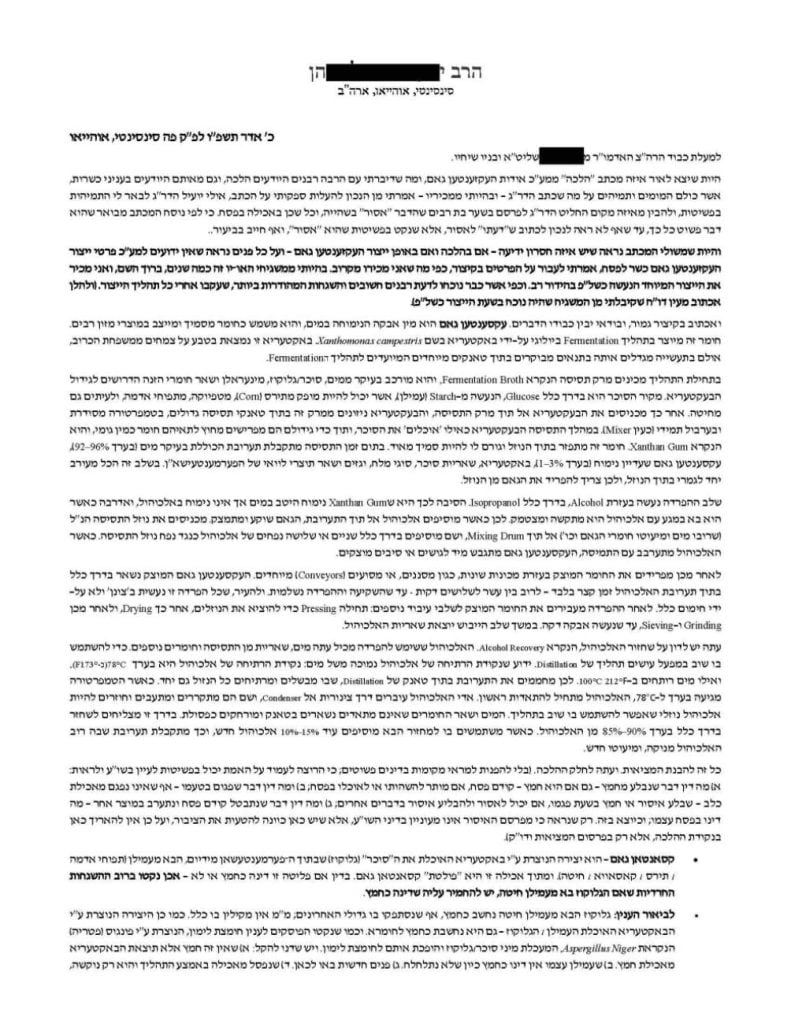
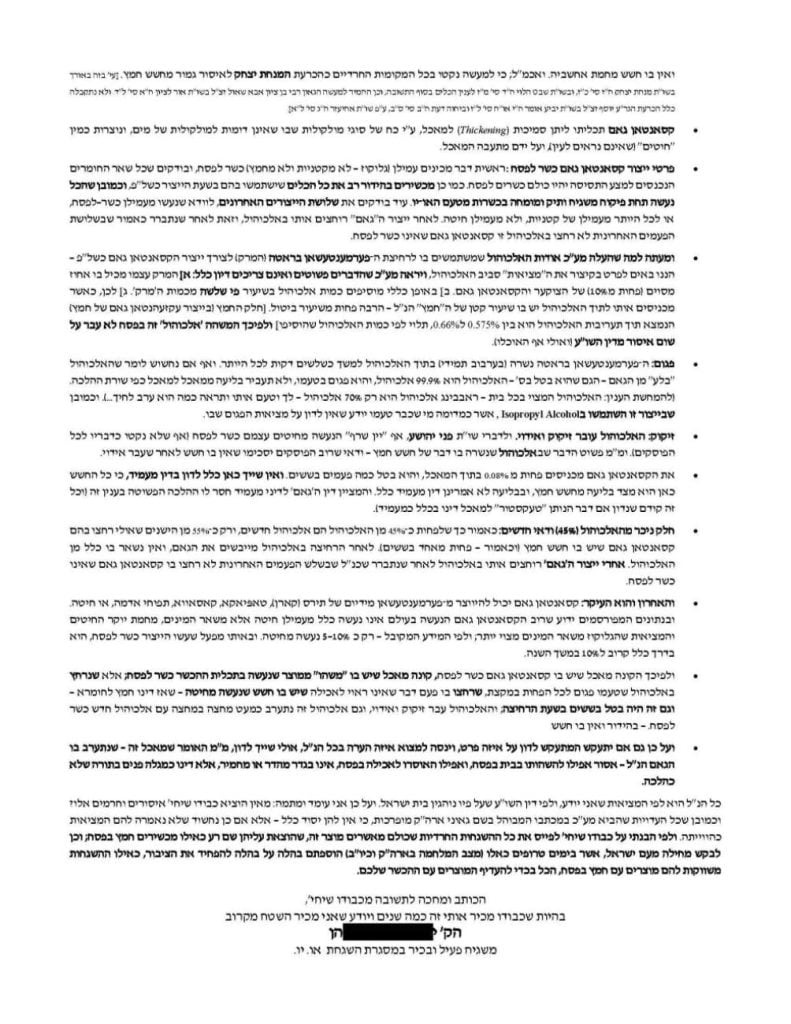
Rabbi Weissmandel issued a lengthy responsa dated 21 Adar 5786 defending the permissibility of xanthan gum on multiple halachic grounds.
On the question of whether the gum’s thickening function gives it a stringent status that overrides normal bitul – known as the din of ma’amid – Rabbi Weissmandel rules that this “applies only when the congealing agent is itself intrinsically forbidden. But if the agent is not inherently forbidden – only prohibited because it absorbed a forbidden substance from elsewhere – it does not carry the status of a ma’amid.”
On the pagum question, he rules that isopropyl alcohol “is inherently pagum – its off-putting character stems from its own nature, not from any added ingredient.” His conclusion: “One who is lenient acts in full accordance with halacha and need not be moved or troubled.”
A senior OU mashgiach also sent a detailed letter – signing his name but requesting that it not be published – arguing that xanthan gum constitutes less than 0.08% of any final food product, “batel many times over in sixty,” and that the alcohol used “is pagum in taste and does not transfer any absorbed taste into food according to halacha.” He added that calling products with xanthan gum forbidden to keep in the house over Pesach “is not acting as a stringent person – it is distorting Torah law.”
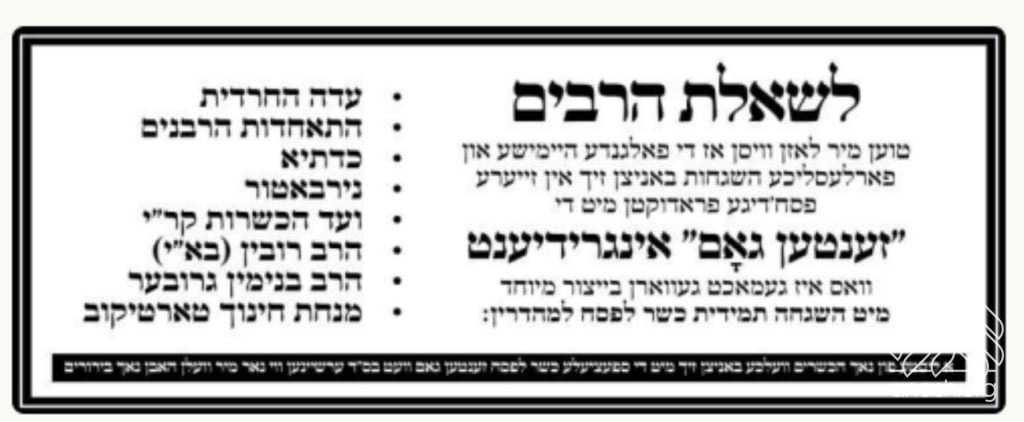
Hisachdus HaRabbanim, which has come under criticism for permitting xanthan gum, responded by publishing a newspaper ad claiming that a long list of respected charedi hashgachos also use xanthan gum in their Pesach products – and included the Eidah Hachareidis on that list.
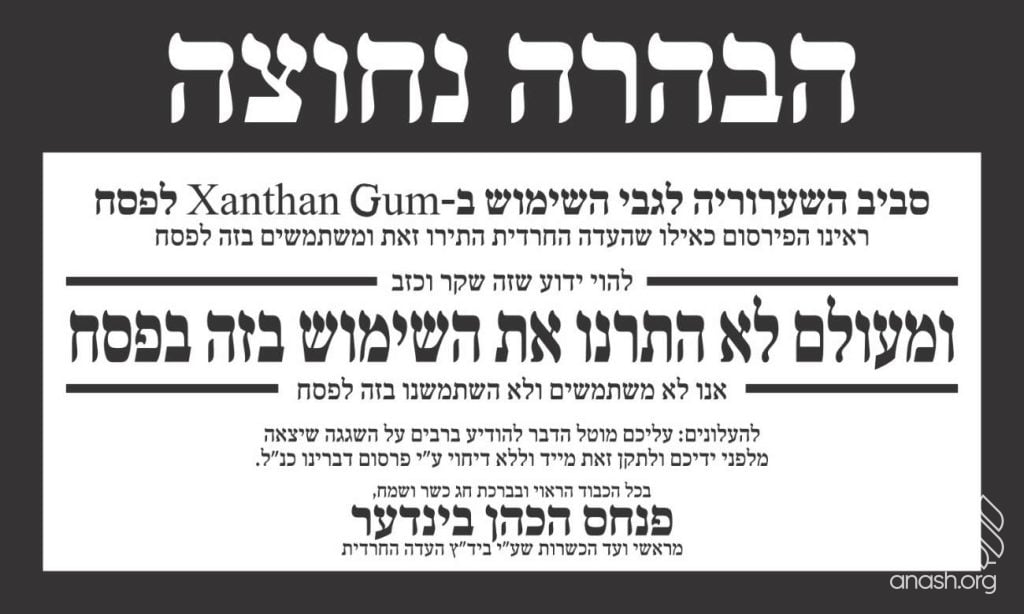
The Eidah responded quickly. Rabbi Pinchas HaKohen Bindler, head of their kashrus committee, issued a formal public denial: “It has come to our attention that certain parties have publicly claimed that the Beis Din Tzedek of the Eidah Hachareidis has permitted the use of xanthan gum for Pesach. We hereby state unequivocally that this is a complete falsehood. We have never issued such a permit, and we do not use this ingredient for Pesach.”
Hisachdus HaRabbanim has yet to issue any clarification.
Vaalov clarified that any products from certain hashgachos that do list xanthan gum on the label are leftover stock from prior years, “produced under supervision that used no chametz alcohol at all” – not a reflection of current production.
“There’s real disappointment,” wrote one forum participant, “among people who are machmir on kitniyos, sheruya, and other Pesach chumros where the actual chametz concern is far smaller – and now discover that these same hashgachos rely on leniencies when it comes to actual chametz on Pesach.”
Many chassidim avoid processed foods altogether, based on the practice of not eating from others (“mishn”) during Pesach. Questions surrounding ingredients like these are yet another reason to limit reliance on processed foods on Pesach.
 COMMENTS


We appreciate your feedback. If you have any additional information to contribute to this article, it will be added below.