



כ״ו תמוז ה׳תשפ״ה | July 21, 2025
Growing a Beard: The Man Behind the Book and the Campaign
In a special interview, Rabbi Moshe Wiener of Crown Heights, executive director of the JCCGCI and the author of the encyclopedic work Hadras Panim Zakan on the significance of growing a beard, shares his remarkable journey to Chassidus and the Rebbe’s deep involvement in the sefer.
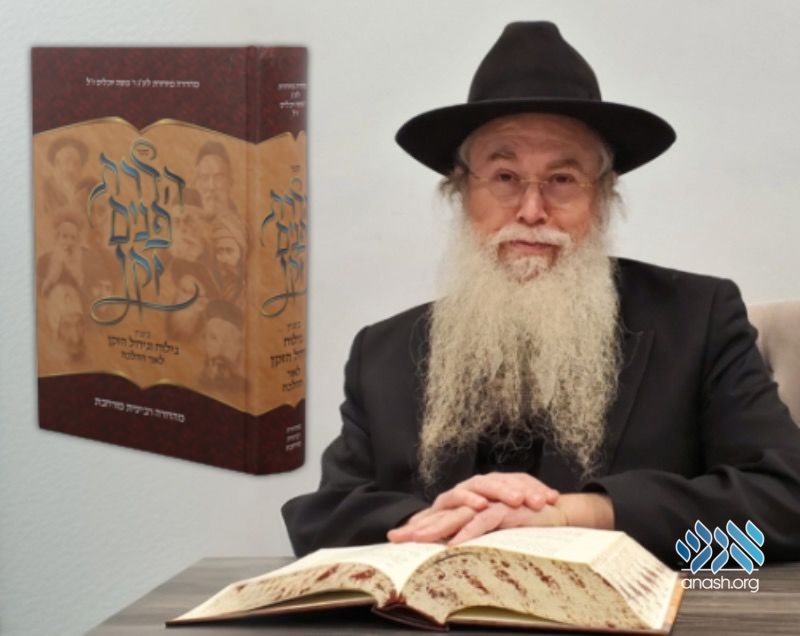
In a special interview, Rabbi Moshe Wiener of Crown Heights, executive director of the JCCGCI and the author of the encyclopedic work Hadras Panim Zakan on the significance of growing a beard, shares his remarkable journey to Chassidus and the Rebbe’s deep involvement in the sefer.
By Kfar Chabad Magazine
Translated by Rabbi Yehuda Altein
Rabbi Moshe Nissan Wiener is the author of the monumental work Hadras Panim Zakan, an encyclopedic exploration of the Torah’s perspective on preserving the beard.
The sefer, held in great esteem by the Rebbe, has had a remarkable impact on countless readers. The Rebbe not only saw great importance in the sefer but was personally involved in guiding its preparation and printing. Initially published in 5738 (1978), it is now in its fourth printing, expanded to an impressive 1,227 pages.
An article in Kfar Chabad and translated by Rabbi Yehuda Altein takes an in-depth look at the Sefer, the Rebbe’s deep involvement, and the author’s fascinating journey to chassidus.
In addition to his contributions to Torah scholarship, Rabbi Wiener serves as the executive director of the Jewish Community Council of Greater Coney Island (JCCGCI), a widely-acclaimed and highly respected organization offering diverse social services to all segments of the population across New York City, supported by both government and private sector grants and contributions.
Rabbi Wiener’s path to Lubavitch was a fascinating journey. Raised in a non-Lubavitch home in North Woodmere, Long Island, his first encounter with Chabad was through a local summer camp at Yeshiva (Toras Chaim) of South Shore, directed by Rabbi Mordechai Dubinsky. Young Moshe Nissan formed a close bond with the Dubinsky family, sparking his admiration for the Chabad way of life.
As a teenager, he attended Yeshiva University, where Lubavitcher bochurim such as Rabbis Chaim Farro (later Shliach in Manchester), Daniel Goldberg (a prominent Chabad author), and Heshel Greenberg (now Shliach in Buffalo) regularly gave shiurim in Chassidus. Moshe Nissan became a dedicated participant, gradually embracing Chassidus and transforming into a Lubavitcher chossid. The influence of other YU students who had embraced Chabad, such as Rabbi Yechezkel Kornfeld (now Shliach in Seattle, Washington) and Mordechai Litzman (now residing in Monsey), further cemented his path.
Moshe Nissan spent the summer of 5728 (1968) at a camp where one of the learning rebbes was Rabbi Simcha Werner (then a kollel yungerman in Beis Medrash Elyon in Monsey and for decades thereafter the Rebbe’s Shliach to Monsey) who taught Kuntres U’Mayan to Moshe Nissan and has been a source of inspiration and guidance to him ever since.
His first encounter with the Rebbe was at a farbrengen on Purim, 5728 (1968). Deeply inspired, Moshe Nissan began visiting Crown Heights every Sunday during YU’s free hours, where he studied with the bochurim at 770 and davened with the Rebbe. At the Rebbe’s directive, he also frequently visited and consulted with Rabbi Yisroel Jacobson.
Desiring a more immersive yeshiva experience, Moshe Nissan transferred to Ner Yisrael in Baltimore with his parents’ approval, where he maintained a strong connection to Chassidus. He studied weekly with the local shliach, Reb Itche Springer, and secretly organized Chassidus shiurim among his peers and authored a booklet based on concepts in Chassidus entitled “An Inquest Into Essence,” which was distributed to the bochurim in the yeshiva.
This didn’t go unnoticed. The bochurim joked that he was turning Ner Yisrael into a Chabad yeshiva – so much so that their Purim spiel revolved around his activities! However, the administration disapproved, and he was eventually asked to leave.
Throughout this time, Moshe Nissan corresponded with the Rebbe, sharing his challenges and receiving guidance and encouragement. Moshe Nissan continued his studies at the Mirrer Yeshiva, which was more accommodating of his Lubavitch inclinations.
While learning in the Mirrer Yeshiva, located on Ocean Parkway in Brooklyn and Avenue R, Moshe Nissan would travel several times a week to the United Lubavitcher Yeshiva on Ocean Parkway near Avenue H, to attend the shiurim given there by Reb Yoel Kahan.
At his parents’ request, he also went to college, earning an MS in counseling psychology. (His dissertation, “The Body and the Soul: Unity or Duality? A Torah Perspective,” now available on Amazon, is based on ideas in Chassidus heard from Reb Yoel Kahan).
Several of the Mirrer Yeshiva students who Moshe Nissan studied Chassidus with and brought to Farbrengens, eventually transferred to Lubavitcher yeshivos and some became Shluchim.
Also while at Mirrer Yeshiva, Moshe Nissan founded “Yeshivas HaErev,” a summer learning program for yeshiva day school students who were not spending the summer in a structured camp environment and were at risk of losing much of what they gained in Yeshiva during the school year.
As instructors, Moshe Nissan engaged yungerlite from the Mirrer Yeshiva Kollel, giving many their first experience in Chinuch (resulting, some eventually dedicated their careers to chinuch). Yeshivas HaErev was warmly endorsed by the local yeshiva principals and eventually expanded to a year-round tutoring and homework assistance program, staffed by Mirrer Yeshiva Kollel yungerleit.
It was in the Mirrer Yeshiva that Moshe Nissan began researching the Torah sources on preserving the beard, to inspire and encourage his colleagues to stop shaving and grow their beards. This laid the groundwork for what would later become Hadras Panim Zakan.
It was a journey of research and study that continues to this day. First published in Adar Rishon, 5738 (1978), the 728 page sefer sold out within months. A second, 800 page edition with many important additions was printed later that year, followed by a 1,024-page third edition in 5766 (2006) and the most recent 1,227-page version in 5781 (2021), published in two volumes.
THE REBBE’S INVOLVEMENT
Throughout its development, Rabbi Wiener kept the Rebbe informed of his progress, often seeking the Rebbe’s guidance on challenges he encountered. Here are some highlights of their correspondence:
• In early 5737, Rabbi Wiener asked great experts such as Rabbi Yosef Kapach (who translated and explained the Rambam’s writings), and Rabbi Avrohom Sofer (who published volumes of the Meiri’s Beis Ha’Bechirah) about an apparent contradiction between the Rambam’s statements regarding cutting the beard with scissors in the Sefer HaYad (Hilchos Avodah Zarah 12:1 and 12:7) and his statements in his Teshuvos (vol. 2, siman 244) and submitted their responses to the Rebbe. The Rebbe replied with his own approach to the problem (which is printed in Hadras Ponim Zokon, p. 68, and which was later published in Igros Kodesh, vol. 32, p. 324).
• Rabbi Wiener sent a question to many rabbonim all over the world about an apparent contradiction between the Rashba quoted by the Tzemach Tzedek and another statement of the Rashba and received some answers. Two rabbonim, Rabbi Sholom Morosov z’l and Rabbi Hillel Pevsner z’l, suggested the same answer and Rabbi Wiener submitted the answers of the various Rabbonim to the Rebbe. The Rebbe’s answer was short and clear: To print the resolution proposed by Rabbis Morosov and Pevsner as is. The Rebbe added a bracha: I will mention it at the tziyun. May all of the above be in a good and successful time.
• In a letter dated 3 Adar, 5737, the author wrote that he had asked various Rabbonim to clarify certain halachic difficulties relating to the contents of the sefer. As an example, he mentioned the view of Rabbeinu Yonah, cited in a teshuvah of the Tzemach Tzedek (Yoreh Deiah, vol. 1, 93:9), in which he lacked clarity.
The Rebbe responded with a sharp maaneh (printed in Igros Kodesh, vol. 32, p. 133): “The goal of the book is that by reading it, people will realize the severity of removing the beard and the importance of growing it. To this end, it must be actually published and distributed. Although you have been working on it for several years now, you continue to find new subjects requiring discussion, for which you write letters to Rabbonim across the world! It will never end at this rate!
“Publish the book in its current state as soon as possible. Regarding all your difficulties, publish them as a separate booklet at a later time.”
At the end of his letter, the author asked the Rebbe for a brachah for success. The Rebbe replied: “I will mention all the above at the Ohel.”
• In a letter dated 3 Kislev, 5738, Rabbi Wiener asked the Rebbe for a brachah in obtaining a haskamah from a certain American gadol. The Rebbe replied: “Meanwhile, I am sure you are doing whatever you can to expedite the publication.”
• After the sefer was published, the author worked on getting book reviews published in Algemeiner Journal and The Jewish Press. In addition to describing the sefer itself, the editors wanted to include personal information about the author, something Rabbi Wiener was not so keen on. In a letter dated 12 Adar Sheni, 5738, Rabbi Wiener asked the Rebbe if he should insist that they omit such information.
The Rebbe replied: “If there is any personal information, you can persuade the editors of these two newspapers to omit—good. Otherwise, just let it go, as it is extremely important that they print an article about the book. The same applies to the Hamaor publication and to newspapers in Eretz Yisroel. How many sefarim were sold so far? I will mention the contents of your letter at the Ohel.”
• After Pesach of that year, when a book review about the sefer was prepared by the publisher of the rabbinic journal Hamaor, Rabbi Wiener received the following maaneh from the Rebbe:
“I am surprised that the article did not mention the number of pages in the sefer, which, in this case, is in itself an advocacy supporting the sefer’s conclusions. You will surely make sure that future articles do mention the number of pages. Advertise the sefer in Eretz Yisroel (including among the Sephardim, for reasons you can understand). It is customary to give a discount to yeshiva bochurim, and to advertise this.”
The Rebbe enclosed a $100 bill and wrote:
“Enclosed please find my participation in all of the above. At this time it is even more important to advertise the sefer right away, to annul etc. during the days of sefiras ha’omer, as you can easily understand.”
(Apparently, the Rebbe’s intention was that during sefirah, when men let their beards grow in any case, it is easier for them to be persuaded to continue growing their beards afterward as well.)
• On 23 Iyar, 5738, the Rebbe wrote to Rabbi Wiener (who had shared concern about opposition to the sefer by some well-known Rabbonim):
“Move forward and actually print the second edition. Completely disregard those who attempt to confuse you, and the confusions themselves. The merit of the public is on your side. May Hashem grant you hatzlachah and enable you to share good news. I will mention the contents of your letter at the Ohel.”
• In Elul of that year, the Rebbe again sent out an answer:
“In connection with matters pertaining to the month of Elul and Tishrei – it is worthwhile that you once again publicize about his sefer HPZ, and perhaps [offer] a special price for this time (lowered). And perhaps to also publish a pamphlet of additions.” The Rebbe again enclosed $100 as his participation.
• A year later, the Rebbe wrote an English letter to a bochur learning in Telz, dated 12 Teves, 5739:
Your letter of Rosh Chodesh Teves reached me with some delay. In it you write that you stopped shaving, with the intention to grow a beard.
I trust you have seen the Sefer “Hadras Ponim Zokon,” whose author is a Talmid of the Mirer Yeshiva, which was published recently, with Haskomos by prominent Rabbonim, on the significance and the must and importance of growing a full beard. The Sefer also includes Teshuvos Bruros by Gdolei Yisroel who had been asked for an opinion in this matter.
May Hashem Yisborach grant you Hatzlocho that in addition to preserving the sanctity of Hadras Ponim you should go from strength to strength in Torah learning and the observance of its Mitzvos with Hiddur…
All of this offers a small glimpse into the great affinity the Rebbe held for this sefer. In fact, volumes 32-33 of the Rebbe’s Igros Kodesh include eight (8) letters about sefer Hadras Ponim Zokon.
*
WHY IS GROWING A BEARD SO IMPORTANT?
An interview with Rabbi Moshe Nissan Wiener conducted by Kfar Chabad writer Rabbi Menachem Mendel Bronfman
R. M.M.B.: Rabbi Wiener, I’d like to pose a challenging question. When you look around and see so many frum Jews shaving their beards, it’s hard not to wonder: If they do it, why do I need to be so careful? What would you say to someone grappling with this thought?
R.M.N.W.: That’s an important question, and it touches on a fundamental issue. To truly understand, you need to know the historical context. It is widely assumed that the “Mesorah” of the Litvish world is to be beardless. Reality is that until the winds of assimilation swept through the Jewish world, all non-Chassidic Jewish men throughout Lita (Lithuania) and Russia grew full beards. The Chofetz Chaim writes that only one in a thousand did not keep their beard. Growing a beard is the Jewish mesorah; it’s the quintessential Jewish appearance.
The Radak writes that from the time the Torah was given, Jews refrained from shaving or trimming their beards. Even under the harshest decrees, Jews clung to this practice. The Midrash (Eichah Rabbah 5:5 as understood by the Yafe Anaf commentary) recounts how the evil emperor Hadrian decreed that all Jews must cut their beards, threatening execution by decapitation for those who didn’t comply. Yet, Jews refused to obey.
The unfortunate reality is that the practice of shaving beards arose from foreign influences. The Chida writes in Shaylos U’Teshuvos Chaim Sha’al (2:23) that in the days of the Mishnah, the Gemara, and through the Geonim and beyond, no Jew shaved his beard. This changed in Europe due to extended interactions with non-Jews. Even the Poskim who permitted removing the beard only allowed it in situations of extreme duress or persecution.
In Eastern Europe, shaving beards became more common in the past two centuries, largely due to the influence of haskalah, Communism, and Zionism, which tragically claimed many victims. Unfortunately, even many frum Jews were affected and began removing their beards. Rabbi Binyamin Yehoshua Silver observed that intermingling with non-Jews caused some Jews to abandon the traditional Jewish appearance. Rabbi Michel Yehuda Lefkowitz remarked that the desire to find heterim to shave often stems from being drawn to worldly pleasures.
The Rebbe once shared a fascinating exchange on this topic. A visitor argued that shaving could be halachically permissible. The Rebbe responded with a rhetorical question: “When someone draws Moshe Rabbeinu or Aharon Hakohen—whether the artist is Jewish or not—why are they always depicted with full beards? Surely Moshe Rabbeinu, who received the Torah directly from Hashem, knew all the heterim being cited!” The visitor conceded that he couldn’t envision Moshe Rabbeinu—or for that matter, any frum Jew from previous generations—without a beard.
The takeaway is clear: a beard-framed face is the time-honored and pristine appearance of a Jew.
R. M.M.B.: That’s powerful. But what about the halachic aspect?
R.M.N.W.: Cutting a beard involves multiple prohibitions, both d’oraisa and d’rabbanan. Many leading Poskim, both Rishonim and Acharonim, have ruled that it is forbidden to cut the beard even without a razor, and there are many proofs to this approach. In Shaalos U’Teshuvos Toras Sholom (section 45) we find a “Public Announcement” addressed “To our Jewish brethren, “believers, children of believers” [i.e., to all Jews, not just Chassidim] and stating that:
“There are many who are lenient and cut their beards with scissors, declaring that they are acting in accordance with the Halachah… It is our obligation to announce publicly that they are in error, for this is absolutely prohibited (issur gomur) according to Torah law (mid’oraysa). Many of the earlier and later Torah giants (Rishonim and Acharonim) have proven and clarified that those who do so transgress several Torah prohibitions (kamah lavin) [here are cited source references, including the teshuvah of the Tzemach Tzedek]….Everyone is obligated to inform his family members of this severe prohibition (issur chomur), so that a root of [spiritual] decay will not grow from his family.
Rabbi Zalman Shimon Dworkin, in his Haskama to sefer Hadras Ponim Zokon, addressed a mistaken notion some individuals have. He wrote that while people assume that growing a beard is just a Chassidic or Kabbalistic practice, and the prevalent view allows it, this is incorrect.
The Tzemach Tzedek was famously stringent about not shaving even without a razor, but other Poskim across the Jewish world, including contemporary ones, have also maintained this position. Rabbi Dworkin emphasized that many who shave are simply unaware of the severity of the matter.
In the words of the Frierdiker Rebbe (in a lengthy halachic responsum, first printed in Kovetz Yagdil Torah, New York, Sivan-Tammuz 5743, sec. 61):
“Concerning cutting the beard… even trimming with scissors…even in order to straighten the hair of the beard and style them… Halachah and Kabbalah coincide in this case that it is forbidden…trimming the beard even slightly is not merely a kabbalistic stringency, but a matter forbidden by Halachah.”
R.M.M.B.: On a spiritual level, why indeed is growing a beard so important?
R.M.N.W.: There is a lot to say on this, but for now I’ll share just one point. The Zohar teaches that the source of the beard from the higher worlds is the thirteen spiritual aspects known as yud-gimmel tikkunei dikna, which correspond to the thirteen attributes of Divine mercy and the thirteen methods of Torah interpretation.
In essence, the beard serves as a conduit for Divine blessings. The Zohar continues, “Woe to the one who lays a hand on the precious supernal beard!”
This idea is discussed in many sources. The Bnei Yissachar, for instance, writes that growing a beard elicits the thirteen attributes of Divine mercy and, as emanating from the thirteen methods of Torah interpretation, enables us to understand Torah properly, which is no longer possible if one even trims his beard. He states further that this is a tradition originating from Moshe Rabbeinu who received it from Hashem Himself.
Earlier, in sefer Likutei Halachos (one of the most authoritative sefarim of Breslov), in Yoreh Deah, Hilchos Giluach, we find that “The fundamental dimensions (עיקר) of the Jewish faith and of Judaism are dependent on the beard and the peyos…. All of the hairs of the beard are lofty and sublime, and they are awesome channels of [Divine] energy…. Through them are drawn down the entire wisdom of the holy Torah and the mitzvos through which it is possible to appreciate G-dliness… one who lifts his hand and destroys this holiness… uproots himself and his soul from Hashem.”
The beard is a manifestation of tzelem Elokim—the Divine image. It holds sanctity and serves as the source of blessing.
Throughout the generations many treated beard hairs with sanctity, and placed them in sheimos if they fell out. All these sources, and more, are discussed at length in Hadras Panim Zakan.
MESIRAS NEFESH FOR THE BEARD
Rabbi Wiener has also authored a Hebrew compilation titled Mesiras Nefesh for the Beard. One of its objectives is to disprove the mistaken notion that growing the beard is a chassidic conduct, limited to those with a high level of piety and commitment.
This publication debunks this myth. It is a compelling testament to the attitude of Jews through- out the ages to go to great lengths to preserve the beard, even in the face of unimaginable hardship and persecution.
The publication makes it clear that Jews throughout history—be it the tailor or the scholar, the water carrier or the rabbi—viewed their beard as an integral part of their very identity. It was easier for them to imagine living without a hand or leg than without a beard! Persecuted from all sides, suffering from poverty and hardship—their assets were not gold or silver but their tzelem Elokim.
The more recent book’s Table of Contents highlights the breadth of this awe-inspiring mesiras nefesh. The first four chapters include compelling accounts of Jews throughout the ages who faced persecution, and yet clung to their beards as an integral part of their identity. For example, Chapters Three and Four showcase the heroic efforts of those who fought against all odds to preserve their beards during the horrors of the Holocaust and the dark days of Soviet Russia.
Chapters Five and Six deal with withstanding outside pressure. It explores how Jewish individuals from all walks of life stood firm in their commitment to their beards, despite overwhelming outside pressure and societal norms that urged them to conform (such as those prevalent in the United States in the first half of the nineteenth century).
Chapters Seven and Eight focus on the proper approach toward keeping one’s beard in the face of disagreements with parents or difficulties in marital harmony. Finally, Chapter Nine discusses maintaining the beard even when serving in the military (e.g., the Russian Imperial Army and the Armed Forces of the United States).
This publication is a timely reminder of the extraordinary lengths to which ordinary Jewish individuals have gone to maintain this vital element of Yiddishkeit. The stories it conveys serve as a testament to a Jew’s steadfastness to preserve his beard despite all odds, complementing the halachic perspectives presented in Hadras Ponim Zakan.
A MESSAGE FOR LUBAVITCHER CHASSIDIM
R.M.M.B.: Rabbi Wiener, what message would you like to share specifically with Lubavitcher chassidim?
R.M.N.W.: It’s well-known how Lubavitcher chassidim displayed extraordinary mesiras nefesh to preserve their beards, even during the harshest times in Soviet Russia. However, this historical dedication shouldn’t be the sole reason for chassidim today to keep their beards.
The Shaloh Hakadosh provides a profound insight into the verse, “Zeh Keili ve’anveihu, Elokei avi va’aromemenhu” (“This is my G-d, and I will beautify Him; the G-d of my father, and I will exalt Him”). He explains that if your connection to Hashem stems primarily from tradition—Elokei avi (the G-d of my father)—then va’aromemenhu (I will exalt Him), implying that Hashem remains distant and abstract from your personal experience. However, if you have a personal relationship with Hashem—Zeh Keili (This is my G-d)—then ve’anveihu (ani vahu, “I and He”), expressing a close, deep bond.
The same principle applies here. When you take the time to study the sources and truly understand the importance of growing a beard, it transforms this practice into something personal and meaningful—not just a continuation of what your parents or ancestors did.
A key tool in accomplishing this is the sefer Hadras Ponim Zakan, which provides an in-depth exploration of the subject.
Another benefit of learning this sefer is that it equips you to share what you’ve learned with others. By doing so, you can inspire others to grow their beards, even those who might not have done so otherwise.
I merited that the Rebbe reviewed and edited the foreword to my sefer Kevudah Bas Melech. In that foreword, I included (and the Rebbe did not edit) a beautiful teaching from Reb Pinchas Koritzer, a disciple of the Baal Shem Tov. He said that the geulah depends on a single hair. This statement is traditionally understood to refer to both to growing the hair of the beard, as explored in Hadras Ponim Zakan, and to women covering their hair, the focus of sefer Kevudah Bas Melech [also authored by Rabbi Wiener with the Rebbe’s staunch encouragement and detailed guidance].
These two areas represent some of the greatest spiritual challenges of our time. By standing firm in these areas, we hasten the coming of Moshiach—may it take place tekef umiyad mamash!
For a print version of the article, click here.
 COMMENTS


We appreciate your feedback. If you have any additional information to contribute to this article, it will be added below.